

Korean grammar is different like this
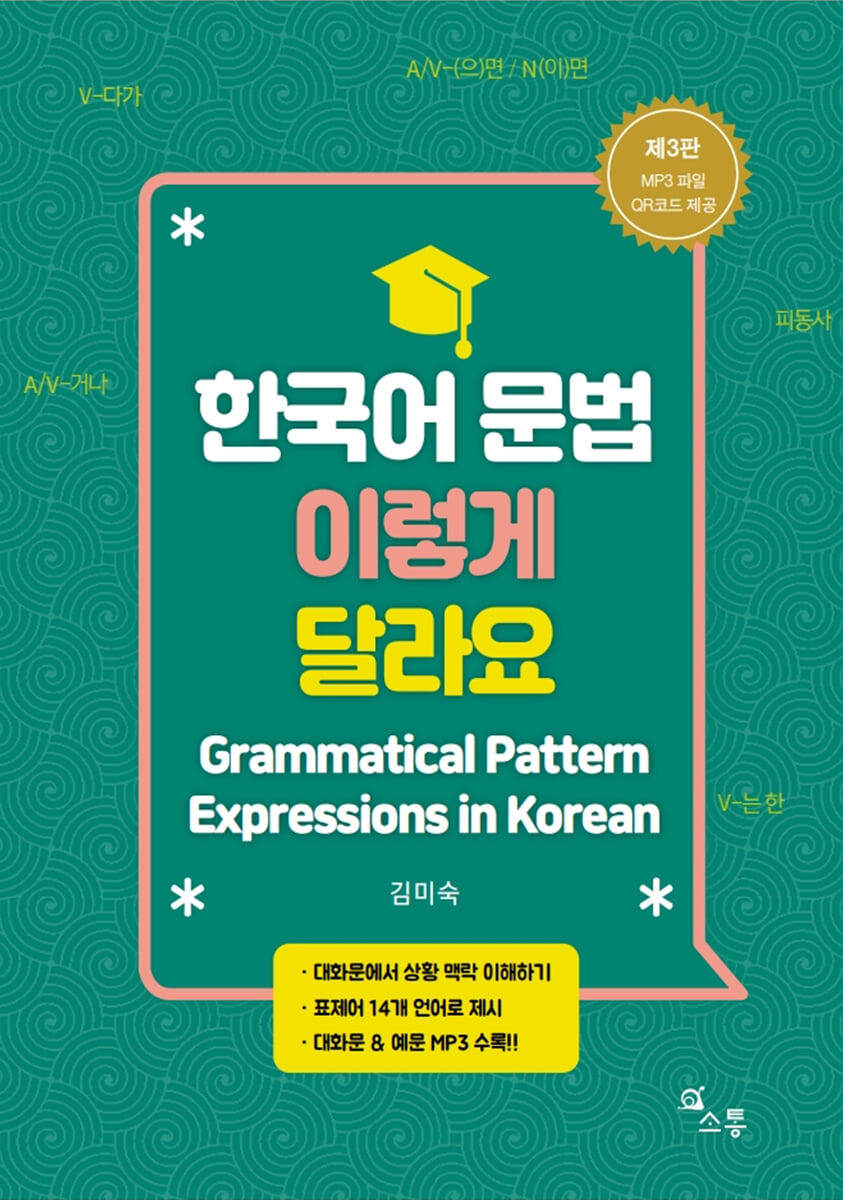 |
Description
Book Introduction
A grammar book filled with the Korean language teacher's classroom know-how.
This book is helpful to foreign students who want to study the differences in Korean expressions.
Korean sentence patterns are largely classified into two parts (sentence patterns with similar meanings and sentence patterns with similar forms), and sentence patterns with similar meanings are categorized by function such as cause/reason, listing of facts, purpose/intention, selection, continuation of situation, order of time, concession, condition/assumption, causative voice, passive voice, guess, and result, and similar grammars are compared and contrasted.
The headings for each functional category were presented in 12 languages, starting with the languages of countries with many Korean language learners in Korea, such as China, Vietnam, and Mongolia.
Each grammar item begins with a dialogue that helps learners understand the context in which the expressive sentence structure is used. This dialogue can be used as an introduction when introducing the learning sentence structure in classroom lessons.
We also included more examples to help learners understand, and provided a space to organize points to keep in mind when using sentence structures.
This is because learners can remember Korean expressions better if they find the characteristics of the expressions on their own.
As a special appendix, we provide a summary of key grammar in Chinese.
The revised edition includes more examples so that students can be exposed to a wide range of examples.
This book is helpful to foreign students who want to study the differences in Korean expressions.
Korean sentence patterns are largely classified into two parts (sentence patterns with similar meanings and sentence patterns with similar forms), and sentence patterns with similar meanings are categorized by function such as cause/reason, listing of facts, purpose/intention, selection, continuation of situation, order of time, concession, condition/assumption, causative voice, passive voice, guess, and result, and similar grammars are compared and contrasted.
The headings for each functional category were presented in 12 languages, starting with the languages of countries with many Korean language learners in Korea, such as China, Vietnam, and Mongolia.
Each grammar item begins with a dialogue that helps learners understand the context in which the expressive sentence structure is used. This dialogue can be used as an introduction when introducing the learning sentence structure in classroom lessons.
We also included more examples to help learners understand, and provided a space to organize points to keep in mind when using sentence structures.
This is because learners can remember Korean expressions better if they find the characteristics of the expressions on their own.
As a special appendix, we provide a summary of key grammar in Chinese.
The revised edition includes more examples so that students can be exposed to a wide range of examples.
- You can preview some of the book's contents.
Preview
GOODS SPECIFICS
- Date of issue: August 1, 2024
- Page count, weight, size: 334 pages | 148*210*30mm
- ISBN13: 9791191957396
- ISBN10: 119195739X
You may also like
카테고리
korean


korean

![ELLE 엘르 스페셜 에디션 A형 : 12월 [2025]](http://librairie.coreenne.fr/cdn/shop/files/b8e27a3de6c9538896439686c6b0e8fb.jpg?v=1766436872&width=3840)


