

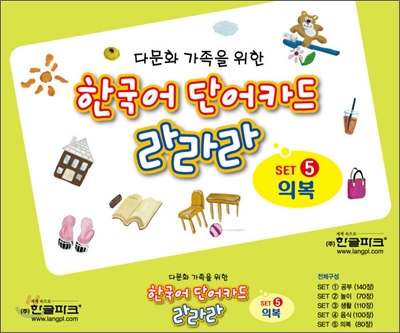
Korean Word Card Lalala Set 5 Clothing
 |
Description
Book Introduction
Korean language learning materials for marriage immigrants and their children.
This set of Korean vocabulary cards is designed for mothers and their children, ages 5 to 7, to study together. SET 5 focuses on the theme of clothing and includes six instructional cards, one vocabulary list card, and 80 vocabulary cards.
This set of Korean vocabulary cards is designed for mothers and their children, ages 5 to 7, to study together. SET 5 focuses on the theme of clothing and includes six instructional cards, one vocabulary list card, and 80 vocabulary cards.
Publisher's Review
Card Design Overview
1.
Vocabulary composition
Essential vocabulary for married immigrant women and school-age children (ages 5-7) is categorized into ‘daily vocabulary’ and ‘learning tool vocabulary’ and organized in the form of flashcards.
1) What is everyday vocabulary?
Vocabulary for basic communication (BICS: Basic Interpersonal Communication Skills), vocabulary for adapting to life in Korea, vocabulary for improving interpersonal relationships, vocabulary focused on spoken language
(Example) eat, sleep, wear, go, come
2) What is learning tool vocabulary?
Enhances critical thinking skills, prepares students for school, and focuses on written language.
(Example) Compare, explain, discuss, experiment, present
2.
Criteria for selecting titles
1) After analyzing the frequency of 10 types of vocabulary, including the National Institute of the Korean Language's 'Korean Language with Female Marriage Immigrants' ① and ②, the general purpose Korean beginner vocabulary ('Beginner Korean Learning Dictionary'), the Korean dictionary for children, and the English-Chinese-Korean Illustrated Dictionary, a total of 500 vocabulary words were extracted.
2) When selecting vocabulary, foreign words, vulgar words, and non-educational words were excluded despite their high frequency of actual use.
3) The vocabulary needed by married immigrant women and their children is divided into five areas by topic.
This parish was designed to address, to some extent, the low average educational attainment and poor educational environment of married immigrant women, and its unique feature is that it presents essential 'learning'-related vocabulary at a very basic level.
3.
Subject Areas
SET 1_Study (140 sheets): Basic verbs related to learning (add, subtract, read, listen, think, discuss, present, memorize, etc.), subject names (math, English, physical education, etc.), school supplies (noticebooks, pencils, rulers, glue, pencil cases, etc.), musical instrument names, occupational names, etc.
SET 2_Play (70 sheets): Play (rock-paper-scissors, pretend play, amusement park, etc.), Hobbies (soccer, hiking, travel, etc.), Holidays, Benefits of Civilization (games, soap operas, movies, etc.), Various Verbs (play, run, play), Type of Housing, Names of House Spaces (living room, kitchen), Community Office, Resident Registration Card
SET 3_Life (110 pages): Living space (large supermarket, pharmacy, hospital), house structure (yard, living room, front door, kitchen), major holidays/anniversaries (Seollal, Chuseok, ancestral rites), common verbs (wash, sleep, wake up)
SET 4_Food (100 sheets): Ingredients, cooking-related verbs (grill, steam, boil), food names (bulgogi, kimchi, tteokbokki, samgyeopsal)
SET 5_Clothing (80 sheets): Types of clothing (skirts, pants, coats), color adjectives, body names (head, waist, legs, feet), various accessories (rings, watches, glasses)
Vocabulary composition
Essential vocabulary for married immigrant women and school-age children (ages 5-7) is categorized into ‘daily vocabulary’ and ‘learning tool vocabulary’ and organized in the form of flashcards.
1) What is everyday vocabulary?
Vocabulary for basic communication (BICS: Basic Interpersonal Communication Skills), vocabulary for adapting to life in Korea, vocabulary for improving interpersonal relationships, vocabulary focused on spoken language
(Example) eat, sleep, wear, go, come
2) What is learning tool vocabulary?
Enhances critical thinking skills, prepares students for school, and focuses on written language.
(Example) Compare, explain, discuss, experiment, present
2.
Criteria for selecting titles
1) After analyzing the frequency of 10 types of vocabulary, including the National Institute of the Korean Language's 'Korean Language with Female Marriage Immigrants' ① and ②, the general purpose Korean beginner vocabulary ('Beginner Korean Learning Dictionary'), the Korean dictionary for children, and the English-Chinese-Korean Illustrated Dictionary, a total of 500 vocabulary words were extracted.
2) When selecting vocabulary, foreign words, vulgar words, and non-educational words were excluded despite their high frequency of actual use.
3) The vocabulary needed by married immigrant women and their children is divided into five areas by topic.
This parish was designed to address, to some extent, the low average educational attainment and poor educational environment of married immigrant women, and its unique feature is that it presents essential 'learning'-related vocabulary at a very basic level.
3.
Subject Areas
SET 1_Study (140 sheets): Basic verbs related to learning (add, subtract, read, listen, think, discuss, present, memorize, etc.), subject names (math, English, physical education, etc.), school supplies (noticebooks, pencils, rulers, glue, pencil cases, etc.), musical instrument names, occupational names, etc.
SET 2_Play (70 sheets): Play (rock-paper-scissors, pretend play, amusement park, etc.), Hobbies (soccer, hiking, travel, etc.), Holidays, Benefits of Civilization (games, soap operas, movies, etc.), Various Verbs (play, run, play), Type of Housing, Names of House Spaces (living room, kitchen), Community Office, Resident Registration Card
SET 3_Life (110 pages): Living space (large supermarket, pharmacy, hospital), house structure (yard, living room, front door, kitchen), major holidays/anniversaries (Seollal, Chuseok, ancestral rites), common verbs (wash, sleep, wake up)
SET 4_Food (100 sheets): Ingredients, cooking-related verbs (grill, steam, boil), food names (bulgogi, kimchi, tteokbokki, samgyeopsal)
SET 5_Clothing (80 sheets): Types of clothing (skirts, pants, coats), color adjectives, body names (head, waist, legs, feet), various accessories (rings, watches, glasses)
As international marriages increase, Korean language textbooks are being produced by governments, universities, and civic service organizations, but they are still insufficient in quantity and variety.
In particular, there is a need for Korean language textbooks that can be easily utilized in multicultural centers, immigrant women's centers, and civic schools, and there is an urgent need for self-study textbooks that take into account the circumstances of female marriage immigrants who cannot attend educational institutions every day to learn Korean.
Moreover, there is a near-total lack of Korean language textbooks and related materials that take into account the age-related characteristics of children from so-called multicultural families, who are often overlooked in Korean language education. Therefore, their development and distribution are urgently needed.
This is because the early childhood years are the first time that children from multicultural families acquire basic academic skills.
In this sense, 『Korean Word Card Lalala』 will be a very useful resource for Korean language education for marriage immigrants and their children.
As international marriages increase, Korean language textbooks are being produced by governments, universities, and civic service organizations, but they are still insufficient in quantity and variety.
In particular, there is a need for Korean language textbooks that can be easily utilized in multicultural centers, immigrant women's centers, and civic schools, and there is an urgent need for self-study textbooks that take into account the circumstances of female marriage immigrants who cannot attend educational institutions every day to learn Korean.
Moreover, there is a near-total lack of Korean language textbooks and related materials that take into account the age-related characteristics of children from so-called multicultural families, who are often overlooked in Korean language education. Therefore, their development and distribution are urgently needed.
This is because the early childhood years are the first time when children from multicultural families acquire basic academic skills.
In this sense, 『Korean Word Card Lalala』 will be a very useful resource for Korean language education for marriage immigrants and their children.
In particular, there is a need for Korean language textbooks that can be easily utilized in multicultural centers, immigrant women's centers, and civic schools, and there is an urgent need for self-study textbooks that take into account the circumstances of female marriage immigrants who cannot attend educational institutions every day to learn Korean.
Moreover, there is a near-total lack of Korean language textbooks and related materials that take into account the age-related characteristics of children from so-called multicultural families, who are often overlooked in Korean language education. Therefore, their development and distribution are urgently needed.
This is because the early childhood years are the first time that children from multicultural families acquire basic academic skills.
In this sense, 『Korean Word Card Lalala』 will be a very useful resource for Korean language education for marriage immigrants and their children.
As international marriages increase, Korean language textbooks are being produced by governments, universities, and civic service organizations, but they are still insufficient in quantity and variety.
In particular, there is a need for Korean language textbooks that can be easily utilized in multicultural centers, immigrant women's centers, and civic schools, and there is an urgent need for self-study textbooks that take into account the circumstances of female marriage immigrants who cannot attend educational institutions every day to learn Korean.
Moreover, there is a near-total lack of Korean language textbooks and related materials that take into account the age-related characteristics of children from so-called multicultural families, who are often overlooked in Korean language education. Therefore, their development and distribution are urgently needed.
This is because the early childhood years are the first time when children from multicultural families acquire basic academic skills.
In this sense, 『Korean Word Card Lalala』 will be a very useful resource for Korean language education for marriage immigrants and their children.
GOODS SPECIFICS
- Date of publication: August 25, 2010
- Page count, weight, size: 1 page | 894g | 185*120*15mm
- ISBN13: 9788955189483
- ISBN10: 8955189486
You may also like
카테고리
korean


korean

![GQ KOREA Mark (Monthly): December [2025]](http://librairie.coreenne.fr/cdn/shop/files/8ef265dbbfbf186523ed75ba7319009d.jpg?v=1765340328&width=3840)


