

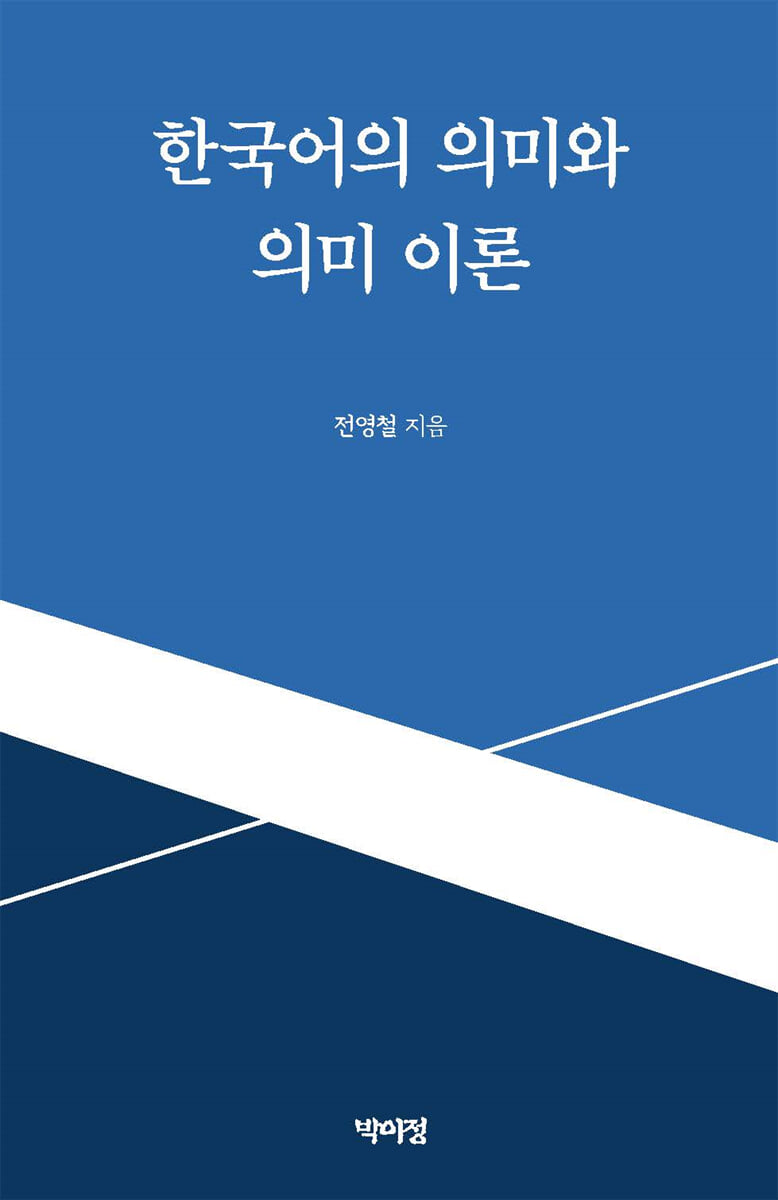
Meaning and Semantic Theory in Korean
 |
Description
Book Introduction
The purpose of this book is to observe how meaning operates in Korean and to explore how this can be effectively explained.
Humans live their lives constantly giving and receiving meaning without even being able to properly define it.
We live our lives sharing meanings on such a vast scale, so accurately and so quickly, without even knowing what they are. Even a brief glimpse into the world of meaning reveals a surprising array of possibilities.
What would happen if we couldn't communicate meaning through language? It's a difficult assumption to even imagine.
In this book, we will try to glimpse into the semantic world of the Korean language.
This book is divided into five parts.
In Part I, we learn about the essence of linguistic meaning.
It deals with what meaning is and what its main characteristics are.
In Part II, we examine the form of meaning realized at the level of words, which are the smallest unit of semantic analysis and the most powerful psychological entity.
In Part III, we observe several semantic phenomena realized at the level of sentences.
A sentence is a representative linguistic unit formed by combining words and is a unit of analysis in which a proposition is realized.
Part IV deals with semantic phenomena involving context.
If the contents of Parts II and III are about the inherent meaning of linguistic expressions, the contents of Part IV are about the meaning derived from the inherent meaning of linguistic expressions through the intervention of contextual elements.
It is a field commonly called pragmatics.
Finally, in Part V, we examine semantic theories.
First, we briefly outline the history of semantic research, and then examine the basic principles of the two major semantic theories of modern semantics: formal semantics and cognitive semantics.
Humans live their lives constantly giving and receiving meaning without even being able to properly define it.
We live our lives sharing meanings on such a vast scale, so accurately and so quickly, without even knowing what they are. Even a brief glimpse into the world of meaning reveals a surprising array of possibilities.
What would happen if we couldn't communicate meaning through language? It's a difficult assumption to even imagine.
In this book, we will try to glimpse into the semantic world of the Korean language.
This book is divided into five parts.
In Part I, we learn about the essence of linguistic meaning.
It deals with what meaning is and what its main characteristics are.
In Part II, we examine the form of meaning realized at the level of words, which are the smallest unit of semantic analysis and the most powerful psychological entity.
In Part III, we observe several semantic phenomena realized at the level of sentences.
A sentence is a representative linguistic unit formed by combining words and is a unit of analysis in which a proposition is realized.
Part IV deals with semantic phenomena involving context.
If the contents of Parts II and III are about the inherent meaning of linguistic expressions, the contents of Part IV are about the meaning derived from the inherent meaning of linguistic expressions through the intervention of contextual elements.
It is a field commonly called pragmatics.
Finally, in Part V, we examine semantic theories.
First, we briefly outline the history of semantic research, and then examine the basic principles of the two major semantic theories of modern semantics: formal semantics and cognitive semantics.
index
introduction
I.
The meaning of language
Chapter 1: The Meaning of Meaning
Chapter 2: Characteristics of Linguistic Meaning
Ⅱ.
Meaning of words
Chapter 3: Word Fields and Component Analysis
Chapter 4: Semantic Relationships of Vocabulary
Ⅲ.
Meaning of the sentence
Chapter 5 Tenses and Aspects
Chapter 6: Aspects
Chapter 7: Semantic Relationships in Sentences: Implications and Premises
Ⅳ.
Meaning of context
Chapter 8 Language Acts
Chapter 9 Implications
Chapter 10: Facing the Face
Chapter 11 Directive
Chapter 12 Information Structure
V.
semantic theory
Chapter 13: A Brief History of Meaning Studies
Chapter 14 Formal Semantics
Chapter 15 Cognitive Semantics
References
index
I.
The meaning of language
Chapter 1: The Meaning of Meaning
Chapter 2: Characteristics of Linguistic Meaning
Ⅱ.
Meaning of words
Chapter 3: Word Fields and Component Analysis
Chapter 4: Semantic Relationships of Vocabulary
Ⅲ.
Meaning of the sentence
Chapter 5 Tenses and Aspects
Chapter 6: Aspects
Chapter 7: Semantic Relationships in Sentences: Implications and Premises
Ⅳ.
Meaning of context
Chapter 8 Language Acts
Chapter 9 Implications
Chapter 10: Facing the Face
Chapter 11 Directive
Chapter 12 Information Structure
V.
semantic theory
Chapter 13: A Brief History of Meaning Studies
Chapter 14 Formal Semantics
Chapter 15 Cognitive Semantics
References
index
GOODS SPECIFICS
- Date of issue: June 30, 2023
- Page count, weight, size: 320 pages | 152*223*15mm
- ISBN13: 9791158488970
You may also like
카테고리
korean


korean

![ELLE 엘르 스페셜 에디션 A형 : 12월 [2025]](http://librairie.coreenne.fr/cdn/shop/files/b8e27a3de6c9538896439686c6b0e8fb.jpg?v=1766436872&width=3840)


