

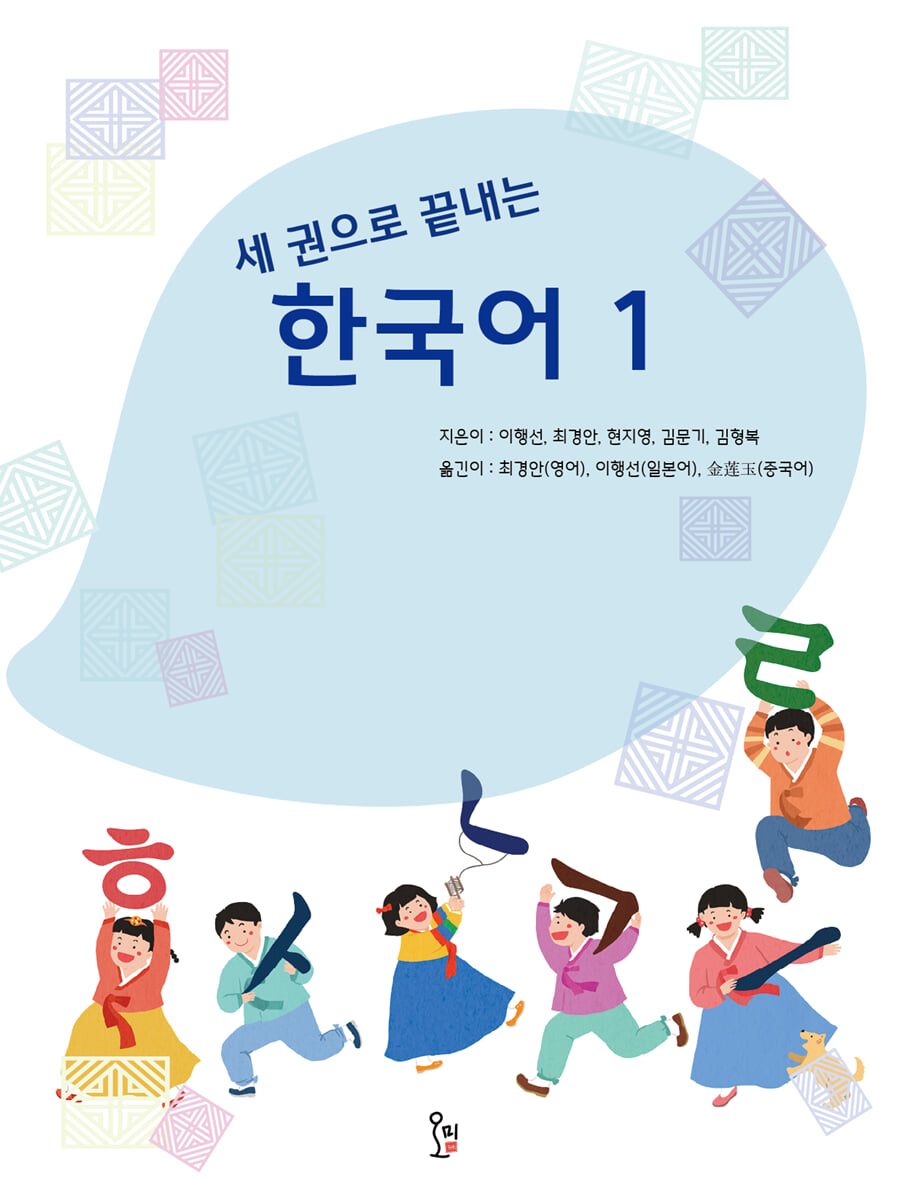
Korean in Three Volumes 1
 |
Description
Book Introduction
『Korean in Three Volumes』 was planned to be a three-volume series. The beginner textbook covers the existing level 1 to the first half of level 2, the intermediate textbook covers the latter half of level 2 to level 3, and the advanced textbook covers levels 4 and 5.
Each textbook consists of 12 units.
We have tried to arrange the vocabulary, grammar, and expressions in each unit so that they are frequently used in real-life situations and take the learner's level into consideration.
Each textbook consists of 12 units.
We have tried to arrange the vocabulary, grammar, and expressions in each unit so that they are frequently used in real-life situations and take the learner's level into consideration.
- You can preview some of the book's contents.
Preview
index
preface
Unit composition
korean
Lesson 1 Hello?
Where is the 2nd and 3rd grade student cafeteria?
Lesson 3 I watched a movie with my friend yesterday.
Lesson 4 How much is this?
Lesson 5 What are you going to do this vacation?
Lesson 6: What season do you like?
Lesson 7: How does the bulgogi taste?
Would you like to go play a game with 8?
Lesson 9: My grandfather is in his hometown.
Lesson 10 I'm going to Gyeongbokgung Palace.
Lesson 11 Have you ever been to Jeju Island?
Lesson 12 I have a fever and a swollen throat.
Appendix 1 Answer
Appendix 2 Listening Script
Appendix 3 Translation (English, Japanese, Chinese)
Appendix 4 Vocabulary List
Unit composition
korean
Lesson 1 Hello?
Where is the 2nd and 3rd grade student cafeteria?
Lesson 3 I watched a movie with my friend yesterday.
Lesson 4 How much is this?
Lesson 5 What are you going to do this vacation?
Lesson 6: What season do you like?
Lesson 7: How does the bulgogi taste?
Would you like to go play a game with 8?
Lesson 9: My grandfather is in his hometown.
Lesson 10 I'm going to Gyeongbokgung Palace.
Lesson 11 Have you ever been to Jeju Island?
Lesson 12 I have a fever and a swollen throat.
Appendix 1 Answer
Appendix 2 Listening Script
Appendix 3 Translation (English, Japanese, Chinese)
Appendix 4 Vocabulary List
Into the book
<text>
Sujin: The weather suddenly got hot.
Nicole: Yes, the wind isn't cool even at night.
So I don't really like summer.
Sujin: I like summer.
I love being able to swim in the ocean in the summer.
What season does Soojin like?
Nicole: I like winter.
Because I can ski.
Every winter, I go skiing with my friends.
Sujin: It doesn't snow in my hometown in the winter.
So I can't ski.
Nicole: Then, let's go skiing together during winter break.
Sujin: Okay.
1.
Please answer.
(1) What season does Sujin like?
(2) Why does Nicole like winter?
(3) What do Sujin and Nicole do during winter vacation?
2.
What season do you like? Talk to your friends.
Listening and Speaking
1.
Listen to the following and choose the correct answer.
(1) What season is it now?
① Spring ② Summer ③ Fall ④ Winter
(2) Where are the two people now?
① Park ② Coffee shop ③ School ④ Subway
2.
Listen and answer the following.
(1) What season is it now?
(2) Where do the two of you go on Saturday?
Sujin: The weather suddenly got hot.
Nicole: Yes, the wind isn't cool even at night.
So I don't really like summer.
Sujin: I like summer.
I love being able to swim in the ocean in the summer.
What season does Soojin like?
Nicole: I like winter.
Because I can ski.
Every winter, I go skiing with my friends.
Sujin: It doesn't snow in my hometown in the winter.
So I can't ski.
Nicole: Then, let's go skiing together during winter break.
Sujin: Okay.
1.
Please answer.
(1) What season does Sujin like?
(2) Why does Nicole like winter?
(3) What do Sujin and Nicole do during winter vacation?
2.
What season do you like? Talk to your friends.
Listening and Speaking
1.
Listen to the following and choose the correct answer.
(1) What season is it now?
① Spring ② Summer ③ Fall ④ Winter
(2) Where are the two people now?
① Park ② Coffee shop ③ School ④ Subway
2.
Listen and answer the following.
(1) What season is it now?
(2) Where do the two of you go on Saturday?
--- From "Lesson 5: What season do you like?"
Publisher's Review
"Korean in Three Volumes 1" is an integrated beginner-level textbook for foreign learners who are just beginning to study Korean.
Accordingly, the ‘Korean’ unit was placed at the very front, and it was composed of 12 units in total, from Unit 1 to Unit 12.
The 'Hangul' unit focuses on practicing pronouncing and writing vowel and consonant letters.
And each unit from Lesson 1 to Lesson 12 is presented in the following order: ‘Vocabulary - Grammar and Expressions - Text - Listening and Speaking - Reading and Writing - Korean Culture - Vocabulary - TOPIK Practice.’
Each lesson begins with a 'vocabulary' section, which presents vocabulary related to the topic or function of each unit, as well as questions to activate the schema.
In the 'Grammar and Expression' section, grammar and expression items for language functions related to the topic of each unit are arranged by level, taking into account the learner's level and actual frequency of use.
In the 'Main Text' section, situations corresponding to the topic and function of each unit are presented in the form of dialogue.
These were selected to be usable in real-life situations and were designed to improve Korean language skills.
In addition, problems were presented to check whether learners accurately understood the content of the text, and problems that could be linked to language function practice.
The 'Listening and Speaking' section allows you to practice listening and speaking that matches the topic and function of each unit, and the 'Reading and Writing' section allows you to practice reading and writing that matches the topic and function of each unit.
First, in 'Reading', a text related to the topic was presented and problems were presented to check whether the learners accurately understood the content.
And in 'Writing', we presented short and simple questions that could be answered, and presented activities that could be used to organize these questions into a complete text.
In the 'Korean Culture' section, Korean culture related to the topic of each unit is presented.
In the 'Vocabulary Boost' section that follows, vocabulary is presented in relation to the topic or function of each unit. These vocabulary words are related to the vocabulary presented in the 'text' and serve as a kind of learning material for vocabulary expansion.
In the 'TOPIK Practice Questions' section, problems in TOPIK format are presented mainly related to 'grammar and expressions' of each unit.
This will help you become familiar with the types of TOPIK test questions.
Accordingly, the ‘Korean’ unit was placed at the very front, and it was composed of 12 units in total, from Unit 1 to Unit 12.
The 'Hangul' unit focuses on practicing pronouncing and writing vowel and consonant letters.
And each unit from Lesson 1 to Lesson 12 is presented in the following order: ‘Vocabulary - Grammar and Expressions - Text - Listening and Speaking - Reading and Writing - Korean Culture - Vocabulary - TOPIK Practice.’
Each lesson begins with a 'vocabulary' section, which presents vocabulary related to the topic or function of each unit, as well as questions to activate the schema.
In the 'Grammar and Expression' section, grammar and expression items for language functions related to the topic of each unit are arranged by level, taking into account the learner's level and actual frequency of use.
In the 'Main Text' section, situations corresponding to the topic and function of each unit are presented in the form of dialogue.
These were selected to be usable in real-life situations and were designed to improve Korean language skills.
In addition, problems were presented to check whether learners accurately understood the content of the text, and problems that could be linked to language function practice.
The 'Listening and Speaking' section allows you to practice listening and speaking that matches the topic and function of each unit, and the 'Reading and Writing' section allows you to practice reading and writing that matches the topic and function of each unit.
First, in 'Reading', a text related to the topic was presented and problems were presented to check whether the learners accurately understood the content.
And in 'Writing', we presented short and simple questions that could be answered, and presented activities that could be used to organize these questions into a complete text.
In the 'Korean Culture' section, Korean culture related to the topic of each unit is presented.
In the 'Vocabulary Boost' section that follows, vocabulary is presented in relation to the topic or function of each unit. These vocabulary words are related to the vocabulary presented in the 'text' and serve as a kind of learning material for vocabulary expansion.
In the 'TOPIK Practice Questions' section, problems in TOPIK format are presented mainly related to 'grammar and expressions' of each unit.
This will help you become familiar with the types of TOPIK test questions.
GOODS SPECIFICS
- Publication date: December 30, 2021
- Page count, weight, size: 251 pages | 768g | 210*280*15mm
- ISBN13: 9791197720505
- ISBN10: 1197720502
You may also like
카테고리
korean


korean

![ELLE 엘르 스페셜 에디션 A형 : 12월 [2025]](http://librairie.coreenne.fr/cdn/shop/files/b8e27a3de6c9538896439686c6b0e8fb.jpg?v=1766436872&width=3840)


