

Korean language and culture
 |
Description
Book Introduction
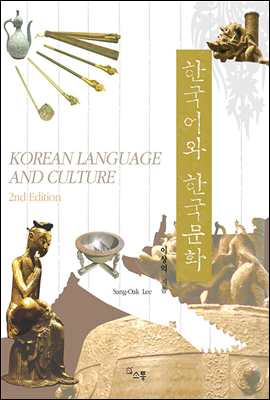
Korean language and culture, a Korean studies textbook for foreigners.
This book compiles the author's lecture notes on Korean language and Korean studies, from his first Korean studies class for UCLA exchange students in 1987 to his current lectures (for international students) at the Seoul National University Center for Teaching and Learning.
It covers almost every aspect of Korea, from an overview of the Korean language to Korean history, art, music, literature, traditional culture, philosophy, and honorifics, making it an excellent textbook for helping foreigners understand Korea.
A glossary of terms has been attached as an appendix, and the previously insufficient content has been revised and supplemented, and a large number of color photos have been inserted.
The glossary was also replaced with English-Korean translations to ensure that foreign students have no difficulty reading and learning it.
This could be a useful textbook for foreign students interested in Korea and the Korean language.
This book compiles the author's lecture notes on Korean language and Korean studies, from his first Korean studies class for UCLA exchange students in 1987 to his current lectures (for international students) at the Seoul National University Center for Teaching and Learning.
It covers almost every aspect of Korea, from an overview of the Korean language to Korean history, art, music, literature, traditional culture, philosophy, and honorifics, making it an excellent textbook for helping foreigners understand Korea.
A glossary of terms has been attached as an appendix, and the previously insufficient content has been revised and supplemented, and a large number of color photos have been inserted.
The glossary was also replaced with English-Korean translations to ensure that foreign students have no difficulty reading and learning it.
This could be a useful textbook for foreign students interested in Korea and the Korean language.
index
1. Overview of Korean
2-1. Korean History
2-2. Nature and Society in Korea
3. Korean Art I
4. Korean Art II
5. Korean Music I
6. Korean Music II
7. Korean Music III
8. Korean Literature I
9. Korean Literature II
10. Traditional culture
11. Korean Philosophy I
12. Korean Philosophy II
13. Honorifics
2-1. Korean History
2-2. Nature and Society in Korea
3. Korean Art I
4. Korean Art II
5. Korean Music I
6. Korean Music II
7. Korean Music III
8. Korean Literature I
9. Korean Literature II
10. Traditional culture
11. Korean Philosophy I
12. Korean Philosophy II
13. Honorifics
Into the book
'The only artificial things in the rear garden (of the Joseon palace) are the walls surrounding the garden and a few stones placed here and there to keep the ground from rotting… … Entering there, one is met with a cry of admiration at this uncreated creation.'
What a Joseon garden looked like can be seen from the back garden of Chilgung Palace at the foot of Bugak Mountain in Seoul.
This back garden is not really a garden at all; it is just a section of the skirt of the mountain that has been walled in and included within the grounds of Chilgung.
The only thing artificial here is the wall that circumscribes the garden and some stones placed here and there for soil erosion control.
And yet it is a splendid garden.
Entering it, cries of admiration greet this uncreated creation.
Not the sort of admiration for the skill of an architect or an expert in landscaping trained thoroughly in the modern sense.
For the perfection of beauty and naturalness, explanations are superfluous; One feels such perfection intuitively.
--- p.118
'(Japanese art critic) The late Yanagi Muneyoshi defined the world of Joseon porcelain as the world before beauty and ugliness arose.
Tanaka Toyotaro said, "Korean porcelain was born rather than created." (From the text)
“Simple and ordinary”, were the words of
the late Muneyoshi Yanagi, the famous art connoisseur, who fell in love with Korean
art, when he was shown the best tea bowl in Japan, called Kizaemon-Ido, a 16th century
rice bowl of Joseon Korea.
Yanagi defined the world of Joseon potters as the
world before beauty and ugliness.
Go Yu-seop called it "planned planlessness".
What a Joseon garden looked like can be seen from the back garden of Chilgung Palace at the foot of Bugak Mountain in Seoul.
This back garden is not really a garden at all; it is just a section of the skirt of the mountain that has been walled in and included within the grounds of Chilgung.
The only thing artificial here is the wall that circumscribes the garden and some stones placed here and there for soil erosion control.
And yet it is a splendid garden.
Entering it, cries of admiration greet this uncreated creation.
Not the sort of admiration for the skill of an architect or an expert in landscaping trained thoroughly in the modern sense.
For the perfection of beauty and naturalness, explanations are superfluous; One feels such perfection intuitively.
--- p.118
'(Japanese art critic) The late Yanagi Muneyoshi defined the world of Joseon porcelain as the world before beauty and ugliness arose.
Tanaka Toyotaro said, "Korean porcelain was born rather than created." (From the text)
“Simple and ordinary”, were the words of
the late Muneyoshi Yanagi, the famous art connoisseur, who fell in love with Korean
art, when he was shown the best tea bowl in Japan, called Kizaemon-Ido, a 16th century
rice bowl of Joseon Korea.
Yanagi defined the world of Joseon potters as the
world before beauty and ugliness.
Go Yu-seop called it "planned planlessness".
--- From the text
Publisher's Review
This book, which has been consistently loved as an introductory Korean studies book for foreigners (Korean-English translation), has been published in a revised edition following the second printing of the first edition.
We have revised and supplemented the content that was previously insufficient.
Additionally, we have inserted a large number of color photos to help readers understand.
The glossary has also been replaced with English-Korean translations to ensure that foreign students have no difficulty reading and learning it.
Below is a brief introduction to the book.
[Introduction]
This book is a perfect guide to study Korean Language and Culture for foreigners and advanced learners.
Author has worked in Korean studies over 30 years and has organized Korean language and culture very systematically.
Also this book is a compilation of teaching materials and resources accumulated while teaching "Korean Language and Culture", a course that has been offered over 14 years since 1997 as an exam graduate exemption subject for foreign students at Seoul National University.
Korean Language and Culture covers almost every aspect of Korea, from an overview of the Korean language to Korean history, art, music, literature, traditional culture, philosophy, and honorifics, helping foreigners gain a clear understanding of Korea by describing the essential core concepts.
Additionally, it describes the historical exchanges, influences, and differences with neighboring countries (China, Japan, the United States, etc.) from Gojoseon to the present, allowing for a broader understanding of Korea.
Based on over 30 years of teaching experience and continuous improvement, [Korean Language and Culture] is a carefully selected collection of materials that have undergone thorough research.
This book will be of great help in improving your Korean language skills, as it includes a Korean-English glossary as an appendix.
We have revised and supplemented the content that was previously insufficient.
Additionally, we have inserted a large number of color photos to help readers understand.
The glossary has also been replaced with English-Korean translations to ensure that foreign students have no difficulty reading and learning it.
Below is a brief introduction to the book.
[Introduction]
This book is a perfect guide to study Korean Language and Culture for foreigners and advanced learners.
Author has worked in Korean studies over 30 years and has organized Korean language and culture very systematically.
Also this book is a compilation of teaching materials and resources accumulated while teaching "Korean Language and Culture", a course that has been offered over 14 years since 1997 as an exam graduate exemption subject for foreign students at Seoul National University.
Korean Language and Culture covers almost every aspect of Korea, from an overview of the Korean language to Korean history, art, music, literature, traditional culture, philosophy, and honorifics, helping foreigners gain a clear understanding of Korea by describing the essential core concepts.
Additionally, it describes the historical exchanges, influences, and differences with neighboring countries (China, Japan, the United States, etc.) from Gojoseon to the present, allowing for a broader understanding of Korea.
Based on over 30 years of teaching experience and continuous improvement, [Korean Language and Culture] is a carefully selected collection of materials that have undergone thorough research.
This book will be of great help in improving your Korean language skills, as it includes a Korean-English glossary as an appendix.
GOODS SPECIFICS
- Date of issue: September 8, 2011
- Page count, weight, size: 480 pages | 176*248*30mm
- ISBN13: 9788993454413
- ISBN10: 8993454418
You may also like
카테고리
korean


korean

![GQ KOREA Mark (Monthly): December [2025]](http://librairie.coreenne.fr/cdn/shop/files/8ef265dbbfbf186523ed75ba7319009d.jpg?v=1765340328&width=3840)


