

Principles and Practice of Korean Language Classes
 |
Description
Book Introduction
This book is a guide and manual for Korean language teachers.
We have tried to cover all the teaching and learning-related issues that Korean language teachers must deal with in actual educational settings, and to organize them so that they can be intuitively understood through specific, practical examples.
Therefore, through this book, prospective/beginner Korean language teachers will be able to confirm what kind of teacher is desired and demanded in the field of Korean language education.
This book is designed to be used as a personal study guide for Korean language teachers as well as a teaching material for practical classes in training courses or Korean language education major courses.
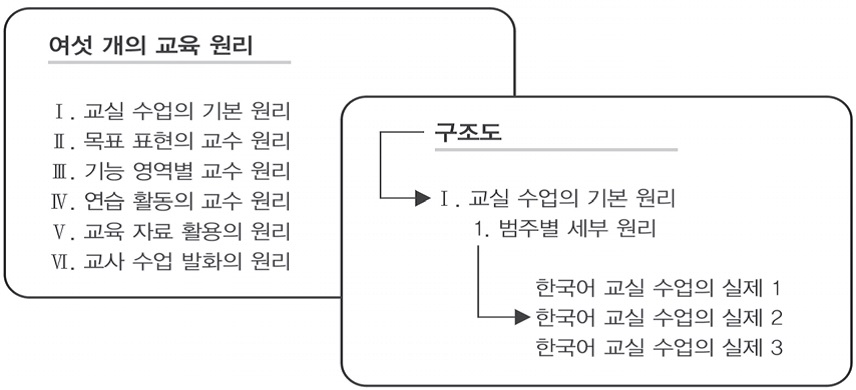
This book divides the principles that must be known in the field of Korean language education into the following categories: first, basic principles of classroom instruction; second, teaching principles of target expression; third, teaching principles by functional area; fourth, teaching principles of practice activities; fifth, principles of utilizing educational materials; and lastly, principles of teacher instructional speech.
For each of these educational principles, detailed principles are selected and their practical application in Korean language classrooms is explained with illustrations wherever necessary.
The educational principles are categorized by area into items that Korean language teachers need to know in actual educational settings.
Through this, you will be able to understand matters related to the reality of education.
This book analyzes and proposes detailed principles by category for each area and describes how these are applied in actual classes.
As Korean language teachers read this book, they will find that their own knowledge and the teaching methods presented in this book are firmly aligned.
We have tried to cover all the teaching and learning-related issues that Korean language teachers must deal with in actual educational settings, and to organize them so that they can be intuitively understood through specific, practical examples.
Therefore, through this book, prospective/beginner Korean language teachers will be able to confirm what kind of teacher is desired and demanded in the field of Korean language education.
This book is designed to be used as a personal study guide for Korean language teachers as well as a teaching material for practical classes in training courses or Korean language education major courses.
This book divides the principles that must be known in the field of Korean language education into the following categories: first, basic principles of classroom instruction; second, teaching principles of target expression; third, teaching principles by functional area; fourth, teaching principles of practice activities; fifth, principles of utilizing educational materials; and lastly, principles of teacher instructional speech.
For each of these educational principles, detailed principles are selected and their practical application in Korean language classrooms is explained with illustrations wherever necessary.
The educational principles are categorized by area into items that Korean language teachers need to know in actual educational settings.
Through this, you will be able to understand matters related to the reality of education.
This book analyzes and proposes detailed principles by category for each area and describes how these are applied in actual classes.
As Korean language teachers read this book, they will find that their own knowledge and the teaching methods presented in this book are firmly aligned.
index
Ⅰ.
Basic principles of classroom instruction
1. A teacher is a professional who comprehensively coordinates and manages the classroom situation.
/ 15
2. The core content must be presented appropriately and appropriately, taking into account the function.
/ 23
3 The explanation should be concise, easy to understand and step-by-step.
/ 31
4 The more moderately distressed the learner is, the better the quality of the class.
/ 39
5 The variety of questions that learners will ask is quite predictable.
/ 47
6 There are levels to examples that are meaningful to learners.
/ 56
7 There is no need to ask questions that have no educational effect.
/ 63
Ⅱ.
Teaching Principles of Objective Expression
1. Consider the learner's information and situation from the introduction of the target expression.
/ 73
2. Target expressions (sentence patterns) and vocabulary are comprehensively organized.
/ 84
3 Pay more attention to the connection between the preceding and following clauses rather than the 'V/A-ending'.
/ 92
4. The input form is presented in stages starting from the basic form.
/ 99
5 Linking expressions are as important as expressing goals.
/ 107
6 Emphasize the goal expression and present it with a real-life situation.
/ 115
Ⅲ.
Teaching principles by functional area
1 Functional areas should be focused on a domain-by-domain basis from an integration perspective.
/ 127
2 Listening is a process of immediate interpretation of information.
/ 133
3 Speaking is the process of directly providing information.
/ 141
4 Reading is a process of subjective interpretation of information.
/ 148
5 Writing is the process of documenting information.
/ 155
Basic principles of classroom instruction
1. A teacher is a professional who comprehensively coordinates and manages the classroom situation.
/ 15
2. The core content must be presented appropriately and appropriately, taking into account the function.
/ 23
3 The explanation should be concise, easy to understand and step-by-step.
/ 31
4 The more moderately distressed the learner is, the better the quality of the class.
/ 39
5 The variety of questions that learners will ask is quite predictable.
/ 47
6 There are levels to examples that are meaningful to learners.
/ 56
7 There is no need to ask questions that have no educational effect.
/ 63
Ⅱ.
Teaching Principles of Objective Expression
1. Consider the learner's information and situation from the introduction of the target expression.
/ 73
2. Target expressions (sentence patterns) and vocabulary are comprehensively organized.
/ 84
3 Pay more attention to the connection between the preceding and following clauses rather than the 'V/A-ending'.
/ 92
4. The input form is presented in stages starting from the basic form.
/ 99
5 Linking expressions are as important as expressing goals.
/ 107
6 Emphasize the goal expression and present it with a real-life situation.
/ 115
Ⅲ.
Teaching principles by functional area
1 Functional areas should be focused on a domain-by-domain basis from an integration perspective.
/ 127
2 Listening is a process of immediate interpretation of information.
/ 133
3 Speaking is the process of directly providing information.
/ 141
4 Reading is a process of subjective interpretation of information.
/ 148
5 Writing is the process of documenting information.
/ 155
Detailed image
GOODS SPECIFICS
- Date of issue: January 30, 2020
- Page count, weight, size: 274 pages | 173*246*20mm
- ISBN13: 9791186453810
- ISBN10: 1186453818
You may also like
카테고리
korean


korean

![ELLE 엘르 스페셜 에디션 A형 : 12월 [2025]](http://librairie.coreenne.fr/cdn/shop/files/b8e27a3de6c9538896439686c6b0e8fb.jpg?v=1766436872&width=3840)


