

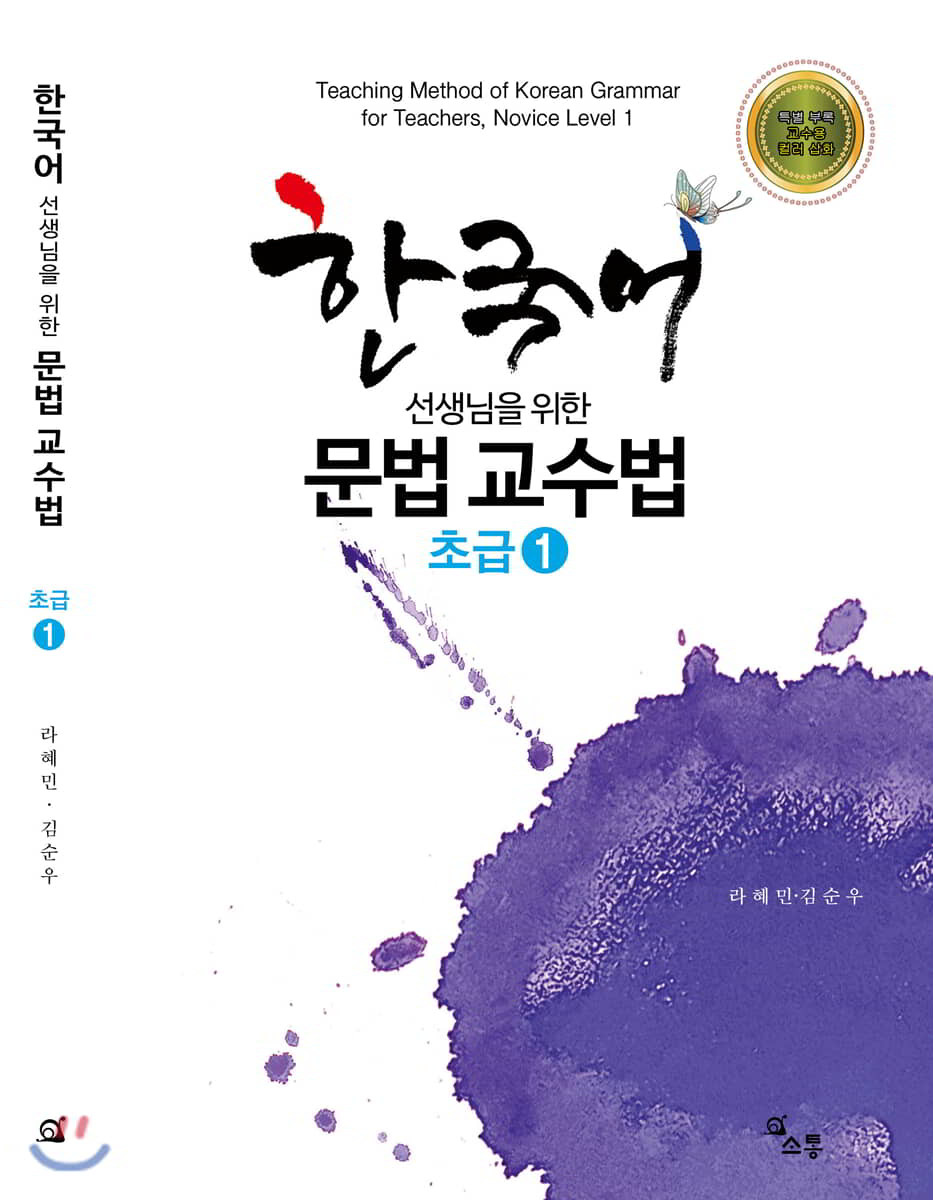
Grammar Teaching Methods for Korean Teachers, Level 1
 |
Description
Book Introduction
The target audience for Korean language learners is becoming increasingly diverse, including general learners who are interested in Korean culture, such as K-POP, learners for academic purposes who want to advance to Korean universities (graduate schools), married immigrant women who want to settle down in Korean society, children from multicultural families, and foreign workers.
Accordingly, the demand for Korean language teachers has also increased significantly, and Korean language teacher training programs are being operated not only by educational institutions within universities (language education centers, undergraduate and graduate schools), but also by various related organizations and groups.
Many Korean language learners say that the subtle differences in grammatical expressions are too difficult to learn.
Grammar can be a burdensome area for beginning teachers who have to deal with students' difficulties on the front lines.
Therefore, when teaching Korean grammar, teachers have to think about the optimal teaching method.
This book has been consistently loved by readers since its first edition was published in 2011.
The revised edition includes picture cards for introducing grammar as an appendix so that it can be used immediately in educational settings, and the illustrations included on the CD of the first edition have been distributed to the web hard data room so that they can be used free of charge (for non-commercial purposes).
I hope this book will be of some help in resolving difficulties encountered in educational settings, and will also help Korean language learners accurately understand Korean expressions.
Additionally, this book includes most of the sentence patterns covered in the beginner level.
Starting from the most basic 'Korean alphabet teaching', 40 representative sentence patterns are presented step by step.
Accordingly, the demand for Korean language teachers has also increased significantly, and Korean language teacher training programs are being operated not only by educational institutions within universities (language education centers, undergraduate and graduate schools), but also by various related organizations and groups.
Many Korean language learners say that the subtle differences in grammatical expressions are too difficult to learn.
Grammar can be a burdensome area for beginning teachers who have to deal with students' difficulties on the front lines.
Therefore, when teaching Korean grammar, teachers have to think about the optimal teaching method.
This book has been consistently loved by readers since its first edition was published in 2011.
The revised edition includes picture cards for introducing grammar as an appendix so that it can be used immediately in educational settings, and the illustrations included on the CD of the first edition have been distributed to the web hard data room so that they can be used free of charge (for non-commercial purposes).
I hope this book will be of some help in resolving difficulties encountered in educational settings, and will also help Korean language learners accurately understand Korean expressions.
Additionally, this book includes most of the sentence patterns covered in the beginner level.
Starting from the most basic 'Korean alphabet teaching', 40 representative sentence patterns are presented step by step.
index
1.
gather
2.
Ja yin
3.
Support
4.
It's [name], is it [name]?
5.
[Dong], [hyung] is/are you [Dong], [hyung] is/are you?
6.
[Name] is/is
7.
[Name]
8.
[brightness
9.
[Name] is/is
10.
[Name]
11.
In [name]
12.
[Noun] Yes/Is it, [Noun] Yes/Is it?
13.
It's not [name]
14.
[name
15.
[Dong],[hyung] are you/are you/are you/are you? [Dong],[hyung] are you/are you/are you/are you?
16.
[Dong], [Hyeong] are not there
17.
'ㄹ' drop
18.
'ㄷ' irregularity
19.
'Eu' elimination
20.
Number (Chinese character)
21.
Numbers (one, two, three...)
22.
[Dong], [Hyung] was/was/was
23.
B irregular
24.
S irregular
25.
[Name] and/or
26.
I want to [Dong]
27.
[Name] at (time)
28.
Let's go/let's go
29.
[Dong] Shall we do it/should we do it?
30.
To [name]
31.
From [name]
32.
[Dong], [Hyung]
33.
[Dong]l will be/eul will be
34.
[Noun] me/ina
35.
[Dong], [Hyeong]go
36.
Honorifics
37.
[Dong]seyo/seyo
38.
Don't [do]
39.
[Name]
40.
While [doing]/while
gather
2.
Ja yin
3.
Support
4.
It's [name], is it [name]?
5.
[Dong], [hyung] is/are you [Dong], [hyung] is/are you?
6.
[Name] is/is
7.
[Name]
8.
[brightness
9.
[Name] is/is
10.
[Name]
11.
In [name]
12.
[Noun] Yes/Is it, [Noun] Yes/Is it?
13.
It's not [name]
14.
[name
15.
[Dong],[hyung] are you/are you/are you/are you? [Dong],[hyung] are you/are you/are you/are you?
16.
[Dong], [Hyeong] are not there
17.
'ㄹ' drop
18.
'ㄷ' irregularity
19.
'Eu' elimination
20.
Number (Chinese character)
21.
Numbers (one, two, three...)
22.
[Dong], [Hyung] was/was/was
23.
B irregular
24.
S irregular
25.
[Name] and/or
26.
I want to [Dong]
27.
[Name] at (time)
28.
Let's go/let's go
29.
[Dong] Shall we do it/should we do it?
30.
To [name]
31.
From [name]
32.
[Dong], [Hyung]
33.
[Dong]l will be/eul will be
34.
[Noun] me/ina
35.
[Dong], [Hyeong]go
36.
Honorifics
37.
[Dong]seyo/seyo
38.
Don't [do]
39.
[Name]
40.
While [doing]/while
Publisher's Review
This book is divided into six stages as follows:
1.
Preliminary knowledge stage: The meaning, characteristics, and reference points of the target sentence structure are presented so that the teacher can understand it.
2.
Introduction stage: This is the stage where the target sentence structure is introduced to the learner.
This is a very important step because the introduction stage allows learners to guess the usage of the target sentence structure and understand the situations in which it is used.
The introductory situation in which the target sentence structure is used is presented through dialogue or related pictures.
3.
Presentation stage: Present the sentence structure to be studied and provide examples used in the introduction.
When presenting examples, examples that should be referenced, such as those with and without final consonants and irregular usage, are presented.
4.
Practice phase: Various methods, such as replacement practice and response practice, were provided to ensure that learners could practice sufficiently.
5.
Utilization stage: Various activity methods such as interview activities, information filling, songs, and games were suggested to enable students to use the target sentence structure in a fun and communicative way in classroom situations.
6.
Tip: Information on teaching materials needed to teach the target sentence structure and points to keep in mind when teaching the target sentence structure are provided.
1.
Preliminary knowledge stage: The meaning, characteristics, and reference points of the target sentence structure are presented so that the teacher can understand it.
2.
Introduction stage: This is the stage where the target sentence structure is introduced to the learner.
This is a very important step because the introduction stage allows learners to guess the usage of the target sentence structure and understand the situations in which it is used.
The introductory situation in which the target sentence structure is used is presented through dialogue or related pictures.
3.
Presentation stage: Present the sentence structure to be studied and provide examples used in the introduction.
When presenting examples, examples that should be referenced, such as those with and without final consonants and irregular usage, are presented.
4.
Practice phase: Various methods, such as replacement practice and response practice, were provided to ensure that learners could practice sufficiently.
5.
Utilization stage: Various activity methods such as interview activities, information filling, songs, and games were suggested to enable students to use the target sentence structure in a fun and communicative way in classroom situations.
6.
Tip: Information on teaching materials needed to teach the target sentence structure and points to keep in mind when teaching the target sentence structure are provided.
GOODS SPECIFICS
- Date of issue: July 15, 2019
- Page count, weight, size: 232 pages | 611g | 185*260*20mm
- ISBN13: 9791186453759
- ISBN10: 1186453753
You may also like
카테고리
korean


korean

![GQ KOREA Mark (Monthly): December [2025]](http://librairie.coreenne.fr/cdn/shop/files/8ef265dbbfbf186523ed75ba7319009d.jpg?v=1765340328&width=3840)


