

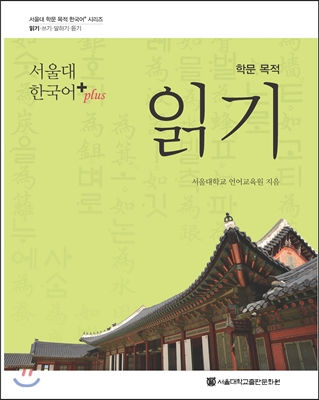
Seoul National University Korean Plus Academic Purpose Reading
 |
Description
Book Introduction
This is one of the Seoul National University Korean+ Academic Purpose Reading, Writing, Speaking, and Listening courses developed by the Seoul National University Language Education Institute. It was developed to help learners who want to develop academic Korean communication skills acquire those skills in a short period of time.
Vocabulary Mastery | Present vocabulary related to the topic and learn its meaning and usage through sentences.
Reading Texts | Read a variety of written texts, including expository writing, editorials, essays, and novels, and understand their structure and linguistic expressions. Learn a variety of reading skills, including skimming, reading closely, identifying themes, and identifying arguments and evidence.
Understanding the Content | Read the text for the relevant lesson and check what you read through the questions.
Understanding Structure | Presents and practices expressions related to writing functions such as arguing, describing, summarizing, and analyzing.
Writing | Learners complete writing assignments individually or with peers, developing a variety of writing styles, including argumentative, expository, and descriptive writing.
Self-assessment | Self-assessment questions allow learners to check their own learning achievements in the subject, leading to self-directed learning.
Appendix | Provides model answers to practice problems and a vocabulary index.
Vocabulary Mastery | Present vocabulary related to the topic and learn its meaning and usage through sentences.
Reading Texts | Read a variety of written texts, including expository writing, editorials, essays, and novels, and understand their structure and linguistic expressions. Learn a variety of reading skills, including skimming, reading closely, identifying themes, and identifying arguments and evidence.
Understanding the Content | Read the text for the relevant lesson and check what you read through the questions.
Understanding Structure | Presents and practices expressions related to writing functions such as arguing, describing, summarizing, and analyzing.
Writing | Learners complete writing assignments individually or with peers, developing a variety of writing styles, including argumentative, expository, and descriptive writing.
Self-assessment | Self-assessment questions allow learners to check their own learning achievements in the subject, leading to self-directed learning.
Appendix | Provides model answers to practice problems and a vocabulary index.
- You can preview some of the book's contents.
Preview
index
preface
Note
Textbook composition table
Lesson 1: The World of Reading
Lesson 2 Language and Culture
Lesson 3: Stress and Health
Lesson 4 Korean Temples
Lesson 5: Division of North and South Korea
Lesson 6: Beauty of Korea
Lesson 7: Study Styles in Different Countries
Lesson 8: The Mysterious World of Microorganisms
Lesson 9: The Future of Tap Water
Lesson 10 Nature and Life
Lesson 11: The History of Coffee in Korea
Lesson 12: Economy and Talent
Lesson 13 Poetry and Emotion
Lesson 14: Experiences of Enlightenment
Lesson 15 Literature and Society
supplement
Note
Textbook composition table
Lesson 1: The World of Reading
Lesson 2 Language and Culture
Lesson 3: Stress and Health
Lesson 4 Korean Temples
Lesson 5: Division of North and South Korea
Lesson 6: Beauty of Korea
Lesson 7: Study Styles in Different Countries
Lesson 8: The Mysterious World of Microorganisms
Lesson 9: The Future of Tap Water
Lesson 10 Nature and Life
Lesson 11: The History of Coffee in Korea
Lesson 12: Economy and Talent
Lesson 13 Poetry and Emotion
Lesson 14: Experiences of Enlightenment
Lesson 15 Literature and Society
supplement
Into the book
4.
Let's read the following passage and answer the questions.
There are many beautiful pure Korean words related to 'rain' in the Korean language.
It's about to start raining
When a few drops fall, they are called 'raindrops'.
The rain falling like powder is '
Ruby', heavy and pouring rain is 'small rain', rain falls very lightly enough to cover the dust
The rain is called 'dust jam'.
East wind, west wind, south wind, and north wind should also be written in pure Korean.
east
The wind blowing from the south is called the 'saebaram', the wind blowing from the west is called the 'hanibaram', and the wind blowing from the south is called the 'saebaram'.
The wind blowing from the north is called 'Maparam', and the wind blowing from the north is called 'Denbaram'.
Spring rain, summer rain, autumn rain, winter
Rain also has its own unique and beautiful pure Korean words.
There is a lot to do in spring, so it rains
Because I have to work even when I come, it rains, and in the summer, there is no busy work, so it rains.
It rains 'Zambia' because it's good to take a nap when you come.
In the fall, the autumn harvest is over and rice cakes are made.
It rains 'tteokbi' because you can eat and rest leisurely, and in winter, it is the off-season for farming, so you can drink alcohol.
It is called 'soolbi' because it is good to have fun while drinking.
1) Let's write down the topic of this article.
2) Let's find the sentences in this text that break the unity and underline them.
3) Please explain why the underlined sentence in 2) above harms the unity of this text.
Let's see.
5.
The following is a jumbled up version of the text.
Let's read carefully and answer the questions.
(a) In the Korean Peninsula, there are big thorn fish, small thorn fish, thorn fish, blue thorn fish, and duman thorn fish.
there is.
But people say that all kinds of thornbacks die protecting their young.
As you know, only the bighead trout actually lays eggs and dies after protecting its young.
(I) There was once a long novel titled 'Thorn Fish' that became a bestseller.
Don't eat
With a heart like a thorn fish that takes care of its eggs without sleeping, it got leukemia.
This is a novel about a father's love for his son who is on the verge of death.
(Lesson 2, Language and Culture, p. 38)
Let's read the following passage and answer the questions.
There are many beautiful pure Korean words related to 'rain' in the Korean language.
It's about to start raining
When a few drops fall, they are called 'raindrops'.
The rain falling like powder is '
Ruby', heavy and pouring rain is 'small rain', rain falls very lightly enough to cover the dust
The rain is called 'dust jam'.
East wind, west wind, south wind, and north wind should also be written in pure Korean.
east
The wind blowing from the south is called the 'saebaram', the wind blowing from the west is called the 'hanibaram', and the wind blowing from the south is called the 'saebaram'.
The wind blowing from the north is called 'Maparam', and the wind blowing from the north is called 'Denbaram'.
Spring rain, summer rain, autumn rain, winter
Rain also has its own unique and beautiful pure Korean words.
There is a lot to do in spring, so it rains
Because I have to work even when I come, it rains, and in the summer, there is no busy work, so it rains.
It rains 'Zambia' because it's good to take a nap when you come.
In the fall, the autumn harvest is over and rice cakes are made.
It rains 'tteokbi' because you can eat and rest leisurely, and in winter, it is the off-season for farming, so you can drink alcohol.
It is called 'soolbi' because it is good to have fun while drinking.
1) Let's write down the topic of this article.
2) Let's find the sentences in this text that break the unity and underline them.
3) Please explain why the underlined sentence in 2) above harms the unity of this text.
Let's see.
5.
The following is a jumbled up version of the text.
Let's read carefully and answer the questions.
(a) In the Korean Peninsula, there are big thorn fish, small thorn fish, thorn fish, blue thorn fish, and duman thorn fish.
there is.
But people say that all kinds of thornbacks die protecting their young.
As you know, only the bighead trout actually lays eggs and dies after protecting its young.
(I) There was once a long novel titled 'Thorn Fish' that became a bestseller.
Don't eat
With a heart like a thorn fish that takes care of its eggs without sleeping, it got leukemia.
This is a novel about a father's love for his son who is on the verge of death.
(Lesson 2, Language and Culture, p. 38)
--- From the text
GOODS SPECIFICS
- Date of issue: March 30, 2017
- Page count, weight, size: 256 pages | 790g | 210*270*20mm
- ISBN13: 9788952118059
- ISBN10: 8952118057
You may also like
카테고리
korean


korean

![GQ KOREA Mark (Monthly): December [2025]](http://librairie.coreenne.fr/cdn/shop/files/8ef265dbbfbf186523ed75ba7319009d.jpg?v=1765340328&width=3840)


