

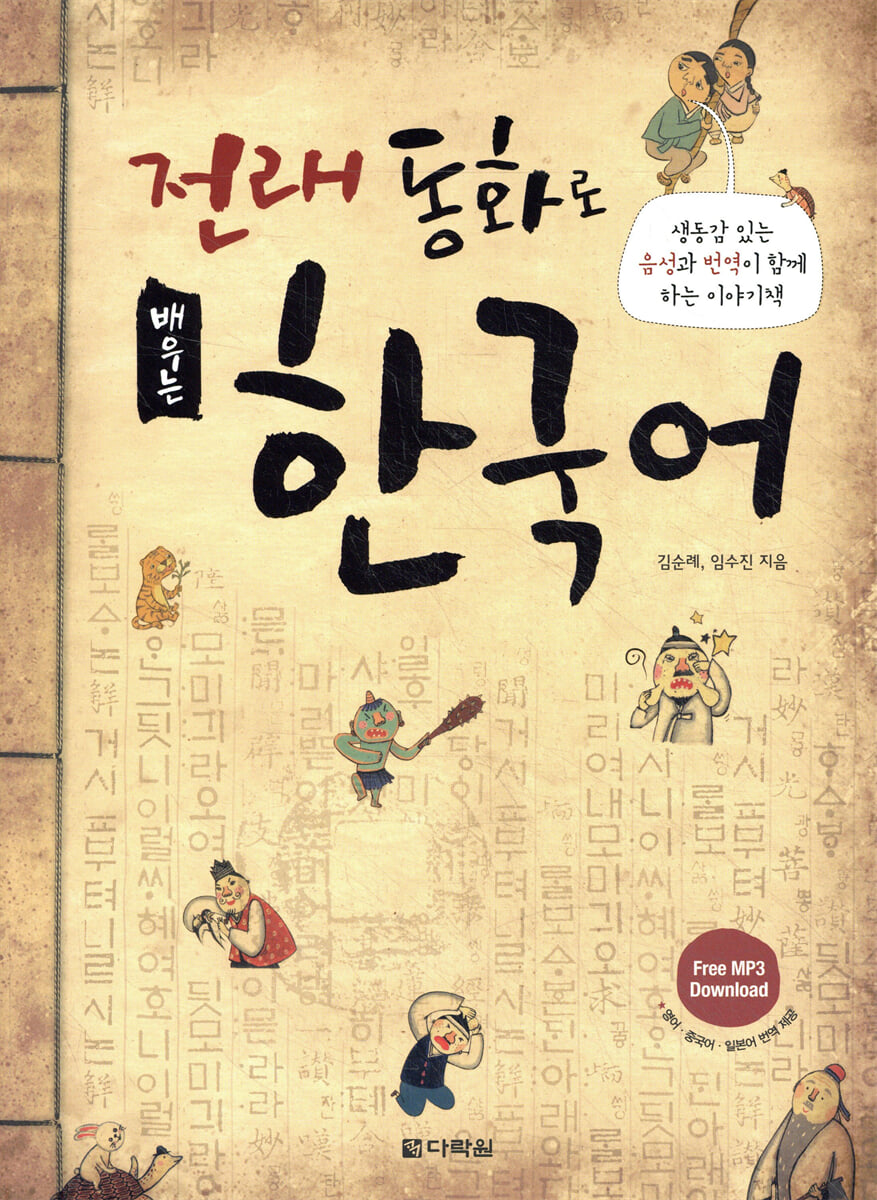
Learning Korean through traditional fairy tales
 |
Description
Book Introduction
A new reading resource with fun illustrations, vibrant voices, and translations! 'Learning Korean through Traditional Fairy Tales' is a Korean reading textbook for intermediate level Korean language learners. Learn Korean proverbs, idiomatic expressions, vocabulary, and grammar in a more fun way through traditional fairy tales. Additionally, it aims to improve learners' listening, reading, writing, and speaking skills through vivid voices, illustrations, and various activities, and to help them understand Korean people and Korean culture. English, Chinese, and Japanese translations of vocabulary, sentence patterns, and story texts are provided to help learners answer their questions and learn accurately. This book is designed to help learners learn Korean easily and enjoyably by utilizing the characteristics of traditional fairy tales. This book was designed to stimulate interest as a pre-reading activity, as reading long passages can be burdensome for learners who are accustomed to short passages. That is, before reading, look at the illustrations and talk about them, and listen to the content. This will help you learn the vocabulary and expressions needed for the reading process. Post-reading activities include turning the story into a dialogue and acting it out, or retelling the ending. This will help you increase your interest in reading and build your confidence in listening and speaking. |
index
preface
Note
Syllabus
time
A moral and entertaining story
Lesson 1: The Story of the Frog
2nd and 3rd year pass
Lesson 3: The Lazy Man Who Became a Cow
Lesson 4: Strange Spring
A mysterious and fantastic story
Lesson 5: The Hunchbacked Old Man
Lesson 6: The Story of Dangun
Lesson 7: Gold Axe and Silver Axe
Lesson 8 Sun and Moon
Lesson 9: The Fairy and the Woodcutter
Classic Korean novels
Lesson 10 Kongjwi and Patjwi
Lesson 11 Heungbu and Nolbu
Lesson 12: The Filial Daughter Simcheong (Simcheongjeon)
Lesson 13: Rabbit's Liver (Byeoljubujeon)
Lesson 14 Chunhyangjeon
Lesson 15 The Tale of Hong Gildong
supplement
★ Model Answer
★ Vocabulary Index
★ Play script
Special Appendix (Translation)
★ Learn sentence patterns and expressions
★ Reading with thought
Table of Contents
Preface
Explanatory Notes
Syllabus
Contents Index
Instructive, Interesting Stories
Chapter 1 The Story of the Green Frog
Chapter 2 Three-Year Hill
Chapter 3 The Lazybones Who Became a Cow
Chapter 4 The Strange Spring Water
Mysterious, Fantastical Stories
Chapter 5 The Lumpy Old Man
Chapter 6: The Story of Dangun
Chapter 7 The Golden Ax and the Silver Ax
Chapter 8 The Sun and the Moon
Chapter 9 The Fairy and the Woodcutter
Korean Classical Novels
Chapter 10 Kongji and Patji
Chapter 11 Heungbu and Nolbu
Chapter 12 Dutiful Daughter Shim Cheong
Chapter 13 The Rabbit's Liver
Chapter 14 The Story of Chunhyang
Chapter 15 The Story of Hong Gildong
Appendix
Answer Key
Vocabulary Index
Skit Scripts
Separate Appendix (Translations)
Grammar and Expression Practice
Reading to Comprehend
Note
Syllabus
time
A moral and entertaining story
Lesson 1: The Story of the Frog
2nd and 3rd year pass
Lesson 3: The Lazy Man Who Became a Cow
Lesson 4: Strange Spring
A mysterious and fantastic story
Lesson 5: The Hunchbacked Old Man
Lesson 6: The Story of Dangun
Lesson 7: Gold Axe and Silver Axe
Lesson 8 Sun and Moon
Lesson 9: The Fairy and the Woodcutter
Classic Korean novels
Lesson 10 Kongjwi and Patjwi
Lesson 11 Heungbu and Nolbu
Lesson 12: The Filial Daughter Simcheong (Simcheongjeon)
Lesson 13: Rabbit's Liver (Byeoljubujeon)
Lesson 14 Chunhyangjeon
Lesson 15 The Tale of Hong Gildong
supplement
★ Model Answer
★ Vocabulary Index
★ Play script
Special Appendix (Translation)
★ Learn sentence patterns and expressions
★ Reading with thought
Table of Contents
Preface
Explanatory Notes
Syllabus
Contents Index
Instructive, Interesting Stories
Chapter 1 The Story of the Green Frog
Chapter 2 Three-Year Hill
Chapter 3 The Lazybones Who Became a Cow
Chapter 4 The Strange Spring Water
Mysterious, Fantastical Stories
Chapter 5 The Lumpy Old Man
Chapter 6: The Story of Dangun
Chapter 7 The Golden Ax and the Silver Ax
Chapter 8 The Sun and the Moon
Chapter 9 The Fairy and the Woodcutter
Korean Classical Novels
Chapter 10 Kongji and Patji
Chapter 11 Heungbu and Nolbu
Chapter 12 Dutiful Daughter Shim Cheong
Chapter 13 The Rabbit's Liver
Chapter 14 The Story of Chunhyang
Chapter 15 The Story of Hong Gildong
Appendix
Answer Key
Vocabulary Index
Skit Scripts
Separate Appendix (Translations)
Grammar and Expression Practice
Reading to Comprehend
Publisher's Review
Storybook with vivid voice and translation
- By naturally learning vocabulary and expressions related to the situations and characters in the pictures while looking at the pictures, and by imagining how the text will unfold, we encouraged active learning.
- While listening to the text in a lively voice, students were asked to arrange the randomly mixed pictures of 'Imagine a Story' in order and then compose a story.
In this process, you can naturally learn new vocabulary and expressions.
- You can read the traditional fairy tale text written for intermediate learners and check the contents you guessed before reading.
- By reading the text, checking the meaning and usage of grammar inferred from the context, and creating sentences, you can use grammar accurately.
- By looking at the pictures arranged in the order of the traditional fairy tale story, students can practice changing the sentences in the text's written language into spoken language and then decorate it with a role play.
- From the learner's perspective, the content of traditional fairy tales was expanded and transformed, and active speaking was enabled through cultural comparison.
- It is designed to relieve the stress of learning by arranging it in a fun format, such as proverbs, quizzes, songs, games, and puzzles related to the material or topic of the text.
- The vocabulary translations in this book help students resolve their questions about the vocabulary they guessed, and the appendix in this book provides English-Chinese-Japanese translations that accurately reflect the content, allowing students to accurately confirm their understanding.
The Characteristics of this Book
This book utilizes the characteristics of traditional fairy tales to allow readers to learn Korean in an interesting and easy manner.
For those who are used to reading shorter texts, we have included pre-reading activities to arouse interest in the subject matter.
Specifically, illustrations for discussion are provided before entering the main text content.
Through such activities, readers can become acquainted with the vocabulary and expressions necessary for reading the main text.
Then, after reading the text, post-reading activities are provided for reenacting the storylines through role-play and conversation, and also for acting out different possible endings to the fairy tales.
Such activities serve not only to reinforce the joy of reading, but also foster increased confidence in listening and speaking.
- Motivates active study of the content by providing illustrations to familiarize readers with the main situations, characters, vocabulary, and expressions related to the fairy tales, and then having them imagine how the story will turn out.
- While listening to lifelike audio recordings of the main texts, readers must first take a set of randomly ordered illustrations and put them in the correct chronological order to make a coherent story.
Through this process, readers become easily familiarized with new vocabulary and expressions.
- Intermediate level readers can directly confirm whether their ideas constructed about the story content during the pre-reading activities when they read the main fairy tale texts.
- After reading the main texts and confirming the meaning of the related grammar points and their usage, readers can write their own sentences using the new grammar correctly.
- After the illustrations describing the content have been placed in the correct order in accordance with the fairy tale plots, readers can practice summarizing the written Korean content using spoken Korean forms, and then extend the exercise by directly acting out the plot events through role plays.
- Readers can actively practice conversation by further modifying and expanding on the content of the traditional fairy tales through cultural comparisons based on their own personal perspectives and experiences.
- The inclusion of a variety of interesting content formats, such as proverbs, quizzes, songs, games, and puzzles lets readers feel less intimidated by the main text content of the fairy tales.
- To help satisfy the curiosity of wanting to find out the meaning of many of the words and phrases in the main text, we provide a separately bound appendix containing English, Chinese, and Japanese translations for all of the important vocabulary, grammar expressions, and full main texts so that readers can more clearly comprehend what they have read.
- By naturally learning vocabulary and expressions related to the situations and characters in the pictures while looking at the pictures, and by imagining how the text will unfold, we encouraged active learning.
- While listening to the text in a lively voice, students were asked to arrange the randomly mixed pictures of 'Imagine a Story' in order and then compose a story.
In this process, you can naturally learn new vocabulary and expressions.
- You can read the traditional fairy tale text written for intermediate learners and check the contents you guessed before reading.
- By reading the text, checking the meaning and usage of grammar inferred from the context, and creating sentences, you can use grammar accurately.
- By looking at the pictures arranged in the order of the traditional fairy tale story, students can practice changing the sentences in the text's written language into spoken language and then decorate it with a role play.
- From the learner's perspective, the content of traditional fairy tales was expanded and transformed, and active speaking was enabled through cultural comparison.
- It is designed to relieve the stress of learning by arranging it in a fun format, such as proverbs, quizzes, songs, games, and puzzles related to the material or topic of the text.
- The vocabulary translations in this book help students resolve their questions about the vocabulary they guessed, and the appendix in this book provides English-Chinese-Japanese translations that accurately reflect the content, allowing students to accurately confirm their understanding.
The Characteristics of this Book
This book utilizes the characteristics of traditional fairy tales to allow readers to learn Korean in an interesting and easy manner.
For those who are used to reading shorter texts, we have included pre-reading activities to arouse interest in the subject matter.
Specifically, illustrations for discussion are provided before entering the main text content.
Through such activities, readers can become acquainted with the vocabulary and expressions necessary for reading the main text.
Then, after reading the text, post-reading activities are provided for reenacting the storylines through role-play and conversation, and also for acting out different possible endings to the fairy tales.
Such activities serve not only to reinforce the joy of reading, but also foster increased confidence in listening and speaking.
- Motivates active study of the content by providing illustrations to familiarize readers with the main situations, characters, vocabulary, and expressions related to the fairy tales, and then having them imagine how the story will turn out.
- While listening to lifelike audio recordings of the main texts, readers must first take a set of randomly ordered illustrations and put them in the correct chronological order to make a coherent story.
Through this process, readers become easily familiarized with new vocabulary and expressions.
- Intermediate level readers can directly confirm whether their ideas constructed about the story content during the pre-reading activities when they read the main fairy tale texts.
- After reading the main texts and confirming the meaning of the related grammar points and their usage, readers can write their own sentences using the new grammar correctly.
- After the illustrations describing the content have been placed in the correct order in accordance with the fairy tale plots, readers can practice summarizing the written Korean content using spoken Korean forms, and then extend the exercise by directly acting out the plot events through role plays.
- Readers can actively practice conversation by further modifying and expanding on the content of the traditional fairy tales through cultural comparisons based on their own personal perspectives and experiences.
- The inclusion of a variety of interesting content formats, such as proverbs, quizzes, songs, games, and puzzles lets readers feel less intimidated by the main text content of the fairy tales.
- To help satisfy the curiosity of wanting to find out the meaning of many of the words and phrases in the main text, we provide a separately bound appendix containing English, Chinese, and Japanese translations for all of the important vocabulary, grammar expressions, and full main texts so that readers can more clearly comprehend what they have read.
GOODS SPECIFICS
- Publication date: November 28, 2012
- Page count, weight, size: 280 pages | 658g | 188*254*20mm
- ISBN13: 9788927730989
- ISBN10: 8927730984
You may also like
카테고리
korean


korean

![ELLE 엘르 스페셜 에디션 A형 : 12월 [2025]](http://librairie.coreenne.fr/cdn/shop/files/b8e27a3de6c9538896439686c6b0e8fb.jpg?v=1766436872&width=3840)


