

Oh my god
 |
Description
Book Introduction
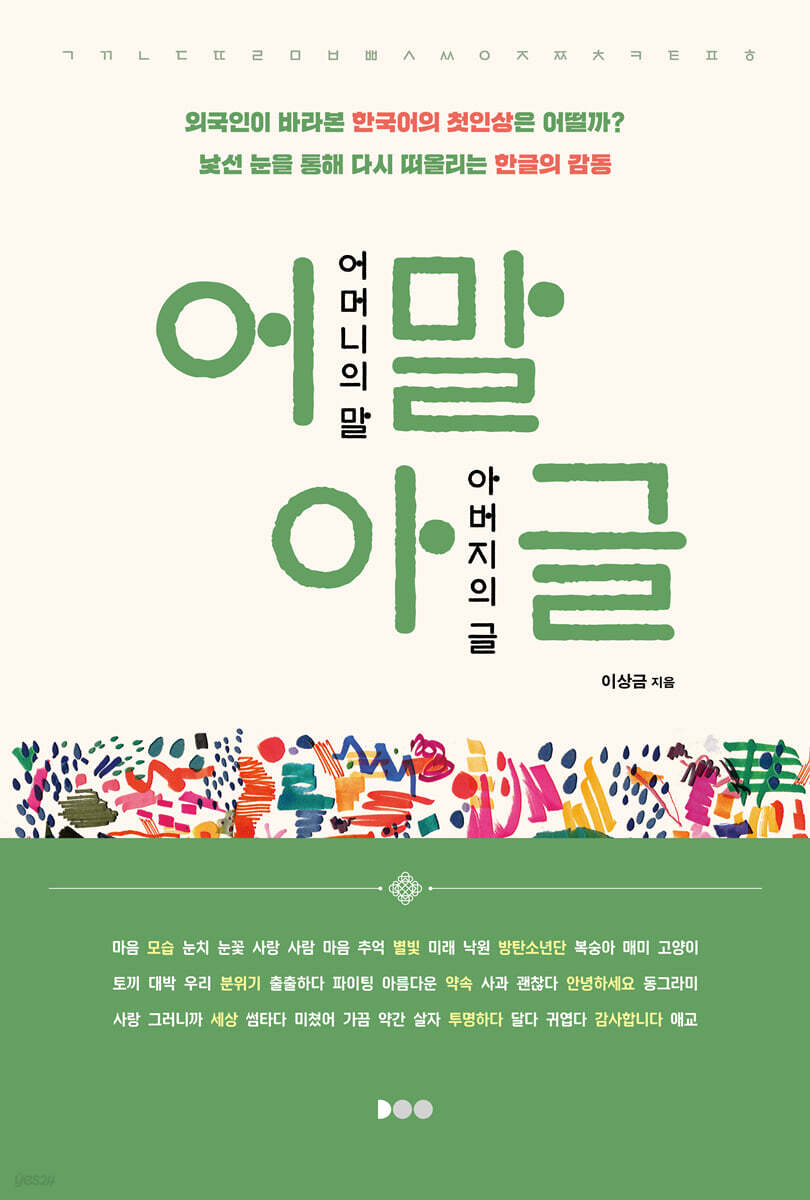
What is the first impression of the Korean language from a foreigner's perspective?
The emotion of Hangul revisited through unfamiliar eyes
The world's love for the Korean language is growing day by day.
The Oxford English Dictionary even introduces English words that originated from Korean separately.
The special treatment focusing on 26 keywords including 'daebak' is truly a 'jackpot'.
Thanks to the Korean Wave, Korean culture has rapidly spread throughout the world and has even become a center of the English-speaking world.
We live in an era where the status of the Korean language is rising and countless foreigners are becoming interested in our language and actively trying to learn it.
But do we really understand our native language?
Aren't you just superficially pleased with the idea that Hangul is great and the Korean Wave is a trend?
Because our native language is so familiar, an outside perspective is essential to view it objectively.
In other words, if we look into how learners from other cultures perceive the Korean language, we too will be able to rediscover the emotion of language that we had long forgotten.
The title of the book, ‘Eomal-a-geul’, is an abbreviation of ‘Mother’s Words’ and ‘Father’s Writings’, and signifies the roots and first impressions of language that are embodied in childhood.
Just as children naturally inherit linguistic knowledge from their parents and sometimes parents are surprised by their child's linguistic prowess, this book focuses on the concerns of teachers who want to teach Korean to foreigners and the reactions of learners who are trying to learn Hangul for the first time.
This work is unique in that it delves deeply into the first impressions foreigners have of the Korean language and the Korean alphabet.
The emotion of Hangul revisited through unfamiliar eyes
The world's love for the Korean language is growing day by day.
The Oxford English Dictionary even introduces English words that originated from Korean separately.
The special treatment focusing on 26 keywords including 'daebak' is truly a 'jackpot'.
Thanks to the Korean Wave, Korean culture has rapidly spread throughout the world and has even become a center of the English-speaking world.
We live in an era where the status of the Korean language is rising and countless foreigners are becoming interested in our language and actively trying to learn it.
But do we really understand our native language?
Aren't you just superficially pleased with the idea that Hangul is great and the Korean Wave is a trend?
Because our native language is so familiar, an outside perspective is essential to view it objectively.
In other words, if we look into how learners from other cultures perceive the Korean language, we too will be able to rediscover the emotion of language that we had long forgotten.
The title of the book, ‘Eomal-a-geul’, is an abbreviation of ‘Mother’s Words’ and ‘Father’s Writings’, and signifies the roots and first impressions of language that are embodied in childhood.
Just as children naturally inherit linguistic knowledge from their parents and sometimes parents are surprised by their child's linguistic prowess, this book focuses on the concerns of teachers who want to teach Korean to foreigners and the reactions of learners who are trying to learn Hangul for the first time.
This work is unique in that it delves deeply into the first impressions foreigners have of the Korean language and the Korean alphabet.
- You can preview some of the book's contents.
Preview
index
As we begin
Why publish a book like this?
Classification and arrangement of data
Part 1: The Evolution of Hangul and the Oxford English Dictionary
Part 2 What is the most beautiful Korean alphabet?
Part 3: The Potential of Hangul and Countermeasures
Part 4: Korean and the Standard Korean Dictionary of the OED
In closing
References and Websites
Why publish a book like this?
Classification and arrangement of data
Part 1: The Evolution of Hangul and the Oxford English Dictionary
Part 2 What is the most beautiful Korean alphabet?
Part 3: The Potential of Hangul and Countermeasures
Part 4: Korean and the Standard Korean Dictionary of the OED
In closing
References and Websites
Publisher's Review
Eyes, heart, future, starlight, us, one…
Another possibility of Hangul sprouting with pure eyes
Learners from other cultures who are new to Korean are often surprised by the unique connotations of our language.
For example, the word 'nunchi' is so deeply ingrained in Korean culture that it cannot be accurately translated into other languages.
The same goes for words like 'one'.
Also, in Western civilizations where individualism is strong, people say 'my country' and not 'our country'.
Even words like 'starlight' are unfamiliar concepts, so most people first encounter them through Yun Dong-ju's poetry when learning Korean.
Those pure eyes are another possibility of Hangul and the Korean language.
It is clear that the shallow boasting about Hangul being the best among all writing systems or the Korean language craze, also known as “nationalism,” has limitations in further elevating the value and status of Hangul and the Korean language.
For the beauty of our language to be realistic and universally persuasive, we must transparently accept the perspectives and interests of the world and cultivate the awareness to see things anew through their eyes.
Hangul Today, Hangul's Future
A must-read for educators teaching Korean abroad
Author Lee Sang-geum has been teaching East Asian culture and Korean literature at the Department of Asian Studies at the University of Latvia since the spring semester of 2018, and has observed that students' interest in Korean is much greater than that in Japanese or Chinese.
Korean was also the most popular major chosen each year.
When I looked into that heat, I saw culture.
As Korea's corporate and cultural influence spreads across the globe, it has awakened a passion for challenging the unfamiliar Korean language.
The author has tried to weave into the book the virtuous cycle of education, which begins with curiosity about K-culture and then leads to interest in the pronunciation and appearance of the Korean language.
In particular, Part 2, “What is the most beautiful Korean language?” contains the impressions of the Korean language written by a Latvian university student without any modifications.
The sentences are awkward, but that is why the students' impressions and admiration are pure.
The author's clear philosophy of re-examining our language through the eyes of a true reader, without any distortion, is reflected in this book.
Another possibility of Hangul sprouting with pure eyes
Learners from other cultures who are new to Korean are often surprised by the unique connotations of our language.
For example, the word 'nunchi' is so deeply ingrained in Korean culture that it cannot be accurately translated into other languages.
The same goes for words like 'one'.
Also, in Western civilizations where individualism is strong, people say 'my country' and not 'our country'.
Even words like 'starlight' are unfamiliar concepts, so most people first encounter them through Yun Dong-ju's poetry when learning Korean.
Those pure eyes are another possibility of Hangul and the Korean language.
It is clear that the shallow boasting about Hangul being the best among all writing systems or the Korean language craze, also known as “nationalism,” has limitations in further elevating the value and status of Hangul and the Korean language.
For the beauty of our language to be realistic and universally persuasive, we must transparently accept the perspectives and interests of the world and cultivate the awareness to see things anew through their eyes.
Hangul Today, Hangul's Future
A must-read for educators teaching Korean abroad
Author Lee Sang-geum has been teaching East Asian culture and Korean literature at the Department of Asian Studies at the University of Latvia since the spring semester of 2018, and has observed that students' interest in Korean is much greater than that in Japanese or Chinese.
Korean was also the most popular major chosen each year.
When I looked into that heat, I saw culture.
As Korea's corporate and cultural influence spreads across the globe, it has awakened a passion for challenging the unfamiliar Korean language.
The author has tried to weave into the book the virtuous cycle of education, which begins with curiosity about K-culture and then leads to interest in the pronunciation and appearance of the Korean language.
In particular, Part 2, “What is the most beautiful Korean language?” contains the impressions of the Korean language written by a Latvian university student without any modifications.
The sentences are awkward, but that is why the students' impressions and admiration are pure.
The author's clear philosophy of re-examining our language through the eyes of a true reader, without any distortion, is reflected in this book.
GOODS SPECIFICS
- Date of issue: November 6, 2024
- Page count, weight, size: 224 pages | 424g | 152*225*15mm
- ISBN13: 9791191694260
- ISBN10: 1191694267
You may also like
카테고리
korean


korean

![ELLE 엘르 스페셜 에디션 A형 : 12월 [2025]](http://librairie.coreenne.fr/cdn/shop/files/b8e27a3de6c9538896439686c6b0e8fb.jpg?v=1766436872&width=3840)


