

 |
Book Introduction
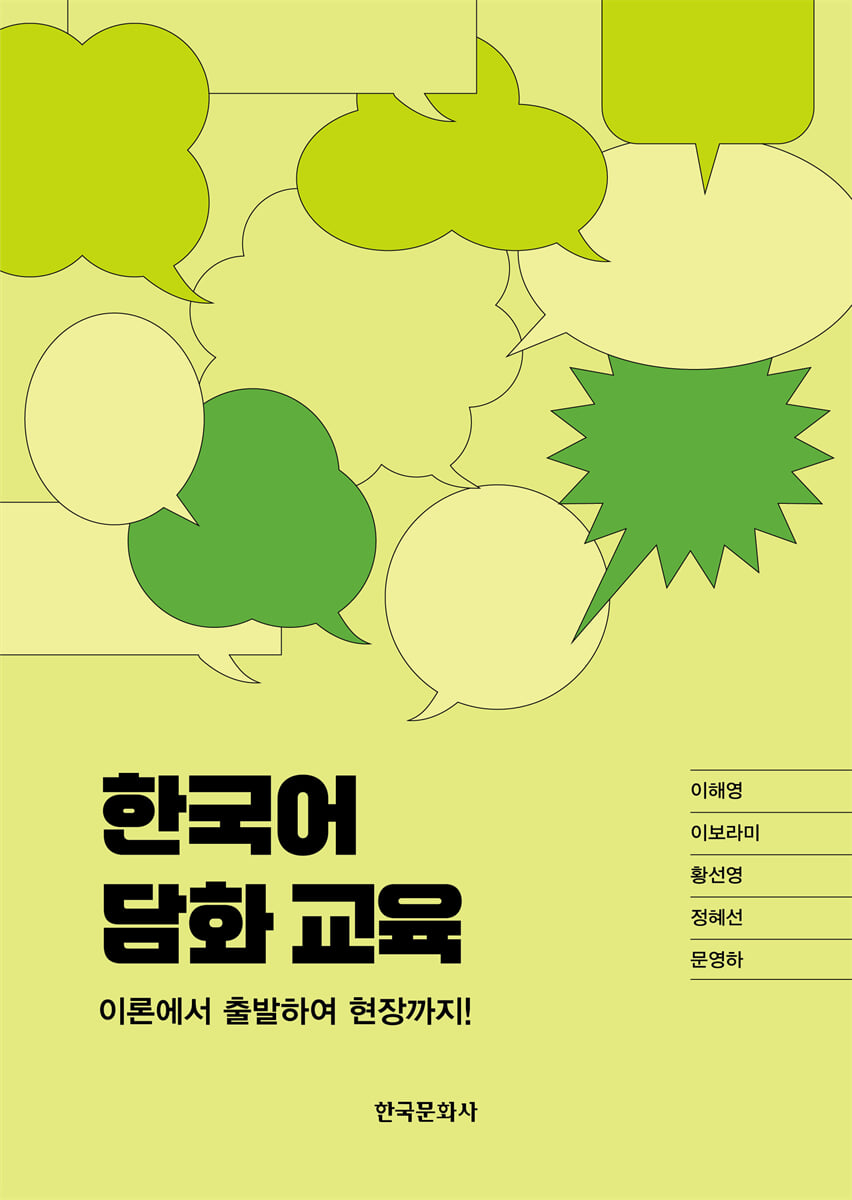
Beginning with an examination of how grammar, vocabulary, and prosody function in actual communication, this course covers Korean discourse from a cross-cultural perspective, examining the differences between spoken and written language, genres, and styles.
To ensure applicability in Korean language education settings, each chapter ends with a section titled "Application to Korean Language Education." Furthermore, the final chapter of the book summarizes the academic background of discourse studies to serve as a guide for readers seeking in-depth study.
- You can preview some of the book's contents.
Preview
index
Chapter 1: Entering the World of Conversation in the Korean Language Classroom
Clues to solving the problem found in the conversation
1.1.
Beyond sentences, into discourse!
1.2.
Discourse as viewed by researchers
1.3.
Discourse Education in Korean Classrooms
Chapter 2: Cohesion and Cohesion in Korean Language Education
Teamwork that creates cohesion and cohesion, discourse and text.
2.1.
Words and writing, what's in them!
2.2.
That's textuality
2.3.
Learner's speech and writing
2.4.
Strong bond in discourse
2.5.
Applying it to Korean language education
Chapter 3: The Function and Teaching of Grammar in Discourse
Let's solve Korean grammar problems that cannot be solved within a sentence at the discourse level!
3.1.
Why we care about grammar in conversation
3.2.
Masters of Cohesion, Grammatical Devices
3.3.
Applying it to Korean language education
Chapter 4: The Function and Education of Vocabulary in Discourse
Discover new aspects of vocabulary active in Korean conversation.
4.1.
Why we care about vocabulary in conversation
4.2.
Make conversation conversation! Vocabulary that functions as a coagulant.
4.3.
Signals sent by vocabulary: A guide to understanding discourse
4.4.
Differences in vocabulary density between spoken and written language
4.5.
Applying it to Korean language education
Chapter 5: The Function and Education of Prosody in Discourse
Let's pay attention to the prosodic phenomena that function in Korean discourse!
5.1.
Why we care about prosody in discourse
5.2.
Discourse as Discourse! The Discursive Function of Prosody
5.3.
Applying it to Korean language education
Chapter 6: Korean Discourse Markers and Fluency Education
Make Korean more delicious and savory
6.1.
The completion of the discourse is achieved by using discourse markers.
6.2.
Discovery of discourse markers
6.3.
Discourse marker use and fluency
6.4.
Applying it to Korean language education
Chapter 7: Korean Spoken Discourse and Spoken Language Learning
If you know the spoken language, you can see it! The art of vivid speaking!
7.1.
Real colloquialism? Fake colloquialism?
7.2.
Learner's concerns, spoken language
7.3.
Characteristics and Types of Korean Spoken Discourse
7.4.
Applying it to Korean language education
Chapter 8: Learning Korean Text and Written Language
Knowing the characteristics of octopus makes writing and reading a breeze!
8.1.
Writing that feels like writing, writing that doesn't feel like writing
8.2.
Learner's Concerns: Writing
8.3.
Characteristics and types of Korean text
8.4.
Applying it to Korean language education
Chapter 9: Structure and Teaching of Korean Discourse
Up to larger types of discourse structures
9.1.
Discourse Structure, the Beginning of Communication
9.2.
Information deployment, the beginning of topic development
9.3.
Larger types of information placement
9.4.
Interaction structure of conversation
9.5.
Fluent speaking, narrative structure
9.6.
Applying it to Korean language education
Chapter 10: Genres, Styles, and Education of Korean Discourse
Beyond the distinction between spoken and written language
10.1.
The various forms of discourse and text
10.2.
Genre and Language
10.3.
Stylistic and frame shifts
10.4.
Applying it to Korean language education
Chapter 11: Korean Discourse Education and Culture
Culture is also evident in the way discourse is structured!
11.1.
Culture in conversation!
11.2.
Differences in discourse structure brought about by cultural differences
11.3.
Applying it to Korean language education
Chapter 12: The Deep and Wide World of Conversation: The Beginning and the End
Before delving into discourse education, let's look back at various academic discourses.
12.1.
The Importance of Looking Back
12.2.
A culmination of discourse exploration, but an unfinished story
12.3.
To the Korean classroom!
References
Search
Publisher's Review
Even after 25 years of teaching foreign students and training professors, I am sometimes amazed when I see foreigners using the flavorful Korean expressions and writing and conversing with subtle nuances.
Korean language classes are changing as more and more learners seek to grow beyond simple Korean Wave consumption and become future experts on Korea.
To communicate successfully, you need to know pronunciation, intonation, vocabulary, and grammar, but you also need to understand the underlying meaning and the sociocultural information contained in the Korean language.
Additionally, in order to make the other person understand and accurately convey your intentions, you must be able to use logical and persuasive speech and writing.
Since taking up a position at Ewha Womans University in 2000, one of the topics I have researched and lectured on the longest while guiding Korean language education students has been 'Korean discourse education'. This topic is receiving even more attention these days as learning needs change.
However, there was no textbook that analyzed Korean discourse in actual lectures and provided insights that could be applied to Korean language education.
Ultimately, I had no choice but to proceed with the lecture by referring to books from other language education fields and applying them to Korean language education.
Accordingly, with the help of my fellow professors, I recorded and organized three years of lectures and planned a book titled 'Reading Professor Lee Hae-young's Lectures'.
I wrote this book with students who wrote papers while taking my lecture classes, and I also recorded and reflected the actual lectures to capture the vividness of the lectures.
I am excited by the prospect that this will allow me to discuss Korean discourse analysis and educational application methods with overseas researchers outside the classroom.
However, the plan was put on hold for a while while serving as the chairman of the Sejong Institute Foundation for three years.
Although it was an unexpected interruption, it actually provided an opportunity for deeper reflection and to reflect on the latest research trends.
Of course, as the preparation period has lengthened, there are some parts that have changed from the initial concept, and there are still concerns about whether the overall flow of the discourse is being conveyed well through the multiple revisions.
Writing this book gave me the opportunity to delve deeper into what makes a discourse truly discourse and how it can be applied in Korean language classrooms.
Language is more than just a tool for communication; it is a gateway to understanding, connection, and cultural enrichment.
This richness is especially enhanced when we deeply understand the discourse.
This book is designed to provide practical assistance in discourse research and teaching.
Beginning with an examination of how grammar, vocabulary, and prosody function in actual communication, this course covers Korean discourse from a cross-cultural perspective, examining the differences between spoken and written language, genres, and styles.
To ensure applicability in Korean language education settings, each chapter ends with a section titled "Application to Korean Language Education." Furthermore, the final chapter of the book summarizes the academic background of discourse studies to serve as a guide for readers seeking in-depth study.
What does it mean to teach Korean? Having met countless foreigners and taught them Korean, I've realized that they've begun to dream of their future through the language.
In particular, during the past three years as the Chairman of the Sejong Institute Foundation, I have been able to see many learners from around the world and realize their dreams even more clearly.
Learning vivid Korean will be a strong companion for learners as they move toward their dreams.
Perhaps the authors of this book became interested in 'discourse' because of their desire to convey the living Korean language and the language that embodies the hearts of Koreans.
Readers who pick up this book will also have a dream of helping learners express themselves effectively in a variety of situations, beyond complex grammar and a rich vocabulary.
I hope that this book will serve as valuable nourishment for Korean language education and discourse analysis research for readers with such intentions.
Lead author
Lee Hae-young
You may also like
카테고리

korean

![GQ KOREA Mark (Monthly): December [2025]](http://librairie.coreenne.fr/cdn/shop/files/8ef265dbbfbf186523ed75ba7319009d.jpg?v=1765340328&width=3840)


