

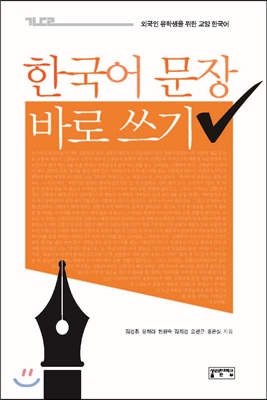
Write Korean sentences correctly
 |
Description
Book Introduction
This book is designed to help international students develop the ability to accurately express their thoughts in Korean.
Many international students, despite their intellectual abilities, lack the grammatical knowledge of Korean and are unable to accurately express their thoughts to their professors or classmates.
Therefore, international students need the ability to accurately express their thoughts in Korean.
This textbook focuses on systematically learning Korean grammar and practicing finding and correcting sentence errors on one's own to help international students develop these skills.
Many international students, despite their intellectual abilities, lack the grammatical knowledge of Korean and are unable to accurately express their thoughts to their professors or classmates.
Therefore, international students need the ability to accurately express their thoughts in Korean.
This textbook focuses on systematically learning Korean grammar and practicing finding and correcting sentence errors on one's own to help international students develop these skills.
index
preface
Note
Lesson 1: To whom do you express it?
Lesson 2: What is the situation?
Lesson 3 Are the sentence elements used correctly? (1)
Lesson 4 Are the sentence elements used correctly? (2)
Lesson 5: Verb or Adjective (1)
Lesson 6: Verb or Adjective (2)
Lesson 7: Is the use of particles correct? (1)
Lesson 8: Is the use of particles correct? (2)
Lesson 9: Are the quotations used correctly?
Lesson 10: Are the tenses used correctly?
Lesson 11: Are the expressions used correctly?
Lesson 12 Is the spacing correct?
reference
Punctuation marks to watch out for
Verbs to be careful of
Adverbial response
Types of negative sentences
Look up Korean dictionary
Investigations to be cautious about
Frequently used quotation expressions
The suffix '-the-'
Commonly misspelled expressions
supplement
Grammar Terms Explanation
Practice Problem Answers
Note
Lesson 1: To whom do you express it?
Lesson 2: What is the situation?
Lesson 3 Are the sentence elements used correctly? (1)
Lesson 4 Are the sentence elements used correctly? (2)
Lesson 5: Verb or Adjective (1)
Lesson 6: Verb or Adjective (2)
Lesson 7: Is the use of particles correct? (1)
Lesson 8: Is the use of particles correct? (2)
Lesson 9: Are the quotations used correctly?
Lesson 10: Are the tenses used correctly?
Lesson 11: Are the expressions used correctly?
Lesson 12 Is the spacing correct?
reference
Punctuation marks to watch out for
Verbs to be careful of
Adverbial response
Types of negative sentences
Look up Korean dictionary
Investigations to be cautious about
Frequently used quotation expressions
The suffix '-the-'
Commonly misspelled expressions
supplement
Grammar Terms Explanation
Practice Problem Answers
Publisher's Review
In the 'Korean Language Textbook for International Students' series, international students share their thoughts
A guide to help you develop the ability to express yourself accurately in Korean.
As the number of international students at Korean universities has increased recently, interest in their academic abilities has also increased.
There is a big difference in content and level between Korean for general purposes and Korean for academic purposes required at university.
For international students to have a successful college life, basic Korean language skills learned at the Korean Language Institute are not enough for everyday life.
This is because communication that takes place at universities is characterized by being centered on written language in formal situations.
In addition, you need Korean language skills that are sufficient to learn not only general knowledge but also specialized knowledge.
Without these language skills, international students will have difficulty managing their university life.
And above all, developing academic language skills is essential to maximizing your mathematical abilities in college.
Based on this awareness of the problem, Sungkyunkwan University's undergraduate school developed and released a series of 'Korean language textbooks for international students'.
This textbook aims to help international students successfully complete their university studies.
Since the course is structured around the practical skills necessary for academic study along with the Korean communication skills required at university, we believe that both Korean language proficiency and academic ability will naturally improve over the course of study.
This book is designed to help international students develop the ability to accurately express their thoughts in Korean.
Many international students, despite their intellectual abilities, lack the grammatical knowledge of Korean and are unable to accurately express their thoughts to their professors or classmates.
Therefore, international students need the ability to accurately express their thoughts in Korean.
This textbook focuses on systematically learning Korean grammar and practicing finding and correcting sentence errors on one's own to help international students develop these skills.
The examples presented in this textbook are errors that actually appeared in reports, presentations, and discussion papers written by international students.
It is expected that by practicing correcting errors made by other international learners, international students will be able to write more accurately and edit their own writing.
A guide to help you develop the ability to express yourself accurately in Korean.
As the number of international students at Korean universities has increased recently, interest in their academic abilities has also increased.
There is a big difference in content and level between Korean for general purposes and Korean for academic purposes required at university.
For international students to have a successful college life, basic Korean language skills learned at the Korean Language Institute are not enough for everyday life.
This is because communication that takes place at universities is characterized by being centered on written language in formal situations.
In addition, you need Korean language skills that are sufficient to learn not only general knowledge but also specialized knowledge.
Without these language skills, international students will have difficulty managing their university life.
And above all, developing academic language skills is essential to maximizing your mathematical abilities in college.
Based on this awareness of the problem, Sungkyunkwan University's undergraduate school developed and released a series of 'Korean language textbooks for international students'.
This textbook aims to help international students successfully complete their university studies.
Since the course is structured around the practical skills necessary for academic study along with the Korean communication skills required at university, we believe that both Korean language proficiency and academic ability will naturally improve over the course of study.
This book is designed to help international students develop the ability to accurately express their thoughts in Korean.
Many international students, despite their intellectual abilities, lack the grammatical knowledge of Korean and are unable to accurately express their thoughts to their professors or classmates.
Therefore, international students need the ability to accurately express their thoughts in Korean.
This textbook focuses on systematically learning Korean grammar and practicing finding and correcting sentence errors on one's own to help international students develop these skills.
The examples presented in this textbook are errors that actually appeared in reports, presentations, and discussion papers written by international students.
It is expected that by practicing correcting errors made by other international learners, international students will be able to write more accurately and edit their own writing.
GOODS SPECIFICS
- Date of publication: April 29, 2016
- Page count, weight, size: 152 pages | 374g | 173*245*12mm
- ISBN13: 9791155501634
- ISBN10: 1155501632
You may also like
카테고리
korean


korean

![ELLE 엘르 스페셜 에디션 A형 : 12월 [2025]](http://librairie.coreenne.fr/cdn/shop/files/b8e27a3de6c9538896439686c6b0e8fb.jpg?v=1766436872&width=3840)


