

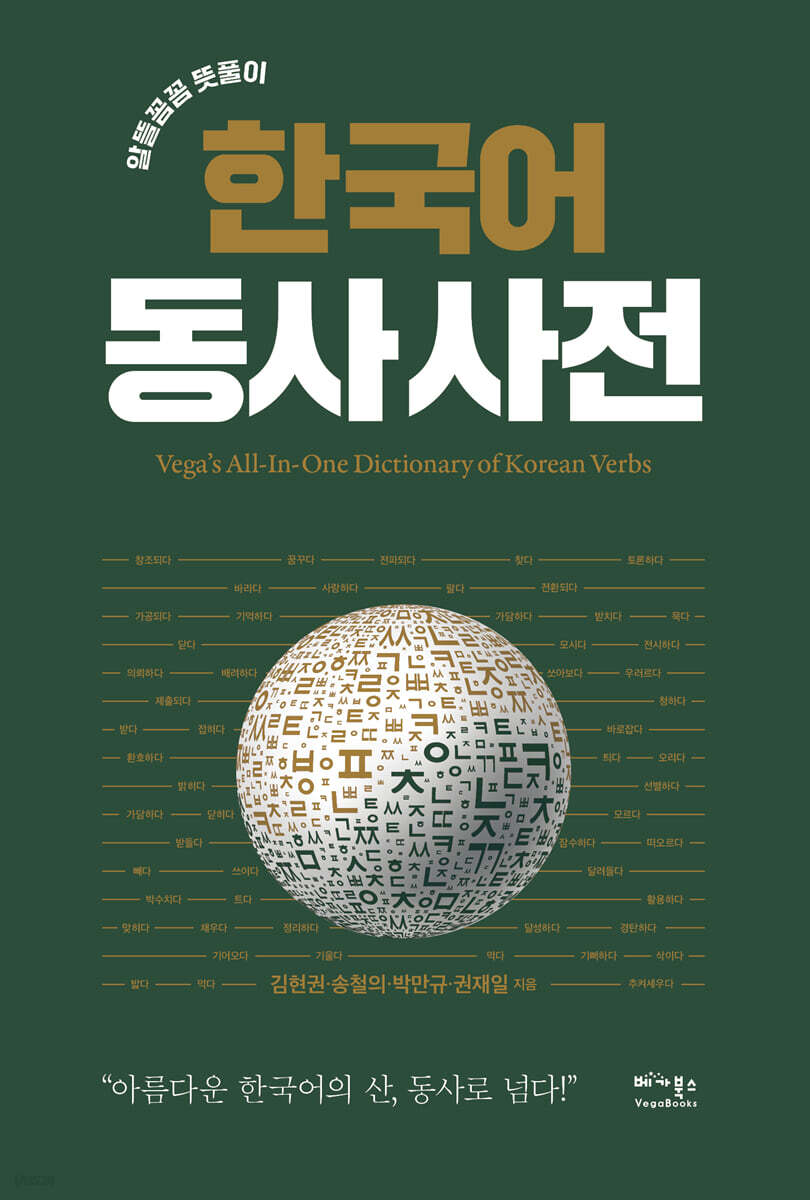
Korean Verb Dictionary
 |
Description
Book Introduction
There are less than 10 countries in the world that have compiled a 'verb phrase dictionary'!
Now, Korea has joined the ranks of countries with a proud 'verb phrase dictionary'!
A sentence is the most basic unit that allows humans to express their thoughts.
But that sentence is made up of a frame modified by a verb.
For example, the sentence 'He gave her a gift' is formed by the verb 'gave' rather than 'he', 'she', or 'gift'.
Because the moment ‘give’ is given, ‘who’, ‘to whom’, and ‘what’ become necessary.
So, verbs are the framework of our thinking.
Since verbs have such a privileged position compared to other parts of speech, it is natural that we make efforts to gain more knowledge about them._From the introduction
Now, Korea has joined the ranks of countries with a proud 'verb phrase dictionary'!
A sentence is the most basic unit that allows humans to express their thoughts.
But that sentence is made up of a frame modified by a verb.
For example, the sentence 'He gave her a gift' is formed by the verb 'gave' rather than 'he', 'she', or 'gift'.
Because the moment ‘give’ is given, ‘who’, ‘to whom’, and ‘what’ become necessary.
So, verbs are the framework of our thinking.
Since verbs have such a privileged position compared to other parts of speech, it is natural that we make efforts to gain more knowledge about them._From the introduction
- You can preview some of the book's contents.
Preview
index
A ~ H
Detailed image
.jpg)
Into the book
“It was compiled based on the data of approximately 5,000 verbs built up in the “Modern Korean Verb Phrase Dictionary” research project, a foundational research support project in the field of Korean studies at the Academy of Korean Studies from 2012 to 2015.
The result of this research project is in the form of an electronic dictionary. Unfortunately, it is not easy for the general public to access this electronic dictionary, so this dictionary is a revision and supplement to the paper dictionary format.
“Simply switching systems was quite challenging, but it took a full three years to correct errors, including minor ones, supplement the content, and especially refine the examples to make them simpler and more natural.”
“This dictionary is a systematic analysis and description of grammatical and semantic information for 5,472 Korean verbs, compiled so that the linguistic information can be utilized for various purposes.
The purpose of compiling this book was to be utilized by Korean language researchers, as well as Korean language learners and Korean language educators both domestically and internationally.
And this dictionary was compiled based on the theory of vocabulary, including the theory of lexical grammar and semantic-text correspondence, so it is comparable to any verb grammar dictionary in any language in the world, and we are proud to say that it is of the highest level in terms of the number of entries and presentation of linguistic information.”
The result of this research project is in the form of an electronic dictionary. Unfortunately, it is not easy for the general public to access this electronic dictionary, so this dictionary is a revision and supplement to the paper dictionary format.
“Simply switching systems was quite challenging, but it took a full three years to correct errors, including minor ones, supplement the content, and especially refine the examples to make them simpler and more natural.”
“This dictionary is a systematic analysis and description of grammatical and semantic information for 5,472 Korean verbs, compiled so that the linguistic information can be utilized for various purposes.
The purpose of compiling this book was to be utilized by Korean language researchers, as well as Korean language learners and Korean language educators both domestically and internationally.
And this dictionary was compiled based on the theory of vocabulary, including the theory of lexical grammar and semantic-text correspondence, so it is comparable to any verb grammar dictionary in any language in the world, and we are proud to say that it is of the highest level in terms of the number of entries and presentation of linguistic information.”
--- From the "Preface"
Publisher's Review
The efforts of four leading linguists in Korea,
Finally seeing the fruits of 7 years of hard work!
Former 8th Director of the National Institute of the Korean Language and President of the Korean Language Society
The Korean language craze will continue as long as it is supported by cultural and economic influence.
Before this, we ourselves must first be able to write Korean correctly. _ Professor Kwon Jae-il
10th Director of the National Institute of the Korean Language and President of the Korean Language Society
The use of correct language is an issue that concerns our entire society.
I am working hard to cultivate our language into a dignified language. _Professor Song Cheol
Served as the 9th President of the Korean Dictionary Society and a member of the National Language Deliberation Council
We are working to efficiently provide the language information needed for artificial intelligence in the Fourth Industrial Revolution.
Professor Park Man-gyu
President of the Korean Linguistic Society
I hope this dictionary will serve as an excellent guide for linguists and learners studying Korean, contributing significantly to raising the level of Korean language research and education. _Professor Kim Hyun-kwon
The first Korean dictionary of verb phrases, complete with definitions, has been published!
5,472 carefully selected verbs - Korean verbs, so rich and diverse!
(1) The concept of ‘verb phrase dictionary’
* A sentence is the most basic unit that allows humans to express their thoughts.
The sentence is made up of a frame modified by a verb.
The 'Verb Phrase Dictionary' is an unprecedented dictionary that provides a complete 'interpretation' of the meanings of verbs, the backbone of the Korean language, along with specific examples of how they change and are applied.
(2) What meaning is contained in this ‘verb phrase dictionary’?
* There are countless languages on Earth, but there are less than 10 languages that have a 'verb phrase dictionary', including English, German, French, and Japanese.
First of all, it is difficult to collect verbs in the first place, and the usage of verbs itself must be scientific and regular.
* In the case of Korean, a very small-scale verb phrase dictionary appeared for a short time a long time ago, but then disappeared without any attention.
Therefore, this dictionary, which was created through the hard work, dedication, and sincerity of four linguists over six years, can be said to be Korea's first full-fledged 'verb phrase dictionary.'
* Thanks to this dictionary, Korea has finally joined the ranks of the few linguistically advanced countries that have a proper 'verb phrase dictionary'.
Not only that, but based on the theory of vocabulary, including the theory of lexical grammar and semantic-text correspondence, it is comparable to any verb grammar dictionary in any language in the world, and can even boast of being the world's best in terms of the number of headwords and the level of microstructural information.
(3) What are the main features of the ‘Korean Verb Dictionary with Detailed Meaning Interpretations’?
* A surprisingly rich vocabulary of 5,472 Korean verbs! Including auxiliary and functional verbs, it covers 100% of the verbs we use in our daily lives.
* The detailed verb interpretation is a 'first for the Korean people' that has never been seen before, and contains almost all language information, including notation, etymology, grammatical category, form, syntax, meaning, collocation, idiom, and examples.
* It also presents semantic relationships such as synonyms, antonyms, hypernyms, and hyponyms, which can be said to be the most important semantic information in a dictionary.
It also contains a wealth of information on the incompleteness of verb conjugation, as well as on constraints on tense and aspect, which were not found in existing dictionaries.
* As the number of Korean language learners and educators around the world is growing at an incredible rate, we have provided headwords and examples of their usage in both Korean and English to provide them with a 'dripping' helping hand.
* The content of this dictionary was created based on the results of four years of research and investigation conducted by four prominent Korean language and dictionary professors with government support, and went through three years of revision, re-examination, and editing before being published as a book.
(4) What type of dictionary is it specifically?
* The 1,358-page paper dictionary borrows the size and form of the language dictionaries we commonly encounter, and is bound in expensive but sturdy hardcover for efficient long-term preservation.
* The electronic dictionary (eDictionary) is scheduled to be published 6 to 12 months after the paper dictionary.
(5) Which people or organizations/institutions would welcome this dictionary?
* Educators and regular Korean language learners teaching Korean at domestic universities and institutions such as Sejong Institute (estimated at around 25,000 as of July 2021)
* The number of Korean language learners and educators is rapidly increasing in over 76 countries around the world (estimated at around 90,000 as of July 2021, and growing rapidly)
* All public and private libraries in Korea (including electronic libraries)
* Domestic and international internet portals (Naver, Daum, Kakao, Google, Amazon, etc.) that seek to include Korean in various software, services, and online dictionaries using AI
5,472 Important Korean Verbs!
A comprehensive overview of the core language information of Korean verbs!
Aiming for the functionality of a Korean learner's dictionary!
English explanations and examples for foreign teachers and learners!
Basic data for artificial intelligence and natural language processing!
Support for foundational research in Korean studies and results of follow-up research
Finally seeing the fruits of 7 years of hard work!
Former 8th Director of the National Institute of the Korean Language and President of the Korean Language Society
The Korean language craze will continue as long as it is supported by cultural and economic influence.
Before this, we ourselves must first be able to write Korean correctly. _ Professor Kwon Jae-il
10th Director of the National Institute of the Korean Language and President of the Korean Language Society
The use of correct language is an issue that concerns our entire society.
I am working hard to cultivate our language into a dignified language. _Professor Song Cheol
Served as the 9th President of the Korean Dictionary Society and a member of the National Language Deliberation Council
We are working to efficiently provide the language information needed for artificial intelligence in the Fourth Industrial Revolution.
Professor Park Man-gyu
President of the Korean Linguistic Society
I hope this dictionary will serve as an excellent guide for linguists and learners studying Korean, contributing significantly to raising the level of Korean language research and education. _Professor Kim Hyun-kwon
The first Korean dictionary of verb phrases, complete with definitions, has been published!
5,472 carefully selected verbs - Korean verbs, so rich and diverse!
(1) The concept of ‘verb phrase dictionary’
* A sentence is the most basic unit that allows humans to express their thoughts.
The sentence is made up of a frame modified by a verb.
The 'Verb Phrase Dictionary' is an unprecedented dictionary that provides a complete 'interpretation' of the meanings of verbs, the backbone of the Korean language, along with specific examples of how they change and are applied.
(2) What meaning is contained in this ‘verb phrase dictionary’?
* There are countless languages on Earth, but there are less than 10 languages that have a 'verb phrase dictionary', including English, German, French, and Japanese.
First of all, it is difficult to collect verbs in the first place, and the usage of verbs itself must be scientific and regular.
* In the case of Korean, a very small-scale verb phrase dictionary appeared for a short time a long time ago, but then disappeared without any attention.
Therefore, this dictionary, which was created through the hard work, dedication, and sincerity of four linguists over six years, can be said to be Korea's first full-fledged 'verb phrase dictionary.'
* Thanks to this dictionary, Korea has finally joined the ranks of the few linguistically advanced countries that have a proper 'verb phrase dictionary'.
Not only that, but based on the theory of vocabulary, including the theory of lexical grammar and semantic-text correspondence, it is comparable to any verb grammar dictionary in any language in the world, and can even boast of being the world's best in terms of the number of headwords and the level of microstructural information.
(3) What are the main features of the ‘Korean Verb Dictionary with Detailed Meaning Interpretations’?
* A surprisingly rich vocabulary of 5,472 Korean verbs! Including auxiliary and functional verbs, it covers 100% of the verbs we use in our daily lives.
* The detailed verb interpretation is a 'first for the Korean people' that has never been seen before, and contains almost all language information, including notation, etymology, grammatical category, form, syntax, meaning, collocation, idiom, and examples.
* It also presents semantic relationships such as synonyms, antonyms, hypernyms, and hyponyms, which can be said to be the most important semantic information in a dictionary.
It also contains a wealth of information on the incompleteness of verb conjugation, as well as on constraints on tense and aspect, which were not found in existing dictionaries.
* As the number of Korean language learners and educators around the world is growing at an incredible rate, we have provided headwords and examples of their usage in both Korean and English to provide them with a 'dripping' helping hand.
* The content of this dictionary was created based on the results of four years of research and investigation conducted by four prominent Korean language and dictionary professors with government support, and went through three years of revision, re-examination, and editing before being published as a book.
(4) What type of dictionary is it specifically?
* The 1,358-page paper dictionary borrows the size and form of the language dictionaries we commonly encounter, and is bound in expensive but sturdy hardcover for efficient long-term preservation.
* The electronic dictionary (eDictionary) is scheduled to be published 6 to 12 months after the paper dictionary.
(5) Which people or organizations/institutions would welcome this dictionary?
* Educators and regular Korean language learners teaching Korean at domestic universities and institutions such as Sejong Institute (estimated at around 25,000 as of July 2021)
* The number of Korean language learners and educators is rapidly increasing in over 76 countries around the world (estimated at around 90,000 as of July 2021, and growing rapidly)
* All public and private libraries in Korea (including electronic libraries)
* Domestic and international internet portals (Naver, Daum, Kakao, Google, Amazon, etc.) that seek to include Korean in various software, services, and online dictionaries using AI
5,472 Important Korean Verbs!
A comprehensive overview of the core language information of Korean verbs!
Aiming for the functionality of a Korean learner's dictionary!
English explanations and examples for foreign teachers and learners!
Basic data for artificial intelligence and natural language processing!
Support for foundational research in Korean studies and results of follow-up research
GOODS SPECIFICS
- Publication date: December 23, 2021
- Format: Hardcover book binding method guide
- Page count, weight, size: 1,358 pages | 1,232g | 125*187*60mm
- ISBN13: 9791168210080
- ISBN10: 1168210089
You may also like
카테고리
korean


korean

![GQ KOREA Mark (Monthly): December [2025]](http://librairie.coreenne.fr/cdn/shop/files/8ef265dbbfbf186523ed75ba7319009d.jpg?v=1765340328&width=3840)


