

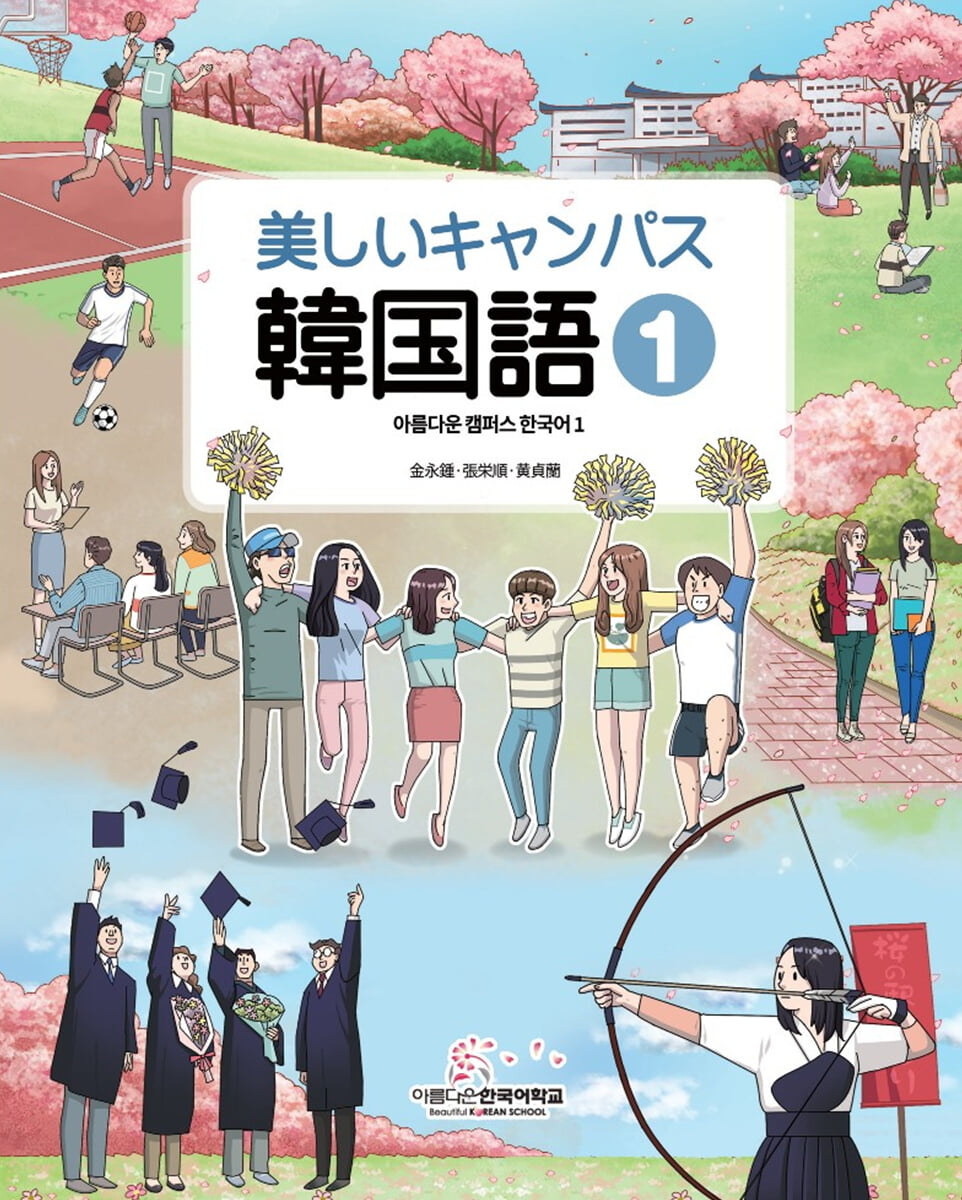
Beautiful Campus Korean 1
 |
Description
Book Introduction
Mutual exchanges between Korea and Japan have been actively developing since the Korean Wave boom in the early 21st century.
Recently, there have been many opportunities to encounter Korean in various situations in daily life.
As more and more Japanese people become interested in Korean movies, dramas, and K-pop, the number of Korean language learners is also on the rise.
In the midst of this, we have published [Beautiful Campus Korean] for learners who are just starting to learn Korean.
Recently, there have been many opportunities to encounter Korean in various situations in daily life.
As more and more Japanese people become interested in Korean movies, dramas, and K-pop, the number of Korean language learners is also on the rise.
In the midst of this, we have published [Beautiful Campus Korean] for learners who are just starting to learn Korean.
- You can preview some of the book's contents.
Preview
index
..when publishing a book_it corresponds to publication
Note: Textbook structure and usage
Characters_ Characters
Textbook composition table_Textbook composition table
Table of Contents_Table of Contents
Words used in the classroom_Words used in the classroom
About Hangul_Hangul
Comparison of Korean pronunciation notation_ Comparison of Korean pronunciation notation
.Lesson 1 Basic Vowels Basic Vowels
Lesson 2 Basic Consonants Basic Consonants
Lesson 3 Diphthongs Diphthongs
Lesson 4: Light and Soft Consonants
Lesson 5: Supporting Patch
Lesson 6 Hello? Hello.
Lesson 7: What are your hobbies? What are your hobbies?
Lesson 8: What is this? What is this?
Lesson 9: What do you usually do on weekends? What do you always do on weekends?
Lesson 10: What kind of food do you like? What is your favorite dish?
Lesson 11: Where is the bank? Where is the bank?
Lesson 12: When is your birthday? When is your birthday?
.Appendix Appendix
.1. "Listen and try" "Practice and try" Answer
2. Korean pronunciation rules Korean pronunciation rules
3.
Irregular Verbs Irregular Verbs
4. Verb Conjugation Table Verb Conjugation Table
5. Vocabulary Index of the Subject Vocabulary Index of the Subject
6. Comparison table of Japanese kana and Hangul
7.
Japanese notation in Hangul Japanese notation in Hangul
Note: Textbook structure and usage
Characters_ Characters
Textbook composition table_Textbook composition table
Table of Contents_Table of Contents
Words used in the classroom_Words used in the classroom
About Hangul_Hangul
Comparison of Korean pronunciation notation_ Comparison of Korean pronunciation notation
.Lesson 1 Basic Vowels Basic Vowels
Lesson 2 Basic Consonants Basic Consonants
Lesson 3 Diphthongs Diphthongs
Lesson 4: Light and Soft Consonants
Lesson 5: Supporting Patch
Lesson 6 Hello? Hello.
Lesson 7: What are your hobbies? What are your hobbies?
Lesson 8: What is this? What is this?
Lesson 9: What do you usually do on weekends? What do you always do on weekends?
Lesson 10: What kind of food do you like? What is your favorite dish?
Lesson 11: Where is the bank? Where is the bank?
Lesson 12: When is your birthday? When is your birthday?
.Appendix Appendix
.1. "Listen and try" "Practice and try" Answer
2. Korean pronunciation rules Korean pronunciation rules
3.
Irregular Verbs Irregular Verbs
4. Verb Conjugation Table Verb Conjugation Table
5. Vocabulary Index of the Subject Vocabulary Index of the Subject
6. Comparison table of Japanese kana and Hangul
7.
Japanese notation in Hangul Japanese notation in Hangul
Publisher's Review
This book is the first introductory book for learning Korean.
Lessons 1-5 of the text are “Characters and Pronunciation.”
Learn the Korean character system and pronunciation, and develop your reading and writing skills through five stages.
Lessons 6-12 are “Grammar and Conversation.”
It is structured to help you learn basic grammar and vocabulary and improve your conversational skills.
The structure of this document is as follows:
Think about it, think about it
It is the introduction stage.
Before going into the main text, we are posting about three images of the content of each lesson so that learners can visualize what they will learn.
Read the dialogue. Read the dialogue.
At the beginner level, you will learn content themed around everyday life, such as “self-introduction,” “hobbies,” and “things you like.”
The text includes “Vocabulary and Expressions” and “Japanese Translation.”
Learn and Become a Spouse
Depending on the content of each lesson, the meaning of new sentence patterns or expressions, as well as how to create them, are explained.
The learning points are presented in the form of examples and tables.
I'm adding more practice problems if needed.
In "Let's Learn More," examples are provided for grammar, vocabulary, and expressions, allowing for a variety of learning experiences.
Tell Me, Let's Talk
This is a conversation practice using learning points.
By practicing in pairs, we are able to communicate in various situations, including everyday life.
〈Try it out, try it out〉
This is an exercise to see how applicable it is by assuming a real communication scene.
Practice conversations by referring to the content learned in each lesson or the tables provided.
It allows learners to practice conversations with others by imagining specific situations, as well as expressing their thoughts and feelings.
Write, write
This is a practice of writing or composing Korean characters according to the theme or situation of each subject.
It also provides examples such as “self-introduction” and “family introduction,” so it can be used as a review.
Listen, listen
Listen to the audio of the conversation using the vocabulary, expressions, and sentence structures learned in each lesson using QR codes and check if you can understand the content.
It is structured to facilitate listening practice.
Let's practice, let's practice
We are challenging you to practice problems arranged as a summary of each subject.
It can also be used as a task.
Knowing how much you understand of what you learned in each subject leads to self-affirmation.
New Words New Words
New words that appear in addition to those presented in the text of “Let’s Read a Conversation” or “Spouse” or in pictures or tables are included.
Exploring Korean Culture! Exploring Korean Culture!
Each department has a Korean culture corner where students can learn about Korean daily life and culture, thereby deepening their understanding of other cultures.
〈Appendix Appendix〉
1.
The answer to "Let's listen and see" and "Let's practice"
2.
Japanese pronunciation notation
3.
Pronunciation change rules
4.
Explanation of "Irregular Verbs"
5.
Reference materials (「Conjugation Table of Verbs」 「Conjugation Table of Irregular Verbs」)
6.
"Vocabulary Index"
7.
Hangul list
※The phonetic symbols are based on the International Phonetic Alphabet (IPA) (revised to 2020).
※The Romanization of Korean follows the standard pronunciation of Korean.
Lessons 1-5 of the text are “Characters and Pronunciation.”
Learn the Korean character system and pronunciation, and develop your reading and writing skills through five stages.
Lessons 6-12 are “Grammar and Conversation.”
It is structured to help you learn basic grammar and vocabulary and improve your conversational skills.
The structure of this document is as follows:
Think about it, think about it
It is the introduction stage.
Before going into the main text, we are posting about three images of the content of each lesson so that learners can visualize what they will learn.
Read the dialogue. Read the dialogue.
At the beginner level, you will learn content themed around everyday life, such as “self-introduction,” “hobbies,” and “things you like.”
The text includes “Vocabulary and Expressions” and “Japanese Translation.”
Learn and Become a Spouse
Depending on the content of each lesson, the meaning of new sentence patterns or expressions, as well as how to create them, are explained.
The learning points are presented in the form of examples and tables.
I'm adding more practice problems if needed.
In "Let's Learn More," examples are provided for grammar, vocabulary, and expressions, allowing for a variety of learning experiences.
Tell Me, Let's Talk
This is a conversation practice using learning points.
By practicing in pairs, we are able to communicate in various situations, including everyday life.
〈Try it out, try it out〉
This is an exercise to see how applicable it is by assuming a real communication scene.
Practice conversations by referring to the content learned in each lesson or the tables provided.
It allows learners to practice conversations with others by imagining specific situations, as well as expressing their thoughts and feelings.
Write, write
This is a practice of writing or composing Korean characters according to the theme or situation of each subject.
It also provides examples such as “self-introduction” and “family introduction,” so it can be used as a review.
Listen, listen
Listen to the audio of the conversation using the vocabulary, expressions, and sentence structures learned in each lesson using QR codes and check if you can understand the content.
It is structured to facilitate listening practice.
Let's practice, let's practice
We are challenging you to practice problems arranged as a summary of each subject.
It can also be used as a task.
Knowing how much you understand of what you learned in each subject leads to self-affirmation.
New Words New Words
New words that appear in addition to those presented in the text of “Let’s Read a Conversation” or “Spouse” or in pictures or tables are included.
Exploring Korean Culture! Exploring Korean Culture!
Each department has a Korean culture corner where students can learn about Korean daily life and culture, thereby deepening their understanding of other cultures.
〈Appendix Appendix〉
1.
The answer to "Let's listen and see" and "Let's practice"
2.
Japanese pronunciation notation
3.
Pronunciation change rules
4.
Explanation of "Irregular Verbs"
5.
Reference materials (「Conjugation Table of Verbs」 「Conjugation Table of Irregular Verbs」)
6.
"Vocabulary Index"
7.
Hangul list
※The phonetic symbols are based on the International Phonetic Alphabet (IPA) (revised to 2020).
※The Romanization of Korean follows the standard pronunciation of Korean.
GOODS SPECIFICS
- Publication date: March 15, 2022
- Page count, weight, size: Page count being confirmed | 540g | 210*260*20mm
- ISBN13: 9788991869820
- ISBN10: 8991869823
You may also like
카테고리
korean


korean

![GQ KOREA Mark (Monthly): December [2025]](http://librairie.coreenne.fr/cdn/shop/files/8ef265dbbfbf186523ed75ba7319009d.jpg?v=1765340328&width=3840)


