

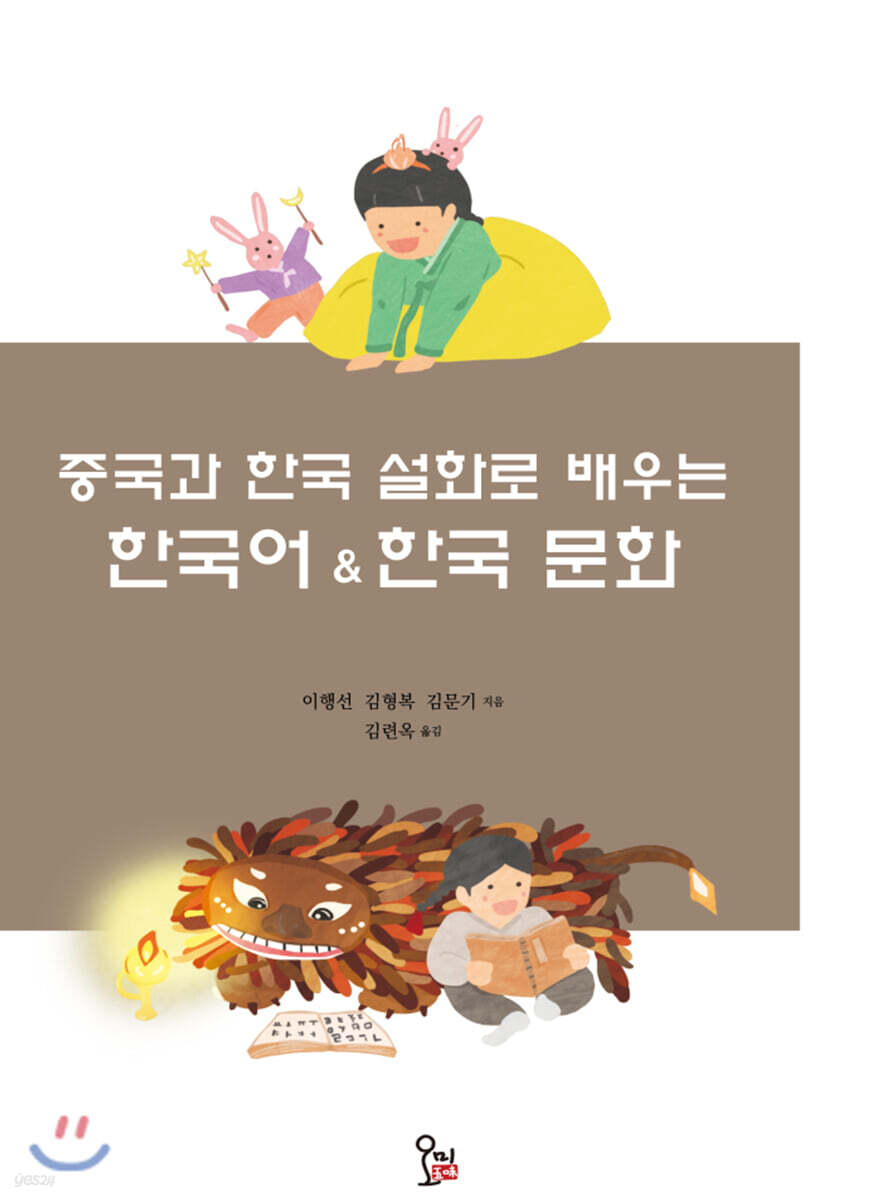
Learning Korean through Chinese and Korean folktales and Korean culture
 |
Description
Book Introduction
Learning Korean & Culture through Chinese and Korean Tales is a Korean culture textbook for intermediate and higher level learners.
The purpose of this book is to learn about Korean culture through a comparison of the cultures of the two countries based on Chinese and Korean folktales.
First, considering Chinese learners, we first presented Chinese tales such as [The Hairy Girl], [The Weaver Girl], [The Tiger Story], [The Plain Girl in White Water], and [The Leaf-Limited Tale].
Second, Korean folktales with narrative structures corresponding to Chinese folktales were presented as [The Fairy and the Woodcutter], [The Cowherd and the Weaver Girl], [The Brothers and Sisters Who Became the Sun and the Moon], [The Lady of the Wind], and [Kongjwi and Patjwi].
Through this, learners can discover the universality and specificity of the folktales of both countries by comparing and contrasting the cultures of both countries inherent in the folktales.
Third, these cultural education contents were integrated with language skills such as speaking, writing, and reading to lead to various cultural practice activities.
The cultural practice activity focused on thinking about and discussing the cultural similarities and differences seen in the folktales of the two countries.
Fourth, intermediate-level grammar and expressions from Chinese and Korean folktales were selected and placed in an appendix.
It consists of ‘combined information’, ‘meaning’, ‘examples’, ‘practice problems’, and ‘application problems’.
Tales are a familiar and interesting material for everyone, and while they share universal elements, they also show variations depending on the cultural background of each country, making them very useful for cultural education through cultural comparison.
I hope that through this book, Chinese learners will actively broaden their understanding of the cultures of both countries and improve their Korean communication skills.
The purpose of this book is to learn about Korean culture through a comparison of the cultures of the two countries based on Chinese and Korean folktales.
First, considering Chinese learners, we first presented Chinese tales such as [The Hairy Girl], [The Weaver Girl], [The Tiger Story], [The Plain Girl in White Water], and [The Leaf-Limited Tale].
Second, Korean folktales with narrative structures corresponding to Chinese folktales were presented as [The Fairy and the Woodcutter], [The Cowherd and the Weaver Girl], [The Brothers and Sisters Who Became the Sun and the Moon], [The Lady of the Wind], and [Kongjwi and Patjwi].
Through this, learners can discover the universality and specificity of the folktales of both countries by comparing and contrasting the cultures of both countries inherent in the folktales.
Third, these cultural education contents were integrated with language skills such as speaking, writing, and reading to lead to various cultural practice activities.
The cultural practice activity focused on thinking about and discussing the cultural similarities and differences seen in the folktales of the two countries.
Fourth, intermediate-level grammar and expressions from Chinese and Korean folktales were selected and placed in an appendix.
It consists of ‘combined information’, ‘meaning’, ‘examples’, ‘practice problems’, and ‘application problems’.
Tales are a familiar and interesting material for everyone, and while they share universal elements, they also show variations depending on the cultural background of each country, making them very useful for cultural education through cultural comparison.
I hope that through this book, Chinese learners will actively broaden their understanding of the cultures of both countries and improve their Korean communication skills.
- You can preview some of the book's contents.
Preview
index
Lesson 1 The Fairy and the Woodcutter 14
Lesson 2: The Cowherd and the Weaver Girl 28
Lesson 3: The Brothers Who Became the Sun and the Moon 40
Lesson 4: The Great Horned Owl 54
Lesson 5: Yangsan Baekjeon 64
Lesson 6 Kongjwi and Patjwi 76
Appendix 1 Grammar and Expressions 86
Appendix 2 Chinese Translation 150
Appendix 3 Answer 166
Lesson 2: The Cowherd and the Weaver Girl 28
Lesson 3: The Brothers Who Became the Sun and the Moon 40
Lesson 4: The Great Horned Owl 54
Lesson 5: Yangsan Baekjeon 64
Lesson 6 Kongjwi and Patjwi 76
Appendix 1 Grammar and Expressions 86
Appendix 2 Chinese Translation 150
Appendix 3 Answer 166
Into the book
During the Jin Dynasty, there was a young man living in Xinyu County, Yuzhang County.
One day, while I was working in the field, I heard the sound of a bird's wings flapping from somewhere.
I looked towards the place where the sound was coming from and saw six or seven women.
Next to it was a wing suit.
The young man approached stealthily and hid one of the winged garments as a joke.
The women were startled by the sudden appearance of the young man.
So I quickly put on my wings and turned into a bird and flew away.
But one woman was left alone, unable to find her winged robe.
The young man fell in love with her at first sight.
The couple got married, had three daughters, and lived happily ever after.
--- From "Part of the Mock Woman"
Once upon a time, there lived a kind-hearted woodcutter in a village.
One day, while I was chopping wood in the forest, a deer came running towards me.
“Please save me, woodcutter.
“The hunter is chasing!”
The woodcutter quickly hid the deer.
… …
The deer points out the pond where the fairy comes down to bathe.
“Hide one of the winged robes while the fairies bathe.
And don't show me your winged clothes until you have three children."
When the full moon rose, the fairies came down to the pond as the deer had said.
The woodcutter secretly hid one of the winged clothes.
The fairies who had finished bathing were ascending to the sky, but one fairy was crying because she could not ascend.
Then a woodcutter appeared and took the fairy back home.
--- From "The Fairy and the Woodcutter"
[Learning Activities]
In the Chinese tale [The Fairy and the Woodcutter] and the Korean tale [The Fairy and the Woodcutter], the man stole the woman's clothes and married her.
If a similar situation were to arise in our time, what would you do if you were a woman (a fairy) whose wings had been stolen? And what would you do if you listened to the deer's words? Why?
In [The Fairy and the Woodcutter], the deer is told not to show her wings until she has given birth to three children.
What do you think is the reason?
One day, while I was working in the field, I heard the sound of a bird's wings flapping from somewhere.
I looked towards the place where the sound was coming from and saw six or seven women.
Next to it was a wing suit.
The young man approached stealthily and hid one of the winged garments as a joke.
The women were startled by the sudden appearance of the young man.
So I quickly put on my wings and turned into a bird and flew away.
But one woman was left alone, unable to find her winged robe.
The young man fell in love with her at first sight.
The couple got married, had three daughters, and lived happily ever after.
--- From "Part of the Mock Woman"
Once upon a time, there lived a kind-hearted woodcutter in a village.
One day, while I was chopping wood in the forest, a deer came running towards me.
“Please save me, woodcutter.
“The hunter is chasing!”
The woodcutter quickly hid the deer.
… …
The deer points out the pond where the fairy comes down to bathe.
“Hide one of the winged robes while the fairies bathe.
And don't show me your winged clothes until you have three children."
When the full moon rose, the fairies came down to the pond as the deer had said.
The woodcutter secretly hid one of the winged clothes.
The fairies who had finished bathing were ascending to the sky, but one fairy was crying because she could not ascend.
Then a woodcutter appeared and took the fairy back home.
--- From "The Fairy and the Woodcutter"
[Learning Activities]
In the Chinese tale [The Fairy and the Woodcutter] and the Korean tale [The Fairy and the Woodcutter], the man stole the woman's clothes and married her.
If a similar situation were to arise in our time, what would you do if you were a woman (a fairy) whose wings had been stolen? And what would you do if you listened to the deer's words? Why?
In [The Fairy and the Woodcutter], the deer is told not to show her wings until she has given birth to three children.
What do you think is the reason?
--- From the text
GOODS SPECIFICS
- Date of publication: August 25, 2019
- Page count, weight, size: 175 pages | 190*260*20mm
- ISBN13: 9791196418991
- ISBN10: 1196418993
You may also like
카테고리
korean


korean

![GQ KOREA Mark (Monthly): December [2025]](http://librairie.coreenne.fr/cdn/shop/files/8ef265dbbfbf186523ed75ba7319009d.jpg?v=1765340328&width=3840)


