

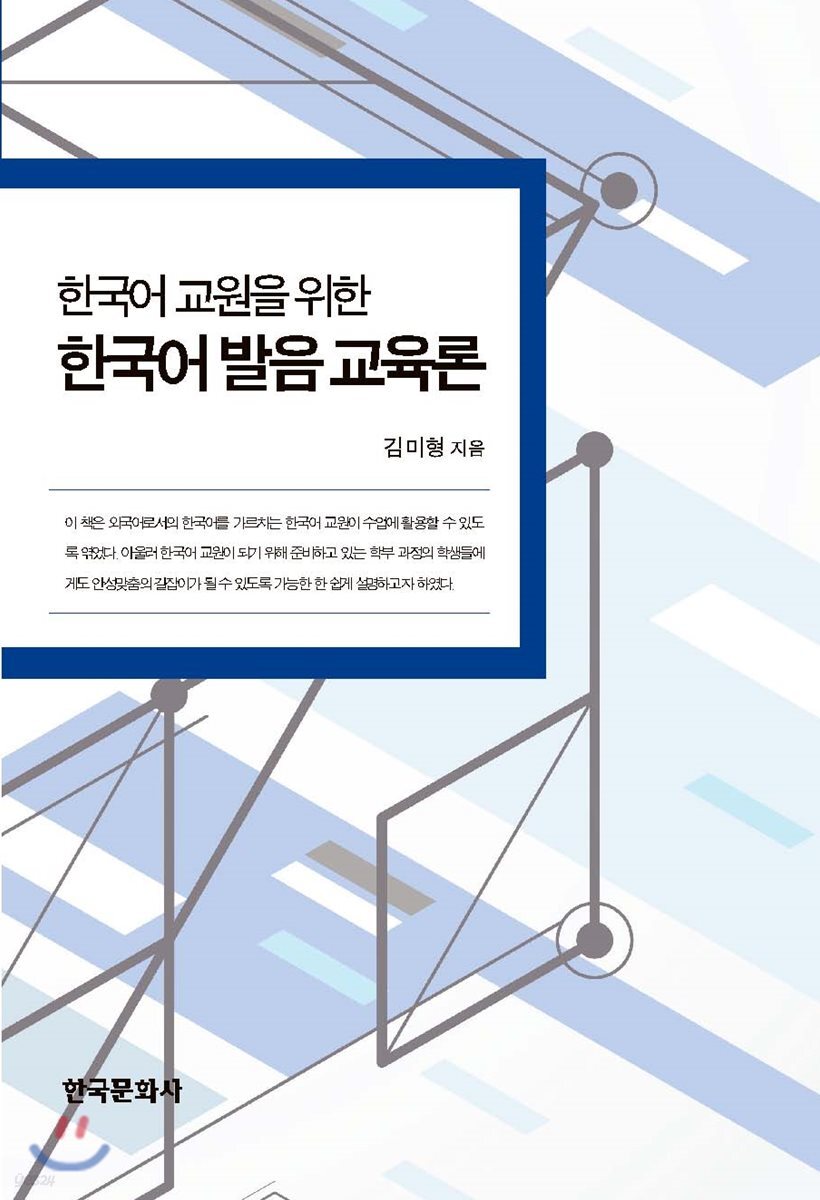
Korean Pronunciation Teaching Theory for Korean Language Teachers
 |
Description
Book Introduction
The phonetic alphabet that is more closely related to sound than any other alphabet is Hangul, the alphabet used to write the Korean language.
In order to teach Korean pronunciation to the fullest extent possible, teachers must have a thorough understanding of the principles.
Based on such a theoretical foundation, systematic pronunciation education can be provided to Korean language learners.
With this intention, this book was written in two parts: the basic theory of phonology and the theory of pronunciation education.
Additionally, by describing the practical part separately, we wanted to help students apply it directly in actual classroom settings.
In order to teach Korean pronunciation to the fullest extent possible, teachers must have a thorough understanding of the principles.
Based on such a theoretical foundation, systematic pronunciation education can be provided to Korean language learners.
With this intention, this book was written in two parts: the basic theory of phonology and the theory of pronunciation education.
Additionally, by describing the practical part separately, we wanted to help students apply it directly in actual classroom settings.
- You can preview some of the book's contents.
Preview
index
introduction
Chapter 1: Overview of Phonology and Pronunciation Education
Chapter 2: Basic Phonological Theory
2.1.
Phonetics and Phonology
2.2.
Korean vowel and consonant system
2.3.
Korean syllable structure
2.4.
Korean phoneme combination rules
2.5.
Korean Standard Pronunciation and Phonology
2.6.
Prosodic elements of Korean
Chapter 3: Basic Theory of Pronunciation Education
3.1.
The position of pronunciation education in language teaching methods
3.2.
Standard Korean Language Curriculum and Korean Pronunciation Education
3.3.
Types of activities and lesson models for pronunciation education
3.4.
Error analysis and pronunciation training at beginner, intermediate, and advanced levels
3.5.
Contrastive error analysis and pronunciation training
Chapter 4: Pronunciation Education Practice
4.1.
Vowel and consonant pronunciation training
4.2.
Syllable pronunciation training
4.3.
Pronunciation education based on phoneme changes
4.4.
Teaching rhyme elements
4.5.
Pronunciation training practice
References
supplement
Search
Chapter 1: Overview of Phonology and Pronunciation Education
Chapter 2: Basic Phonological Theory
2.1.
Phonetics and Phonology
2.2.
Korean vowel and consonant system
2.3.
Korean syllable structure
2.4.
Korean phoneme combination rules
2.5.
Korean Standard Pronunciation and Phonology
2.6.
Prosodic elements of Korean
Chapter 3: Basic Theory of Pronunciation Education
3.1.
The position of pronunciation education in language teaching methods
3.2.
Standard Korean Language Curriculum and Korean Pronunciation Education
3.3.
Types of activities and lesson models for pronunciation education
3.4.
Error analysis and pronunciation training at beginner, intermediate, and advanced levels
3.5.
Contrastive error analysis and pronunciation training
Chapter 4: Pronunciation Education Practice
4.1.
Vowel and consonant pronunciation training
4.2.
Syllable pronunciation training
4.3.
Pronunciation education based on phoneme changes
4.4.
Teaching rhyme elements
4.5.
Pronunciation training practice
References
supplement
Search
Into the book
What is the relationship between phonology and pronunciation education? To answer this question, we must first understand what phonology is and what pronunciation education is.
In our society, the effectiveness of convergence is being recognized and activities are actively underway to explore convergence in various fields.
One type of this can be said to be the fusion of theory and application, and it can be said that the application of phonological theory and pronunciation education in the field has precisely this fusion characteristic.
Compared to the modern society's tendency to create creative fusion between heterogeneous fields of expertise, phonology and pronunciation education are similar fields with common roots. However, it would be beneficial to study them while creatively thinking about the fusion relationship between the two.
Phonology is the study of the sounds people make when they speak.
It systematically studies and organizes topics related to human speech sounds, such as what sounds people use when speaking, what changes occur when sounds meet, and what distinctive sounds exist in each language group.
Pronunciation education is a field of study that studies how to best educate foreigners to learn and master a language well.
It systematically researches and organizes topics necessary for people to learn to speak, such as the order in which to teach the sounds of a language, what points should be taught with particular importance, what points teachers should pay attention to, and what activities are good to do to increase proficiency.
The first study in pronunciation education is phonology.
If you don't know phonology, you can't properly understand pronunciation education.
In order for Korean language teachers to effectively teach pronunciation to foreigners, they must have a good understanding of Korean phonology theory.
However, what we need to teach foreign learners is not the Korean phonological theory itself.
Since the goal is to enable foreigners to speak Korean, teaching theory is not appropriate.
For this reason, a separate appropriate educational theory is needed, and that is pronunciation education theory.
We teach pronunciation rather than phonology, and Korean pronunciation cannot be achieved by simply telling students to follow along, so teachers need an appropriate teaching theory to utilize in their education.
Let's take an example.
Even people who have not majored in phonology can teach Korean vowels and consonants to foreigners.
However, teaching vowels and consonants is teaching the most basic pieces of sound, and at the same time, teaching the Korean alphabet is done in parallel.
After these basic steps, you should be able to pronounce Korean words, read Korean written in Hangul, and even string words together to form Korean sentences.
Since there are more than one or two Korean characters and more than one or two Korean sentences, it is impossible not to worry about how to efficiently teach foreigners the enormous amount of Korean language materials.
Then, let us organize the definitions and goals of phonology and pronunciation education theory.
Building on this content, we will explore more expanded content in each section of this book.
In our society, the effectiveness of convergence is being recognized and activities are actively underway to explore convergence in various fields.
One type of this can be said to be the fusion of theory and application, and it can be said that the application of phonological theory and pronunciation education in the field has precisely this fusion characteristic.
Compared to the modern society's tendency to create creative fusion between heterogeneous fields of expertise, phonology and pronunciation education are similar fields with common roots. However, it would be beneficial to study them while creatively thinking about the fusion relationship between the two.
Phonology is the study of the sounds people make when they speak.
It systematically studies and organizes topics related to human speech sounds, such as what sounds people use when speaking, what changes occur when sounds meet, and what distinctive sounds exist in each language group.
Pronunciation education is a field of study that studies how to best educate foreigners to learn and master a language well.
It systematically researches and organizes topics necessary for people to learn to speak, such as the order in which to teach the sounds of a language, what points should be taught with particular importance, what points teachers should pay attention to, and what activities are good to do to increase proficiency.
The first study in pronunciation education is phonology.
If you don't know phonology, you can't properly understand pronunciation education.
In order for Korean language teachers to effectively teach pronunciation to foreigners, they must have a good understanding of Korean phonology theory.
However, what we need to teach foreign learners is not the Korean phonological theory itself.
Since the goal is to enable foreigners to speak Korean, teaching theory is not appropriate.
For this reason, a separate appropriate educational theory is needed, and that is pronunciation education theory.
We teach pronunciation rather than phonology, and Korean pronunciation cannot be achieved by simply telling students to follow along, so teachers need an appropriate teaching theory to utilize in their education.
Let's take an example.
Even people who have not majored in phonology can teach Korean vowels and consonants to foreigners.
However, teaching vowels and consonants is teaching the most basic pieces of sound, and at the same time, teaching the Korean alphabet is done in parallel.
After these basic steps, you should be able to pronounce Korean words, read Korean written in Hangul, and even string words together to form Korean sentences.
Since there are more than one or two Korean characters and more than one or two Korean sentences, it is impossible not to worry about how to efficiently teach foreigners the enormous amount of Korean language materials.
Then, let us organize the definitions and goals of phonology and pronunciation education theory.
Building on this content, we will explore more expanded content in each section of this book.
--- From the text
Publisher's Review
This book was compiled for use in classes by Korean language teachers who teach Korean as a foreign language.
We also tried to explain it as simply as possible so that it can serve as a perfect guide for undergraduate students preparing to become Korean language teachers.
With the establishment of a Korean language teacher course in undergraduate programs, students have become required to study both traditional phonological theory and new Korean pronunciation education theory.
Accordingly, I dismantled the Life Phonology that I had published in 2005 and restructured it to teach the basic theory of phonology and to effectively teach Korean based on it.
It is not that easy to read Korean written in Hangul properly.
It is clear that Hangul is easier to learn than any other language.
Each letter has a set sound value, making it easier to learn.
So, when you learn Korean, it's easy to think that you just have to write what you say, and you also make the mistake of thinking that you have to pronounce words exactly as they're written.
This is precisely the difficulty of Korean notation and pronunciation.
In other words, because it is a text that is so scientifically well-structured, expectations for it are high, and so it is difficult to accept situations where more study is required.
However, the English alphabet, which is a phonemic alphabet, does not have consistent sound values, so rather than looking for scientific principles, you have to memorize the spelling of each word.
Korean is much easier than that process.
People who use Korean and Hangul should be fully aware of this and use the language or learn Korean.
Therefore, it is very difficult to write Hangul according to pronunciation, and it is a slightly wrong complaint that shifts responsibility to others to say why the spelling keeps changing.
Because the spelling doesn't change often.
However, since Korean is a language where Hangul letters represent sounds as they are, there is a desire to write them as they sound from the beginning, and Hangul is something that is written naturally, but in such a situation, when the principles of spelling are applied, it is realized that it does not happen automatically, and as a result, complaints about it being difficult arise.
As such, Hangul, the phonetic alphabet that writes the Korean language, is more closely related to sounds than any other alphabet.
In order to teach Korean pronunciation to the fullest extent possible, teachers must have a thorough understanding of the principles.
Based on such a theoretical foundation, systematic pronunciation education can be provided to Korean language learners.
With this intention, this book was written in two parts: the basic theory of phonology and the theory of pronunciation education.
Additionally, by describing the practical part separately, we wanted to help students apply it directly in actual classroom settings.
The number of people around the world who want to learn Korean is increasing.
Many Korean language classes are opening abroad and the number of domestic students studying abroad is increasing.
To be a good Korean teacher for them, you must have a unique perspective on teaching Korean pronunciation.
I hope this book will be a positive influence on Korean language teachers and those preparing to become Korean language teachers.
We also tried to explain it as simply as possible so that it can serve as a perfect guide for undergraduate students preparing to become Korean language teachers.
With the establishment of a Korean language teacher course in undergraduate programs, students have become required to study both traditional phonological theory and new Korean pronunciation education theory.
Accordingly, I dismantled the Life Phonology that I had published in 2005 and restructured it to teach the basic theory of phonology and to effectively teach Korean based on it.
It is not that easy to read Korean written in Hangul properly.
It is clear that Hangul is easier to learn than any other language.
Each letter has a set sound value, making it easier to learn.
So, when you learn Korean, it's easy to think that you just have to write what you say, and you also make the mistake of thinking that you have to pronounce words exactly as they're written.
This is precisely the difficulty of Korean notation and pronunciation.
In other words, because it is a text that is so scientifically well-structured, expectations for it are high, and so it is difficult to accept situations where more study is required.
However, the English alphabet, which is a phonemic alphabet, does not have consistent sound values, so rather than looking for scientific principles, you have to memorize the spelling of each word.
Korean is much easier than that process.
People who use Korean and Hangul should be fully aware of this and use the language or learn Korean.
Therefore, it is very difficult to write Hangul according to pronunciation, and it is a slightly wrong complaint that shifts responsibility to others to say why the spelling keeps changing.
Because the spelling doesn't change often.
However, since Korean is a language where Hangul letters represent sounds as they are, there is a desire to write them as they sound from the beginning, and Hangul is something that is written naturally, but in such a situation, when the principles of spelling are applied, it is realized that it does not happen automatically, and as a result, complaints about it being difficult arise.
As such, Hangul, the phonetic alphabet that writes the Korean language, is more closely related to sounds than any other alphabet.
In order to teach Korean pronunciation to the fullest extent possible, teachers must have a thorough understanding of the principles.
Based on such a theoretical foundation, systematic pronunciation education can be provided to Korean language learners.
With this intention, this book was written in two parts: the basic theory of phonology and the theory of pronunciation education.
Additionally, by describing the practical part separately, we wanted to help students apply it directly in actual classroom settings.
The number of people around the world who want to learn Korean is increasing.
Many Korean language classes are opening abroad and the number of domestic students studying abroad is increasing.
To be a good Korean teacher for them, you must have a unique perspective on teaching Korean pronunciation.
I hope this book will be a positive influence on Korean language teachers and those preparing to become Korean language teachers.
GOODS SPECIFICS
- Date of issue: March 5, 2019
- Page count, weight, size: 216 pages | 153*225*20mm
- ISBN13: 9788968177439
- ISBN10: 8968177430
You may also like
카테고리
korean


korean

![GQ KOREA Mark (Monthly): December [2025]](http://librairie.coreenne.fr/cdn/shop/files/8ef265dbbfbf186523ed75ba7319009d.jpg?v=1765340328&width=3840)


