

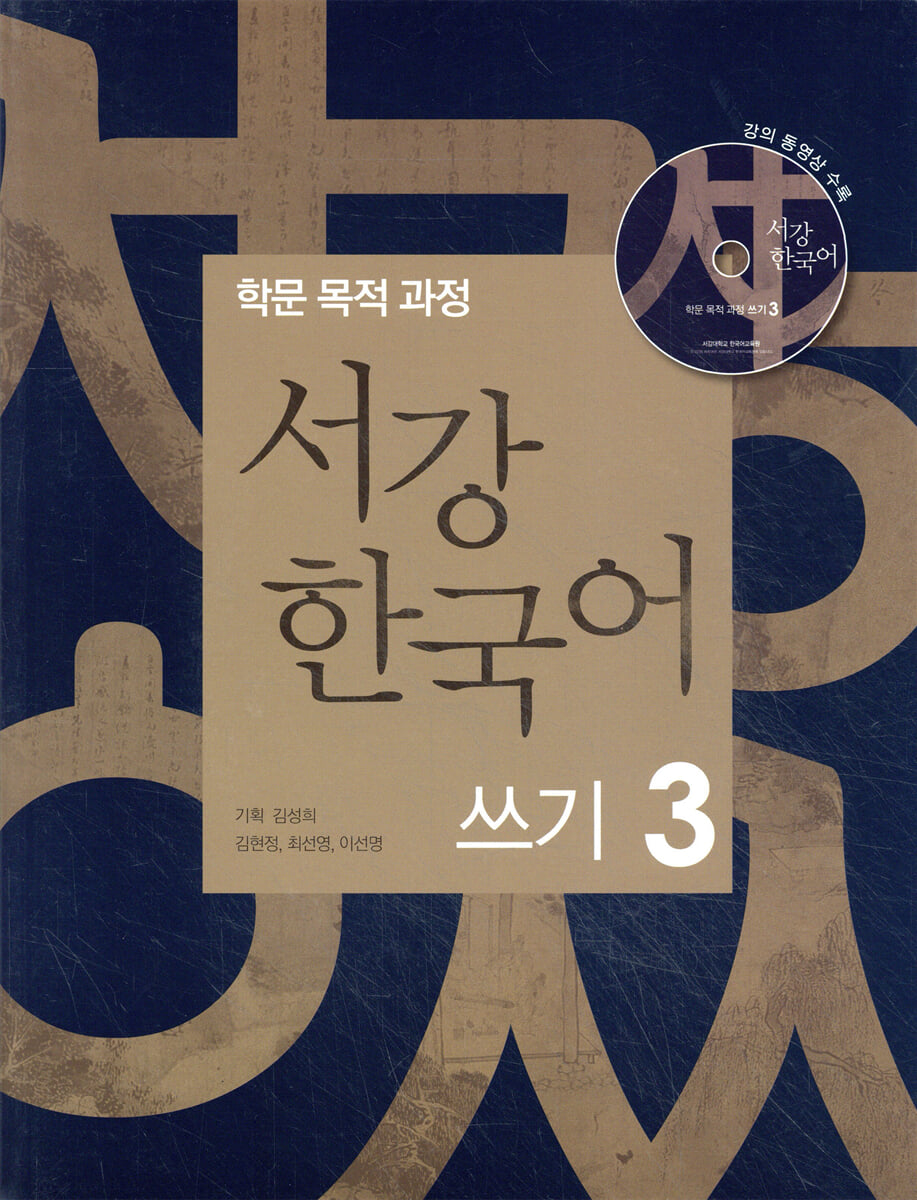
Sogang Korean Writing 3
 |
Description
Book Introduction
Korean language textbook for foreigners.
It is organized around topics related to major subjects such as Korean, psychology, economics, and natural science (physics) so that you can experience the Korean university curriculum in advance.
In each unit, you can practice learning vocabulary, taking notes, writing reports, and writing test answers.
By adapting university courses to the level of international students, we help academic students experience the on-site atmosphere of Korean universities in advance.
It is organized around topics related to major subjects such as Korean, psychology, economics, and natural science (physics) so that you can experience the Korean university curriculum in advance.
In each unit, you can practice learning vocabulary, taking notes, writing reports, and writing test answers.
By adapting university courses to the level of international students, we help academic students experience the on-site atmosphere of Korean universities in advance.
index
Note
Contents Table
Unit composition
Preliminary Korean sentence patterns
1.
How to write Korean sentences correctly
2.
Sentence pattern practice
Chapter 1 Understanding Korean
1.
〈Vocabulary Learning〉 [Reading] Hangul is a phonetic alphabet
2.
Note-taking [Lecture] Characteristics of Internet Language
3.
〈Report Writing〉 Internet Language and Language Life
4.
〈Writing Test Answers〉Characteristics of Phonetic Letters
Chapter 2 Understanding Psychology
1.
〈Vocabulary Learning〉 [Reading] How to write the letter E and its personality
2.
Note-taking [Lecture] Self-Targeting
3.
〈Report Writing〉 Desire for Independence
Chapter 3: Understanding the Economy
1.
〈Vocabulary Learning〉 [Reading] The Principle of Supply and Demand
2.
〈Note-taking〉 [Lecture] Opportunity Cost
3.
〈Report Writing〉 My career path, what is the rational choice?
4.
〈Exam Answer Writing〉 The Concept of Opportunity Cost
Chapter 4: Understanding Nature
1.
Vocabulary Learning [Reading] Newton's Hard-Throwing Apple
2.
Note-taking [Lecture] The Law of Energy
3.
〈Report Writing〉Why should we conserve energy?
4.
〈Exam Answer Writing〉 The Law of Conservation of Energy and the Law of Entropy
supplement
Appendix 1 Lecture Script
Appendix 2 Answers and Examples
Appendix 3 Vocabulary Translation (Chinese/English)
Contents Table
Unit composition
Preliminary Korean sentence patterns
1.
How to write Korean sentences correctly
2.
Sentence pattern practice
Chapter 1 Understanding Korean
1.
〈Vocabulary Learning〉 [Reading] Hangul is a phonetic alphabet
2.
Note-taking [Lecture] Characteristics of Internet Language
3.
〈Report Writing〉 Internet Language and Language Life
4.
〈Writing Test Answers〉Characteristics of Phonetic Letters
Chapter 2 Understanding Psychology
1.
〈Vocabulary Learning〉 [Reading] How to write the letter E and its personality
2.
Note-taking [Lecture] Self-Targeting
3.
〈Report Writing〉 Desire for Independence
Chapter 3: Understanding the Economy
1.
〈Vocabulary Learning〉 [Reading] The Principle of Supply and Demand
2.
〈Note-taking〉 [Lecture] Opportunity Cost
3.
〈Report Writing〉 My career path, what is the rational choice?
4.
〈Exam Answer Writing〉 The Concept of Opportunity Cost
Chapter 4: Understanding Nature
1.
Vocabulary Learning [Reading] Newton's Hard-Throwing Apple
2.
Note-taking [Lecture] The Law of Energy
3.
〈Report Writing〉Why should we conserve energy?
4.
〈Exam Answer Writing〉 The Law of Conservation of Energy and the Law of Entropy
supplement
Appendix 1 Lecture Script
Appendix 2 Answers and Examples
Appendix 3 Vocabulary Translation (Chinese/English)
Publisher's Review
This textbook is a Korean language textbook designed to allow foreigners to experience the Korean university course curriculum in advance.
To this end, the units were structured around topics related to major subjects such as Korean, psychology, economics, and natural science (physics), with the aim of enabling students to acquire the knowledge and study skills necessary for university courses by ‘learning vocabulary (through reading), taking notes (while listening to lectures), writing reports, and writing exam answers.’
In particular, it can be said to be a must-read for academic learners who wish to experience the on-site atmosphere of Korean universities in advance, as it reproduces the university course curriculum in a modified and reduced form to suit the level of foreign learners.
The first characteristic of this textbook is that it allows students to experience the university course in advance through simulation.
This can provide strong motivation to learners and reduce the burden of studying after entering university.
Second, the content was selected from general academic areas at the university liberal arts level, but topics containing core concepts or principles that could encompass various majors were selected.
Third, to the extent possible, we increased the realism by including actual report writing assignments and exam questions presented at universities.
Fourth, we made it possible to collect the basic content knowledge necessary for writing by reading textbooks and listening to lectures.
Students will realize that reading specialized books and attending lectures serves as preliminary work for 'writing reports' or 'taking exams', and will be able to develop the skills to organically connect and utilize the knowledge acquired through classes at university.
Fifth, by including “Writing Exam Answers” as a unit, we have enabled students to effectively prepare for and practice taking exams.
To this end, the units were structured around topics related to major subjects such as Korean, psychology, economics, and natural science (physics), with the aim of enabling students to acquire the knowledge and study skills necessary for university courses by ‘learning vocabulary (through reading), taking notes (while listening to lectures), writing reports, and writing exam answers.’
In particular, it can be said to be a must-read for academic learners who wish to experience the on-site atmosphere of Korean universities in advance, as it reproduces the university course curriculum in a modified and reduced form to suit the level of foreign learners.
The first characteristic of this textbook is that it allows students to experience the university course in advance through simulation.
This can provide strong motivation to learners and reduce the burden of studying after entering university.
Second, the content was selected from general academic areas at the university liberal arts level, but topics containing core concepts or principles that could encompass various majors were selected.
Third, to the extent possible, we increased the realism by including actual report writing assignments and exam questions presented at universities.
Fourth, we made it possible to collect the basic content knowledge necessary for writing by reading textbooks and listening to lectures.
Students will realize that reading specialized books and attending lectures serves as preliminary work for 'writing reports' or 'taking exams', and will be able to develop the skills to organically connect and utilize the knowledge acquired through classes at university.
Fifth, by including “Writing Exam Answers” as a unit, we have enabled students to effectively prepare for and practice taking exams.
GOODS SPECIFICS
- Date of issue: March 29, 2019
- Page count, weight, size: 156 pages | 477g | 210*275*20mm
- ISBN13: 9788992491747
- ISBN10: 8992491743
You may also like
카테고리
korean


korean

![GQ KOREA Mark (Monthly): December [2025]](http://librairie.coreenne.fr/cdn/shop/files/8ef265dbbfbf186523ed75ba7319009d.jpg?v=1765340328&width=3840)


