

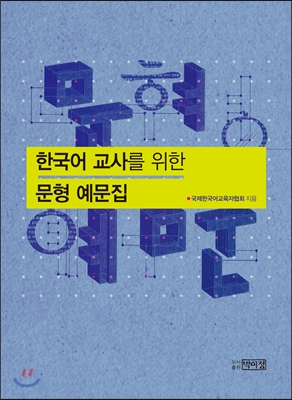
Sentence Pattern Example Collection for Korean Teachers
 |
Description
Book Introduction
Includes sentence patterns and examples for Korean language teachers.
The meaning and combination information of each sentence pattern are explained, and example sentences using the sentence pattern are included.
Intermediate level grammar was composed taking into account the frequency of previous TOPIK questions.
Vocabulary also uses intermediate-level words to create example sentences, and various example sentences that fit the grammar help with understanding.
The meaning and combination information of each sentence pattern are explained, and example sentences using the sentence pattern are included.
Intermediate level grammar was composed taking into account the frequency of previous TOPIK questions.
Vocabulary also uses intermediate-level words to create example sentences, and various example sentences that fit the grammar help with understanding.
index
01. Together
02.-Geondeon1
03.-geoden2, -geoden(yo)
04.-Ge6, -Ge2
05.-Ge Ha Da
06.-Go Nada
07.-Go hear
08.-Go Malda
09.-Go Bo-ni (-Go Bo-ni/-Go Bo-ni)
10. - Want to (- Want to/- Want to)
11.- High school freshman, Lee Go
12.-2nd year of high school
13. -4th grade, -high school (yo)
14.-Altitude
15.-Not at all (yo)
16.-The report
17.-Goja
18.-So
19.-That's right, -That's right
20.-It is bound to happen
21.- Gigi (yo)
22. -for, -for
23.-In the meantime
24.-In the meantime
25. -n result, -eun result
26. -n Kim-e, neun Kim-e, -eun Kim-e
27. -I said, -I said
28. -n next, -eun next
29. -is as it is, -is as it is2, -is as it is1
30. Instead of -n, instead of -neun, instead of -eun
31. -ndeul, -indeul
32. -ㄴ seems, -는 seems, -은 seems
33. -n as much, -neun as much, -eun as much
34.-n on the other hand, - on the other hand, - on the other hand
35.-ㄴ? count, -neun count
36. -ㄴ줄, -은줄, -는줄 know/don't know
37. -ㄴ is to blame, -는 is to blame, -은 is to blame
38. -nda, -nda, -da2
39. -ndagana1, -ndagana1, -dagana1, -ragagana1
40. -nda go1, -neun dago1, -da go1, -da go3
41.-ㄴ지, -지
42. -nkeo-nyeon, -neunkeo-nyeon, -eunkeo-nyeon
43. -Nama, -Inama
44. -I think, -(으)ㄴ think, 는가 think
45.-I want to
46.-Na4, but
47.-Me
48.-Yes2
49. Because
50.- On the way
51.- in the wind
52. -ㄴ between, -는 between
53.- is one
54.-ni1, -ini
55.-ni4, -euni2
56.-Da4
57.-Da-ga, -da5
58.-Approaching
59.- Even if you come
60.-I saw it all
61.-If you look at it?
62. - Even if I say so, - Even if I say so
63.-Again
64.-Daero
65.-Duni
66.-Thera
67.-Even if
68.-Dunn
69.-Deunde2, -Deundeyo
70.-Catalogue
71.-Deun(ji)1, -Deun
72.-Deundeun (ji)1, -Deundeun (ji)
73.-like
74. -It follows, -ㄹ follows, -eul only, -ㄹ only
75.-ㄹ teni (kka), -을 teni (kka)
76.-ㄹ geul tteunde, -을 geul tteunde
77. -ㄹ걸요, -을걸요
78. Not only -ㄹ, not only -을
79.-Even if it is.
Even if
80. Ra3 (-rago1)
81.-Rani4, -Eurani1
82.-Rani5, -Eurani2
83.- or 1, - or something like that
84.-Ran 1, -Iran
85.-try1, -try1
86.-trying to do 2, -trying to do 2, -trying to do
87.-Ryeom, -Eureom
88.- due to, - due to
89.-from, -from
90.- for, - for
91.-Ma-neun, -Man2
92. Even
93.-(as if)
94.- Even if it's the same
95.-If only
96.-as much
97.-myeo1, -yeo
98.-Myeon 1, -Myeon
99. -If it doesn't work, -If it doesn't work, -If it doesn't work, -If it doesn't work
100. I wish it were - I wish it were -
101. -So, -So
102. Report
103. Only
104. Sadong 1 (-i-, -hi-, -ri-, -gi-, u-, gu-, chu-)
105. Sadong 2 (-do)
106. Sadong 3 (-ge hada)
107. Ah1, Hey1
108. -Ah go, -eo go, -yeo go
109. -Ah have, -eo have, -yeo have
110. -Ah put, -eo put, -yeo put
111. -Ah, daeda, -eo, daeda, -yeo daeda
112. -Ah, -eo, -yeo
113. -Ah give, -eo give, -yeo give
114. -Ah, throw away, -eo, throw away
115. -Ah come, -eo come, -yeo come
116. -A2, -Eo1, -Yeo1
117. -Ada, -Where, -Yeoda
118. -Ado, -Eodo, -Yeodo
119. -Ara1, -Eora1, -Yeora1
120. -Arthur Inji, -Eoseo Inji, -Eoseo Inji
121. -Aya, -Ayaman, -Eoya, -Yeoya
122. -I have to-, -I have to-, -I have to-
123.-Ayaji2, -Ayaji2, -Yeodaji2
124. -It was, -It was, -It was
125.-was, -was, -was
126. -was, -was, -was
127. Hey, hey
128.- About, - About
129.- About, - About
130.-According to
According to 131.
132. Compared to, compared to, compared to
133.-by
According to 134.
135.-
136.L
137. John 1
138.- (으)ㄴ? When I see that, ?- When I see that
139.-(으)ㄴ shape, -는 shape
140.-(으)ㄴ is the law, is the law
141.-(으)ㄴ is the same, -는 is the same
142. -n pretend, -neun pretend
143.-(으)ㄴ Chae
144. I should have done it, I should have done it
145.-(으)ㄹ 밢하다, 을 밢하다
146.-(으)ㄹ까, -까보다
147. -(으)ㄹ까, -까
148.-(으)ㄹ까하다(싶다),-까하다(싶다)
149.-(으)ㄹ 과(하여), -을 과(하여)
150.-(으)ㄹ 이가 있습니다
151.-(으)ㄹ 할하다, -을 할하다
152.-(으)ㄹ sseomsa, -을 sseomsa
153.-(으)ㄹ으로, -을보다
154.-(으)ㄹ to the extent, -을 to the extent
155.-(으)ㄹ know (don't know)
156.-(으)ㄹ 지적
157.-(으)남나
158.-(으)려다
159.-I was just about to do it
160.-(으)하라
161.-Euni4
162.-(eu)nimangeul
163.-Eulraeya
164.(This) too
165. (This) is it
166.-Ja2, -Ja-ni(kka)3, -Ja Hani
167.-Sleep 2, -Sleep
168. -To sleep (-to sleep)
169.-As soon as
170. -That's right, -That's right
171. Even
172.- Hit, hit
173. Passive 1 (-i-, -hi-, -ri-, -gi-)
174. -Ajida, -eojida, -yeojida
175. Passive 3 (-ge doe)
176. And
177. To Hanta
▶ Intermediate Sentence Pattern Practice Problems
▶ Appendix
1.
Frequency of Topik Appearance in the International Standard Korean Language Model (Stage 2) Sentence Patterns
2.
Frequency of Topik Grammar Items
02.-Geondeon1
03.-geoden2, -geoden(yo)
04.-Ge6, -Ge2
05.-Ge Ha Da
06.-Go Nada
07.-Go hear
08.-Go Malda
09.-Go Bo-ni (-Go Bo-ni/-Go Bo-ni)
10. - Want to (- Want to/- Want to)
11.- High school freshman, Lee Go
12.-2nd year of high school
13. -4th grade, -high school (yo)
14.-Altitude
15.-Not at all (yo)
16.-The report
17.-Goja
18.-So
19.-That's right, -That's right
20.-It is bound to happen
21.- Gigi (yo)
22. -for, -for
23.-In the meantime
24.-In the meantime
25. -n result, -eun result
26. -n Kim-e, neun Kim-e, -eun Kim-e
27. -I said, -I said
28. -n next, -eun next
29. -is as it is, -is as it is2, -is as it is1
30. Instead of -n, instead of -neun, instead of -eun
31. -ndeul, -indeul
32. -ㄴ seems, -는 seems, -은 seems
33. -n as much, -neun as much, -eun as much
34.-n on the other hand, - on the other hand, - on the other hand
35.-ㄴ? count, -neun count
36. -ㄴ줄, -은줄, -는줄 know/don't know
37. -ㄴ is to blame, -는 is to blame, -은 is to blame
38. -nda, -nda, -da2
39. -ndagana1, -ndagana1, -dagana1, -ragagana1
40. -nda go1, -neun dago1, -da go1, -da go3
41.-ㄴ지, -지
42. -nkeo-nyeon, -neunkeo-nyeon, -eunkeo-nyeon
43. -Nama, -Inama
44. -I think, -(으)ㄴ think, 는가 think
45.-I want to
46.-Na4, but
47.-Me
48.-Yes2
49. Because
50.- On the way
51.- in the wind
52. -ㄴ between, -는 between
53.- is one
54.-ni1, -ini
55.-ni4, -euni2
56.-Da4
57.-Da-ga, -da5
58.-Approaching
59.- Even if you come
60.-I saw it all
61.-If you look at it?
62. - Even if I say so, - Even if I say so
63.-Again
64.-Daero
65.-Duni
66.-Thera
67.-Even if
68.-Dunn
69.-Deunde2, -Deundeyo
70.-Catalogue
71.-Deun(ji)1, -Deun
72.-Deundeun (ji)1, -Deundeun (ji)
73.-like
74. -It follows, -ㄹ follows, -eul only, -ㄹ only
75.-ㄹ teni (kka), -을 teni (kka)
76.-ㄹ geul tteunde, -을 geul tteunde
77. -ㄹ걸요, -을걸요
78. Not only -ㄹ, not only -을
79.-Even if it is.
Even if
80. Ra3 (-rago1)
81.-Rani4, -Eurani1
82.-Rani5, -Eurani2
83.- or 1, - or something like that
84.-Ran 1, -Iran
85.-try1, -try1
86.-trying to do 2, -trying to do 2, -trying to do
87.-Ryeom, -Eureom
88.- due to, - due to
89.-from, -from
90.- for, - for
91.-Ma-neun, -Man2
92. Even
93.-(as if)
94.- Even if it's the same
95.-If only
96.-as much
97.-myeo1, -yeo
98.-Myeon 1, -Myeon
99. -If it doesn't work, -If it doesn't work, -If it doesn't work, -If it doesn't work
100. I wish it were - I wish it were -
101. -So, -So
102. Report
103. Only
104. Sadong 1 (-i-, -hi-, -ri-, -gi-, u-, gu-, chu-)
105. Sadong 2 (-do)
106. Sadong 3 (-ge hada)
107. Ah1, Hey1
108. -Ah go, -eo go, -yeo go
109. -Ah have, -eo have, -yeo have
110. -Ah put, -eo put, -yeo put
111. -Ah, daeda, -eo, daeda, -yeo daeda
112. -Ah, -eo, -yeo
113. -Ah give, -eo give, -yeo give
114. -Ah, throw away, -eo, throw away
115. -Ah come, -eo come, -yeo come
116. -A2, -Eo1, -Yeo1
117. -Ada, -Where, -Yeoda
118. -Ado, -Eodo, -Yeodo
119. -Ara1, -Eora1, -Yeora1
120. -Arthur Inji, -Eoseo Inji, -Eoseo Inji
121. -Aya, -Ayaman, -Eoya, -Yeoya
122. -I have to-, -I have to-, -I have to-
123.-Ayaji2, -Ayaji2, -Yeodaji2
124. -It was, -It was, -It was
125.-was, -was, -was
126. -was, -was, -was
127. Hey, hey
128.- About, - About
129.- About, - About
130.-According to
According to 131.
132. Compared to, compared to, compared to
133.-by
According to 134.
135.-
136.L
137. John 1
138.- (으)ㄴ? When I see that, ?- When I see that
139.-(으)ㄴ shape, -는 shape
140.-(으)ㄴ is the law, is the law
141.-(으)ㄴ is the same, -는 is the same
142. -n pretend, -neun pretend
143.-(으)ㄴ Chae
144. I should have done it, I should have done it
145.-(으)ㄹ 밢하다, 을 밢하다
146.-(으)ㄹ까, -까보다
147. -(으)ㄹ까, -까
148.-(으)ㄹ까하다(싶다),-까하다(싶다)
149.-(으)ㄹ 과(하여), -을 과(하여)
150.-(으)ㄹ 이가 있습니다
151.-(으)ㄹ 할하다, -을 할하다
152.-(으)ㄹ sseomsa, -을 sseomsa
153.-(으)ㄹ으로, -을보다
154.-(으)ㄹ to the extent, -을 to the extent
155.-(으)ㄹ know (don't know)
156.-(으)ㄹ 지적
157.-(으)남나
158.-(으)려다
159.-I was just about to do it
160.-(으)하라
161.-Euni4
162.-(eu)nimangeul
163.-Eulraeya
164.(This) too
165. (This) is it
166.-Ja2, -Ja-ni(kka)3, -Ja Hani
167.-Sleep 2, -Sleep
168. -To sleep (-to sleep)
169.-As soon as
170. -That's right, -That's right
171. Even
172.- Hit, hit
173. Passive 1 (-i-, -hi-, -ri-, -gi-)
174. -Ajida, -eojida, -yeojida
175. Passive 3 (-ge doe)
176. And
177. To Hanta
▶ Intermediate Sentence Pattern Practice Problems
▶ Appendix
1.
Frequency of Topik Appearance in the International Standard Korean Language Model (Stage 2) Sentence Patterns
2.
Frequency of Topik Grammar Items
Detailed image

Publisher's Review
This book is a teacher's reference book that provides accurate and diverse examples needed by teachers currently teaching Korean.
It can not only help Korean language teachers write lesson plans, prepare classes, and teach sentence patterns, but also help prospective teachers prepare for lectures and build their knowledge of sentence patterns.
It contains 15 to 20 example sentences for each intermediate sentence pattern of the International Standard Korean Language Model (Level 2), providing sufficient examples for intermediate and higher level Korean learners to master the sentence patterns.
The content of the examples is composed of highly usable examples considering a variety of learners.
1.
entry
1) Based on the intermediate grammar list of the 2nd stage of development of the International Korean Language Education Standard Model published by the National Institute of the Korean Language in 2011, the list was readjusted taking into account the frequency of previous TOPIK questions.
Therefore, frequently used colloquial expressions and causative and passive expressions were added to the list, and expressions that are not commonly used today were excluded.
Examples of exclusion lists) -는구려, -는구먼
2) The particles, endings, etc. were not distinguished in detail, and the close air relationship between particles, endings, (dependent) nouns, auxiliary verbs, etc. was presented as an ‘expression.’
2.
Meaning and explanation
1) In cases where a single heading has multiple meanings (up to 9), examples for each meaning are written separately by indicating them separately.
2) The meaning of each sentence pattern follows the opinions agreed upon by the majority in dictionaries, papers, etc., and the meanings are presented with educational convenience as a priority.
3) When the preceding and following sentences are used in a diagram, they are written together for visual convenience, but in the sentence, they are written with spaces according to spelling rules.
3.
Example
1) Considering that Korean language teachers need to provide appropriate examples when explaining Korean grammar, we wrote at an intermediate vocabulary level as much as possible and provided a wider variety of examples that fit the grammar.
2) Teachers with at least 300 hours of teaching experience created practical examples from corpora and other sources, focusing on examples most suitable for use in educational settings, with explanations of sentence patterns as simple as possible.
3) 17 to 20 examples are included for each sentence pattern, but for sentence patterns with multiple meanings or sentence patterns that can be explained with very few examples, the number of examples has been increased or decreased accordingly.
It can not only help Korean language teachers write lesson plans, prepare classes, and teach sentence patterns, but also help prospective teachers prepare for lectures and build their knowledge of sentence patterns.
It contains 15 to 20 example sentences for each intermediate sentence pattern of the International Standard Korean Language Model (Level 2), providing sufficient examples for intermediate and higher level Korean learners to master the sentence patterns.
The content of the examples is composed of highly usable examples considering a variety of learners.
1.
entry
1) Based on the intermediate grammar list of the 2nd stage of development of the International Korean Language Education Standard Model published by the National Institute of the Korean Language in 2011, the list was readjusted taking into account the frequency of previous TOPIK questions.
Therefore, frequently used colloquial expressions and causative and passive expressions were added to the list, and expressions that are not commonly used today were excluded.
Examples of exclusion lists) -는구려, -는구먼
2) The particles, endings, etc. were not distinguished in detail, and the close air relationship between particles, endings, (dependent) nouns, auxiliary verbs, etc. was presented as an ‘expression.’
2.
Meaning and explanation
1) In cases where a single heading has multiple meanings (up to 9), examples for each meaning are written separately by indicating them separately.
2) The meaning of each sentence pattern follows the opinions agreed upon by the majority in dictionaries, papers, etc., and the meanings are presented with educational convenience as a priority.
3) When the preceding and following sentences are used in a diagram, they are written together for visual convenience, but in the sentence, they are written with spaces according to spelling rules.
3.
Example
1) Considering that Korean language teachers need to provide appropriate examples when explaining Korean grammar, we wrote at an intermediate vocabulary level as much as possible and provided a wider variety of examples that fit the grammar.
2) Teachers with at least 300 hours of teaching experience created practical examples from corpora and other sources, focusing on examples most suitable for use in educational settings, with explanations of sentence patterns as simple as possible.
3) 17 to 20 examples are included for each sentence pattern, but for sentence patterns with multiple meanings or sentence patterns that can be explained with very few examples, the number of examples has been increased or decreased accordingly.
GOODS SPECIFICS
- Date of publication: October 22, 2013
- Page count, weight, size: 279 pages | 615g | 188*254*20mm
- ISBN13: 9788962924459
- ISBN10: 8962924455
You may also like
카테고리
korean


korean

![GQ KOREA Mark (Monthly): December [2025]](http://librairie.coreenne.fr/cdn/shop/files/8ef265dbbfbf186523ed75ba7319009d.jpg?v=1765340328&width=3840)


