

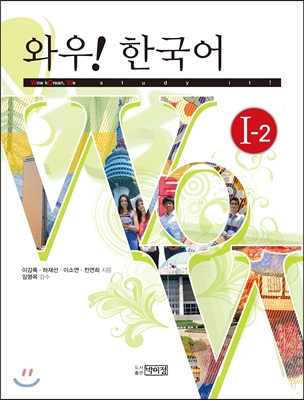
Wow! Korean 1-2
 |
Description
Book Introduction
Korean language textbook for foreigners.
It is aimed at beginners of Korean and covers three areas: speaking, listening, and reading.
‘Reading’ and ‘writing’ are integrated, and ‘writing’ can be reinforced through activities for each subject.
It provides abundant pictures and photos to help you intuitively understand the content and context, and it also helps you check what you have learned through the TOPIK-type confirmation learning section and become familiar with the types of Korean language proficiency tests.
It is aimed at beginners of Korean and covers three areas: speaking, listening, and reading.
‘Reading’ and ‘writing’ are integrated, and ‘writing’ can be reinforced through activities for each subject.
It provides abundant pictures and photos to help you intuitively understand the content and context, and it also helps you check what you have learned through the TOPIK-type confirmation learning section and become familiar with the types of Korean language proficiency tests.
index
CHAPTER 01 What does the teacher do?
CHAPTER 02 What are you doing these days?
CHAPTER 03 What are you doing now?
CHAPTER 04 What kind of person do you like?
CHAPTER 05 What gift did you receive yesterday?
CHAPTER 06 How many more people are coming?
CHAPTER 07 What are you going to buy?
CHAPTER 08 Shall I choose for you?
CHAPTER 09 Do you want to go together?
CHAPTER 10 Are you getting ready to go to Everland?
CHAPTER 11 Why didn't you come to school yesterday?
CHAPTER 12 I'm busy, so should I order something?
CHAPTER 13 Can I turn on the heater?
CHAPTER 14 Have you tried spicy stir-fried chicken?
CHAPTER 15 What would you like to do on a deserted island?
CHAPTER 16 How do I borrow a book?
CHAPTER 17 Will I do well on this test?
CHAPTER 18 Do you think you'll do well on the test?
CHAPTER 19 You're in Dunsan-dong?
Search
CHAPTER 02 What are you doing these days?
CHAPTER 03 What are you doing now?
CHAPTER 04 What kind of person do you like?
CHAPTER 05 What gift did you receive yesterday?
CHAPTER 06 How many more people are coming?
CHAPTER 07 What are you going to buy?
CHAPTER 08 Shall I choose for you?
CHAPTER 09 Do you want to go together?
CHAPTER 10 Are you getting ready to go to Everland?
CHAPTER 11 Why didn't you come to school yesterday?
CHAPTER 12 I'm busy, so should I order something?
CHAPTER 13 Can I turn on the heater?
CHAPTER 14 Have you tried spicy stir-fried chicken?
CHAPTER 15 What would you like to do on a deserted island?
CHAPTER 16 How do I borrow a book?
CHAPTER 17 Will I do well on this test?
CHAPTER 18 Do you think you'll do well on the test?
CHAPTER 19 You're in Dunsan-dong?
Search
Publisher's Review
Wow Korean was developed with the goal of publishing an integrated textbook divided into areas suitable for basic Korean language learners for academic purposes.
In Korean language education for beginners, it is important for learners to understand the content and context of the learning without using their native language or a medium.
The most significant feature of this textbook is that it includes numerous illustrations and photographs, allowing beginner Korean language learners to intuitively understand the content and context.
And, we focused on helping students understand the content of each subject through appropriate practice problems and on being able to use what they understood in real language situations through various assignment activities.
Wow Korean I-1 and I-2 are for beginners of Korean language and the difficulty level of the textbook is similar to the general level of integrated textbooks divided into areas for beginners of Korean language.
If you teach and learn Korean I-1 and I-2 normally, you can expect to reach level 1 of Korean language proficiency.
The study time required is 4 to 5 hours per subject, and 80 to 100 hours per volume consisting of 19 to 20 subjects.
The textbook is divided into three areas: ‘speaking, listening, and reading’, and ‘reading’ and ‘writing’ are integrated.
We have made it possible to reinforce ‘writing’ through activities for each subject.
Speaking and grammar were integrated and allocated about 2 hours for each area, and listening, reading and writing, and activities were allocated about 2 hours.
The order of presentation of grammar and expressions was presented sequentially, giving priority to difficulty level.
We aimed to achieve balanced development across all areas by providing exercises and activities for each grammar to improve understanding and application of grammar.
The topics of the speaking, listening, and reading passages were selected by considering topics and situations that could occur within the limited scope of activities of beginner learners, and 12 to 16 vocabulary words necessary for grammar use and expression were presented for each subject along with pictures.
Reading and writing are structured reading passages with realistic content, enabling formal writing skills and practical writing skills to be learned.
Additionally, each subject has a TOPIK-type confirmation learning section so that students can simultaneously prepare for the regular evaluation of their learning content and become familiar with the types of the Korean language proficiency test.
In Korean language education for beginners, it is important for learners to understand the content and context of the learning without using their native language or a medium.
The most significant feature of this textbook is that it includes numerous illustrations and photographs, allowing beginner Korean language learners to intuitively understand the content and context.
And, we focused on helping students understand the content of each subject through appropriate practice problems and on being able to use what they understood in real language situations through various assignment activities.
Wow Korean I-1 and I-2 are for beginners of Korean language and the difficulty level of the textbook is similar to the general level of integrated textbooks divided into areas for beginners of Korean language.
If you teach and learn Korean I-1 and I-2 normally, you can expect to reach level 1 of Korean language proficiency.
The study time required is 4 to 5 hours per subject, and 80 to 100 hours per volume consisting of 19 to 20 subjects.
The textbook is divided into three areas: ‘speaking, listening, and reading’, and ‘reading’ and ‘writing’ are integrated.
We have made it possible to reinforce ‘writing’ through activities for each subject.
Speaking and grammar were integrated and allocated about 2 hours for each area, and listening, reading and writing, and activities were allocated about 2 hours.
The order of presentation of grammar and expressions was presented sequentially, giving priority to difficulty level.
We aimed to achieve balanced development across all areas by providing exercises and activities for each grammar to improve understanding and application of grammar.
The topics of the speaking, listening, and reading passages were selected by considering topics and situations that could occur within the limited scope of activities of beginner learners, and 12 to 16 vocabulary words necessary for grammar use and expression were presented for each subject along with pictures.
Reading and writing are structured reading passages with realistic content, enabling formal writing skills and practical writing skills to be learned.
Additionally, each subject has a TOPIK-type confirmation learning section so that students can simultaneously prepare for the regular evaluation of their learning content and become familiar with the types of the Korean language proficiency test.
GOODS SPECIFICS
- Date of publication: September 12, 2013
- Page count, weight, size: 288 pages | 755g | 210*297*20mm
- ISBN13: 9788962924435
- ISBN10: 8962924439
You may also like
카테고리
korean


korean

![GQ KOREA Mark (Monthly): December [2025]](http://librairie.coreenne.fr/cdn/shop/files/8ef265dbbfbf186523ed75ba7319009d.jpg?v=1765340328&width=3840)


