

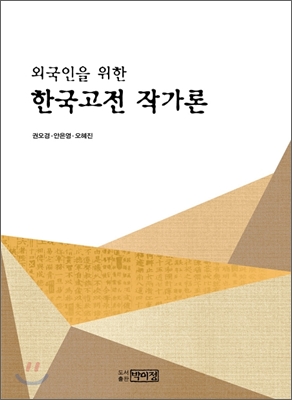
Korean Classical Writers
 |
Description
Book Introduction
Korean culture education should no longer be taught as a subset of Korean language education, but rather as a unique area or an integrated area with Korean language education to achieve the goal of developing intercultural communication skills.
Additionally, textbooks for advanced-level specialized education for international students studying abroad for academic purposes must be continuously developed for each subject.
This book was written for use as a university major subject education in response to these historical backgrounds and demands.
This text reexamines Korea's representative writers of the past from a contemporary perspective, and through the writers, it provides an understanding of Korea's traditional culture, and furthermore, through the lives, actions, literary works, and historical background of 10 representative classical writers who fiercely lived through Korea's modern culture, it allows us to understand them.
Additionally, textbooks for advanced-level specialized education for international students studying abroad for academic purposes must be continuously developed for each subject.
This book was written for use as a university major subject education in response to these historical backgrounds and demands.
This text reexamines Korea's representative writers of the past from a contemporary perspective, and through the writers, it provides an understanding of Korea's traditional culture, and furthermore, through the lives, actions, literary works, and historical background of 10 representative classical writers who fiercely lived through Korea's modern culture, it allows us to understand them.
index
When publishing a book
Composition of the textbook
Choi Chi-won
1.
Historical background
2.
career
3.
literature
4.
Further Reading
· Jeong Ji-sang
1.
Historical background
2.
career
3.
literature
4.
Further Reading
· Lee Gyu-bo
1.
Historical background
2.
career
3.
literature
4.
Further Reading
· This color
1.
Historical background
2.
career
3.
literature
4.
Further Reading
· Kim Si-seup
1.
Historical background
2.
career
3.
literature
4.
Further Reading
· Hwang Jini
1.
Historical background
2.
career
3.
literature
4.
Further Reading
· Jeong Cheol
1.
Historical background
2.
career
3.
literature
4.
Further Reading
· Heo Nanseolheon
1.
Historical background
2.
career
3.
literature
4.
Further Reading
Kim Cheon-taek
1.
Historical background
2.
career
3.
literature
4.
Further Reading
Park Ji-won
1.
Historical background
2.
career
3.
literature
4.
Further Reading
Browse 1 History and Culture
Lookup 2 Vocabulary
Composition of the textbook
Choi Chi-won
1.
Historical background
2.
career
3.
literature
4.
Further Reading
· Jeong Ji-sang
1.
Historical background
2.
career
3.
literature
4.
Further Reading
· Lee Gyu-bo
1.
Historical background
2.
career
3.
literature
4.
Further Reading
· This color
1.
Historical background
2.
career
3.
literature
4.
Further Reading
· Kim Si-seup
1.
Historical background
2.
career
3.
literature
4.
Further Reading
· Hwang Jini
1.
Historical background
2.
career
3.
literature
4.
Further Reading
· Jeong Cheol
1.
Historical background
2.
career
3.
literature
4.
Further Reading
· Heo Nanseolheon
1.
Historical background
2.
career
3.
literature
4.
Further Reading
Kim Cheon-taek
1.
Historical background
2.
career
3.
literature
4.
Further Reading
Park Ji-won
1.
Historical background
2.
career
3.
literature
4.
Further Reading
Browse 1 History and Culture
Lookup 2 Vocabulary
Publisher's Review
Recently, with the development of the Korean economy, foreign workers, married immigrant women, foreign students, and foreigners with special occupations have begun to enter Korea.
Korean language education as a foreign language targeting these people has also developed at a tremendous pace, and during this period, content and teaching-learning methods for Korean language education have been presented and the foundation has been laid.
Additionally, universities took the lead in creating culturally-related teaching materials, and teaching methods and classes for cultural education were implemented in various educational settings.
However, when looking at foreign examples, it can be said that Korean language culture education is just taking its first steps.
Korean culture education should no longer be taught as a subset of Korean language education, but rather as a unique area or an integrated area with Korean language education to achieve the goal of developing intercultural communication skills.
Additionally, textbooks for advanced-level specialized education for international students studying abroad for academic purposes must be continuously developed for each subject.
This book was created for use as a university major subject education in response to these historical backgrounds and demands.
This text reexamines Korea's representative writers of the past from a contemporary perspective, and through these writers, we understand Korea's traditional culture. Furthermore, through the lives, actions, literary works, and historical background of 10 representative classical writers who fiercely lived through Korea's modern culture, we understand them.
The study of classical Korean writers is a field of study that is difficult even for Korean students to understand.
Therefore, we only deal with representative works, but we structured the content so that readers can understand, explore, and learn about the situation at the time on their own.
That is, it was designed to help advanced foreign learners understand Korean traditional culture, understand the Korean language and Korean people, and find themselves through literary works and compare them with their home culture.
Korean language education as a foreign language targeting these people has also developed at a tremendous pace, and during this period, content and teaching-learning methods for Korean language education have been presented and the foundation has been laid.
Additionally, universities took the lead in creating culturally-related teaching materials, and teaching methods and classes for cultural education were implemented in various educational settings.
However, when looking at foreign examples, it can be said that Korean language culture education is just taking its first steps.
Korean culture education should no longer be taught as a subset of Korean language education, but rather as a unique area or an integrated area with Korean language education to achieve the goal of developing intercultural communication skills.
Additionally, textbooks for advanced-level specialized education for international students studying abroad for academic purposes must be continuously developed for each subject.
This book was created for use as a university major subject education in response to these historical backgrounds and demands.
This text reexamines Korea's representative writers of the past from a contemporary perspective, and through these writers, we understand Korea's traditional culture. Furthermore, through the lives, actions, literary works, and historical background of 10 representative classical writers who fiercely lived through Korea's modern culture, we understand them.
The study of classical Korean writers is a field of study that is difficult even for Korean students to understand.
Therefore, we only deal with representative works, but we structured the content so that readers can understand, explore, and learn about the situation at the time on their own.
That is, it was designed to help advanced foreign learners understand Korean traditional culture, understand the Korean language and Korean people, and find themselves through literary works and compare them with their home culture.
GOODS SPECIFICS
- Date of issue: March 9, 2012
- Page count, weight, size: 225 pages | 454g | 178*248*20mm
- ISBN13: 9788962922882
- ISBN10: 8962922886
You may also like
카테고리
korean


korean

![GQ KOREA Mark (Monthly): December [2025]](http://librairie.coreenne.fr/cdn/shop/files/8ef265dbbfbf186523ed75ba7319009d.jpg?v=1765340328&width=3840)


