

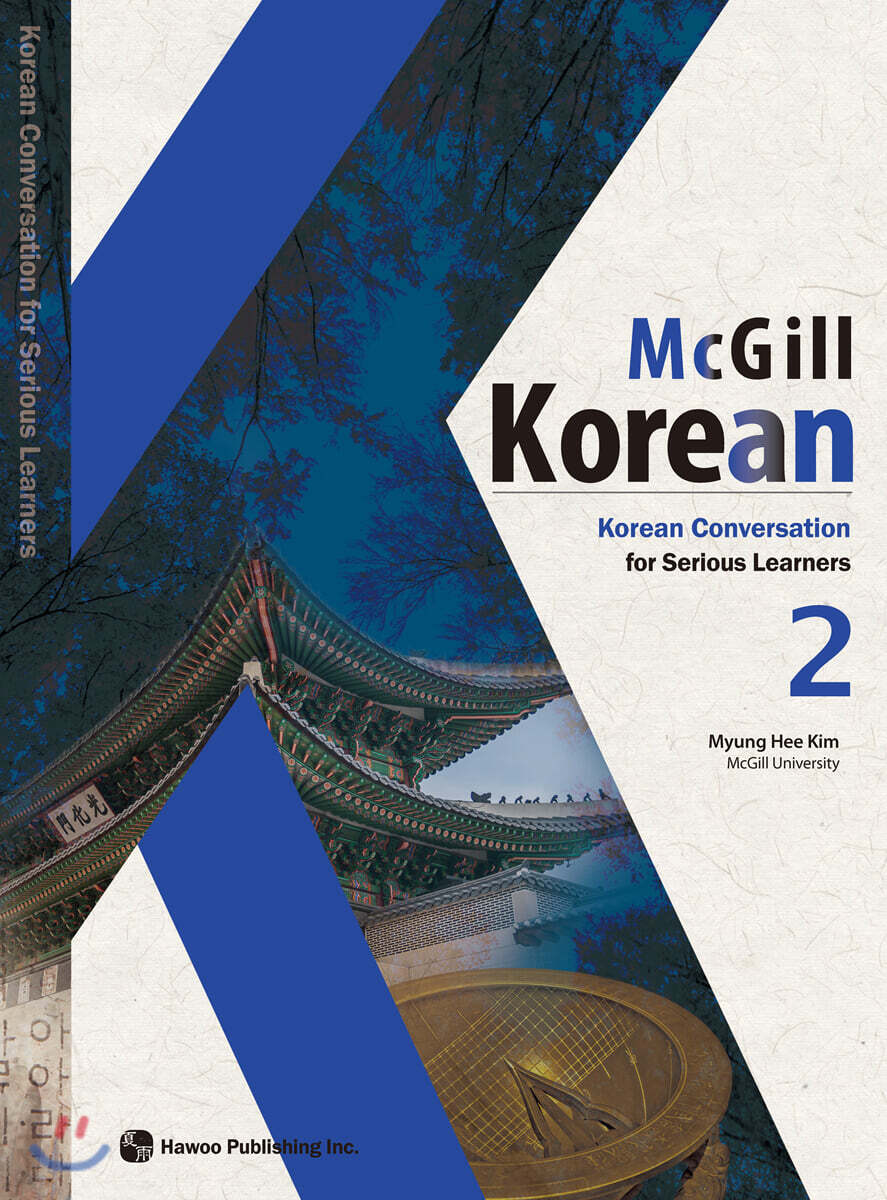
McGill Korean 2
 |
Description
Book Introduction
"McGill Korean 2" is a Korean grammar textbook and contains approximately 90-100 hours of grammar lectures for English-speaking adults (university and graduate students).
McGill University's second-year Korean language course, like the first-year course, is a 9-credit course that runs for two semesters (26 weeks) and has a total of 130 hours of class time, one hour per day.
Of those, 90-100 hours are spent studying grammar using McGill Korean 2 as a textbook, and the remaining 30-40 hours are spent on practice activities such as listening, speaking, and translation.
Materials needed for practice activities are mainly materials other than textbooks.
These non-textbook materials are selected and used appropriately based on students' interests and Korean language level to encourage more active participation.
Therefore, listening and speaking practice materials may change from year to year.
While Volume 1 focuses on acquiring sentence structure, that is, creating structurally correct sentences, Volume 2 deals with grammar that requires a complex consideration of context, word composition, and various other factors.
Even a structurally well-formed sentence, when considered separately, must be written in context to achieve the desired communication.
As context becomes more important, the learning process also becomes more situation-focused.
It covers topics from daily life in eight chapters, and within each topic, four different situations are presented through examples of conversations, texts, and listening practice.
McGill University's second-year Korean language course, like the first-year course, is a 9-credit course that runs for two semesters (26 weeks) and has a total of 130 hours of class time, one hour per day.
Of those, 90-100 hours are spent studying grammar using McGill Korean 2 as a textbook, and the remaining 30-40 hours are spent on practice activities such as listening, speaking, and translation.
Materials needed for practice activities are mainly materials other than textbooks.
These non-textbook materials are selected and used appropriately based on students' interests and Korean language level to encourage more active participation.
Therefore, listening and speaking practice materials may change from year to year.
While Volume 1 focuses on acquiring sentence structure, that is, creating structurally correct sentences, Volume 2 deals with grammar that requires a complex consideration of context, word composition, and various other factors.
Even a structurally well-formed sentence, when considered separately, must be written in context to achieve the desired communication.
As context becomes more important, the learning process also becomes more situation-focused.
It covers topics from daily life in eight chapters, and within each topic, four different situations are presented through examples of conversations, texts, and listening practice.
index
Preface
To the teachers
Introduction
Terms used in Grammar Explanations
Table of contents
Contents
Unit 01 Greetings
Greetings1
Greetings 2
Greetings 3
Ariane Introduces Herself
Unit 02 Weather
Weather and Seasons
Typhoon
Weather Forecast
Seoraksan MT Field Trip to Mt.
Seorak Mountain
Unit 03 Shopping
In a Shoe Shop
In a Clothing Store
Fashion and Individual Character
Exchange and Reimbursement
Unit 04 Invitation and Gifts
Dinner Invitation
Visiting Gifts
Invitation for Friends' Gathering
Gifts for Housewarming
Unit 05 Korean Food
Rice Cake Soup
Fish Dishes
Bulgogi Recipe
Spicy Chicken
Unit 06 Health
In a Hospital
In a Drugstore
To be healthy
Ankle Injury
Unit 07 Shape Description
Hair Style
Lost Items
Different Kinds of Bags
Studio Apartment
Unit 08 Personality Description
Description of Personality
Ideal Type
Personality and Career
Ondal the Fool and the Princess Pyeonggang
Appendix
Listening Script
Answers for Exercises
Index of Grammar Points
To the teachers
Introduction
Terms used in Grammar Explanations
Table of contents
Contents
Unit 01 Greetings
Greetings1
Greetings 2
Greetings 3
Ariane Introduces Herself
Unit 02 Weather
Weather and Seasons
Typhoon
Weather Forecast
Seoraksan MT Field Trip to Mt.
Seorak Mountain
Unit 03 Shopping
In a Shoe Shop
In a Clothing Store
Fashion and Individual Character
Exchange and Reimbursement
Unit 04 Invitation and Gifts
Dinner Invitation
Visiting Gifts
Invitation for Friends' Gathering
Gifts for Housewarming
Unit 05 Korean Food
Rice Cake Soup
Fish Dishes
Bulgogi Recipe
Spicy Chicken
Unit 06 Health
In a Hospital
In a Drugstore
To be healthy
Ankle Injury
Unit 07 Shape Description
Hair Style
Lost Items
Different Kinds of Bags
Studio Apartment
Unit 08 Personality Description
Description of Personality
Ideal Type
Personality and Career
Ondal the Fool and the Princess Pyeonggang
Appendix
Listening Script
Answers for Exercises
Index of Grammar Points
Publisher's Review
As in McGill Korean 1, McGill Korean 2 also designed the Korean language learning course based on the following three questions.
1.
Learning assignments
While the relationship between words within a sentence was important in the first year, understanding context and word structure become important in the second year.
The main goal is to create sentences that fit the context and to accurately understand the complex structure of words.
As an example, we can learn step by step how the indirect speech endings, one of the most important grammar points in Korean, are combined with attributive endings or connective endings to form a single word.
In addition, it covers various connective endings that can be difficult to learn in Korean.
In learning connective endings, we focus on understanding the relationship between the two simple sentences we want to connect and accurately grasping the speaker's intention.
2.
Learning order
In the first year, sentence structure was the focus, and there was an efficient learning order for acquiring the basic grammar required for this, so it was important to follow that order.
In contrast, if contextual understanding is the focus, the learning order can be somewhat flexible.
In McGill Korean 2, I introduced what I considered the most important and useful grammatical elements of Korean grammar as early as possible so that students could continue to practice and review them multiple times throughout the two semesters.
3.
How to explain
The basic method of explanation is similar to that of McGill Korean 1, which teaches the minimum elements with meaning separately so that students can analyze and understand these minimum elements when combined with other elements, and can also combine them with other elements to create sentences.
Korean is an agglutinative language, so it often has many different elements added together to form a single word.
To reach fluency in Korean, you must understand and be able to use the meaning of each component.
Language is a complex system governed by certain grammatical rules that serves as a tool for communication using spoken and written words.
Of course, we cannot cover all the phenomena that occur in language during a given lecture period.
However, we can give students 'tricks' to understand and use these linguistic phenomena in a general way.
Once you get the hang of it, you can figure out what role it plays in a sentence and how to use it, just by looking up the meaning of things you didn't see directly in class.
1.
Learning assignments
While the relationship between words within a sentence was important in the first year, understanding context and word structure become important in the second year.
The main goal is to create sentences that fit the context and to accurately understand the complex structure of words.
As an example, we can learn step by step how the indirect speech endings, one of the most important grammar points in Korean, are combined with attributive endings or connective endings to form a single word.
In addition, it covers various connective endings that can be difficult to learn in Korean.
In learning connective endings, we focus on understanding the relationship between the two simple sentences we want to connect and accurately grasping the speaker's intention.
2.
Learning order
In the first year, sentence structure was the focus, and there was an efficient learning order for acquiring the basic grammar required for this, so it was important to follow that order.
In contrast, if contextual understanding is the focus, the learning order can be somewhat flexible.
In McGill Korean 2, I introduced what I considered the most important and useful grammatical elements of Korean grammar as early as possible so that students could continue to practice and review them multiple times throughout the two semesters.
3.
How to explain
The basic method of explanation is similar to that of McGill Korean 1, which teaches the minimum elements with meaning separately so that students can analyze and understand these minimum elements when combined with other elements, and can also combine them with other elements to create sentences.
Korean is an agglutinative language, so it often has many different elements added together to form a single word.
To reach fluency in Korean, you must understand and be able to use the meaning of each component.
Language is a complex system governed by certain grammatical rules that serves as a tool for communication using spoken and written words.
Of course, we cannot cover all the phenomena that occur in language during a given lecture period.
However, we can give students 'tricks' to understand and use these linguistic phenomena in a general way.
Once you get the hang of it, you can figure out what role it plays in a sentence and how to use it, just by looking up the meaning of things you didn't see directly in class.
GOODS SPECIFICS
- Publication date: April 29, 2020
- Page count, weight, size: 248 pages | 589g | 188*257*20mm
- ISBN13: 9791190154512
- ISBN10: 119015451X
You may also like
카테고리
korean


korean

![GQ KOREA Mark (Monthly): December [2025]](http://librairie.coreenne.fr/cdn/shop/files/8ef265dbbfbf186523ed75ba7319009d.jpg?v=1765340328&width=3840)


