

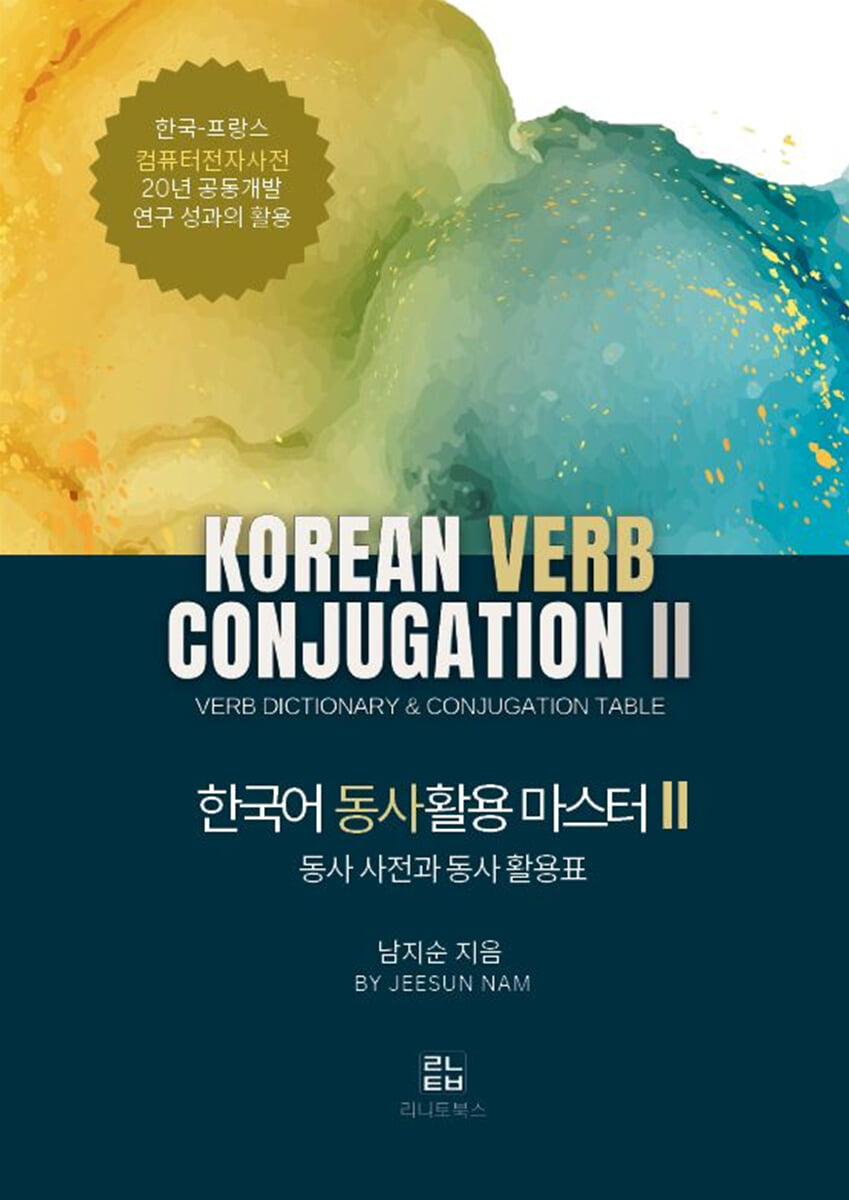
Master Korean Verb Conjugation 2 Verb Dictionary and Verb Conjugation Table
 |
Description
Book Introduction
This book classifies Korean verb conjugation groups into nine categories and presents a table of conjugation changes for each group to help advanced Korean learners correctly write and use the various conjugations of Korean verbs.
Master Korean Verb Conjugation I.
In the section 'Understanding the Principles of Verb Conjugation', each component of verb conjugation and its combination principles are explained, and in this book, based on these principles, all possible combinations of conjugation forms are presented in a table.
This book contains conjugation information for approximately 2,400 Korean verbs along with their English equivalents.
The inflectional changes presented in the inflectional tables for each inflectional group are presented in approximately 450 complex configurations for 45 final suffixes, and through the additional correspondence table for approximately 170 final suffixes presented separately, you can learn the expanded inflectional types for one verb, which has been expanded to approximately 2,300.
Ultimately, learners will be able to learn all 5 million Korean verb conjugations using the conjugation information in the verb dictionary included in this book.
(☞ 2,300 conjugations per verb x 2,400 verb titles = 5,520,000 conjugations)
The reason why Korean conjugation forms have such a complex appearance is that, first of all, expressions such as ‘tense’ and ‘subject honorifics’, and modal expressions such as ‘guess’ and ‘reminiscence’ can be inserted in a complex manner between the verb stem and the conjugation ending.
Additionally, each conjugation ending has a different form depending on whether it ends a sentence, induces an adverbial clause within a sentence, induces an attributive clause modifying a noun, or forms a noun clause within a sentence.
In this case, in the case of the final form, the form changes depending on the social relationship with the conversation partner, whether it is informal, polite, or formal.
In addition, the form of the conjugation ending is further subdivided depending on whether the sentence type is a general declarative sentence, an interrogative sentence, or an imperative sentence.
For example, let's assume that a question is given asking, "Give an interrogative sentence structure that expresses respect for the subject in a past situation for the verbs 'help/go/know.'"
As seen in 'Did you help?/Did you go?/Did you know?', the number of possible combinations for a single verb increases exponentially as interrogative endings such as |시|, |때|, and |나나/까게/냐| are combined.
Since it is not possible to simply memorize the number of these combinations, learners can efficiently learn these various conjugation forms by understanding the principles of morphological changes in the stem and endings of each verb and the conditions for combining various conjugation endings.
Master Korean Verb Conjugation I.
In the section 'Understanding the Principles of Verb Conjugation', each component of verb conjugation and its combination principles are explained, and in this book, based on these principles, all possible combinations of conjugation forms are presented in a table.
This book contains conjugation information for approximately 2,400 Korean verbs along with their English equivalents.
The inflectional changes presented in the inflectional tables for each inflectional group are presented in approximately 450 complex configurations for 45 final suffixes, and through the additional correspondence table for approximately 170 final suffixes presented separately, you can learn the expanded inflectional types for one verb, which has been expanded to approximately 2,300.
Ultimately, learners will be able to learn all 5 million Korean verb conjugations using the conjugation information in the verb dictionary included in this book.
(☞ 2,300 conjugations per verb x 2,400 verb titles = 5,520,000 conjugations)
The reason why Korean conjugation forms have such a complex appearance is that, first of all, expressions such as ‘tense’ and ‘subject honorifics’, and modal expressions such as ‘guess’ and ‘reminiscence’ can be inserted in a complex manner between the verb stem and the conjugation ending.
Additionally, each conjugation ending has a different form depending on whether it ends a sentence, induces an adverbial clause within a sentence, induces an attributive clause modifying a noun, or forms a noun clause within a sentence.
In this case, in the case of the final form, the form changes depending on the social relationship with the conversation partner, whether it is informal, polite, or formal.
In addition, the form of the conjugation ending is further subdivided depending on whether the sentence type is a general declarative sentence, an interrogative sentence, or an imperative sentence.
For example, let's assume that a question is given asking, "Give an interrogative sentence structure that expresses respect for the subject in a past situation for the verbs 'help/go/know.'"
As seen in 'Did you help?/Did you go?/Did you know?', the number of possible combinations for a single verb increases exponentially as interrogative endings such as |시|, |때|, and |나나/까게/냐| are combined.
Since it is not possible to simply memorize the number of these combinations, learners can efficiently learn these various conjugation forms by understanding the principles of morphological changes in the stem and endings of each verb and the conditions for combining various conjugation endings.
index
Preface | Author's Preface ii
Note | How to Use This Book vii
Understanding Terminology | Basic Concepts ix
Book Structure | Table of Contents xi
Chapter 1.
Understanding Verb Dictionary and Conjugation Tables
1 Korean Verb Conjugation Dictionary 3
1.1 Korean Verb Dictionary 3, arranged alphabetically
1.2 Classification criteria for nine Korean verb conjugation groups 4
1.3 22 subtypes of 9 verb conjugation groups 5
2 Verb conjugation group-by-group table 10
2.1 Usage of 'Conclusive, Adjective, Noun, and Adverbial' 10
2.2 Insertion of 'honorifics, tense, and modality' suffixes 11
2.3 Comparing the ending variations for representative endings by usage type 12
Chapter 2.
Korean Verb Conjugation Dictionary
|ga| type verb 19
|I| Type 32 Verbs
|da| Type 36 Verbs
|ma| Type verb 44
|Bar| Type Verb 50
|Sa| type verb 62
|Ah| Type verb 73
|ja| Type verb 88
|차| Type Verb 103
|ka| Type Verb 111
|ta| type verb 112
|Pa| Type Verb 116
|ha| Type verb 120
Chapter 3.
Conjugation table by verb group
Verb conjugation group-by-group table 130
Table 131: Representative and Variant Forms of Conjugative Endings
1st Army | Verbs with '아' Conjugation with Final Consonant 135
Group 1A | Miscellaneous | Type 137
Group 1B | Realize | Type 143
Group 1C | Better | Type 149
1D Group | Know | Type 155
2nd Army | Verbs with 'eot' consonants 161
Group 2A | Laugh | Type 163
Group 2B | Listen | Type 169
Group 2C | Buddha | Type 175
2D Group | Open | Type 181
Third Army | Verbs with the consonant 'ㅤㅏㅆ' 187
3rd Army | Assist | Type 189
4th Army | Verbs with 'ㅤㅓㅆ' Conjugation 195
Group 4 | Lying Down | Type 197
5th Army | 203 Verbs with Unconsonant "ㅤㅏㅆ"
Group 5A | Oda | Type 205
Group 5B | Type 211
5C Group | Collect | Type 217
5D Group | Select | Type 223
6th Army | Verbs with no final consonant 'ㅤㅓㅆ' 229
Group 6A | Learn | Type 231
Group 6B | Become | Type 237
6C Group | Turn off | Type 243
6D Group | Call | Type 249
6E Group |Early| Type 255
7th Army | 261 Verbs with Unconsonant "ㅆ"
7th Army | Go | Type 263
8th Army | 269 Verbs Conjugated with "어트" Without a Final Consonant
8th Army | Rest | Type 271
9th Army | 277 Verbs with "was" Conjugation Without a Final Consonant
9th Army |Hada| Type 279
Note | How to Use This Book vii
Understanding Terminology | Basic Concepts ix
Book Structure | Table of Contents xi
Chapter 1.
Understanding Verb Dictionary and Conjugation Tables
1 Korean Verb Conjugation Dictionary 3
1.1 Korean Verb Dictionary 3, arranged alphabetically
1.2 Classification criteria for nine Korean verb conjugation groups 4
1.3 22 subtypes of 9 verb conjugation groups 5
2 Verb conjugation group-by-group table 10
2.1 Usage of 'Conclusive, Adjective, Noun, and Adverbial' 10
2.2 Insertion of 'honorifics, tense, and modality' suffixes 11
2.3 Comparing the ending variations for representative endings by usage type 12
Chapter 2.
Korean Verb Conjugation Dictionary
|ga| type verb 19
|I| Type 32 Verbs
|da| Type 36 Verbs
|ma| Type verb 44
|Bar| Type Verb 50
|Sa| type verb 62
|Ah| Type verb 73
|ja| Type verb 88
|차| Type Verb 103
|ka| Type Verb 111
|ta| type verb 112
|Pa| Type Verb 116
|ha| Type verb 120
Chapter 3.
Conjugation table by verb group
Verb conjugation group-by-group table 130
Table 131: Representative and Variant Forms of Conjugative Endings
1st Army | Verbs with '아' Conjugation with Final Consonant 135
Group 1A | Miscellaneous | Type 137
Group 1B | Realize | Type 143
Group 1C | Better | Type 149
1D Group | Know | Type 155
2nd Army | Verbs with 'eot' consonants 161
Group 2A | Laugh | Type 163
Group 2B | Listen | Type 169
Group 2C | Buddha | Type 175
2D Group | Open | Type 181
Third Army | Verbs with the consonant 'ㅤㅏㅆ' 187
3rd Army | Assist | Type 189
4th Army | Verbs with 'ㅤㅓㅆ' Conjugation 195
Group 4 | Lying Down | Type 197
5th Army | 203 Verbs with Unconsonant "ㅤㅏㅆ"
Group 5A | Oda | Type 205
Group 5B | Type 211
5C Group | Collect | Type 217
5D Group | Select | Type 223
6th Army | Verbs with no final consonant 'ㅤㅓㅆ' 229
Group 6A | Learn | Type 231
Group 6B | Become | Type 237
6C Group | Turn off | Type 243
6D Group | Call | Type 249
6E Group |Early| Type 255
7th Army | 261 Verbs with Unconsonant "ㅆ"
7th Army | Go | Type 263
8th Army | 269 Verbs Conjugated with "어트" Without a Final Consonant
8th Army | Rest | Type 271
9th Army | 277 Verbs with "was" Conjugation Without a Final Consonant
9th Army |Hada| Type 279
GOODS SPECIFICS
- Date of issue: September 12, 2024
- Page count, weight, size: 304 pages | 148*210*30mm
- ISBN13: 9791198899118
- ISBN10: 1198899115
You may also like
카테고리
korean


korean

![GQ KOREA Mark (Monthly): December [2025]](http://librairie.coreenne.fr/cdn/shop/files/8ef265dbbfbf186523ed75ba7319009d.jpg?v=1765340328&width=3840)


