

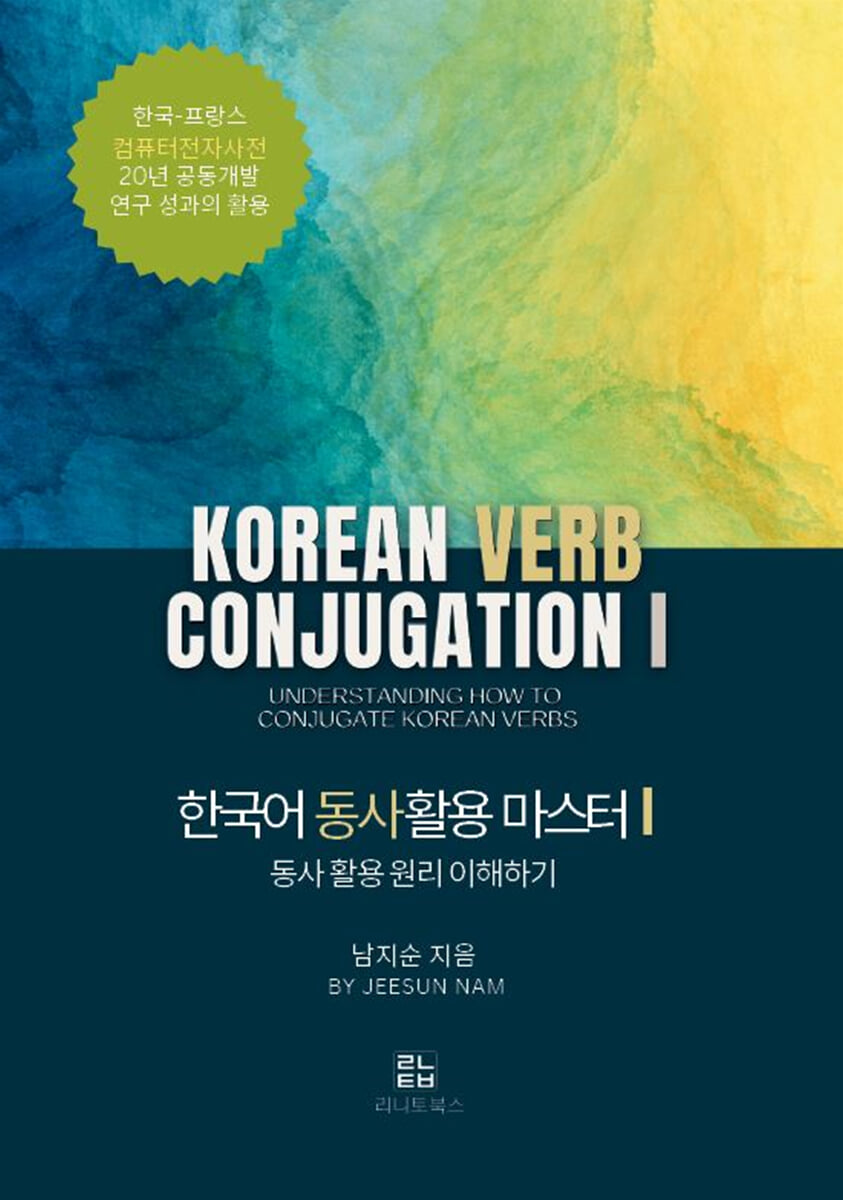
Master Korean Verb Conjugation 1: Understanding Verb Conjugation Principles
 |
Description
Book Introduction
This book was designed to help advanced Korean language learners understand and use the various conjugations of Korean verbs correctly by providing an easy-to-understand explanation of their structure and presenting actual conjugation changes for each verb.
This book explains the principles of how Korean verb conjugation is formed, divided into the characteristics of each verb and the characteristics of the conjugation endings, to help learners systematically understand the fundamental principles and internal regularities of the complex conjugation changes in the Korean language.
Based on this, learners can master Korean verb conjugation II.
In the 'Verb Dictionary and Verb Conjugation Table' section, you can learn about the actual conjugation changes of representative verbs for nine groups of verbs based on these Korean conjugation principles.
In Part II, Korean verbs corresponding to each conjugation group are included in a dictionary along with conjugation information, so learners can find the verb headword they want to know the conjugation change for and learn its conjugation form from the conjugation table for the corresponding conjugation group.
In this book, the conjugation of all Korean verbs is explained by dividing them into nine groups.
Korean verbs were classified into nine types based on the characteristics of 'whether the final syllable of the verb stem has a final consonant' and 'how the |을| form of the past tense changes', and were further classified into 22 types based on detailed characteristics, and representative verbs for each type were introduced.
In addition, the morphological characteristics and principles of use of the 'final/adjective/noun/adverbial (connective)' conjugation endings that are combined with each verb were explained in detail.
In the case of the final form, we looked at the endings used when the sentence type indicates 'declarative sentence/interrogative sentence/imperative sentence' in relation to the three speech styles of 'informal/polite/formal', and in the case of the adverbial form, we divided it into five types of 'cause/condition/concession/explanation/purpose' according to its semantic function and explained the forms and characteristics of various endings.
By examining the order and constraints of the honorific/tense/modal suffixes inserted between verbs and final suffixes, we can understand the fundamental principles of how a single Korean verb can be realized in thousands of conjugated forms.
This book is designed to help advanced Korean language learners understand the complex conjugation system of Korean verbs and master their conjugation changes. However, it is also designed to be a reference for native language researchers entering the field of theoretical linguistics or Korean language studies to systematically understand and study the principles of Korean verb conjugation.
Because the study of Korean morphology has a long history and is fraught with controversies, this book has attempted to strike the best balance between academic curiosity and practical, educational objectives.
Furthermore, just as the development of electronic dictionaries and grammar research for computer-aided natural language processing (NLP) served as the starting point for this book, it is expected to provide meaningful insights to researchers and developers developing morphological analyzers, electronic dictionaries, and language data for Korean NLP in related research institutes and industrial settings.
This book explains the principles of how Korean verb conjugation is formed, divided into the characteristics of each verb and the characteristics of the conjugation endings, to help learners systematically understand the fundamental principles and internal regularities of the complex conjugation changes in the Korean language.
Based on this, learners can master Korean verb conjugation II.
In the 'Verb Dictionary and Verb Conjugation Table' section, you can learn about the actual conjugation changes of representative verbs for nine groups of verbs based on these Korean conjugation principles.
In Part II, Korean verbs corresponding to each conjugation group are included in a dictionary along with conjugation information, so learners can find the verb headword they want to know the conjugation change for and learn its conjugation form from the conjugation table for the corresponding conjugation group.
In this book, the conjugation of all Korean verbs is explained by dividing them into nine groups.
Korean verbs were classified into nine types based on the characteristics of 'whether the final syllable of the verb stem has a final consonant' and 'how the |을| form of the past tense changes', and were further classified into 22 types based on detailed characteristics, and representative verbs for each type were introduced.
In addition, the morphological characteristics and principles of use of the 'final/adjective/noun/adverbial (connective)' conjugation endings that are combined with each verb were explained in detail.
In the case of the final form, we looked at the endings used when the sentence type indicates 'declarative sentence/interrogative sentence/imperative sentence' in relation to the three speech styles of 'informal/polite/formal', and in the case of the adverbial form, we divided it into five types of 'cause/condition/concession/explanation/purpose' according to its semantic function and explained the forms and characteristics of various endings.
By examining the order and constraints of the honorific/tense/modal suffixes inserted between verbs and final suffixes, we can understand the fundamental principles of how a single Korean verb can be realized in thousands of conjugated forms.
This book is designed to help advanced Korean language learners understand the complex conjugation system of Korean verbs and master their conjugation changes. However, it is also designed to be a reference for native language researchers entering the field of theoretical linguistics or Korean language studies to systematically understand and study the principles of Korean verb conjugation.
Because the study of Korean morphology has a long history and is fraught with controversies, this book has attempted to strike the best balance between academic curiosity and practical, educational objectives.
Furthermore, just as the development of electronic dictionaries and grammar research for computer-aided natural language processing (NLP) served as the starting point for this book, it is expected to provide meaningful insights to researchers and developers developing morphological analyzers, electronic dictionaries, and language data for Korean NLP in related research institutes and industrial settings.
index
Preface | Author's Preface ii
Note | How to Use This Book vii
Understanding Terminology | Basic Concepts ix
Book Structure | Table of Contents xi
Chapter 1 | Korean Verb Conjugation Principles
1. Conjugating Korean Verbs | Stems and Endings 3
2. Suffixes that must be included in the conjugation form | Final suffixes 5
2.1 Sentence-ending suffixes | Final tenses 5
2.2 Suffixes that form attributive clauses | Attributive 7
2.3 Suffixes that Form Noun Clauses | Noun Form 8
2.4 Suffixes that Form Adverbial Clauses | Adverbial Forms 9
3 Suffixes that can be inserted inside conjugated forms | 10 prepositional suffixes
3.1 Suffixes Indicating 'Subject Honorifics' | 10 Suffixes Indicating Honorifics
3.2 Suffixes Indicating 'Time' | 11 Tense Suffixes
3.3 Suffixes Expressing 'Guess/Recall' | 14 Modal Suffixes
4. The order of conjugation endings | Honorifics, tenses, and aspects 17
Chapter 2 | Nine Verb Groups
Group 1 | 23 Verbs with '아' Conjugation
Group 1A 'Catch' Type 25
Group 1B 'Realize' Type 27
Group 1C 'Better' Type 29
1D Group 'Know' Type 31
Group 2 | Verbs with '어트' Conjugation with Final Consonant 34
Group 2A 'Smile' Type 36
Group 2B 'Listen' Type 38
Group 2C 'Buddha' type 40
2D Group 'Open' Type 42
Group 3 | Verbs with the consonant 'ㅤㅏㅆ' conjugation 44
3rd Army 'Help' Type 44
Group 4 | Verbs with 'ㅤㅓㅆ' Conjugation with Final Consonants 47
Group 4 'Lying Down' Type 47
Group 5 | 50 Verbs with 'ㅤㅏㅆ' Conjugation Without Final Consonant
Group 5A 'Oda' Type 52
Group 5B 'Boda' Type 55
5C Group 'Gather' Type 57
5D Group 'Choose' Type 59
Group 6 | Verbs with the Unconsonant 'ㅤㅓㅆ' Conjugation 61
Group 6A 'Learning' Type 63
Group 6B 'Become' Type 66
6C Group 'Keuda' Type 68
6D Group 'Burda' Type 70
6E group 'earda' type 72
Group 7 | Verbs with the Unconsonant "ㅆ" Conjugation 74
7th Army 'Go' Type 74
8th Army | 77 Verbs Conjugated with "어트" Without a Final Consonant
8th Army 'Rest' Type 77
Group 9 | 80 Verbs Conjugated with "Is" Without a Final Consonant
9th Army 'Hada' Type 80
Chapter 3 | Types of Conjugation Endings
I Ending Form | Sentence Ending Form 87
1 Informal Speech | "I did" Expressions Between Friends 90
1.1.
Pyeongseomun 90
1.2.
Interrogative sentence 100
1.3.
Command 106
2 Polite Expressions | "I did" Everyday Expressions 111
2.1.
Pyeongseomun 111
2.2.
Interrogative sentence 117
2.3.
Command 121
3 Formal Expressions | Formal Expressions for "I did" 124
3.1.
Pyeongseomun 124
3.2.
Interrogative sentence 126
3.3.
Command 128
II Attributive Forms | 130 Conjugations of Attributive Clauses
1. Attributive clause | Expressing the attributive clause “doing” 130
III Noun Forms | Conjugations that Construct Noun Clauses 136
1 Noun Form | Expressing a “do/do” noun clause 136
IV Adverbial Forms | Conjugations that Form Adverbial Clauses 141
1. Causal Adverbial | "Hani" Expresses Cause/Reason 142
2 Conditional Adverbs | Expressing Conditions/Assumptions 147
3 Adverbial Concessions | Expressing Concession in the Even Sort of "Doing" 151
4 Descriptive Adverbs | Expressing explanation/description of “doing” 155
5 Purpose Adverbs | “To do” Expressing Purpose/Intention 162
Chapter 4 | Inserting Honorifics, Tense, and Aspect
Insertion of Honorifics, Tense, and Aspect | Insertion of Sentence Endings 169
2. 20 Types of Sentence-Ending Combinations | 171
2.1 Current & 'Subject Honorifics' Included | ? & |으| 171
2.2 Past & 'Subject Honorifics' Included | |was| & |hasyeot| 173
2.3 Past, Conjecture & 'Subject Honorifics' Included | |Would Have| & |Would Have| 176
2.4 Past/Reminiscence & 'Subject Honorifics' Included | |Issue| & |Haessue| 177
2.5 Past Perfect & 'Subject Honorifics' Included | |was| & |hasyeot| 179
2.6 Past Perfect, Conjecture & Including 'Subject Honorifics' | |Would Have Been| & |Would Have Been| 181
2.7 Past tense, flashback & 'subject honorifics' included | |waseotteoda| & |haseotteoda| 183
2.8 Future & 'Subject Honorifics' Included | |을 거| & |으실거| 184
2.9 Future/Speculation & Including 'Subject Honorifics' | |Issue| & |Isseue| 187
2.10 Future/Reminiscence & 'Subject Honorifics' Included 189
Appendix | Verb Conjugation Groups and Conjugation Endings
1 Verb Conjugation Group Summary 193
2 Summary of types of conjugated endings 208
3. Summary of the combination of suffixes 221
Note | How to Use This Book vii
Understanding Terminology | Basic Concepts ix
Book Structure | Table of Contents xi
Chapter 1 | Korean Verb Conjugation Principles
1. Conjugating Korean Verbs | Stems and Endings 3
2. Suffixes that must be included in the conjugation form | Final suffixes 5
2.1 Sentence-ending suffixes | Final tenses 5
2.2 Suffixes that form attributive clauses | Attributive 7
2.3 Suffixes that Form Noun Clauses | Noun Form 8
2.4 Suffixes that Form Adverbial Clauses | Adverbial Forms 9
3 Suffixes that can be inserted inside conjugated forms | 10 prepositional suffixes
3.1 Suffixes Indicating 'Subject Honorifics' | 10 Suffixes Indicating Honorifics
3.2 Suffixes Indicating 'Time' | 11 Tense Suffixes
3.3 Suffixes Expressing 'Guess/Recall' | 14 Modal Suffixes
4. The order of conjugation endings | Honorifics, tenses, and aspects 17
Chapter 2 | Nine Verb Groups
Group 1 | 23 Verbs with '아' Conjugation
Group 1A 'Catch' Type 25
Group 1B 'Realize' Type 27
Group 1C 'Better' Type 29
1D Group 'Know' Type 31
Group 2 | Verbs with '어트' Conjugation with Final Consonant 34
Group 2A 'Smile' Type 36
Group 2B 'Listen' Type 38
Group 2C 'Buddha' type 40
2D Group 'Open' Type 42
Group 3 | Verbs with the consonant 'ㅤㅏㅆ' conjugation 44
3rd Army 'Help' Type 44
Group 4 | Verbs with 'ㅤㅓㅆ' Conjugation with Final Consonants 47
Group 4 'Lying Down' Type 47
Group 5 | 50 Verbs with 'ㅤㅏㅆ' Conjugation Without Final Consonant
Group 5A 'Oda' Type 52
Group 5B 'Boda' Type 55
5C Group 'Gather' Type 57
5D Group 'Choose' Type 59
Group 6 | Verbs with the Unconsonant 'ㅤㅓㅆ' Conjugation 61
Group 6A 'Learning' Type 63
Group 6B 'Become' Type 66
6C Group 'Keuda' Type 68
6D Group 'Burda' Type 70
6E group 'earda' type 72
Group 7 | Verbs with the Unconsonant "ㅆ" Conjugation 74
7th Army 'Go' Type 74
8th Army | 77 Verbs Conjugated with "어트" Without a Final Consonant
8th Army 'Rest' Type 77
Group 9 | 80 Verbs Conjugated with "Is" Without a Final Consonant
9th Army 'Hada' Type 80
Chapter 3 | Types of Conjugation Endings
I Ending Form | Sentence Ending Form 87
1 Informal Speech | "I did" Expressions Between Friends 90
1.1.
Pyeongseomun 90
1.2.
Interrogative sentence 100
1.3.
Command 106
2 Polite Expressions | "I did" Everyday Expressions 111
2.1.
Pyeongseomun 111
2.2.
Interrogative sentence 117
2.3.
Command 121
3 Formal Expressions | Formal Expressions for "I did" 124
3.1.
Pyeongseomun 124
3.2.
Interrogative sentence 126
3.3.
Command 128
II Attributive Forms | 130 Conjugations of Attributive Clauses
1. Attributive clause | Expressing the attributive clause “doing” 130
III Noun Forms | Conjugations that Construct Noun Clauses 136
1 Noun Form | Expressing a “do/do” noun clause 136
IV Adverbial Forms | Conjugations that Form Adverbial Clauses 141
1. Causal Adverbial | "Hani" Expresses Cause/Reason 142
2 Conditional Adverbs | Expressing Conditions/Assumptions 147
3 Adverbial Concessions | Expressing Concession in the Even Sort of "Doing" 151
4 Descriptive Adverbs | Expressing explanation/description of “doing” 155
5 Purpose Adverbs | “To do” Expressing Purpose/Intention 162
Chapter 4 | Inserting Honorifics, Tense, and Aspect
Insertion of Honorifics, Tense, and Aspect | Insertion of Sentence Endings 169
2. 20 Types of Sentence-Ending Combinations | 171
2.1 Current & 'Subject Honorifics' Included | ? & |으| 171
2.2 Past & 'Subject Honorifics' Included | |was| & |hasyeot| 173
2.3 Past, Conjecture & 'Subject Honorifics' Included | |Would Have| & |Would Have| 176
2.4 Past/Reminiscence & 'Subject Honorifics' Included | |Issue| & |Haessue| 177
2.5 Past Perfect & 'Subject Honorifics' Included | |was| & |hasyeot| 179
2.6 Past Perfect, Conjecture & Including 'Subject Honorifics' | |Would Have Been| & |Would Have Been| 181
2.7 Past tense, flashback & 'subject honorifics' included | |waseotteoda| & |haseotteoda| 183
2.8 Future & 'Subject Honorifics' Included | |을 거| & |으실거| 184
2.9 Future/Speculation & Including 'Subject Honorifics' | |Issue| & |Isseue| 187
2.10 Future/Reminiscence & 'Subject Honorifics' Included 189
Appendix | Verb Conjugation Groups and Conjugation Endings
1 Verb Conjugation Group Summary 193
2 Summary of types of conjugated endings 208
3. Summary of the combination of suffixes 221
GOODS SPECIFICS
- Date of issue: September 12, 2024
- Page count, weight, size: 240 pages | 148*210*20mm
- ISBN13: 9791198899101
- ISBN10: 1198899107
You may also like
카테고리
korean


korean

![GQ KOREA Mark (Monthly): December [2025]](http://librairie.coreenne.fr/cdn/shop/files/8ef265dbbfbf186523ed75ba7319009d.jpg?v=1765340328&width=3840)


