

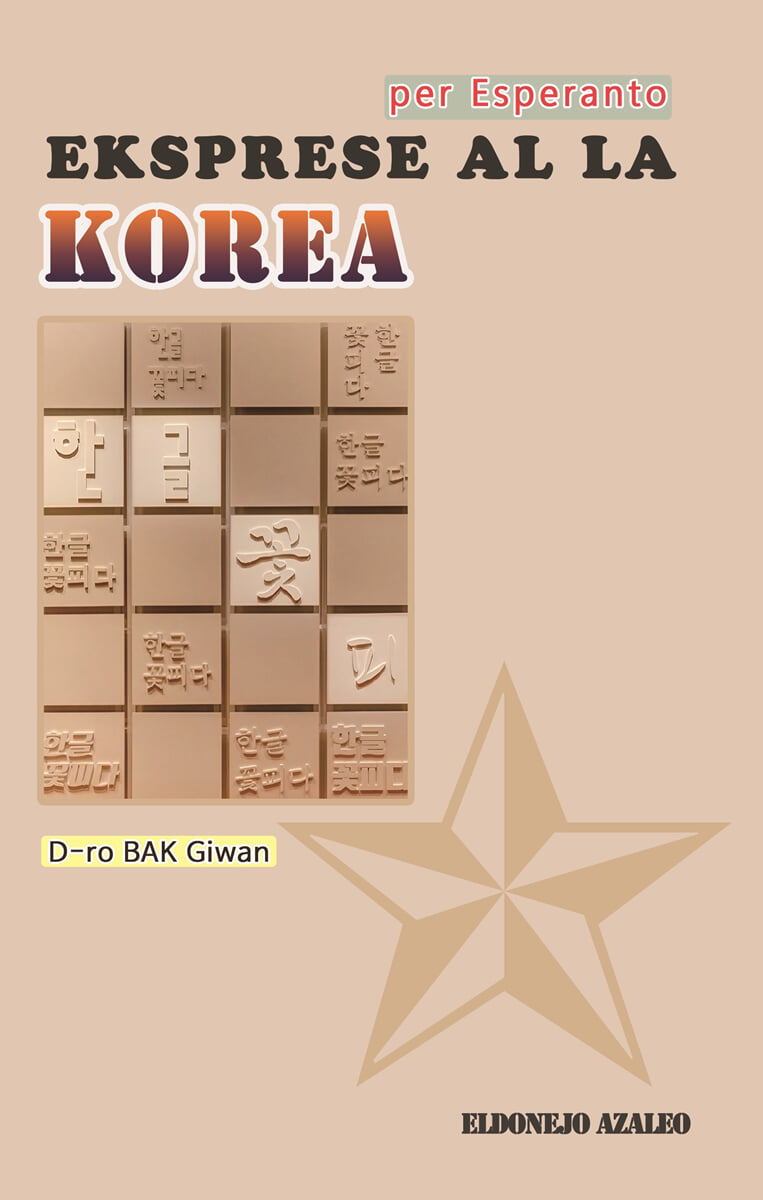
Eksprese al la korea
 |
Description
Book Introduction
A Korean textbook for learning Korean through the international language Esperanto.
We have tried to provide simple explanations of the core grammar items essential for learning Korean, as well as various language items actually needed in daily life.
I added Korean notation to all examples except the Latin notation.
(It was not Latinized according to the spelling of Korean, but rather according to the actual pronunciation.
Therefore, after going through various sound changes, the final form is Latinized.) Through this, not only can Korean sentences be read through Latinization, but Latinization is also possible.
Not only that, you can also see the appearance of Hangul writing or eventually practice writing Hangul.
We have tried to provide simple explanations of the core grammar items essential for learning Korean, as well as various language items actually needed in daily life.
I added Korean notation to all examples except the Latin notation.
(It was not Latinized according to the spelling of Korean, but rather according to the actual pronunciation.
Therefore, after going through various sound changes, the final form is Latinized.) Through this, not only can Korean sentences be read through Latinization, but Latinization is also possible.
Not only that, you can also see the appearance of Hangul writing or eventually practice writing Hangul.
index
Anta?parolo / 7
1.
History of Korea / 9
2.
Alfabeto, latinigoj kaj prononcoj / 10
3.
Fonologia sistemo / 12
4.
Skribado de korea alfabeto / 15
5.
Karakteriza?oj de la Korea / 16
6.
Fonologiaj reguloj / 19
7.
Parolelementoj / 27
8.
Frazelementoj / 29
9.
Pronomoj / 31
10.
Postpozicioj / 34
11.
Konjugacio / 36
12.
Vo?oj / 40
13.
Tensoj / 42
14.
Negado / 45
15.
Honoraj esprimoj / 47
16.
Bazaj tipoj of propozicio kaj la ordo of frazelementoj / 51
17.
Kelkaj utilaj parolturnoj / 54
18.
Bazaj konversacioj / 65
19.
Utilaj esprimoj / 87
20.
Utilaj vortoj / 104
21.
Utilaj verboj kaj adjektivoj / 126
1.
History of Korea / 9
2.
Alfabeto, latinigoj kaj prononcoj / 10
3.
Fonologia sistemo / 12
4.
Skribado de korea alfabeto / 15
5.
Karakteriza?oj de la Korea / 16
6.
Fonologiaj reguloj / 19
7.
Parolelementoj / 27
8.
Frazelementoj / 29
9.
Pronomoj / 31
10.
Postpozicioj / 34
11.
Konjugacio / 36
12.
Vo?oj / 40
13.
Tensoj / 42
14.
Negado / 45
15.
Honoraj esprimoj / 47
16.
Bazaj tipoj of propozicio kaj la ordo of frazelementoj / 51
17.
Kelkaj utilaj parolturnoj / 54
18.
Bazaj konversacioj / 65
19.
Utilaj esprimoj / 87
20.
Utilaj vortoj / 104
21.
Utilaj verboj kaj adjektivoj / 126
Publisher's Review
preface
In 1989, my book for general Korean language learning, "Korean Express," was published.
But to be honest, I admit that it was a bit complicated overall.
I've always hoped that Esperanto speakers in other countries could easily learn Korean through Esperanto.
So I'm still trying.
Then, in 1994, when the 79th World Esperanto Congress was held in Seoul, my booklet, "Provu en la korea" (Speak Korean), was published.
It was actually published mainly for the temporary use of the participants in the World Congress at the time, so it was very small and the content was very poor.
This year, we are publishing a new Korean language textbook that is more concise and easier to understand.
In it, we tried to teach the core grammar items essential for learning Korean with simple explanations, and also tried to teach various language items that are actually necessary in daily life.
I've also added Korean notation to all examples except the Latin notation.
(It was Latinized according to the actual pronunciation, not the spelling of the Korean language.
Therefore, after going through various sound changes, the final form is Latinized.) This allows Korean sentences to be read through Latinization, as well as Latinization itself.
Not only that, you can also see the appearance of Hangul writing, or eventually practice writing Hangul.
Language is not a simple or easy thing.
I read somewhere that Korean is the 4th most difficult language in the world.
However, Hangul is known as the easiest and most scientific alphabet in the world.
Therefore, I hope that this newly published book will be of great help to you in your approach to the Korean language and Hangul.
But at the same time, I must admit that I had no intention of using all of the Korean language in this book, nor could I.
In other words, you cannot learn all of Korean from this book.
But you will still be able to learn basic Korean grammar, and if you memorize it well, you will be able to learn at least the essential everyday expressions.
That is the purpose of this book.
2024
Park Ki-wan
Editor's Note
Jindallae Publishing, established in 2020 to promote Esperanto and its cultural activities, is now in its fifth year.
He has worked hard to expand the reach of Esperanto, publishing over 120 books.
We also had a happy time together, enjoying the joy of publishing a book, which is on many people's bucket lists.
I had a wonderful time reading and writing usefully while publishing the masterpieces of author Julian Modest, translator Jang Jeong-ryeol, and teacher Lee Nak-gi.
Even though it may not sell well, I felt a sense of mission to create books that will be useful to future generations, and I felt a sense of accomplishment when I started with the determination not to let the works of authors who worked hard to translate them go unnoticed. Some of these books produced good results.
Dr. Ki-Wan Park, who received his doctorate in Esperanto studies and taught Esperanto for decades, painstakingly translated "First Esperanto" for several years. Our publishing house published it as a book, and as a follow-up work, "The Norms of Esperanto," which summarizes the eternal textbook and immutable rules of Esperanto written by Dr. Zamenhof himself, in 2023.
And we published 『Esperanto Questions and Answers』, which is a collection of answers given by the creator of Esperanto, Mr. Zamenhof, to questions from various countries around the world regarding Esperanto. Following this, we published 『Grammar of Esperanto: The International Language』 in May of this year, and this book will be published at the end of August.
Thank you again. As Korean culture spreads throughout the world, I hope that many Esperanto speakers will learn Korean through Esperanto through this book.
I sincerely hope that many people will read it and share the joy of equal language.
- Oh Tae-young, CEO of Jindallae Publishing
- Email: 5morning@naver.com Contact: 010-7739-1561 (Publisher CEO Oh Tae-young)
In 1989, my book for general Korean language learning, "Korean Express," was published.
But to be honest, I admit that it was a bit complicated overall.
I've always hoped that Esperanto speakers in other countries could easily learn Korean through Esperanto.
So I'm still trying.
Then, in 1994, when the 79th World Esperanto Congress was held in Seoul, my booklet, "Provu en la korea" (Speak Korean), was published.
It was actually published mainly for the temporary use of the participants in the World Congress at the time, so it was very small and the content was very poor.
This year, we are publishing a new Korean language textbook that is more concise and easier to understand.
In it, we tried to teach the core grammar items essential for learning Korean with simple explanations, and also tried to teach various language items that are actually necessary in daily life.
I've also added Korean notation to all examples except the Latin notation.
(It was Latinized according to the actual pronunciation, not the spelling of the Korean language.
Therefore, after going through various sound changes, the final form is Latinized.) This allows Korean sentences to be read through Latinization, as well as Latinization itself.
Not only that, you can also see the appearance of Hangul writing, or eventually practice writing Hangul.
Language is not a simple or easy thing.
I read somewhere that Korean is the 4th most difficult language in the world.
However, Hangul is known as the easiest and most scientific alphabet in the world.
Therefore, I hope that this newly published book will be of great help to you in your approach to the Korean language and Hangul.
But at the same time, I must admit that I had no intention of using all of the Korean language in this book, nor could I.
In other words, you cannot learn all of Korean from this book.
But you will still be able to learn basic Korean grammar, and if you memorize it well, you will be able to learn at least the essential everyday expressions.
That is the purpose of this book.
2024
Park Ki-wan
Editor's Note
Jindallae Publishing, established in 2020 to promote Esperanto and its cultural activities, is now in its fifth year.
He has worked hard to expand the reach of Esperanto, publishing over 120 books.
We also had a happy time together, enjoying the joy of publishing a book, which is on many people's bucket lists.
I had a wonderful time reading and writing usefully while publishing the masterpieces of author Julian Modest, translator Jang Jeong-ryeol, and teacher Lee Nak-gi.
Even though it may not sell well, I felt a sense of mission to create books that will be useful to future generations, and I felt a sense of accomplishment when I started with the determination not to let the works of authors who worked hard to translate them go unnoticed. Some of these books produced good results.
Dr. Ki-Wan Park, who received his doctorate in Esperanto studies and taught Esperanto for decades, painstakingly translated "First Esperanto" for several years. Our publishing house published it as a book, and as a follow-up work, "The Norms of Esperanto," which summarizes the eternal textbook and immutable rules of Esperanto written by Dr. Zamenhof himself, in 2023.
And we published 『Esperanto Questions and Answers』, which is a collection of answers given by the creator of Esperanto, Mr. Zamenhof, to questions from various countries around the world regarding Esperanto. Following this, we published 『Grammar of Esperanto: The International Language』 in May of this year, and this book will be published at the end of August.
Thank you again. As Korean culture spreads throughout the world, I hope that many Esperanto speakers will learn Korean through Esperanto through this book.
I sincerely hope that many people will read it and share the joy of equal language.
- Oh Tae-young, CEO of Jindallae Publishing
- Email: 5morning@naver.com Contact: 010-7739-1561 (Publisher CEO Oh Tae-young)
GOODS SPECIFICS
- Date of issue: August 30, 2024
- Page count, weight, size: 152 pages | 148*225*20mm
- ISBN13: 9791193760161
- ISBN10: 119376016X
You may also like
카테고리
korean


korean

![GQ KOREA Mark (Monthly): December [2025]](http://librairie.coreenne.fr/cdn/shop/files/8ef265dbbfbf186523ed75ba7319009d.jpg?v=1765340328&width=3840)


