

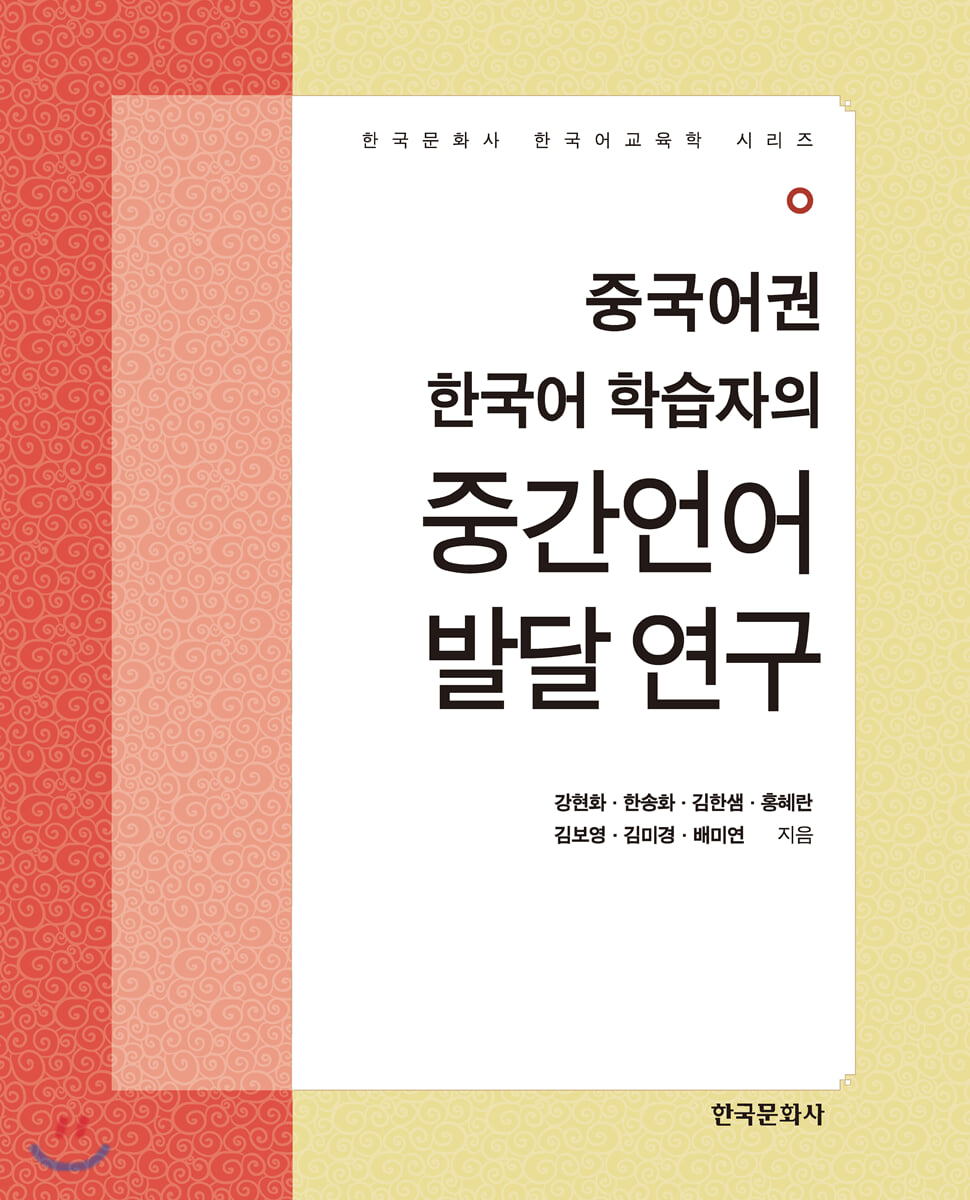
A Study on the Interlanguage Development of Korean Learners in Chinese-Speaking Countries
 |
Description
Book Introduction
It is important to systematically examine the interlanguage development patterns of learners by analyzing large-scale language data produced by learners and to elucidate the characteristics of learners' language acquisition and development based on this.
This is because it goes one step further from the perspective of error analysis, which has been mainly used in learner language studies to date, and allows for a systematic examination of the development of interlanguage, which is a unique language system produced by learners in the process of learning and acquiring the target language.
This book is the first comprehensive work that synthesizes the results of research conducted over three years to examine the characteristics of the interlanguage system and language acquisition and development of Chinese language learners, who account for the largest proportion of Korean language learners.
By quantitatively analyzing the written corpus of Chinese learners, we objectively described usage patterns by level, and by providing basic data in the form of an Excel file via a QR code, researchers interested in the interlanguage of Korean learners can examine the analysis results in detail and use them as reference material.
This is because it goes one step further from the perspective of error analysis, which has been mainly used in learner language studies to date, and allows for a systematic examination of the development of interlanguage, which is a unique language system produced by learners in the process of learning and acquiring the target language.
This book is the first comprehensive work that synthesizes the results of research conducted over three years to examine the characteristics of the interlanguage system and language acquisition and development of Chinese language learners, who account for the largest proportion of Korean language learners.
By quantitatively analyzing the written corpus of Chinese learners, we objectively described usage patterns by level, and by providing basic data in the form of an Excel file via a QR code, researchers interested in the interlanguage of Korean learners can examine the analysis results in detail and use them as reference material.
- You can preview some of the book's contents.
Preview
index
- Preface
Chapter 1 Introduction
1.
Learner Corpus
2.
Study of interlanguage development based on learner corpora
Chapter 2: Composition of the Chinese Language Learners' Corpus
1.
Building a learner corpus
1.1.
Design and construction of learner corpora
1.2.
Current Status of Korean Learner Corpus Construction
1.2.1.
Korean Learner Corpus
1.2.2.
Learner Corpus in Foreign Language Education
2.
Composition of the research corpus
2.1.
Corpus size
2.2.
Corpus collection task
2.3.
Genre of the corpus
2.4.
Topics of the corpus
Chapter 3: Morpheme Usage Patterns in the Chinese Language Learners' Corpus
1.
Principles and Practice of Learner Corpus Morphological Analysis
2.
Usage distribution by morpheme
3.
Usage patterns of major morphemes as examined through keyword analysis
3.1.
Keyword concept and analysis method
3.2.
Keyword analysis by level
3.3.
Keyword analysis by part of speech
4.
Usage patterns by vocabulary category
4.1.
Noun
4.1.1.
common noun
4.1.2.
dependent noun
4.1.3.
pronoun
4.2.
Verb
4.2.1.
verb
4.2.2.
adjective
4.2.3.
auxiliary verbs
4.3.
Modifiers and independent words
4.3.1.
adjective
4.3.2.
General adverbs
4.3.3.
Conjunctive adverb
4.3.4.
interjection
4.4.
Relationship words
4.4.1.
particle
4.4.2.
Auxiliary verb
4.5.
ending of a word
4.5.1.
Prepositional endings
4.5.2.
Connective endings
4.5.3.
Final ending
4.5.4.
Adjectival prepositional endings
4.5.5.
Noun prepositional ending
4.6.
affix
4.6.1.
Noun prefix
4.6.2.
Noun derivation suffix
4.6.3.
Verb derivation suffix
4.6.4.
Adjective derivation suffix
4.7.
Expression sentence patterns
4.7.1.
Frequency of expression patterns
4.7.2.
Differences in the use of expression patterns according to level
- References
Chapter 1 Introduction
1.
Learner Corpus
2.
Study of interlanguage development based on learner corpora
Chapter 2: Composition of the Chinese Language Learners' Corpus
1.
Building a learner corpus
1.1.
Design and construction of learner corpora
1.2.
Current Status of Korean Learner Corpus Construction
1.2.1.
Korean Learner Corpus
1.2.2.
Learner Corpus in Foreign Language Education
2.
Composition of the research corpus
2.1.
Corpus size
2.2.
Corpus collection task
2.3.
Genre of the corpus
2.4.
Topics of the corpus
Chapter 3: Morpheme Usage Patterns in the Chinese Language Learners' Corpus
1.
Principles and Practice of Learner Corpus Morphological Analysis
2.
Usage distribution by morpheme
3.
Usage patterns of major morphemes as examined through keyword analysis
3.1.
Keyword concept and analysis method
3.2.
Keyword analysis by level
3.3.
Keyword analysis by part of speech
4.
Usage patterns by vocabulary category
4.1.
Noun
4.1.1.
common noun
4.1.2.
dependent noun
4.1.3.
pronoun
4.2.
Verb
4.2.1.
verb
4.2.2.
adjective
4.2.3.
auxiliary verbs
4.3.
Modifiers and independent words
4.3.1.
adjective
4.3.2.
General adverbs
4.3.3.
Conjunctive adverb
4.3.4.
interjection
4.4.
Relationship words
4.4.1.
particle
4.4.2.
Auxiliary verb
4.5.
ending of a word
4.5.1.
Prepositional endings
4.5.2.
Connective endings
4.5.3.
Final ending
4.5.4.
Adjectival prepositional endings
4.5.5.
Noun prepositional ending
4.6.
affix
4.6.1.
Noun prefix
4.6.2.
Noun derivation suffix
4.6.3.
Verb derivation suffix
4.6.4.
Adjective derivation suffix
4.7.
Expression sentence patterns
4.7.1.
Frequency of expression patterns
4.7.2.
Differences in the use of expression patterns according to level
- References
Into the book
It is important to systematically examine the interlanguage development patterns of learners by analyzing large-scale language data produced by learners and to elucidate the characteristics of learners' language acquisition and development based on this.
This is because it goes one step further from the perspective of error analysis, which has been mainly used in learner language studies to date, and allows for a systematic examination of the development of interlanguage, which is a unique language system produced by learners in the process of learning and acquiring the target language.
This book aims to examine the interlanguage development of Chinese learners, who account for the largest proportion of Korean language learners.
The research team consisting of the authors of this book has been conducting research on the interlanguage development of Korean language learners sequentially over a period of three years.
First, in the first year, we analyzed domestic and international prior research on Chinese learner corpora, and collected written and spoken data of Chinese learners to build a learner corpus.
In addition, research was conducted to systematize the symbolic markers representing part-of-speech information, clause/sentence unit information, and error information necessary to elucidate the interlanguage system.
In the second year, a quantitative study was conducted on the learners' interlanguage system and developmental characteristics based on a corpus.
Based on the corpus of Chinese learners' phrases, we analyzed the pattern of morpheme usage and compared and analyzed the error patterns in pronunciation, vocabulary, grammar, and discourse areas by level, from beginner to advanced and highest.
We sought to objectively describe the characteristics of interlanguage by quantitatively identifying the usage patterns of interlanguage.
In the third year, based on a review of previous research on learners' interlanguage, we attempted to identify the characteristics of the interlanguage system through qualitative analysis of each item in the pronunciation, vocabulary, grammar, and discourse levels.
By analyzing the actual usage patterns and error rates, and the frequency of errors compared to usage, according to level, and conducting a qualitative analysis of the relevant examples, the interlanguage system and developmental characteristics were identified, and the characteristics of language acquisition and development of Korean language learners were comprehensively observed and described.
This book is a primary work that synthesizes the results of such research and is the result of analyzing the usage patterns of Chinese language learners at different levels based on written materials.
Due to the issue of representativeness, we attempted to provide all usage patterns of Chinese-speaking learners based on written materials, which have the largest quantitative weight, excluding the highest-level learners and spoken materials.
In the future, we plan to continue follow-up research based on spoken language data and error analysis to address these issues.
This book utilizes QR codes to provide the data that formed the basis of the analysis results presented in the text in an Excel file, allowing readers to directly search for and download detailed information not included in the text.
We hope that the materials in this book will be widely utilized by researchers studying language materials for Korean language learners.
This is because it goes one step further from the perspective of error analysis, which has been mainly used in learner language studies to date, and allows for a systematic examination of the development of interlanguage, which is a unique language system produced by learners in the process of learning and acquiring the target language.
This book aims to examine the interlanguage development of Chinese learners, who account for the largest proportion of Korean language learners.
The research team consisting of the authors of this book has been conducting research on the interlanguage development of Korean language learners sequentially over a period of three years.
First, in the first year, we analyzed domestic and international prior research on Chinese learner corpora, and collected written and spoken data of Chinese learners to build a learner corpus.
In addition, research was conducted to systematize the symbolic markers representing part-of-speech information, clause/sentence unit information, and error information necessary to elucidate the interlanguage system.
In the second year, a quantitative study was conducted on the learners' interlanguage system and developmental characteristics based on a corpus.
Based on the corpus of Chinese learners' phrases, we analyzed the pattern of morpheme usage and compared and analyzed the error patterns in pronunciation, vocabulary, grammar, and discourse areas by level, from beginner to advanced and highest.
We sought to objectively describe the characteristics of interlanguage by quantitatively identifying the usage patterns of interlanguage.
In the third year, based on a review of previous research on learners' interlanguage, we attempted to identify the characteristics of the interlanguage system through qualitative analysis of each item in the pronunciation, vocabulary, grammar, and discourse levels.
By analyzing the actual usage patterns and error rates, and the frequency of errors compared to usage, according to level, and conducting a qualitative analysis of the relevant examples, the interlanguage system and developmental characteristics were identified, and the characteristics of language acquisition and development of Korean language learners were comprehensively observed and described.
This book is a primary work that synthesizes the results of such research and is the result of analyzing the usage patterns of Chinese language learners at different levels based on written materials.
Due to the issue of representativeness, we attempted to provide all usage patterns of Chinese-speaking learners based on written materials, which have the largest quantitative weight, excluding the highest-level learners and spoken materials.
In the future, we plan to continue follow-up research based on spoken language data and error analysis to address these issues.
This book utilizes QR codes to provide the data that formed the basis of the analysis results presented in the text in an Excel file, allowing readers to directly search for and download detailed information not included in the text.
We hope that the materials in this book will be widely utilized by researchers studying language materials for Korean language learners.
--- From the preface
GOODS SPECIFICS
- Date of publication: August 28, 2019
- Page count, weight, size: 264 pages | 527g | 190*235*20mm
- ISBN13: 9788968177996
- ISBN10: 8968177996
You may also like
카테고리
korean


korean

![GQ KOREA Mark (Monthly): December [2025]](http://librairie.coreenne.fr/cdn/shop/files/8ef265dbbfbf186523ed75ba7319009d.jpg?v=1765340328&width=3840)


