

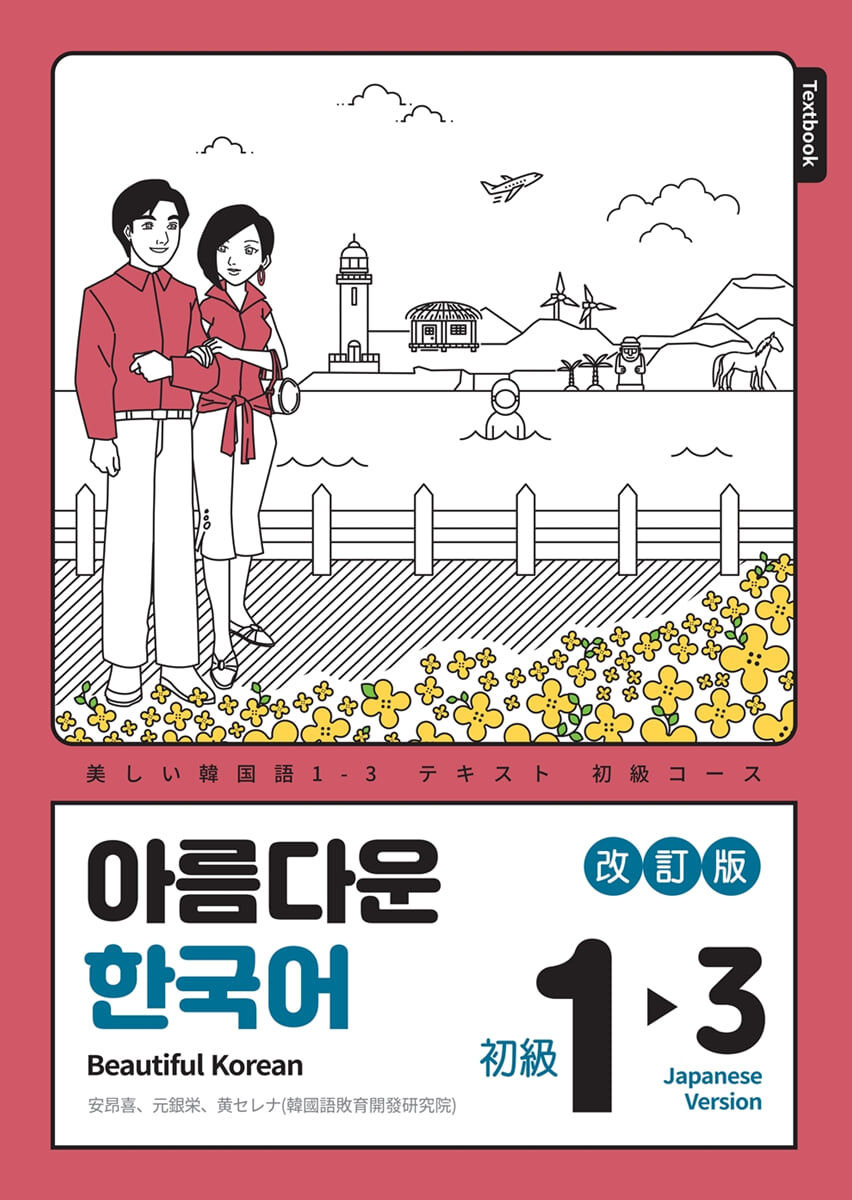
Beautiful Korean 1-3 JAPANESE (Japanese version)
 |
Description
Book Introduction
『Beautiful Korean』 is designed for beginners to learn in English, Japanese, and Chinese, and is designed for self-study as well as in class.
It is an educational method that integrates listening, speaking, writing, and reading.
All photographs and illustrations were created by professional artists to reflect the time period and realism.
You can see a dynamic and living image of Korea today.
You can solve similar types of questions to those on the Test of Proficiency in Korean (TOPIK) through the text.
It is an educational method that integrates listening, speaking, writing, and reading.
All photographs and illustrations were created by professional artists to reflect the time period and realism.
You can see a dynamic and living image of Korea today.
You can solve similar types of questions to those on the Test of Proficiency in Korean (TOPIK) through the text.
- You can preview some of the book's contents.
Preview
index
◆ When publishing a book
◆ Note
◆ Characters
◆ Table of Contents
◆ Textbook composition table
◆ I don't have time because I have a test for Lesson 1.
◆ Lesson 2 Let's go to the cafeteria
◆ Lesson 3: Would you like to order some bulgogi?
◆ Lesson 4: The work isn't over yet
◆ Lesson 5 I couldn't go because I was too busy
◆ Lesson 6: Please change the teacher
◆ Lesson 7 It's going to rain soon
◆ Lesson 8 I like swimming, but I'm not good at it.
◆ Lesson 9 Have you been to Jeju Island?
◆ Lesson 10 It's my father's birthday
◆ Lesson 11: Adults like health foods, so give them ginseng as a gift.
◆ Appendix
Introduction to the Korean Language Education Development Institute
Researcher's history
Translator's history
◆ Note
◆ Characters
◆ Table of Contents
◆ Textbook composition table
◆ I don't have time because I have a test for Lesson 1.
◆ Lesson 2 Let's go to the cafeteria
◆ Lesson 3: Would you like to order some bulgogi?
◆ Lesson 4: The work isn't over yet
◆ Lesson 5 I couldn't go because I was too busy
◆ Lesson 6: Please change the teacher
◆ Lesson 7 It's going to rain soon
◆ Lesson 8 I like swimming, but I'm not good at it.
◆ Lesson 9 Have you been to Jeju Island?
◆ Lesson 10 It's my father's birthday
◆ Lesson 11: Adults like health foods, so give them ginseng as a gift.
◆ Appendix
Introduction to the Korean Language Education Development Institute
Researcher's history
Translator's history
Publisher's Review
When publishing a book
As the status of the Korean language gradually rises, new Korean language textbooks are being developed and published in many places.
In line with this, I have published “Beautiful Korean” based on my extensive experience in the Korean language education field for many years.
『Beautiful Korean』 means both ‘beautiful Korean’ and ‘beautiful Korean.’
It contains the meaning of Korean being a language that represents the spirit and culture of Korea and a Korean who strives to spread such Korean language to the world.
The textbook also tried to convey this meaning well.
『Beautiful Korean』Beginner Level 1 aims to help students learning Korean for the first time learn basic Korean sentence structures and vocabulary and use them to have simple conversations in everyday life.
And, to enable learners to practice and check on their own, we have made it 'learner activity-centered' to stimulate learners' interest, and we have reflected 'task-centered' and 'communication-centered' to enable them to apply the topics covered in the textbook to their daily lives.
We also pursued an 'integrated curriculum' that allowed students to learn the four areas of reading, writing, speaking, and listening evenly.
And we included cultural content to make it easier for learners to access not only the Korean language but also Korean culture.
I hope that the publication of "Beautiful Korean" will provide practical help to many learners who want to learn Korean more easily and approachably.
Of course, we believe this is not the end, but the beginning, and we will continue to work hard to develop new textbooks and supplementary materials that meet the needs of learners and contribute to the development of the Korean language.
Korean Language Education Development Institute
Director Ahn Seong-hee
Note
This book has the following features:
· This textbook, “Beautiful Korean,” is intended for beginner learners.
· This textbook includes a variety of task activities similar to real-life situations, targeting communication skills.
· The beginner level consists of three volumes: I-1, I-2, and I-3, each consisting of 11 lessons.
· A total of 33 lessons in Beginner I-1, I-2, and I-3 are structured to fit 200 hours of Korean language classes, four hours a day, five times a week, for a total of 10 weeks.
· This textbook is a set with a homework book.
· The story unfolds consistently by establishing the main characters.
This is a great device to pique learners' interest.
· It is composed in the order of ‘Let’s read the conversation’, ‘Let’s read along’, ‘Let’s listen’ in the listening textbook, and ‘Let’s listen and write’ in the homework book. At the end of each lesson, the conversation from ‘Let’s read the conversation’ is included once again.
Additionally, for each lesson, we added 'Let's Listen Again', which is a slow, word-for-word conversation about the same content, following the regular-speed conversation of 'Let's Read the Conversation', so that beginner Korean learners can listen to the conversation and follow along.
The book proceeds as follows:
Let's think about it
This is the warm-up phase.
Provide about 3 photos related to the topic of each lesson to help students easily recognize the topic of the unit.
Let's read the conversation
"Beautiful Korean" features foreigners learning Korean and Koreans who interact with them throughout the book.
These are characters who are consistent in personality, taste, voice, appearance, etc.
This setup not only increases learning interest, but also allows learners to naturally recognize how linguistic expressions change as relationships become more intimate.
The dialogue presented in Let's Read the Dialogue is comprised of conversations between these characters and is a model dialogue in which topics and grammar are organically combined.
By studying model conversations with audio that can be transferred directly to situations outside the classroom, learners can naturally acquire Korean.
Vocabulary and expressions
We're introducing new words and expressions from the conversation.
Let's read along
In Let's Read the Conversation, we selected sentences that applied pronunciation rules and tried to repeat the correct pronunciation.
You can learn Korean pronunciation easily and accurately by looking at sentences written in pronunciation and listening to the announcer's pronunciation in the audio and reading along.
Let's learn
Grammar Explanation: Grammar is presented and its explanations are translated into English, Japanese, and Chinese.
Learners can understand grammar accurately through grammar explanations in their native language.
Because grammar explanations are provided in your native language, “Beautiful Korean” allows you to learn Korean without a teacher.
The examples presented four to six sentences that typically use the target grammar.
Sentences using irregular verbs were also presented without exception to ensure that there is no difficulty in learning not only the meaning but also the form.
A word from the teacher:
This is a part where the teacher explains things one by one from the learner's perspective, as if they were facing the learner.
It compares easily confusing grammar to explain similarities and differences, or provides supplementary explanations for things like pronunciation and intonation.
Let's learn more:
This section expands on vocabulary and expressions related to topics and grammar, helping learners use Korean more diversely.
Let's practice
This chapter is for practicing the target grammar of the unit.
Let's practice helps learners correct errors and learn grammar correctly.
After basic practice, we do complex exercises that cover 2-3 grammar points together, and we especially have many pair speaking practice activities so that you can easily connect to the next TASK activity.
Let's talk
This is the part that corresponds to TASK.
Use the learned grammar to engage in speaking activities appropriate to the topic and given situation.
Through these simulated speaking practice situations, we ensured that Korean language skills could be naturally transferred to situations outside the classroom.
Let's listen
This is a topic-related listening activity in which the target grammar is expressed naturally.
Because you hear consistent character dialogue and audio that is identical to real-life situations, it is easy to transfer to situations outside the classroom.
Let's read it
It consists of reading materials appropriate to the topic.
We provide a variety of reading materials, including letters, diaries, advertisements, newspaper articles, invitations, and posters, to help students improve their ability to read and understand texts strategically.
Let's find out / Let's try it:
Depending on the subject, it covers cultural introduction and writing.
'Introduction to Culture' covers a wide range of traditional and modern cultures related to the topic, allowing learners to obtain a wide range of information related to the topic.
‘Writing’ aims to improve integrated language skills of speaking, reading, listening, and writing through various writing activities appropriate to the topic and situation.
new word
To assist learners in their learning, we have included new words that appear throughout the lesson in addition to the vocabulary and expressions covered in the main text of each lesson.
supplement
Appendix 1 includes a listening passage so that you can check the content of the listening.
Appendix 2 summarizes and translates the pronunciation rules of Korean.
Appendix 3 contains a list of frequently used verb conjugations and irregular conjugations.
Appendix 4 is a vocabulary index
Appendix 5 explains in Korean the “Let’s Learn,” “A Word from the Teacher,” and “Let’s Find Out” sections that are covered in each lesson through translation.
Appendix 6 includes a textbook structure chart for Beginner 1-1 and 1-2 to help you understand the overall flow of the beginner level.
As the status of the Korean language gradually rises, new Korean language textbooks are being developed and published in many places.
In line with this, I have published “Beautiful Korean” based on my extensive experience in the Korean language education field for many years.
『Beautiful Korean』 means both ‘beautiful Korean’ and ‘beautiful Korean.’
It contains the meaning of Korean being a language that represents the spirit and culture of Korea and a Korean who strives to spread such Korean language to the world.
The textbook also tried to convey this meaning well.
『Beautiful Korean』Beginner Level 1 aims to help students learning Korean for the first time learn basic Korean sentence structures and vocabulary and use them to have simple conversations in everyday life.
And, to enable learners to practice and check on their own, we have made it 'learner activity-centered' to stimulate learners' interest, and we have reflected 'task-centered' and 'communication-centered' to enable them to apply the topics covered in the textbook to their daily lives.
We also pursued an 'integrated curriculum' that allowed students to learn the four areas of reading, writing, speaking, and listening evenly.
And we included cultural content to make it easier for learners to access not only the Korean language but also Korean culture.
I hope that the publication of "Beautiful Korean" will provide practical help to many learners who want to learn Korean more easily and approachably.
Of course, we believe this is not the end, but the beginning, and we will continue to work hard to develop new textbooks and supplementary materials that meet the needs of learners and contribute to the development of the Korean language.
Korean Language Education Development Institute
Director Ahn Seong-hee
Note
This book has the following features:
· This textbook, “Beautiful Korean,” is intended for beginner learners.
· This textbook includes a variety of task activities similar to real-life situations, targeting communication skills.
· The beginner level consists of three volumes: I-1, I-2, and I-3, each consisting of 11 lessons.
· A total of 33 lessons in Beginner I-1, I-2, and I-3 are structured to fit 200 hours of Korean language classes, four hours a day, five times a week, for a total of 10 weeks.
· This textbook is a set with a homework book.
· The story unfolds consistently by establishing the main characters.
This is a great device to pique learners' interest.
· It is composed in the order of ‘Let’s read the conversation’, ‘Let’s read along’, ‘Let’s listen’ in the listening textbook, and ‘Let’s listen and write’ in the homework book. At the end of each lesson, the conversation from ‘Let’s read the conversation’ is included once again.
Additionally, for each lesson, we added 'Let's Listen Again', which is a slow, word-for-word conversation about the same content, following the regular-speed conversation of 'Let's Read the Conversation', so that beginner Korean learners can listen to the conversation and follow along.
The book proceeds as follows:
Let's think about it
This is the warm-up phase.
Provide about 3 photos related to the topic of each lesson to help students easily recognize the topic of the unit.
Let's read the conversation
"Beautiful Korean" features foreigners learning Korean and Koreans who interact with them throughout the book.
These are characters who are consistent in personality, taste, voice, appearance, etc.
This setup not only increases learning interest, but also allows learners to naturally recognize how linguistic expressions change as relationships become more intimate.
The dialogue presented in Let's Read the Dialogue is comprised of conversations between these characters and is a model dialogue in which topics and grammar are organically combined.
By studying model conversations with audio that can be transferred directly to situations outside the classroom, learners can naturally acquire Korean.
Vocabulary and expressions
We're introducing new words and expressions from the conversation.
Let's read along
In Let's Read the Conversation, we selected sentences that applied pronunciation rules and tried to repeat the correct pronunciation.
You can learn Korean pronunciation easily and accurately by looking at sentences written in pronunciation and listening to the announcer's pronunciation in the audio and reading along.
Let's learn
Grammar Explanation: Grammar is presented and its explanations are translated into English, Japanese, and Chinese.
Learners can understand grammar accurately through grammar explanations in their native language.
Because grammar explanations are provided in your native language, “Beautiful Korean” allows you to learn Korean without a teacher.
The examples presented four to six sentences that typically use the target grammar.
Sentences using irregular verbs were also presented without exception to ensure that there is no difficulty in learning not only the meaning but also the form.
A word from the teacher:
This is a part where the teacher explains things one by one from the learner's perspective, as if they were facing the learner.
It compares easily confusing grammar to explain similarities and differences, or provides supplementary explanations for things like pronunciation and intonation.
Let's learn more:
This section expands on vocabulary and expressions related to topics and grammar, helping learners use Korean more diversely.
Let's practice
This chapter is for practicing the target grammar of the unit.
Let's practice helps learners correct errors and learn grammar correctly.
After basic practice, we do complex exercises that cover 2-3 grammar points together, and we especially have many pair speaking practice activities so that you can easily connect to the next TASK activity.
Let's talk
This is the part that corresponds to TASK.
Use the learned grammar to engage in speaking activities appropriate to the topic and given situation.
Through these simulated speaking practice situations, we ensured that Korean language skills could be naturally transferred to situations outside the classroom.
Let's listen
This is a topic-related listening activity in which the target grammar is expressed naturally.
Because you hear consistent character dialogue and audio that is identical to real-life situations, it is easy to transfer to situations outside the classroom.
Let's read it
It consists of reading materials appropriate to the topic.
We provide a variety of reading materials, including letters, diaries, advertisements, newspaper articles, invitations, and posters, to help students improve their ability to read and understand texts strategically.
Let's find out / Let's try it:
Depending on the subject, it covers cultural introduction and writing.
'Introduction to Culture' covers a wide range of traditional and modern cultures related to the topic, allowing learners to obtain a wide range of information related to the topic.
‘Writing’ aims to improve integrated language skills of speaking, reading, listening, and writing through various writing activities appropriate to the topic and situation.
new word
To assist learners in their learning, we have included new words that appear throughout the lesson in addition to the vocabulary and expressions covered in the main text of each lesson.
supplement
Appendix 1 includes a listening passage so that you can check the content of the listening.
Appendix 2 summarizes and translates the pronunciation rules of Korean.
Appendix 3 contains a list of frequently used verb conjugations and irregular conjugations.
Appendix 4 is a vocabulary index
Appendix 5 explains in Korean the “Let’s Learn,” “A Word from the Teacher,” and “Let’s Find Out” sections that are covered in each lesson through translation.
Appendix 6 includes a textbook structure chart for Beginner 1-1 and 1-2 to help you understand the overall flow of the beginner level.
GOODS SPECIFICS
- Date of issue: April 1, 2025
- Page count, weight, size: 166 pages | 850g | 210*297*5mm
- ISBN13: 9788991869950
- ISBN10: 8991869955
You may also like
카테고리
korean


korean

![GQ KOREA Mark (Monthly): December [2025]](http://librairie.coreenne.fr/cdn/shop/files/8ef265dbbfbf186523ed75ba7319009d.jpg?v=1765340328&width=3840)


