

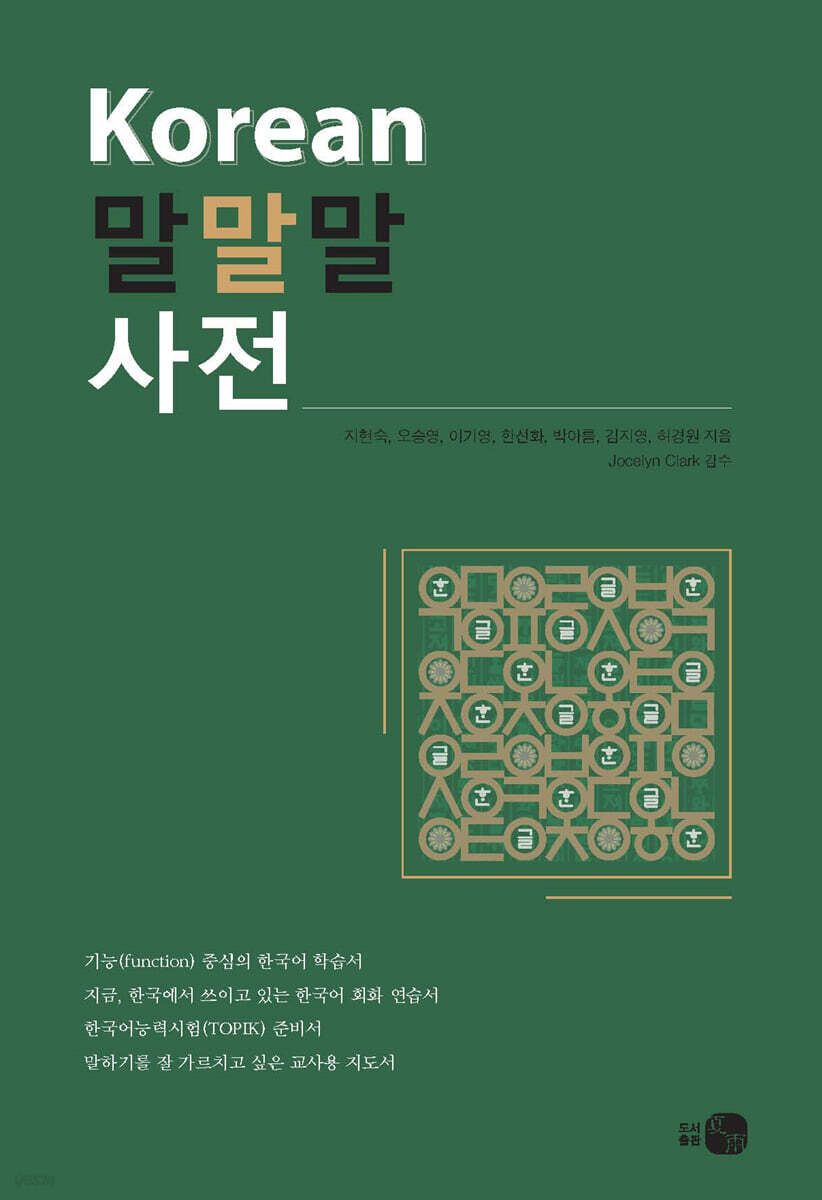
Korean word-for-word dictionary
 |
Description
Book Introduction
『Korean Word Dictionary』 is a self-study book primarily intended to improve the speaking skills of foreigners learning Korean.
To speak Korean fluently, it is important to know a lot of grammar rules accurately, but you also need to quickly understand expressions that Koreans frequently use and be able to use them appropriately in the situation and context.
With this in mind, the authors of this dictionary constructed a corpus of spoken Korean and extracted spoken grammar items based on criteria such as frequency, usefulness, practicality, learnability, and teachability, condensing them into 800 entries and presenting 2,300 similar expressions.
To speak Korean fluently, it is important to know a lot of grammar rules accurately, but you also need to quickly understand expressions that Koreans frequently use and be able to use them appropriately in the situation and context.
With this in mind, the authors of this dictionary constructed a corpus of spoken Korean and extracted spoken grammar items based on criteria such as frequency, usefulness, practicality, learnability, and teachability, condensing them into 800 entries and presenting 2,300 similar expressions.
index
introduction
How to use this book
Part 1.
Functional Speaking Grammar
Engaging in Social Activities
Expressing & Determining Intellectual Attitudes
Imparting & Seeking Factual Information
Expressing & Determining Moral Attitudes
Expressing Emotional Attitudes
Getting Things Done task accomplished
Managing Communication
Telephone Behavior Answering the Phone
Part 2.
Speaking Grammar from ㄱ to ㅎ
Part 3.
Teaching Speaking Grammar in Korean Classes
Korean Lesson Plan 1
Korean Lesson Plan 2
Korean Lesson Plan 3
Korean Lesson Plan 4
Search
About the Author
How to use this book
Part 1.
Functional Speaking Grammar
Engaging in Social Activities
Expressing & Determining Intellectual Attitudes
Imparting & Seeking Factual Information
Expressing & Determining Moral Attitudes
Expressing Emotional Attitudes
Getting Things Done task accomplished
Managing Communication
Telephone Behavior Answering the Phone
Part 2.
Speaking Grammar from ㄱ to ㅎ
Part 3.
Teaching Speaking Grammar in Korean Classes
Korean Lesson Plan 1
Korean Lesson Plan 2
Korean Lesson Plan 3
Korean Lesson Plan 4
Search
About the Author
Publisher's Review
Part 1 of this book reconstructs and presents speaking grammar items focusing on 'communication functions'.
The communication functions were reclassified to fit the characteristics of the Korean language with reference to Omaggio (2001).
If you are having a housewarming party, you can find the 'Invite' function, if a friend seems to be having a problem, you can find the 'Consult' function, and if you need to make an important phone call, you can find the 'Call' function and study the corresponding speaking grammar.
Part 2 of this book is in the form of a 'dictionary'.
Part 2 is arranged in alphabetical order to enhance user convenience.
Above all, this book will be useful for improving your Korean speaking and listening skills.
If you are a learner who has a specific skill that needs to be mastered when studying with this book, you can open Part 1, select the predicted 'function' category, and study it intensively.
It is best to read Part 2 from beginning to end.
In particular, we recommend that you read the example sentences out loud several times while listening to the audio file.
There are quite a few speaking grammar items that appear in the Korean Word Dictionary that, strictly speaking, cannot be defined in a dictionary.
This is because the meaning of spoken communication changes each time depending on who is speaking, where, when, and what is being said.
Taking this into account, the meanings were explained in the order of general definitions in the most commonly used situations and contexts, and, where possible, were divided into informal and formal forms, with two examples provided for each meaning.
To increase the realism of the examples, we included dialogue from movies, dramas, TV entertainment programs, and documentaries, and indicated their sources.
If there is a teacher who wants to teach Korean speaking (spoken) grammar using this book, it would be good to use it as a kind of teaching grammar.
This book will be especially helpful for beginning Korean language teachers who are unsure of how to cover specific skills or speaking grammar topics, or who teach speaking and listening classes and want to know how to explain conversational expressions not covered in existing grammar books.
In Part 3, we present teaching models for teaching speaking grammar in actual Korean language classes at beginner, intermediate, and advanced levels. We hope you will wisely apply and utilize these models in your own classes.
The communication functions were reclassified to fit the characteristics of the Korean language with reference to Omaggio (2001).
If you are having a housewarming party, you can find the 'Invite' function, if a friend seems to be having a problem, you can find the 'Consult' function, and if you need to make an important phone call, you can find the 'Call' function and study the corresponding speaking grammar.
Part 2 of this book is in the form of a 'dictionary'.
Part 2 is arranged in alphabetical order to enhance user convenience.
Above all, this book will be useful for improving your Korean speaking and listening skills.
If you are a learner who has a specific skill that needs to be mastered when studying with this book, you can open Part 1, select the predicted 'function' category, and study it intensively.
It is best to read Part 2 from beginning to end.
In particular, we recommend that you read the example sentences out loud several times while listening to the audio file.
There are quite a few speaking grammar items that appear in the Korean Word Dictionary that, strictly speaking, cannot be defined in a dictionary.
This is because the meaning of spoken communication changes each time depending on who is speaking, where, when, and what is being said.
Taking this into account, the meanings were explained in the order of general definitions in the most commonly used situations and contexts, and, where possible, were divided into informal and formal forms, with two examples provided for each meaning.
To increase the realism of the examples, we included dialogue from movies, dramas, TV entertainment programs, and documentaries, and indicated their sources.
If there is a teacher who wants to teach Korean speaking (spoken) grammar using this book, it would be good to use it as a kind of teaching grammar.
This book will be especially helpful for beginning Korean language teachers who are unsure of how to cover specific skills or speaking grammar topics, or who teach speaking and listening classes and want to know how to explain conversational expressions not covered in existing grammar books.
In Part 3, we present teaching models for teaching speaking grammar in actual Korean language classes at beginner, intermediate, and advanced levels. We hope you will wisely apply and utilize these models in your own classes.
GOODS SPECIFICS
- Date of issue: March 15, 2024
- Page count, weight, size: 474 pages | 152*225*30mm
- ISBN13: 9791167481245
- ISBN10: 1167481240
You may also like
카테고리
korean


korean

![GQ KOREA Mark (Monthly): December [2025]](http://librairie.coreenne.fr/cdn/shop/files/8ef265dbbfbf186523ed75ba7319009d.jpg?v=1765340328&width=3840)


