

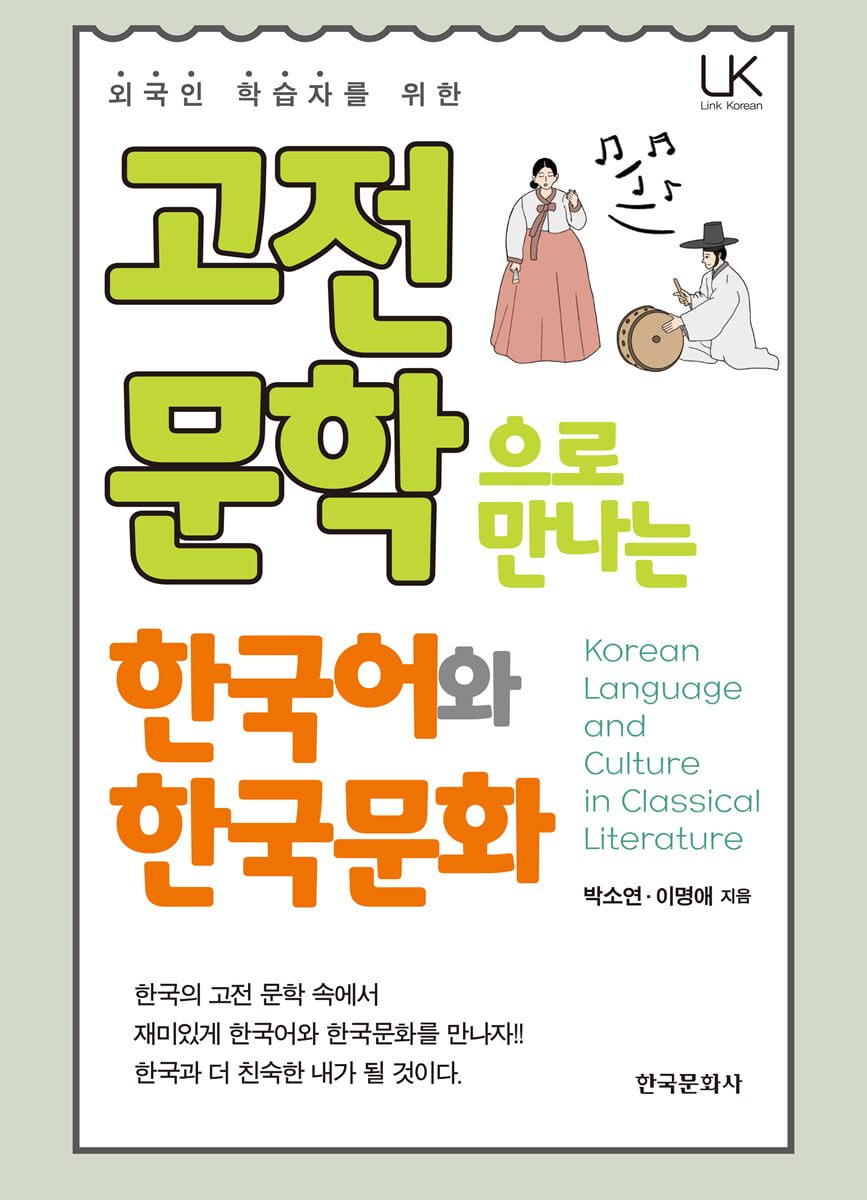
Korean language and culture through classical literature
 |
Description
Book Introduction
Let's have fun discovering the Korean language and culture through classical Korean literature!!
I will become more familiar with Korea.
In-depth learning for intermediate and advanced Korean language learners
Learners learn Korean as a means of communicating with Koreans.
At first, you will mainly study the skills of listening, speaking, reading, and writing.
Intermediate-level learners need to gain a deeper understanding of Korean culture through exposure to a variety of reading materials in Korean.
Among the reading materials, I can recommend representative literary works from each era.
By encountering literature, the art of language, we can learn the refined use of language and understand the historical context, people's lives, and their thoughts and emotions contained in the works.
In particular, representative works of classical literature have stood the test of time and are still read consistently today, serving as a window into the traditional lives and thoughts of Koreans.
This will help you understand Koreans better and communicate more smoothly.
It is structured in the following order: introduction related to the topic, presentation of the work, explanation and vocabulary explanation of the work, confirmation of the content, learning important sentence patterns and vocabulary, assignment activities, and reading about Korean culture.
Learners will encounter interesting works every hour and have fun engaging in a variety of activities, naturally learning about Korean language and culture, including Korean thought, emotions, and lifestyle.
I will become more familiar with Korea.
In-depth learning for intermediate and advanced Korean language learners
Learners learn Korean as a means of communicating with Koreans.
At first, you will mainly study the skills of listening, speaking, reading, and writing.
Intermediate-level learners need to gain a deeper understanding of Korean culture through exposure to a variety of reading materials in Korean.
Among the reading materials, I can recommend representative literary works from each era.
By encountering literature, the art of language, we can learn the refined use of language and understand the historical context, people's lives, and their thoughts and emotions contained in the works.
In particular, representative works of classical literature have stood the test of time and are still read consistently today, serving as a window into the traditional lives and thoughts of Koreans.
This will help you understand Koreans better and communicate more smoothly.
It is structured in the following order: introduction related to the topic, presentation of the work, explanation and vocabulary explanation of the work, confirmation of the content, learning important sentence patterns and vocabulary, assignment activities, and reading about Korean culture.
Learners will encounter interesting works every hour and have fun engaging in a variety of activities, naturally learning about Korean language and culture, including Korean thought, emotions, and lifestyle.
- You can preview some of the book's contents.
Preview
index
Preface ___ v
Chapter 1 What is Classical Literature?
Chapter 2 Ancient Songs
One of the works is a public service
The second work is Hwangjo
Chapter 3: Fragrance
One work, Seodongyo
The two works are public works
Chapter 4: Inner Summary
One work of art at a low price
There are two works
Chapter 5 Poetry
One work, one heart
Two works of Ouga
Chapter 6 Folk Songs
One work, Ganggangsullae
Two works: Arirang
Chapter 7: The Founding Myth
One work, the Dangun myth
Two works: The Jumong myth
Chapter 8: The Legend
One work, Ondal and Princess Pyeonggang
Two works: Jangjamot and Daughter-in-law Rock
Chapter 9 Essay
One work of art
Work 2 Jochimmun
Chapter 10 Novel (1)
One work, Manboksa, giving up
Chapter 11 Novel (2)
One work, The Story of Hong Gildong
Chapter 12: Pansori Novels (1)
One work, Rabbit Exhibition
Chapter 13: Pansori Novels (2)
One work, Chunhyangjeon
■Model Answer
Chapter 1 What is Classical Literature?
Chapter 2 Ancient Songs
One of the works is a public service
The second work is Hwangjo
Chapter 3: Fragrance
One work, Seodongyo
The two works are public works
Chapter 4: Inner Summary
One work of art at a low price
There are two works
Chapter 5 Poetry
One work, one heart
Two works of Ouga
Chapter 6 Folk Songs
One work, Ganggangsullae
Two works: Arirang
Chapter 7: The Founding Myth
One work, the Dangun myth
Two works: The Jumong myth
Chapter 8: The Legend
One work, Ondal and Princess Pyeonggang
Two works: Jangjamot and Daughter-in-law Rock
Chapter 9 Essay
One work of art
Work 2 Jochimmun
Chapter 10 Novel (1)
One work, Manboksa, giving up
Chapter 11 Novel (2)
One work, The Story of Hong Gildong
Chapter 12: Pansori Novels (1)
One work, Rabbit Exhibition
Chapter 13: Pansori Novels (2)
One work, Chunhyangjeon
■Model Answer
Into the book
Chapter 2 Ancient Songs
One of the works is a public service
01 What did people in the past think when they saw a wide and deep river or sea?
02 What do you think of when you see a wide and deep river or sea?
▶Meet the work
Gongmudohaga (Gongmudohaga)
Im-ah, don't cross that water.
Im finally crossed the water.
He fell into the water and died.
What should I do with the person who has passed away now?
Original text in Chinese characters
公無渡河 (公無渡河)
Crossing the River (Gonggyeongdoha)
Fall into the river and die (Tahaisha)
What is Dangnaegongha?
Modern language interpretation
Dear, please don't try to cross.
But in the end, you went into the water.
The waves were so strong that he was swept away.
Now what should we do about this?
▶View the work
“Gongmudogaga” is the first Korean poem that has been passed down.
The title 'Gongmu Dohaga' was created because the poem begins with 'Gongmu Doha (公無渡河)'.
'Gong (公)' is a word that calls someone, 'mu (無)' means 'do not do something', and 'doha (渡河)' means 'cross a river'.
The story about this song goes like this:
"During the Gojoseon period, a boatman named Gwakrijago got up at dawn and was rowing his boat when a man with white hair tried to cross the river carrying a bottle of alcohol.
His wife followed and tried to stop him, but he eventually drowned and died.
His wife then composed and sang this song while playing an instrument called a gonghu (a harp-like instrument).
After the woman finished singing, she threw herself into the water and died.
When Gwak Ri-ja returned, he told his wife Yeo-ok about the song and told her about it. Yeo-ok was sad and sang the song while riding the gong.
After that, this song was spread throughout the world.
Source: "Haedong History"
"Gongmudogaga" sings of the sorrow over the death and separation of a loved one.
The deep sadness expressed in this poem can be called 'han'.
This poem is the first lyric poem in Korea and is famous for dealing with the traditional emotion of 'han'.
One of the works is a public service
01 What did people in the past think when they saw a wide and deep river or sea?
02 What do you think of when you see a wide and deep river or sea?
▶Meet the work
Gongmudohaga (Gongmudohaga)
Im-ah, don't cross that water.
Im finally crossed the water.
He fell into the water and died.
What should I do with the person who has passed away now?
Original text in Chinese characters
公無渡河 (公無渡河)
Crossing the River (Gonggyeongdoha)
Fall into the river and die (Tahaisha)
What is Dangnaegongha?
Modern language interpretation
Dear, please don't try to cross.
But in the end, you went into the water.
The waves were so strong that he was swept away.
Now what should we do about this?
▶View the work
“Gongmudogaga” is the first Korean poem that has been passed down.
The title 'Gongmu Dohaga' was created because the poem begins with 'Gongmu Doha (公無渡河)'.
'Gong (公)' is a word that calls someone, 'mu (無)' means 'do not do something', and 'doha (渡河)' means 'cross a river'.
The story about this song goes like this:
"During the Gojoseon period, a boatman named Gwakrijago got up at dawn and was rowing his boat when a man with white hair tried to cross the river carrying a bottle of alcohol.
His wife followed and tried to stop him, but he eventually drowned and died.
His wife then composed and sang this song while playing an instrument called a gonghu (a harp-like instrument).
After the woman finished singing, she threw herself into the water and died.
When Gwak Ri-ja returned, he told his wife Yeo-ok about the song and told her about it. Yeo-ok was sad and sang the song while riding the gong.
After that, this song was spread throughout the world.
Source: "Haedong History"
"Gongmudogaga" sings of the sorrow over the death and separation of a loved one.
The deep sadness expressed in this poem can be called 'han'.
This poem is the first lyric poem in Korea and is famous for dealing with the traditional emotion of 'han'.
--- From the text
Publisher's Review
This book was designed to help foreign learners naturally learn Korean language and culture while encountering representative works of Korean literature and engaging in a variety of fun activities.
Learners learn Korean as a means of communicating with Koreans.
At first, you will mainly study the skills of listening, speaking, reading, and writing.
Intermediate-level learners need to gain a deeper understanding of Korean culture through exposure to a variety of reading materials in Korean.
Among the reading materials, I can recommend literary works that represent the times above all else.
By encountering literature, the art of language, we can learn the refined and sophisticated use of language and understand the historical context, people's lives, and their thoughts and emotions contained in the work.
In particular, masterpieces of classical literature have stood the test of time and are still read consistently today, serving as a window into the traditional lives and thoughts of Koreans.
This will help you understand Koreans better and communicate more smoothly.
This book is designed for intermediate and higher level Korean language learners, dividing classical Korean literature into poetry and prose, and is organized into an amount that can be learned in one semester of university (graduate) classes.
From the beginning of history to the Joseon Dynasty, we have presented 10 representative genres and 2 representative works from each genre, for a total of 20 pieces.
The works were selected because they are significant in the history of Korean literature and have easy and interesting content.
First, in Chapter 1, we will look at classical literature in general.
Chapters 2 through 6 cover poetry, and chapters 7 through 13 cover prose.
Each chapter is structured in the following order: introduction related to the topic, presentation of the work, explanation and vocabulary explanation of the work, review of the content, learning important sentence patterns and vocabulary, assignment activities, and reading about Korean culture.
Learners will encounter interesting works every hour and have fun engaging in a variety of activities while naturally learning about Korean language and culture, including Korean thought, emotions, and lifestyle.
I sincerely hope that this book will serve as an essential textbook for Korean language classes that actively read and utilize literary works.
Finally, I would like to express my gratitude to the director and staff of Korean Culture Publishing Co., Ltd., who provided great assistance in bringing this textbook to life.
Learners learn Korean as a means of communicating with Koreans.
At first, you will mainly study the skills of listening, speaking, reading, and writing.
Intermediate-level learners need to gain a deeper understanding of Korean culture through exposure to a variety of reading materials in Korean.
Among the reading materials, I can recommend literary works that represent the times above all else.
By encountering literature, the art of language, we can learn the refined and sophisticated use of language and understand the historical context, people's lives, and their thoughts and emotions contained in the work.
In particular, masterpieces of classical literature have stood the test of time and are still read consistently today, serving as a window into the traditional lives and thoughts of Koreans.
This will help you understand Koreans better and communicate more smoothly.
This book is designed for intermediate and higher level Korean language learners, dividing classical Korean literature into poetry and prose, and is organized into an amount that can be learned in one semester of university (graduate) classes.
From the beginning of history to the Joseon Dynasty, we have presented 10 representative genres and 2 representative works from each genre, for a total of 20 pieces.
The works were selected because they are significant in the history of Korean literature and have easy and interesting content.
First, in Chapter 1, we will look at classical literature in general.
Chapters 2 through 6 cover poetry, and chapters 7 through 13 cover prose.
Each chapter is structured in the following order: introduction related to the topic, presentation of the work, explanation and vocabulary explanation of the work, review of the content, learning important sentence patterns and vocabulary, assignment activities, and reading about Korean culture.
Learners will encounter interesting works every hour and have fun engaging in a variety of activities while naturally learning about Korean language and culture, including Korean thought, emotions, and lifestyle.
I sincerely hope that this book will serve as an essential textbook for Korean language classes that actively read and utilize literary works.
Finally, I would like to express my gratitude to the director and staff of Korean Culture Publishing Co., Ltd., who provided great assistance in bringing this textbook to life.
GOODS SPECIFICS
- Publication date: February 18, 2022
- Page count, weight, size: 272 pages | 175*250*20mm
- ISBN13: 9791166850776
- ISBN10: 1166850773
You may also like
카테고리
korean


korean

![GQ KOREA Mark (Monthly): December [2025]](http://librairie.coreenne.fr/cdn/shop/files/8ef265dbbfbf186523ed75ba7319009d.jpg?v=1765340328&width=3840)


