

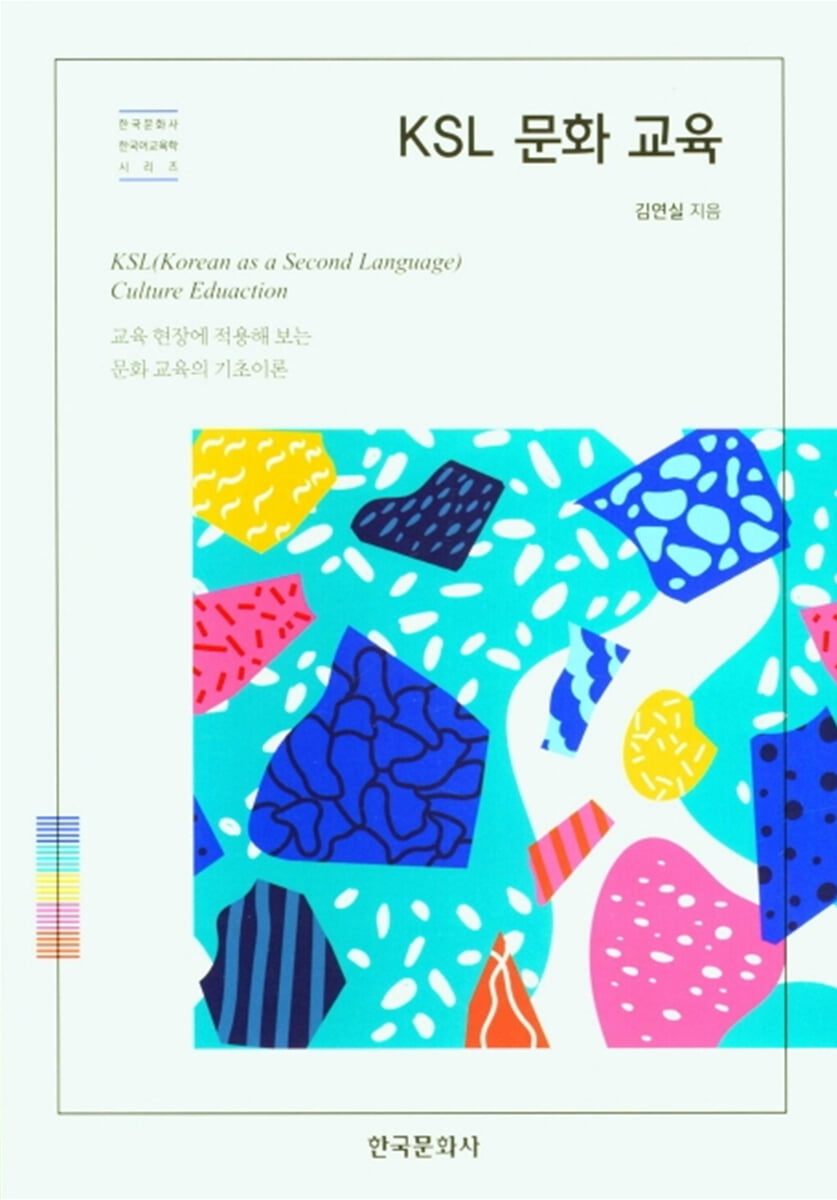
KSL Cultural Education
 |
Description
Book Introduction
In order to provide cultural education, it is necessary to clearly define the concept of culture.
Because we need to define what culture is before we can answer the question of what to teach.
To this end, the concept of culture can be examined from two perspectives.
The first is from a cultural anthropological perspective, and the second is from a foreign language education perspective. Research on KSL cultural education requires an approach from both perspectives.
First, we will be able to design a broad framework from a broad perspective through a general understanding of culture in cultural anthropology.
And, since KSL is also a form of foreign language education, the approach to culture in foreign language education theory will be helpful in organizing detailed contents for cultural education from a microscopic perspective.
Because we need to define what culture is before we can answer the question of what to teach.
To this end, the concept of culture can be examined from two perspectives.
The first is from a cultural anthropological perspective, and the second is from a foreign language education perspective. Research on KSL cultural education requires an approach from both perspectives.
First, we will be able to design a broad framework from a broad perspective through a general understanding of culture in cultural anthropology.
And, since KSL is also a form of foreign language education, the approach to culture in foreign language education theory will be helpful in organizing detailed contents for cultural education from a microscopic perspective.
- You can preview some of the book's contents.
Preview
index
preface
1.
General Discussion on Cultural Education and KSL
1.1.
Cultural education in foreign language education
1.1.1.
The concept of culture and the need for cultural education
1.1.2.
Type classification for selecting cultural education content
1.2. Introduction and Revision of the KSL Curriculum / 32
1.2.1.
Introduction of the 2012 KSL Curriculum
1.2.2.
2017 KSL Curriculum Revision
1.2.3. Clarification of KSL learning targets
2. Cultural Education in the KSL Curriculum
2.1.
Cultural Education Principles and Educational Goals
2.2.
interculturalism
2.3. Critical Analysis of KSL Cultural Education
2.3.1.
Content structure
2.3.2.
Composition principle
2.3.3.
Achievement Standards
2.3.4.
cultural items
2.3.5. Directions for Curriculum Improvement for KSL Cultural Education
3. Cultural education content in KSL textbooks
3.1.
Purpose and analysis criteria of textbook analysis
3.2.
Analysis of Cultural Elements in Korean Communication Textbooks
3.2.1.
Communication textbook for elementary school students
3.2.2.
Communication textbook for middle and high school students
3.3.
Analysis of Cultural Elements in Korean Language Teaching Materials
3.3.1.
Learning tool textbooks for elementary school students
3.3.2.
Learning tool textbooks for middle and high school students
3.4.
Significance and Discussion Points of Textbook Analysis
4. Redesigning the curriculum for KSL cultural education
4.1.
target
4.2.
Content structure
4.2.1.
Content system redesign direction
4.2.2.
Selection of cultural items
4.2.3.
Content system of cultural education curriculum
4.3.
Composition principle
4.3.1.
Setting up cultural comparative observation skills
4.3.2.
Cultural Comparison Observation Skills by Proficiency Level
4.4.
Achievement Standards
4.4.1.
Composition of achievement standards
4.4.2.
Achievement criteria by proficiency level
5. KSL Stage-by-Stage Cultural Education Contents
5.1.
Principles for selecting cultural education content
5.1.1.
Selection of cultural education content
5.1.2.
Principle of expanding cultural education content levels
5.2.
Cultural education content by school age and proficiency level
5.2.1.
Elementary school elementary, middle, and high school cultural education content
5.2.2.
Elementary, middle, and high school cultural education content
1.
General Discussion on Cultural Education and KSL
1.1.
Cultural education in foreign language education
1.1.1.
The concept of culture and the need for cultural education
1.1.2.
Type classification for selecting cultural education content
1.2. Introduction and Revision of the KSL Curriculum / 32
1.2.1.
Introduction of the 2012 KSL Curriculum
1.2.2.
2017 KSL Curriculum Revision
1.2.3. Clarification of KSL learning targets
2. Cultural Education in the KSL Curriculum
2.1.
Cultural Education Principles and Educational Goals
2.2.
interculturalism
2.3. Critical Analysis of KSL Cultural Education
2.3.1.
Content structure
2.3.2.
Composition principle
2.3.3.
Achievement Standards
2.3.4.
cultural items
2.3.5. Directions for Curriculum Improvement for KSL Cultural Education
3. Cultural education content in KSL textbooks
3.1.
Purpose and analysis criteria of textbook analysis
3.2.
Analysis of Cultural Elements in Korean Communication Textbooks
3.2.1.
Communication textbook for elementary school students
3.2.2.
Communication textbook for middle and high school students
3.3.
Analysis of Cultural Elements in Korean Language Teaching Materials
3.3.1.
Learning tool textbooks for elementary school students
3.3.2.
Learning tool textbooks for middle and high school students
3.4.
Significance and Discussion Points of Textbook Analysis
4. Redesigning the curriculum for KSL cultural education
4.1.
target
4.2.
Content structure
4.2.1.
Content system redesign direction
4.2.2.
Selection of cultural items
4.2.3.
Content system of cultural education curriculum
4.3.
Composition principle
4.3.1.
Setting up cultural comparative observation skills
4.3.2.
Cultural Comparison Observation Skills by Proficiency Level
4.4.
Achievement Standards
4.4.1.
Composition of achievement standards
4.4.2.
Achievement criteria by proficiency level
5. KSL Stage-by-Stage Cultural Education Contents
5.1.
Principles for selecting cultural education content
5.1.1.
Selection of cultural education content
5.1.2.
Principle of expanding cultural education content levels
5.2.
Cultural education content by school age and proficiency level
5.2.1.
Elementary school elementary, middle, and high school cultural education content
5.2.2.
Elementary, middle, and high school cultural education content
Into the book
Culture is both learned and acquired, and is both explicit and implicit knowledge.
It is also a concrete product and at the same time a symbolic system.
In this way, it has both existential characteristics.
This means that KSL cultural education must take into account multiple aspects.
In particular, the difference between the two perspectives of holism and idealism suggests important points in the selection of KSL cultural education content and methodology.
This is because the content and methods of cultural education can differ depending on how one views culture.
The holistic approach demonstrates the importance of diversity in selecting cultural education content, which requires consideration of educational content across the entire spectrum of human lifestyles.
Since the context of daily life is the object of culture, KSL learners must closely examine the context of life they encounter.
This means that the cultural education content that KSL learners need most is in the context of their lives.
Therefore, when selecting cultural education content, we must closely examine the current situation facing KSL learners.
A comprehensive review is needed of the environment that learners encounter, not only in their daily lives but also in school life and the academic fields that have a significant impact on students' lives.
After such careful review, the cultural education content must be selected so that the cultural education content that the learners need can be selected.
Furthermore, the idealistic perspective suggests that an educational methodology approach that goes beyond simply conveying the diverse cultural content that appears in phenomena and involves interpretation and critical analysis of it is necessary.
This is also the realization of 'cultural competence', the ultimate goal that must be achieved through cultural education.
The ability to interpret the meaning and values hidden behind a culture using one's own subjective standards is a very important ability in understanding culture.
Even if we deal with various cultural types from a holistic perspective, ultimately, cultural interpretation and critical analysis, that is, cross-cultural comparative activities, are absolutely necessary.
This also emphasizes the importance of spiritual culture and ideological culture as well as material culture and achievement culture in selecting cultural education content.
As symbolic values are also an important element of culture, approaching them can be said to be an essential educational content in cultural education.
It is also a concrete product and at the same time a symbolic system.
In this way, it has both existential characteristics.
This means that KSL cultural education must take into account multiple aspects.
In particular, the difference between the two perspectives of holism and idealism suggests important points in the selection of KSL cultural education content and methodology.
This is because the content and methods of cultural education can differ depending on how one views culture.
The holistic approach demonstrates the importance of diversity in selecting cultural education content, which requires consideration of educational content across the entire spectrum of human lifestyles.
Since the context of daily life is the object of culture, KSL learners must closely examine the context of life they encounter.
This means that the cultural education content that KSL learners need most is in the context of their lives.
Therefore, when selecting cultural education content, we must closely examine the current situation facing KSL learners.
A comprehensive review is needed of the environment that learners encounter, not only in their daily lives but also in school life and the academic fields that have a significant impact on students' lives.
After such careful review, the cultural education content must be selected so that the cultural education content that the learners need can be selected.
Furthermore, the idealistic perspective suggests that an educational methodology approach that goes beyond simply conveying the diverse cultural content that appears in phenomena and involves interpretation and critical analysis of it is necessary.
This is also the realization of 'cultural competence', the ultimate goal that must be achieved through cultural education.
The ability to interpret the meaning and values hidden behind a culture using one's own subjective standards is a very important ability in understanding culture.
Even if we deal with various cultural types from a holistic perspective, ultimately, cultural interpretation and critical analysis, that is, cross-cultural comparative activities, are absolutely necessary.
This also emphasizes the importance of spiritual culture and ideological culture as well as material culture and achievement culture in selecting cultural education content.
As symbolic values are also an important element of culture, approaching them can be said to be an essential educational content in cultural education.
--- From the text
Publisher's Review
preface
The number of students from multicultural families in Korea has been steadily increasing since the 2000s.
Nowadays, it has become quite common to meet friends from multicultural families in the same class.
They are beings who must live together in our society and are also treasures that possess important cultural assets.
Now is the time to make an urgent effort to bring them into society and into our education system.
In response to these social changes, the Korean as a Second Language (KSL) Korean language curriculum was developed and announced in 2012. The KSL (Korean as a Second Language) Korean language curriculum is a second language education program designed for school-age learners.
It is very significant in that it marks the beginning of a full-scale discussion on Korean language education at the public education level.
The primary goal of the Korean language curriculum was to enable students to live in our society without facing difficulties.
Efforts have been made not only to establish the curriculum but also to establish support measures at the level of this primary goal.
Now, we must go one step further and embrace them on a cultural level, and consider how we can utilize them as human resources to expand cultural diversity in our society.
To address these contemporary concerns, I conducted research on KSL's cultural education and published my doctoral dissertation.
This book is based on research conducted while writing my doctoral dissertation, which was published in 2020.
Through books and papers, we have broadened the scope of our content so that it can be utilized not only at the curriculum level but also in actual educational settings, in order to contribute to the field of KSL cultural education.
Therefore, this book does not stop at pointing out and correcting the problems of the current curriculum in terms of cultural education, but also presents practical steps for setting and hierarchizing cultural education content by school age and language level.
I hope that the contents of this book will be helpful in actual KSL education settings, as per the research purpose.
I hope that this will be an important starting point, however small, in the field of KSL cultural education.
I hope that cultural research for multicultural students will become more active in the future and that practical help and support will continue.
I would like to express my sincere gratitude to my advisor, Professor Yang Min-jeong, as well as Professors Chae Ho-seok, Kwon Soon-geung, Lim Chi-gyun, and Noh Chae-hwan, who provided generous advice that helped me establish a research framework.
I would also like to express my gratitude to the publishers who have been so patient while I spent time organizing and preparing the content.
I hope that through this book, the color of KSL cultural education will become richer, so that everyone's hard work will not be wasted.
The number of students from multicultural families in Korea has been steadily increasing since the 2000s.
Nowadays, it has become quite common to meet friends from multicultural families in the same class.
They are beings who must live together in our society and are also treasures that possess important cultural assets.
Now is the time to make an urgent effort to bring them into society and into our education system.
In response to these social changes, the Korean as a Second Language (KSL) Korean language curriculum was developed and announced in 2012. The KSL (Korean as a Second Language) Korean language curriculum is a second language education program designed for school-age learners.
It is very significant in that it marks the beginning of a full-scale discussion on Korean language education at the public education level.
The primary goal of the Korean language curriculum was to enable students to live in our society without facing difficulties.
Efforts have been made not only to establish the curriculum but also to establish support measures at the level of this primary goal.
Now, we must go one step further and embrace them on a cultural level, and consider how we can utilize them as human resources to expand cultural diversity in our society.
To address these contemporary concerns, I conducted research on KSL's cultural education and published my doctoral dissertation.
This book is based on research conducted while writing my doctoral dissertation, which was published in 2020.
Through books and papers, we have broadened the scope of our content so that it can be utilized not only at the curriculum level but also in actual educational settings, in order to contribute to the field of KSL cultural education.
Therefore, this book does not stop at pointing out and correcting the problems of the current curriculum in terms of cultural education, but also presents practical steps for setting and hierarchizing cultural education content by school age and language level.
I hope that the contents of this book will be helpful in actual KSL education settings, as per the research purpose.
I hope that this will be an important starting point, however small, in the field of KSL cultural education.
I hope that cultural research for multicultural students will become more active in the future and that practical help and support will continue.
I would like to express my sincere gratitude to my advisor, Professor Yang Min-jeong, as well as Professors Chae Ho-seok, Kwon Soon-geung, Lim Chi-gyun, and Noh Chae-hwan, who provided generous advice that helped me establish a research framework.
I would also like to express my gratitude to the publishers who have been so patient while I spent time organizing and preparing the content.
I hope that through this book, the color of KSL cultural education will become richer, so that everyone's hard work will not be wasted.
GOODS SPECIFICS
- Publication date: July 30, 2021
- Page count, weight, size: 272 pages | 536g | 175*250*20mm
- ISBN13: 9791166850387
- ISBN10: 1166850382
You may also like
카테고리
korean


korean

![GQ KOREA Mark (Monthly): December [2025]](http://librairie.coreenne.fr/cdn/shop/files/8ef265dbbfbf186523ed75ba7319009d.jpg?v=1765340328&width=3840)


