

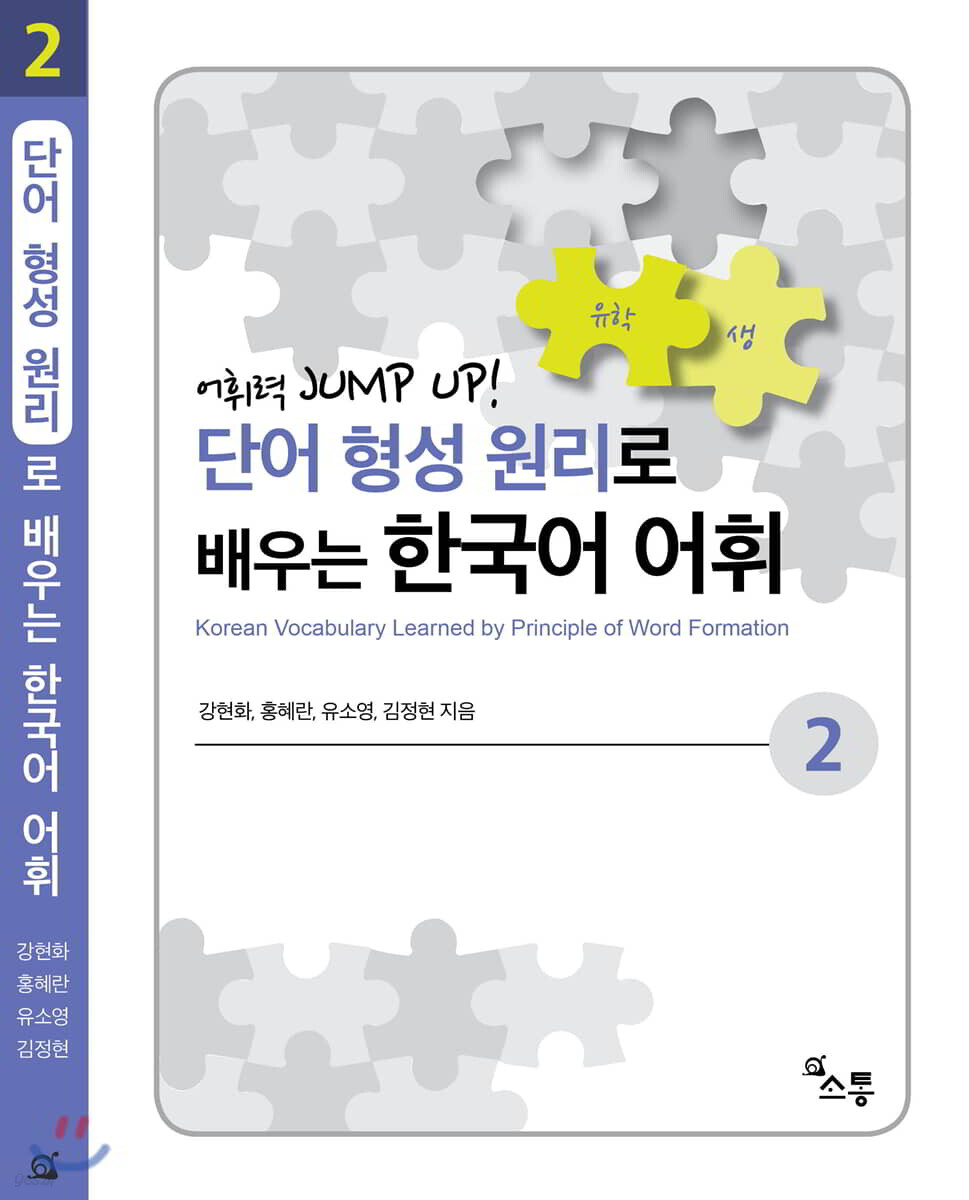
Learning Korean Vocabulary Through Word Formation Principles 2
 |
Description
Book Introduction
The importance of vocabulary learning for foreign language learners is widely known.
Vocabulary learning is the beginning of language acquisition and a stepping stone to mastery, and a learner's vocabulary has a significant impact on the development of language skills.
Vocabulary knowledge plays an important role not only in producing meaning but also in reading comprehension, making it a key factor in determining learners' language ability in both expression and comprehension.
Although various Korean language learning materials have been developed, the publication of "Learning Korean Vocabulary Using Word Formation Principles" is significant in that there have not been many learning materials that can improve vocabulary.
In addition, Korean is a language in which compound words are actively formed through additive words, so vocabulary expansion teaching utilizing the principle of word formation is very useful in Korean language education.
Accordingly, in this book, affixes and affixed roots are grouped together and treated as a unit of forming words.
First, we started by analyzing Korean language education materials to objectively select the control units necessary for Korean language education.
Based on vocabulary exposed in leading Korean language textbooks and Korean language proficiency tests, and compound words extracted from the international standard Korean language curriculum, we extracted high-frequency affixes and affixed roots to systematically and objectively present word-forming units that are highly useful in learning Korean.
In addition, the meaning of each unit of control and the words created from it were presented so that they can be directly utilized in teaching and learning Korean.
Each word is translated and shown as an example of its use in phrases and sentences, allowing readers to understand its meaning and usage.
That is, it was designed to be applied in actual use and appropriate context, starting from the meaning it is intended to express.
Accordingly, this book presents word units grouped by semantic category rather than in alphabetical order, thereby enabling discriminatory learning of word units with similar meanings.
Additionally, it helps students learn at different levels by indicating the level of proficiency in the words.
Korean has many word units with similar meanings, so it is easy to get confused.
The units of Chinese character words are not the same as those in China or Japan, so it is also difficult for learners of Chinese character-based languages.
Taking these points into account, we have tried to help people easily understand the differences between similar control units through comparisons and supplementary explanations whenever possible.
Vocabulary learning is the beginning of language acquisition and a stepping stone to mastery, and a learner's vocabulary has a significant impact on the development of language skills.
Vocabulary knowledge plays an important role not only in producing meaning but also in reading comprehension, making it a key factor in determining learners' language ability in both expression and comprehension.
Although various Korean language learning materials have been developed, the publication of "Learning Korean Vocabulary Using Word Formation Principles" is significant in that there have not been many learning materials that can improve vocabulary.
In addition, Korean is a language in which compound words are actively formed through additive words, so vocabulary expansion teaching utilizing the principle of word formation is very useful in Korean language education.
Accordingly, in this book, affixes and affixed roots are grouped together and treated as a unit of forming words.
First, we started by analyzing Korean language education materials to objectively select the control units necessary for Korean language education.
Based on vocabulary exposed in leading Korean language textbooks and Korean language proficiency tests, and compound words extracted from the international standard Korean language curriculum, we extracted high-frequency affixes and affixed roots to systematically and objectively present word-forming units that are highly useful in learning Korean.
In addition, the meaning of each unit of control and the words created from it were presented so that they can be directly utilized in teaching and learning Korean.
Each word is translated and shown as an example of its use in phrases and sentences, allowing readers to understand its meaning and usage.
That is, it was designed to be applied in actual use and appropriate context, starting from the meaning it is intended to express.
Accordingly, this book presents word units grouped by semantic category rather than in alphabetical order, thereby enabling discriminatory learning of word units with similar meanings.
Additionally, it helps students learn at different levels by indicating the level of proficiency in the words.
Korean has many word units with similar meanings, so it is easy to get confused.
The units of Chinese character words are not the same as those in China or Japan, so it is also difficult for learners of Chinese character-based languages.
Taking these points into account, we have tried to help people easily understand the differences between similar control units through comparisons and supplementary explanations whenever possible.
index
06
Character and State 1: Words that add meaning to words that describe things, people, and objects
high and low
Go-, low-
long and short
Long-, short-
Big, small, many
Big, small, many
New and old
Shin-, Gu-, Sae-, No-
light and heavy
Light-, medium-
Beginning and End, Late
Cho-, late-, first-, last-
unripe, unripe, underripe
Man-, raw-, put-
Central
main
Opposite, against
half-
big, accurate, in full swing
one-
07
Character and State 2: Words that add meaning to words expressing actions and states
None, not (yet)
Mu-, Bu-/Bul-, Bi-, Mi-
very, most, wildly, severely
Cho-, Gyeop-, Choi-, Sae-, Jjit-, Hwi-
again
Do-, Jae-
facing each other, facing each other, facing each other
Right-
useless, pointless
Huh-, dog-
Real, true
really-
Especially different, strange
star-
Correct, original, each
my-
Difficulty, lack
-I am
Psychology, symptoms
-감, -기, -심, -증
nature, characteristic
-castle
degree, ability
-do, -ryeok
08
act
ceremony, event
-food, -jeon, -je, -hoe
act
-uh, -jeon, -jil, -jit
09
Time, quantity and units
Date, time
-day, -gan, -gi, -cheol
quantity
amount, -rate/rate, -minute, number-, total-
unit
-dang, -dae, -byeol
10
Academics and Systems
scholarship
-hak, -ron, -sa
system, plan
-volume, -je, -an, -book, -law
aspect
-poem, -official, -sang
Character and State 1: Words that add meaning to words that describe things, people, and objects
high and low
Go-, low-
long and short
Long-, short-
Big, small, many
Big, small, many
New and old
Shin-, Gu-, Sae-, No-
light and heavy
Light-, medium-
Beginning and End, Late
Cho-, late-, first-, last-
unripe, unripe, underripe
Man-, raw-, put-
Central
main
Opposite, against
half-
big, accurate, in full swing
one-
07
Character and State 2: Words that add meaning to words expressing actions and states
None, not (yet)
Mu-, Bu-/Bul-, Bi-, Mi-
very, most, wildly, severely
Cho-, Gyeop-, Choi-, Sae-, Jjit-, Hwi-
again
Do-, Jae-
facing each other, facing each other, facing each other
Right-
useless, pointless
Huh-, dog-
Real, true
really-
Especially different, strange
star-
Correct, original, each
my-
Difficulty, lack
-I am
Psychology, symptoms
-감, -기, -심, -증
nature, characteristic
-castle
degree, ability
-do, -ryeok
08
act
ceremony, event
-food, -jeon, -je, -hoe
act
-uh, -jeon, -jil, -jit
09
Time, quantity and units
Date, time
-day, -gan, -gi, -cheol
quantity
amount, -rate/rate, -minute, number-, total-
unit
-dang, -dae, -byeol
10
Academics and Systems
scholarship
-hak, -ron, -sa
system, plan
-volume, -je, -an, -book, -law
aspect
-poem, -official, -sang
GOODS SPECIFICS
- Date of issue: July 1, 2019
- Page count, weight, size: 422 pages | 173*235*30mm
- ISBN13: 9791186453728
- ISBN10: 1186453729
You may also like
카테고리
korean


korean

![GQ KOREA Mark (Monthly): December [2025]](http://librairie.coreenne.fr/cdn/shop/files/8ef265dbbfbf186523ed75ba7319009d.jpg?v=1765340328&width=3840)


