

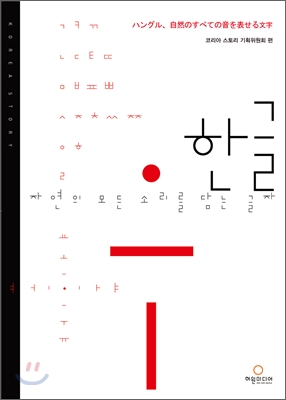
Hangul, the alphabet that contains all the sounds of nature
 |
Description
Book Introduction
This book is structured in a question-and-answer format based on the principles of Hangul's creation, focusing on what you need to know about Hangul, the national alphabet of the Republic of Korea.
It is included with English text so that you can give it as a gift to a foreign friend or explain it to them.
This will be a textbook that provides detailed information about Hangul, which is highly praised as the world's best writing system, and also serve as promotional material that can promote the uniqueness and excellence of our culture.
It is included with English text so that you can give it as a gift to a foreign friend or explain it to them.
This will be a textbook that provides detailed information about Hangul, which is highly praised as the world's best writing system, and also serve as promotional material that can promote the uniqueness and excellence of our culture.
index
Korea Story for those who dream beautiful dreams
Preface to Korea Story Volume 1, Hangul
01 What letters do people living in Korea use now?
02 How did Korea come to use its own unique writing system, Hangul?
03 How did Hangul, the alphabet currently used by Koreans, come into being?
04 When and who created Hangul?
05 Why did King Sejong create Hunminjeongeum?
06 What does Hunminjeongeum mean?
07 What is the reason King Sejong created Hunminjeongeum?
08 What is the principle of yin-yang and the five elements that was used when creating Hunminjeongeum?
09 How was the principle of yin-yang and the five elements applied to the creation of Hunminjeongeum?
10 What principles were used to create the letters of Hunminjeongeum?
11 Why is Hangul said to be the best writing system in the world?
12 How long will it take to learn to read and write Korean?
13 Common Sense About Hangul
Appendix Korean related sites
The beautiful form of Hangul
Preface to Korea Story Volume 1, Hangul
01 What letters do people living in Korea use now?
02 How did Korea come to use its own unique writing system, Hangul?
03 How did Hangul, the alphabet currently used by Koreans, come into being?
04 When and who created Hangul?
05 Why did King Sejong create Hunminjeongeum?
06 What does Hunminjeongeum mean?
07 What is the reason King Sejong created Hunminjeongeum?
08 What is the principle of yin-yang and the five elements that was used when creating Hunminjeongeum?
09 How was the principle of yin-yang and the five elements applied to the creation of Hunminjeongeum?
10 What principles were used to create the letters of Hunminjeongeum?
11 Why is Hangul said to be the best writing system in the world?
12 How long will it take to learn to read and write Korean?
13 Common Sense About Hangul
Appendix Korean related sites
The beautiful form of Hangul
Publisher's Review
Heowon Media planned the Korea Story series to introduce Korean culture to the world.
This book is the first volume of Korea Story.
The power of culture is well demonstrated throughout our history.
The current practice in China and Japan is to try to show off the superiority of a nation even by distorting history.
Korea Story does not intend to romanticize our culture more than it actually is.
We want to promote our culture as it is.
Kim Gu's words, which formed the background for the Korea Story project
“...only culture can cultivate this spirit of humanity.
I hope that our country will not become a country that imitates others, but will become the source, goal, and example of this high and new culture.
“So, I hope that true world peace will be realized in our country and through our country.” (From Kim Gu’s “My Wish”)
Although our culture is spreading around the world under the name of the Korean Wave, the Korean Wave is merely a one-time phenomenon that will soon end when its popularity wanes.
Korea Story aims to be a cultural guide that continuously informs people about Korea, not just a one-time event.
These days, there are many opportunities to meet foreigners anywhere in our country.
All of our citizens should become private diplomatic envoys, but the reality is that we don't even have adequate materials to explain our country's proud culture and history to foreigners.
This book is written in a question-and-answer format based on the principles of Hangul's creation, focusing on what you need to know about Hangul, the national alphabet of the Republic of Korea.
It is included with English text so that you can give it as a gift to a foreign friend or explain it to them.
Do you know the principles of Hangul's creation? Hangul's vowel system incorporates the principles of yin and yang, while its consonant system incorporates the principles of the Five Elements.
When people talk about yin-yang and the five elements, the words fortune telling or four pillars of destiny often come to mind.
That's because they don't know what yin-yang and the five elements are.
In the 15th century, when Hangul was created, it was a time when it was completely unknown whether the Earth rotated or revolved around the sun. The principle of yin-yang and the five elements was developed as a principle to systematically explain all natural phenomena and human activities.
Therefore, it is only natural that the principles of yin-yang and the five elements were applied to create letters to capture the sounds of nature.
The Korean alphabet, which was created in this way, is highly praised by linguists as the best writing system in the world.
Also, in a recent survey asking, "What is our country's most proud cultural heritage?", the most popular answer was Hangul, which clearly shows that Hangul is our foremost cultural heritage that all of our people want to boast about to the world.
But how many people would be able to adequately explain what makes Hangul so superior? The reality is that not many Koreans have a clear understanding of the philosophy and principles upon which Hangul was created, or where its scientific nature and excellence lie.
Therefore, even if we want to inform foreigners of the excellence of Hangul, we cannot properly explain it.
This is primarily because there aren't many opportunities to learn enough about Hangul, and even if you try to learn it yourself, it's not easy to find good books to read.
This is a common problem faced by people who want to promote our culture or foreigners who want to know about Korea.
This book is designed to solve such problems.
This book explains in detail the principles of the creation of Hangul, which contains the sounds of the universe and nature, and Hangul, the world's most advanced 'systematic phonemic writing system.'
To take advantage of the world's only phonemic writing system, we must forget the consonant-vowel order of the past.
Hangul is the most developed phonemic writing system in the world, along with English, which is currently the most widely used, and unlike English, it is the only systematic phonemic writing system in the world that has a system of letter shapes and sounds for both consonants and vowels.
Among Song Chang-sik's songs, there is a song called 'Ganadaramabasa'.
Since we have been learning Hangul as Ganadaramabasaajachakatapaha since we first started learning it, these lyrics will be familiar to you.
However, if this order were reversed as follows, children and foreigners new to learning Hangul would find it much easier to learn. (See page 80 of the book.)
Kaka
Nadata
Mabapa
Lion car
aha
la
Kakanadatamababasajachaahara.
This order is the most efficient way to utilize the consonant system of the Korean alphabet.
This book is the first volume of Korea Story.
The power of culture is well demonstrated throughout our history.
The current practice in China and Japan is to try to show off the superiority of a nation even by distorting history.
Korea Story does not intend to romanticize our culture more than it actually is.
We want to promote our culture as it is.
Kim Gu's words, which formed the background for the Korea Story project
“...only culture can cultivate this spirit of humanity.
I hope that our country will not become a country that imitates others, but will become the source, goal, and example of this high and new culture.
“So, I hope that true world peace will be realized in our country and through our country.” (From Kim Gu’s “My Wish”)
Although our culture is spreading around the world under the name of the Korean Wave, the Korean Wave is merely a one-time phenomenon that will soon end when its popularity wanes.
Korea Story aims to be a cultural guide that continuously informs people about Korea, not just a one-time event.
These days, there are many opportunities to meet foreigners anywhere in our country.
All of our citizens should become private diplomatic envoys, but the reality is that we don't even have adequate materials to explain our country's proud culture and history to foreigners.
This book is written in a question-and-answer format based on the principles of Hangul's creation, focusing on what you need to know about Hangul, the national alphabet of the Republic of Korea.
It is included with English text so that you can give it as a gift to a foreign friend or explain it to them.
Do you know the principles of Hangul's creation? Hangul's vowel system incorporates the principles of yin and yang, while its consonant system incorporates the principles of the Five Elements.
When people talk about yin-yang and the five elements, the words fortune telling or four pillars of destiny often come to mind.
That's because they don't know what yin-yang and the five elements are.
In the 15th century, when Hangul was created, it was a time when it was completely unknown whether the Earth rotated or revolved around the sun. The principle of yin-yang and the five elements was developed as a principle to systematically explain all natural phenomena and human activities.
Therefore, it is only natural that the principles of yin-yang and the five elements were applied to create letters to capture the sounds of nature.
The Korean alphabet, which was created in this way, is highly praised by linguists as the best writing system in the world.
Also, in a recent survey asking, "What is our country's most proud cultural heritage?", the most popular answer was Hangul, which clearly shows that Hangul is our foremost cultural heritage that all of our people want to boast about to the world.
But how many people would be able to adequately explain what makes Hangul so superior? The reality is that not many Koreans have a clear understanding of the philosophy and principles upon which Hangul was created, or where its scientific nature and excellence lie.
Therefore, even if we want to inform foreigners of the excellence of Hangul, we cannot properly explain it.
This is primarily because there aren't many opportunities to learn enough about Hangul, and even if you try to learn it yourself, it's not easy to find good books to read.
This is a common problem faced by people who want to promote our culture or foreigners who want to know about Korea.
This book is designed to solve such problems.
This book explains in detail the principles of the creation of Hangul, which contains the sounds of the universe and nature, and Hangul, the world's most advanced 'systematic phonemic writing system.'
To take advantage of the world's only phonemic writing system, we must forget the consonant-vowel order of the past.
Hangul is the most developed phonemic writing system in the world, along with English, which is currently the most widely used, and unlike English, it is the only systematic phonemic writing system in the world that has a system of letter shapes and sounds for both consonants and vowels.
Among Song Chang-sik's songs, there is a song called 'Ganadaramabasa'.
Since we have been learning Hangul as Ganadaramabasaajachakatapaha since we first started learning it, these lyrics will be familiar to you.
However, if this order were reversed as follows, children and foreigners new to learning Hangul would find it much easier to learn. (See page 80 of the book.)
Kaka
Nadata
Mabapa
Lion car
aha
la
Kakanadatamababasajachaahara.
This order is the most efficient way to utilize the consonant system of the Korean alphabet.
GOODS SPECIFICS
- Date of issue: April 3, 2012
- Page count, weight, size: 121 pages | 188*254*20mm
- ISBN13: 9788992162395
- ISBN10: 8992162391
You may also like
카테고리
korean


korean

![GQ KOREA Mark (Monthly): December [2025]](http://librairie.coreenne.fr/cdn/shop/files/8ef265dbbfbf186523ed75ba7319009d.jpg?v=1765340328&width=3840)


