

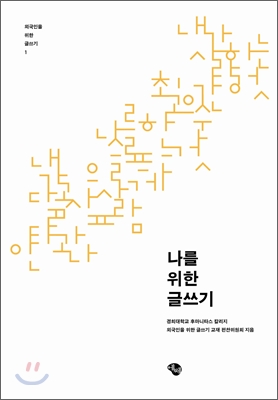
Writing for myself
 |
Description
Book Introduction
This book is designed to help international students practice thinking about and expressing their lives and experiences in Korean.
Breaking away from the traditional method of first instilling theory and techniques, we adopted a method in which students naturally develop their own experiences. Instead of listing too many learning contents, we focus on five topics.
Through five themes: 'What I love, my best moments, what makes me sad, who I want to be like, and others and me,' it provides an opportunity to rediscover not only Korean writing but also the various relationships that have made 'me who I am today.'
Breaking away from the traditional method of first instilling theory and techniques, we adopted a method in which students naturally develop their own experiences. Instead of listing too many learning contents, we focus on five topics.
Through five themes: 'What I love, my best moments, what makes me sad, who I want to be like, and others and me,' it provides an opportunity to rediscover not only Korean writing but also the various relationships that have made 'me who I am today.'
index
preface
To the Professor - Features and Uses of This Book
To Students - Writing, Just Know This!
Chapter 1 What I Love
First Yard_My Dog
Reading Strategy Analytical Reading 1: Analyze the structure to understand the flow
Reading Strategy Critical Reading 1: Expand Your Thinking and Evaluate the Text
Second Yard_419 Closing the Library
Writing Strategies: Creating an Outline for Your Essay
Third Yard_A Dream That Never Sleeps
Fourth yard
Chapter 2 The Best Moment
First yard_It's okay
Reading Strategy Analytical Reading 2: Understand Narrative Structure and Meaning
Second Courtyard_This beautiful truth captured my heart.
Describe your writing strategy
Third Yard: Effort Never Betrays
Fourth yard
Chapter 3 What Makes Me Sad
First Yard_Sister's Will
Summarizing Writing Strategies
Second Yard_We Say Goodbye at the Destroyed River
Writing Strategy: Identifying the Causes of Writing
Third Courtyard_The Insurmountable Wall, Viking
Fourth yard
Chapter 4: The Person I Want to Be Like
First Yard_Between Mom and Aunt
Writing by comparing writing strategies
Second Yard_Gandhi's Hut
Twist the concept of writing strategy
Third Yard: Busan Seagulls Land in Seoul
Rewriting your writing strategy
Fourth yard
Chapter 5 Others and Me
First Yard_Good Daughter and Bad Daughter
Reading Strategy Critical Reading 2: Identifying the Point of View
Using Writing Strategies and Styles
Second Yard_My Mother Tongue is Silence
Change your writing strategy
Third Yard: If You're Going to Do It, Go for 'Good Chocolate'
Rewrite using writing strategy style
Fourth yard
To the Professor - Features and Uses of This Book
To Students - Writing, Just Know This!
Chapter 1 What I Love
First Yard_My Dog
Reading Strategy Analytical Reading 1: Analyze the structure to understand the flow
Reading Strategy Critical Reading 1: Expand Your Thinking and Evaluate the Text
Second Yard_419 Closing the Library
Writing Strategies: Creating an Outline for Your Essay
Third Yard_A Dream That Never Sleeps
Fourth yard
Chapter 2 The Best Moment
First yard_It's okay
Reading Strategy Analytical Reading 2: Understand Narrative Structure and Meaning
Second Courtyard_This beautiful truth captured my heart.
Describe your writing strategy
Third Yard: Effort Never Betrays
Fourth yard
Chapter 3 What Makes Me Sad
First Yard_Sister's Will
Summarizing Writing Strategies
Second Yard_We Say Goodbye at the Destroyed River
Writing Strategy: Identifying the Causes of Writing
Third Courtyard_The Insurmountable Wall, Viking
Fourth yard
Chapter 4: The Person I Want to Be Like
First Yard_Between Mom and Aunt
Writing by comparing writing strategies
Second Yard_Gandhi's Hut
Twist the concept of writing strategy
Third Yard: Busan Seagulls Land in Seoul
Rewriting your writing strategy
Fourth yard
Chapter 5 Others and Me
First Yard_Good Daughter and Bad Daughter
Reading Strategy Critical Reading 2: Identifying the Point of View
Using Writing Strategies and Styles
Second Yard_My Mother Tongue is Silence
Change your writing strategy
Third Yard: If You're Going to Do It, Go for 'Good Chocolate'
Rewrite using writing strategy style
Fourth yard
Publisher's Review
Writing is about writing slowly!
Reconcile with the typist or
Creatively discordable
Writing that builds strength
Step by step
How to find my voice
The first volume of the "Writing for Foreigners" series, "Writing for Myself," published by the Writing for Foreigners Textbook Compilation Committee of Kyung Hee University's Humanities College, has been published.
This book, written by Professor Kim Jin-hae of Kyung Hee University and two others, contains step-by-step instructions on how to write in Korean for foreigners studying in Korea.
While there are many Korean language textbooks, few books specifically teach Korean writing. Furthermore, this is the first book to focus on emotional Korean writing and essay writing for self-expression, rather than on writing academic papers.
Below, we have summarized the meaning, structure, and features of the book.
It is a huge challenge for a person to learn a language other than his or her native language.
A language not only has its own unique system, but also contains the cultural landscape of the people who use it.
Learning a language means learning both a new linguistic system and the cultural landscape of the people who use it.
If you approach language from an instrumental or functional perspective, it cannot be called holistic language learning.
When learning a language, you constantly compare it to your native language, and through this you enter a world of new perceptions and experiences.
The most difficult gateway to language learning is writing.
Writing goes beyond listening, speaking, and reading.
Writing is an act that organically combines critical, reflective, comprehensive, and creative abilities.
From the moment something useful arises, humans begin to stand as independent individuals.
The writer's experiences and concerns are clearly revealed in the writing.
The ultimate goal of all education is to 'have one's own language'.
Having one's own language gives an individual the power to confront the world.
This is a unique characteristic of writing, which is fundamentally different from learning a skill like riding a bicycle, where learning ends once you master it.
Writing is like an endless practice.
At some point it is neither completed nor finished.
Anyone with a modicum of intelligence will realize that only those who reflect on themselves can truly meet others and engage in dialogue with the world.
Writing is a discovery and testimony about oneself and the world.
Writing allows individuals to gain their own unique perspective.
That gaze becomes even more sharp when communicating with others.
However, the current university writing system demands that students who have not received sufficient writing education write academic writing right away.
It prioritizes how quickly you capture the attention of others rather than helping them secure their own attention.
The logical and critical skills required for academic writing are ultimately based on the ability to observe, reflect, savor, and reconstruct oneself and the world.
Reflection and contemplation on one's own life foster the power to truly reconcile with the world or creatively discord with it.
Writing that does not consider the relationship between oneself and the world is dead writing.
Writing is a struggle to see the world and to know who we are and who we are.
The essential goal of writing education is to help me contemplate what kind of life and experiences I have accumulated as I am thrown into this world, what values and challenges our world holds, and how it connects to my life, and to express this in my own words.
This essential goal of writing education has not been properly achieved so far.
This is even more serious in writing education for international students.
Most current writing books for international students emphasize only the functional aspects of writing, failing to encourage students to reflect on their own lives or critically understand their own culture and that of Korea through writing.
This book is designed to help international students practice thinking about and expressing their lives and experiences in Korean.
For this reason, this book chose to ‘go slow.’
Instead of listing too many learning contents, we focused on five topics.
Breaking away from the traditional method of first instilling theory and techniques, we adopted a method in which students naturally develop their own experiences.
Through five themes: 'What I love, my best moments, what makes me sad, who I want to be like, and others and myself,' he approaches his specific life from various angles.
By analyzing or reasoning through the writings of others, we come to re-examine our own 'forgotten past and present'.
In this process, various relationships that made 'me who I am today' will be newly discovered.
The writing topic is designed to encourage students to draw on their own experiences and thoughts, organize their writing into a coherent narrative, and share it with colleagues for further refinement.
All writing is an active and creative process that involves choosing a topic, organizing ideas, finding material, and writing in a way that fits the flow.
It is also a communication task that involves reading one's own writing with colleagues, listening to the problems in the writing, and reflecting them in the writing.
In writing, revision is more important than writing the first draft.
Many students do not follow this process and end up writing poorly written essays.
This book focuses more on the process of composing and refining writing.
We all have countless stories to tell.
Writing is reading life and writing life.
We are each our own unique world and universe.
I hope that for students learning Korean as a foreign language, writing can be a small comfort and an opportunity to show that "another perspective and voice" is possible in Korean society.
So, I hope you don't fall into unconditional admiration or baseless rejection of the society you belong to or Korean society.
I hope that universal humanity will be pursued through the process of confirming that we are different from one another.
Through this process, let us all confirm that we are contemporaries.
Human society desperately needs your 'different perspectives and voices.'
Reconcile with the typist or
Creatively discordable
Writing that builds strength
Step by step
How to find my voice
The first volume of the "Writing for Foreigners" series, "Writing for Myself," published by the Writing for Foreigners Textbook Compilation Committee of Kyung Hee University's Humanities College, has been published.
This book, written by Professor Kim Jin-hae of Kyung Hee University and two others, contains step-by-step instructions on how to write in Korean for foreigners studying in Korea.
While there are many Korean language textbooks, few books specifically teach Korean writing. Furthermore, this is the first book to focus on emotional Korean writing and essay writing for self-expression, rather than on writing academic papers.
Below, we have summarized the meaning, structure, and features of the book.
It is a huge challenge for a person to learn a language other than his or her native language.
A language not only has its own unique system, but also contains the cultural landscape of the people who use it.
Learning a language means learning both a new linguistic system and the cultural landscape of the people who use it.
If you approach language from an instrumental or functional perspective, it cannot be called holistic language learning.
When learning a language, you constantly compare it to your native language, and through this you enter a world of new perceptions and experiences.
The most difficult gateway to language learning is writing.
Writing goes beyond listening, speaking, and reading.
Writing is an act that organically combines critical, reflective, comprehensive, and creative abilities.
From the moment something useful arises, humans begin to stand as independent individuals.
The writer's experiences and concerns are clearly revealed in the writing.
The ultimate goal of all education is to 'have one's own language'.
Having one's own language gives an individual the power to confront the world.
This is a unique characteristic of writing, which is fundamentally different from learning a skill like riding a bicycle, where learning ends once you master it.
Writing is like an endless practice.
At some point it is neither completed nor finished.
Anyone with a modicum of intelligence will realize that only those who reflect on themselves can truly meet others and engage in dialogue with the world.
Writing is a discovery and testimony about oneself and the world.
Writing allows individuals to gain their own unique perspective.
That gaze becomes even more sharp when communicating with others.
However, the current university writing system demands that students who have not received sufficient writing education write academic writing right away.
It prioritizes how quickly you capture the attention of others rather than helping them secure their own attention.
The logical and critical skills required for academic writing are ultimately based on the ability to observe, reflect, savor, and reconstruct oneself and the world.
Reflection and contemplation on one's own life foster the power to truly reconcile with the world or creatively discord with it.
Writing that does not consider the relationship between oneself and the world is dead writing.
Writing is a struggle to see the world and to know who we are and who we are.
The essential goal of writing education is to help me contemplate what kind of life and experiences I have accumulated as I am thrown into this world, what values and challenges our world holds, and how it connects to my life, and to express this in my own words.
This essential goal of writing education has not been properly achieved so far.
This is even more serious in writing education for international students.
Most current writing books for international students emphasize only the functional aspects of writing, failing to encourage students to reflect on their own lives or critically understand their own culture and that of Korea through writing.
This book is designed to help international students practice thinking about and expressing their lives and experiences in Korean.
For this reason, this book chose to ‘go slow.’
Instead of listing too many learning contents, we focused on five topics.
Breaking away from the traditional method of first instilling theory and techniques, we adopted a method in which students naturally develop their own experiences.
Through five themes: 'What I love, my best moments, what makes me sad, who I want to be like, and others and myself,' he approaches his specific life from various angles.
By analyzing or reasoning through the writings of others, we come to re-examine our own 'forgotten past and present'.
In this process, various relationships that made 'me who I am today' will be newly discovered.
The writing topic is designed to encourage students to draw on their own experiences and thoughts, organize their writing into a coherent narrative, and share it with colleagues for further refinement.
All writing is an active and creative process that involves choosing a topic, organizing ideas, finding material, and writing in a way that fits the flow.
It is also a communication task that involves reading one's own writing with colleagues, listening to the problems in the writing, and reflecting them in the writing.
In writing, revision is more important than writing the first draft.
Many students do not follow this process and end up writing poorly written essays.
This book focuses more on the process of composing and refining writing.
We all have countless stories to tell.
Writing is reading life and writing life.
We are each our own unique world and universe.
I hope that for students learning Korean as a foreign language, writing can be a small comfort and an opportunity to show that "another perspective and voice" is possible in Korean society.
So, I hope you don't fall into unconditional admiration or baseless rejection of the society you belong to or Korean society.
I hope that universal humanity will be pursued through the process of confirming that we are different from one another.
Through this process, let us all confirm that we are contemporaries.
Human society desperately needs your 'different perspectives and voices.'
GOODS SPECIFICS
- Date of publication: February 28, 2012
- Page count, weight, size: 172 pages | 188*254*20mm
- ISBN13: 9788993905908
- ISBN10: 8993905908
You may also like
카테고리
korean


korean

![GQ KOREA Mark (Monthly): December [2025]](http://librairie.coreenne.fr/cdn/shop/files/8ef265dbbfbf186523ed75ba7319009d.jpg?v=1765340328&width=3840)


