

Korean spoken grammar
 |
Description
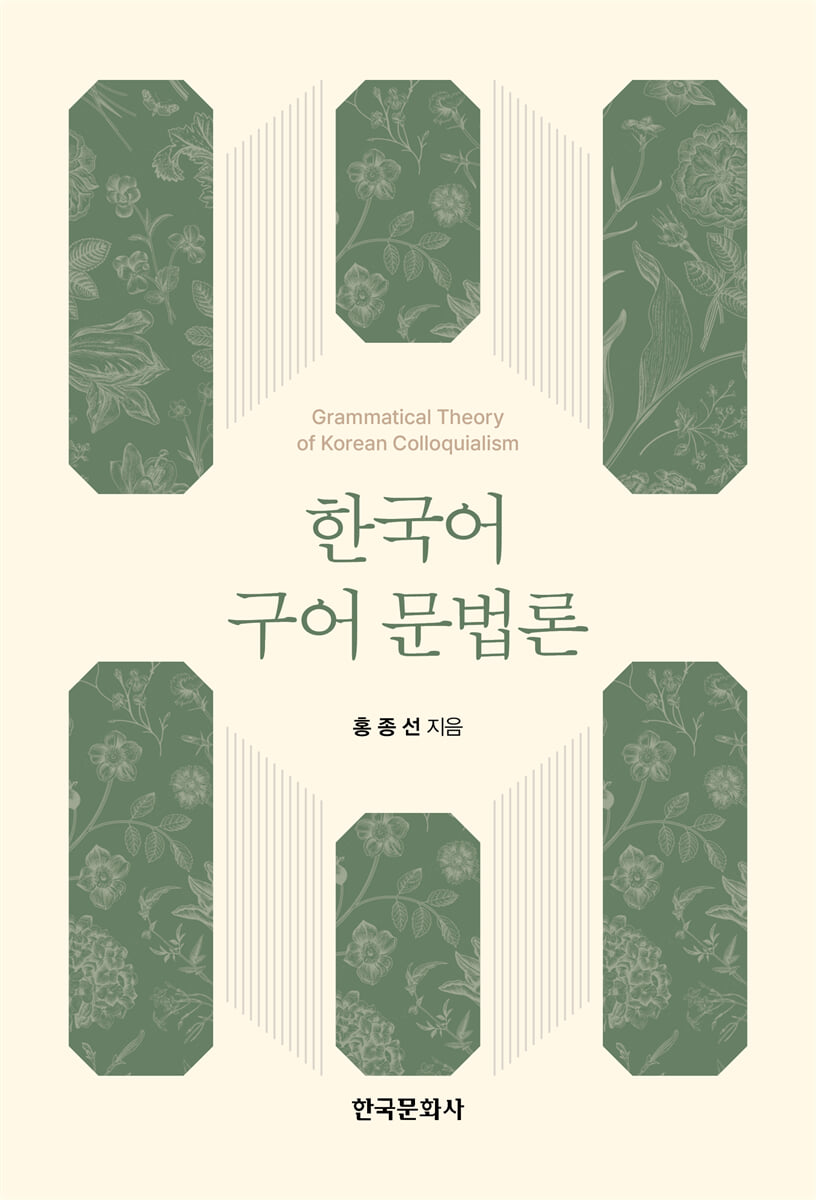
Book Introduction
Although this book is aimed at spoken Korean, it does not exclude content common to the written language.
Moreover, since the spoken grammar system is not yet fully developed, this book was written based on the current school grammar system.
If we only collect grammatical phenomena that exist in spoken language but not in written language, it cannot be called 'spoken language grammar'.
Just as when we say ‘Jeju language system’, we are not only referring to words that exist only on Jeju Island and not on the mainland.
In fact, the name of this book should be 'Korean Grammar'.
If 'Korean grammar' was previously called 'Korean grammar' based on written language-centered grammar, today, when we recognize that spoken language is more important than written language, 'Korean grammar' could become 'Korean grammar' based on spoken language-centered grammar.
Even better, it is an integrated 'Korean grammar' that covers both spoken and written language.
I hope that will happen in the near future.
Moreover, since the spoken grammar system is not yet fully developed, this book was written based on the current school grammar system.
If we only collect grammatical phenomena that exist in spoken language but not in written language, it cannot be called 'spoken language grammar'.
Just as when we say ‘Jeju language system’, we are not only referring to words that exist only on Jeju Island and not on the mainland.
In fact, the name of this book should be 'Korean Grammar'.
If 'Korean grammar' was previously called 'Korean grammar' based on written language-centered grammar, today, when we recognize that spoken language is more important than written language, 'Korean grammar' could become 'Korean grammar' based on spoken language-centered grammar.
Even better, it is an integrated 'Korean grammar' that covers both spoken and written language.
I hope that will happen in the near future.
- You can preview some of the book's contents.
Preview
index
preface
Chapter 1 General Provisions
1.1.
spoken and written language
1.2.
Spoken and written grammar
1.3.
Research on Korean spoken grammar and construction of spoken language data
Chapter 2 Units of Spoken Language
2.1.
Incandescent lamp and unit
2.2.
phonological unit
2.2.1.
phoneme
2.2.2.
syllable
2.3.
morphological unit
2.3.1.
morpheme
The concept and types of morphemes | Morpheme replacement and allomorphism | Morpheme analysis
2.3.2.
word
2.3.3.
Phrase
The concept and recognition of phrases|The form and function of phrases
2.4.
syntactic unit
2.4.1 Spheres and clauses
2.4.2.
sentence
2.5.
discourse unit
2.5.1.
short
2.5.2.
story
Chapter 3 Types and Functions of Words
3.1.
Classification of words into parts of speech
3.2.
Noun
3.2.1.
noun
Common Nouns and Proper Nouns | Independent Nouns and Dependent Nouns
3.2.2.
pronoun
Personal pronouns|Demonstrative pronouns
3.2.3.
investigation
Yangsu-sa|Seosu-sa
3.3.
Verb
3.3.1.
verb
Characteristics of Verbs|Intransitive Verbs, Transitive Verbs
3.3.2.
adjective
Characteristics of Adjectives | Descriptive Adjectives, Demonstrative Adjectives
3.3.3.
'Ida' and 'Itda'
'is'|'is'
3.3.4.
auxiliary verbs
Auxiliary Verbs|Auxiliary Adjectives
3.3.5.
Verb conjugation and conjugation endings
Stems, Endings, and Conjugation|Regular and Irregular Conjugation|System of Ending Conjugation|
Final ending|Final ending 1: Final ending|Final ending 2: Connective ending|
Final Ending 3: Prepositional Ending|Ending a Sentence with a Non-Concluding Ending
3.4.
Modifiers and independent words
3.4.1.
adjective
Denotative adjectives, demonstrative adjectives, and noun adjectives|Chinese character adjectives
3.4.2.
adverb
Adverbs of Component|Adverbs of Sentence
3.4.3.
interjection
3.5.
Relative Words: Particles
3.5.1.
particle
Types of particle positions | Replacement and omission of particle positions
3.5.2.
connection investigation
3.5.3.
Auxiliary verb
Chapter 4: Expanding the Formation of Words
4.1.
The texture of words
Stems and Roots|Suffixes and Affixes|Singular and Compound Words
4.2.
derivation
4.2.1.
Derivative suffix
4.2.2.
Prefix derivatives
4.2.3.
Suffix derivation
Characteristics of suffixes|Noun derivation|Verb derivation|Adjective derivation|
Derivation of adjectives, adverbs, and particles
4.3.
synthesis
4.3.1.
Concept and types of synthesis
4.3.2.
Synthesis and phonological phenomena
4.3.3.
Synthesis by part of speech
Noun compounding | Verb compounding | Adjective compounding | Determiner, adverb, and particle compounding
4.3.4.
Word formation from Chinese characters
Chinese character derivation|Chinese character synthesis
4.4.
Grammaticalization and lexicalization
4.4.1.
Grammaticalization
The concept and types of grammaticalization | The device of grammaticalization | The process and degree of grammaticalization
4.4.2.
Lexicalization
Chapter 5 Sentence Formation and Sentence Types
5.1.
Sentence structure
5.1.1.
Unit of sentence formation
5.1.2.
Sphere and temple
5.1.3.
The concept and scope of sentences
Characteristics and Recognition of Sentences|Fragmented Sentences
5.1.4.
Basic sentence patterns
5.2.
sentence elements
5.2.1.
Components that form sentences
5.2.2.
chief ingredient
5.2.2.1.
subject
Characteristics of the subject | Omission of subject and nominative particle
5.2.2.2.
predicate
Types of Predicates | Predicate Selection Constraints and Co-relationships |
Omission and substitution of predicates
5.2.2.3.
direct object
Characteristics and Recognition of Objects|Pseudo-Objects
5.2.2.4.
Bore 220
5.2.3.
accessory ingredients
5.2.3.1.
adjective
5.2.3.2.
adverb
5.2.4.
Independent Element: Independent Word
5.3.
Types of sentences
5.3.1.
Sentence classification criteria and classification items
5.3.2.
Plain text
5.3.3.
exclamation
5.3.4.
question
5.3.5.
Command statement
5.3.6.
Cheongyumun
Chapter 6: Expanding Sentence Formation
6.1.
Single and compound sentences
6.2.
Connected sentences
6.2.1.
Types and formation of connected sentences
6.2.2.
Syntactic features of connected sentences
6.3.
An Eun-munjang
6.3.1.
Sentences containing noun clauses
6.3.2.
Sentences containing adjective clauses
6.3.3.
Sentences with adverbial clauses
6.3.4.
Sentences containing quotations
6.3.5.
Sentences containing descriptive clauses
6.4.
Grammatical phenomenon of compound sentences
6.4.1.
Omission, substitution, reflexivity
6.4.2.
Movement restrictions
6.4.3.
Constraints on the combination of verb endings
Chapter 7 Grammar Categories
7.1.
Case and argument
7.1.1.
Case, argument and digits
7.1.2.
Argument and semantic role
7.1.3.
Change of rank
7.2.
Honorifics and politeness
7.2.1.
The Concept and Scope of Honorifics and Politeness 287
7.2.2.
Honorific expressions
Honorifics of the subject | Honorifics of the relative | Honorifics of the object | Honorifics
7.2.3.
Polite expressions
Types and Devices of Politeness|Politeness and Honorificity
7.3.
tense, action, and writing style
7.3.1.
tense
Present Tense | Past Tense | Future Tense
7.3.2.
In action
Completed aspect|Incomplete aspect
7.3.3.
mood
Indicative method | Reminiscent method | Inferential method | Intentional method
7.4.
causative and passive voice
7.4.1.
Causative expressions
Types and Scope of Causative Sentences | Syntax and Meaning of Causative Sentences
7.4.2.
Passive expressions
Types and Scope of Passive Sentences | Syntax and Meaning of Passive Sentences
7.5.
Negative sentences
Scope and Types of Negative Sentences | Syntax and Meaning of Negative Sentences
Search
Chapter 1 General Provisions
1.1.
spoken and written language
1.2.
Spoken and written grammar
1.3.
Research on Korean spoken grammar and construction of spoken language data
Chapter 2 Units of Spoken Language
2.1.
Incandescent lamp and unit
2.2.
phonological unit
2.2.1.
phoneme
2.2.2.
syllable
2.3.
morphological unit
2.3.1.
morpheme
The concept and types of morphemes | Morpheme replacement and allomorphism | Morpheme analysis
2.3.2.
word
2.3.3.
Phrase
The concept and recognition of phrases|The form and function of phrases
2.4.
syntactic unit
2.4.1 Spheres and clauses
2.4.2.
sentence
2.5.
discourse unit
2.5.1.
short
2.5.2.
story
Chapter 3 Types and Functions of Words
3.1.
Classification of words into parts of speech
3.2.
Noun
3.2.1.
noun
Common Nouns and Proper Nouns | Independent Nouns and Dependent Nouns
3.2.2.
pronoun
Personal pronouns|Demonstrative pronouns
3.2.3.
investigation
Yangsu-sa|Seosu-sa
3.3.
Verb
3.3.1.
verb
Characteristics of Verbs|Intransitive Verbs, Transitive Verbs
3.3.2.
adjective
Characteristics of Adjectives | Descriptive Adjectives, Demonstrative Adjectives
3.3.3.
'Ida' and 'Itda'
'is'|'is'
3.3.4.
auxiliary verbs
Auxiliary Verbs|Auxiliary Adjectives
3.3.5.
Verb conjugation and conjugation endings
Stems, Endings, and Conjugation|Regular and Irregular Conjugation|System of Ending Conjugation|
Final ending|Final ending 1: Final ending|Final ending 2: Connective ending|
Final Ending 3: Prepositional Ending|Ending a Sentence with a Non-Concluding Ending
3.4.
Modifiers and independent words
3.4.1.
adjective
Denotative adjectives, demonstrative adjectives, and noun adjectives|Chinese character adjectives
3.4.2.
adverb
Adverbs of Component|Adverbs of Sentence
3.4.3.
interjection
3.5.
Relative Words: Particles
3.5.1.
particle
Types of particle positions | Replacement and omission of particle positions
3.5.2.
connection investigation
3.5.3.
Auxiliary verb
Chapter 4: Expanding the Formation of Words
4.1.
The texture of words
Stems and Roots|Suffixes and Affixes|Singular and Compound Words
4.2.
derivation
4.2.1.
Derivative suffix
4.2.2.
Prefix derivatives
4.2.3.
Suffix derivation
Characteristics of suffixes|Noun derivation|Verb derivation|Adjective derivation|
Derivation of adjectives, adverbs, and particles
4.3.
synthesis
4.3.1.
Concept and types of synthesis
4.3.2.
Synthesis and phonological phenomena
4.3.3.
Synthesis by part of speech
Noun compounding | Verb compounding | Adjective compounding | Determiner, adverb, and particle compounding
4.3.4.
Word formation from Chinese characters
Chinese character derivation|Chinese character synthesis
4.4.
Grammaticalization and lexicalization
4.4.1.
Grammaticalization
The concept and types of grammaticalization | The device of grammaticalization | The process and degree of grammaticalization
4.4.2.
Lexicalization
Chapter 5 Sentence Formation and Sentence Types
5.1.
Sentence structure
5.1.1.
Unit of sentence formation
5.1.2.
Sphere and temple
5.1.3.
The concept and scope of sentences
Characteristics and Recognition of Sentences|Fragmented Sentences
5.1.4.
Basic sentence patterns
5.2.
sentence elements
5.2.1.
Components that form sentences
5.2.2.
chief ingredient
5.2.2.1.
subject
Characteristics of the subject | Omission of subject and nominative particle
5.2.2.2.
predicate
Types of Predicates | Predicate Selection Constraints and Co-relationships |
Omission and substitution of predicates
5.2.2.3.
direct object
Characteristics and Recognition of Objects|Pseudo-Objects
5.2.2.4.
Bore 220
5.2.3.
accessory ingredients
5.2.3.1.
adjective
5.2.3.2.
adverb
5.2.4.
Independent Element: Independent Word
5.3.
Types of sentences
5.3.1.
Sentence classification criteria and classification items
5.3.2.
Plain text
5.3.3.
exclamation
5.3.4.
question
5.3.5.
Command statement
5.3.6.
Cheongyumun
Chapter 6: Expanding Sentence Formation
6.1.
Single and compound sentences
6.2.
Connected sentences
6.2.1.
Types and formation of connected sentences
6.2.2.
Syntactic features of connected sentences
6.3.
An Eun-munjang
6.3.1.
Sentences containing noun clauses
6.3.2.
Sentences containing adjective clauses
6.3.3.
Sentences with adverbial clauses
6.3.4.
Sentences containing quotations
6.3.5.
Sentences containing descriptive clauses
6.4.
Grammatical phenomenon of compound sentences
6.4.1.
Omission, substitution, reflexivity
6.4.2.
Movement restrictions
6.4.3.
Constraints on the combination of verb endings
Chapter 7 Grammar Categories
7.1.
Case and argument
7.1.1.
Case, argument and digits
7.1.2.
Argument and semantic role
7.1.3.
Change of rank
7.2.
Honorifics and politeness
7.2.1.
The Concept and Scope of Honorifics and Politeness 287
7.2.2.
Honorific expressions
Honorifics of the subject | Honorifics of the relative | Honorifics of the object | Honorifics
7.2.3.
Polite expressions
Types and Devices of Politeness|Politeness and Honorificity
7.3.
tense, action, and writing style
7.3.1.
tense
Present Tense | Past Tense | Future Tense
7.3.2.
In action
Completed aspect|Incomplete aspect
7.3.3.
mood
Indicative method | Reminiscent method | Inferential method | Intentional method
7.4.
causative and passive voice
7.4.1.
Causative expressions
Types and Scope of Causative Sentences | Syntax and Meaning of Causative Sentences
7.4.2.
Passive expressions
Types and Scope of Passive Sentences | Syntax and Meaning of Passive Sentences
7.5.
Negative sentences
Scope and Types of Negative Sentences | Syntax and Meaning of Negative Sentences
Search
Into the book
Most developed languages on Earth have both spoken and written forms, and there are some differences between the two.
In our daily lives, we use written language, but most of our language use in daily life is done through spoken language.
What are spoken and written language, and how do they differ? To put it simply, it's often said that spoken language is spoken language, while written language is written language. However, the distinction isn't so simple.
A written transcription of a spoken conversation is considered written language, since it's written in words. Reading a written argument, which is realized through sound, is considered spoken language. If the distinction between spoken and written language simply reflects the difference between their respective realizations through speech and writing, then the significance of such a classification might be limited.
This is because the sounds of written conversations and essays read aloud often contain characteristics of spoken and written language that we generally think of as intertwined.
So, would it be better to distinguish between spoken and written language based on the source of that linguistic expression? If so, even if it's transcribed in writing, if the source was spoken conversation, it would still be considered spoken language. Even if a written argument is read aloud, it would still be considered written language.
However, the linguistic characteristics of spoken language are not properly realized in texts that transcribe spoken conversations into text.
It is nearly impossible to represent the numerous subtle differences in rhythm found in spoken language in a written language.
Furthermore, even when reading a written argument, there are many differences in the linguistic interpretation of the sound realization depending on the reader and the reading environment, so it is difficult to find a sound utterance that is neutral to this issue or that realizes the written language as it is.
In our daily lives, we use written language, but most of our language use in daily life is done through spoken language.
What are spoken and written language, and how do they differ? To put it simply, it's often said that spoken language is spoken language, while written language is written language. However, the distinction isn't so simple.
A written transcription of a spoken conversation is considered written language, since it's written in words. Reading a written argument, which is realized through sound, is considered spoken language. If the distinction between spoken and written language simply reflects the difference between their respective realizations through speech and writing, then the significance of such a classification might be limited.
This is because the sounds of written conversations and essays read aloud often contain characteristics of spoken and written language that we generally think of as intertwined.
So, would it be better to distinguish between spoken and written language based on the source of that linguistic expression? If so, even if it's transcribed in writing, if the source was spoken conversation, it would still be considered spoken language. Even if a written argument is read aloud, it would still be considered written language.
However, the linguistic characteristics of spoken language are not properly realized in texts that transcribe spoken conversations into text.
It is nearly impossible to represent the numerous subtle differences in rhythm found in spoken language in a written language.
Furthermore, even when reading a written argument, there are many differences in the linguistic interpretation of the sound realization depending on the reader and the reading environment, so it is difficult to find a sound utterance that is neutral to this issue or that realizes the written language as it is.
--- From the text
Publisher's Review
Linguistics is the study of the system of language, and this system must naturally reflect the reality of language.
Language is constantly changing, so when studying the language of each era or region in linguistics, changes in the language system according to temporal and spatial changes are reflected.
Research on modern Korean should also reflect the reality of the Korean language today.
The actuality of language includes not only time and space, but also various aspects of language realization, such as spoken and written language.
Korean includes the spoken and written language used by Koreans, and includes both the standard language and regional and social dialects.
Recently, awareness of regional dialects in addition to the standard Korean language has increased among Korean speakers, and Korean language scholars are also showing increasing interest in spoken language as well as written language, which presents a bright future for both the use and research of the Korean language.
However, just as interest in regional languages (dialects) is still low compared to the standard language, there is a significant lack of research results on spoken language compared to written language.
Additionally, user-centered grammar development that actively considers the public's perception and understanding is necessary.
Although it has been over a century since linguistic research shifted from a focus on written language to a new recognition of spoken language, the framework of perception that still focuses more on written language than spoken language is not easily changed.
For example, in foreign linguistics or Korean language research papers, examples cited as evidence of actual expressions are more often written than spoken.
Of course, there are many expressions that are used in both spoken and written language, meaning that there is no distinction between spoken and written language, but among the research subjects and examples, there are far more written expressions than spoken expressions.
When discussing or providing examples in Korean language studies, the written language may be preferred because it is relatively formal and morphologically complete. However, spoken language, which is more diverse and has many variations, is also valuable as a subject of study and may even contain more linguistic information.
Nevertheless, the growing interest in the written language can be said to stem largely from the general public's belief that the standard language is superior to dialects, or from the perception of Korean language scholars who consider the standard language a more important subject of study than regional languages.
Although Saussure also spoke of the importance of speech realized through speech, until recently, the world's linguistics community has been more interested in examining the grammatical phenomena of written language than of spoken language.
However, now, we need to focus on regional dialects with a high naturalness, no less than on the formalized standard language, and expand our research horizons to include spoken language, which is more vibrant and diverse than formal and conservative written language.
By doing so, Korean language will become more complete and practical.
I don't think that spoken and written language have separate grammatical systems.
It is different from changing the essence of a language to have several different aspects depending on the speaking situation.
I was able to confirm this empirically while writing this book.
However, since we have previously focused too much on written language in grammar discussions, I believe we need to further develop spoken language grammar, which is just as important as written language in everyday life.
By doing so, we will be able to establish a correct Korean grammar system that encompasses the grammatical systems of spoken and written language.
As a preliminary step toward this, this book examines the grammatical system centered on spoken language.
The way Korean grammar is divided into spoken and written language is too schematic.
These two overlap in most aspects, and there are many differences between them even within spoken or written language depending on the text.
In that respect, it may be more efficient to synthesize the content examined by dividing it by use.
In the future, further research on the grammar system according to each usage area will be necessary to complete a comprehensive Korean grammar system.
In many places, the interpretation was not decided, but rather it was limited to raising issues or presenting various views.
These may be addressed as spoken language research continues to advance.
In this book, examples used to explain grammatical phenomena are rarely cited, except when deemed particularly necessary.
This is because I thought it would be more practical to use examples that are generally considered to be widely used rather than specific examples from any particular source.
Even when using regional or collective dialects as examples, if they are widely used, this is not necessarily stated.
Since I have given examples of expressions that are generally easy to understand, they all represent the broad realities of the Korean language.
Language is constantly changing, so when studying the language of each era or region in linguistics, changes in the language system according to temporal and spatial changes are reflected.
Research on modern Korean should also reflect the reality of the Korean language today.
The actuality of language includes not only time and space, but also various aspects of language realization, such as spoken and written language.
Korean includes the spoken and written language used by Koreans, and includes both the standard language and regional and social dialects.
Recently, awareness of regional dialects in addition to the standard Korean language has increased among Korean speakers, and Korean language scholars are also showing increasing interest in spoken language as well as written language, which presents a bright future for both the use and research of the Korean language.
However, just as interest in regional languages (dialects) is still low compared to the standard language, there is a significant lack of research results on spoken language compared to written language.
Additionally, user-centered grammar development that actively considers the public's perception and understanding is necessary.
Although it has been over a century since linguistic research shifted from a focus on written language to a new recognition of spoken language, the framework of perception that still focuses more on written language than spoken language is not easily changed.
For example, in foreign linguistics or Korean language research papers, examples cited as evidence of actual expressions are more often written than spoken.
Of course, there are many expressions that are used in both spoken and written language, meaning that there is no distinction between spoken and written language, but among the research subjects and examples, there are far more written expressions than spoken expressions.
When discussing or providing examples in Korean language studies, the written language may be preferred because it is relatively formal and morphologically complete. However, spoken language, which is more diverse and has many variations, is also valuable as a subject of study and may even contain more linguistic information.
Nevertheless, the growing interest in the written language can be said to stem largely from the general public's belief that the standard language is superior to dialects, or from the perception of Korean language scholars who consider the standard language a more important subject of study than regional languages.
Although Saussure also spoke of the importance of speech realized through speech, until recently, the world's linguistics community has been more interested in examining the grammatical phenomena of written language than of spoken language.
However, now, we need to focus on regional dialects with a high naturalness, no less than on the formalized standard language, and expand our research horizons to include spoken language, which is more vibrant and diverse than formal and conservative written language.
By doing so, Korean language will become more complete and practical.
I don't think that spoken and written language have separate grammatical systems.
It is different from changing the essence of a language to have several different aspects depending on the speaking situation.
I was able to confirm this empirically while writing this book.
However, since we have previously focused too much on written language in grammar discussions, I believe we need to further develop spoken language grammar, which is just as important as written language in everyday life.
By doing so, we will be able to establish a correct Korean grammar system that encompasses the grammatical systems of spoken and written language.
As a preliminary step toward this, this book examines the grammatical system centered on spoken language.
The way Korean grammar is divided into spoken and written language is too schematic.
These two overlap in most aspects, and there are many differences between them even within spoken or written language depending on the text.
In that respect, it may be more efficient to synthesize the content examined by dividing it by use.
In the future, further research on the grammar system according to each usage area will be necessary to complete a comprehensive Korean grammar system.
In many places, the interpretation was not decided, but rather it was limited to raising issues or presenting various views.
These may be addressed as spoken language research continues to advance.
In this book, examples used to explain grammatical phenomena are rarely cited, except when deemed particularly necessary.
This is because I thought it would be more practical to use examples that are generally considered to be widely used rather than specific examples from any particular source.
Even when using regional or collective dialects as examples, if they are widely used, this is not necessarily stated.
Since I have given examples of expressions that are generally easy to understand, they all represent the broad realities of the Korean language.
GOODS SPECIFICS
- Date of issue: October 30, 2023
- Page count, weight, size: 358 pages | 153*225*17mm
- ISBN13: 9791169191609
You may also like
카테고리
korean


korean

![GQ KOREA Mark (Monthly): December [2025]](http://librairie.coreenne.fr/cdn/shop/files/8ef265dbbfbf186523ed75ba7319009d.jpg?v=1765340328&width=3840)


