

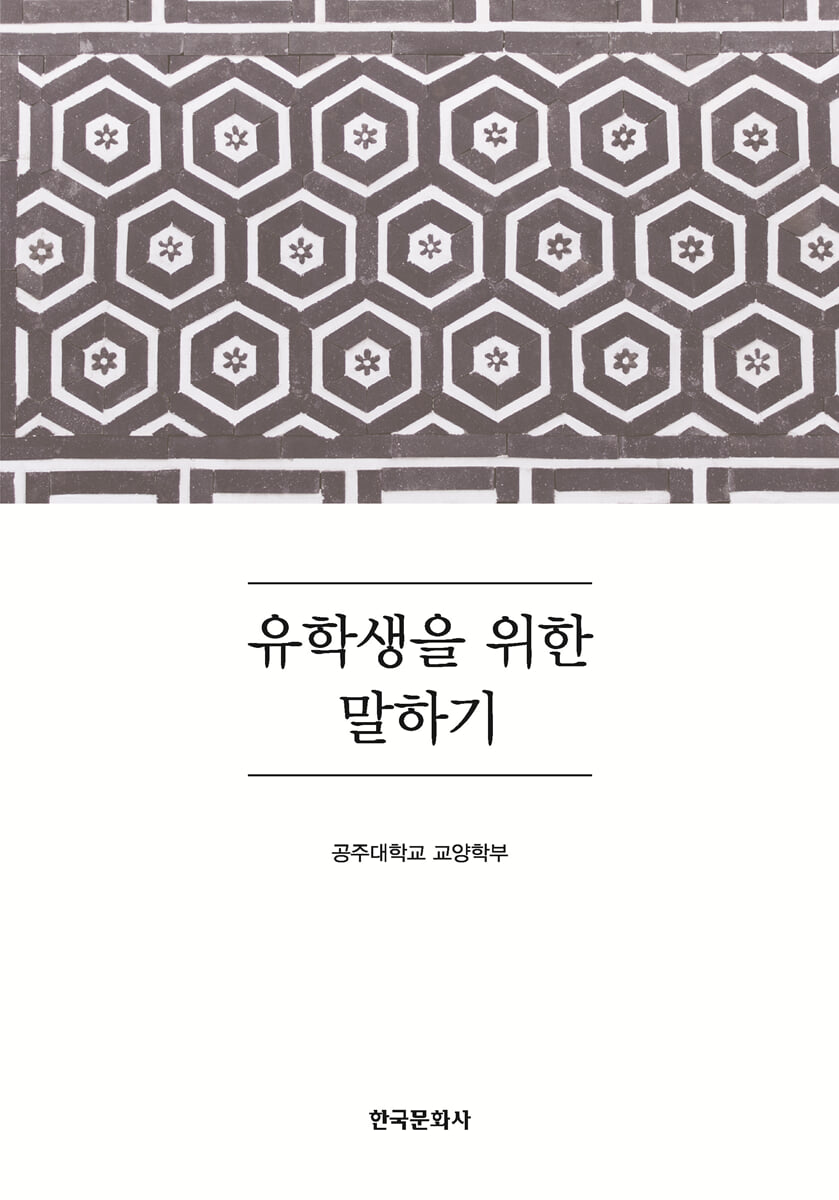
Speaking for International Students
 |
Description
Book Introduction
『Speaking for International Students』 is divided into two parts: Part 1: Korean for Daily Life and Part 2: Korean for University Students.
Daily Korean is divided into three units, allowing you to practice speaking activities necessary for everyday life. Each unit is divided into two sub-units.
College Korean consists of four units that help you develop the presentation, discussion, and debate skills necessary for college mathematics.
Each unit is designed to help you learn and practice creating presentation materials and speaking skills.
― From the notes
Daily Korean is divided into three units, allowing you to practice speaking activities necessary for everyday life. Each unit is divided into two sub-units.
College Korean consists of four units that help you develop the presentation, discussion, and debate skills necessary for college mathematics.
Each unit is designed to help you learn and practice creating presentation materials and speaking skills.
― From the notes
- You can preview some of the book's contents.
Preview
index
Part 1: Daily Korean
1.
communion
1-1 Personality
1-2 Hobbies
2.
request
2-1 Part-time job
2-2 Repair
3.
guess
3-1 visit
3-2 Robot Barista
Part 2 University Korean
1.
Theory and Practice of Presentation
2.
Theory and Practice of Discussion
3.
Theory and Practice of Debate
4.
Expressing appreciation
1.
communion
1-1 Personality
1-2 Hobbies
2.
request
2-1 Part-time job
2-2 Repair
3.
guess
3-1 visit
3-2 Robot Barista
Part 2 University Korean
1.
Theory and Practice of Presentation
2.
Theory and Practice of Discussion
3.
Theory and Practice of Debate
4.
Expressing appreciation
Publisher's Review
‘Speaking for International Students’ consists of two parts: Part 1: Korean for Daily Life and Part 2: Korean for University Students.
Daily Korean is divided into three units, allowing you to practice speaking activities necessary for everyday life. Each unit is divided into two sub-units.
College Korean consists of four units that help you develop the presentation, discussion, and debate skills necessary for college mathematics.
Each unit is designed to help you learn and practice creating presentation materials and speaking skills.
Part 1 of the Korean for Daily Life unit consists of learning objectives, preparation, grammar and expressions, speaking, assignments, and self-evaluation.
[Learning Objectives] presents tasks based on the speaking skills to be achieved in each unit. [Preparation] presents two topic-related questions to activate background knowledge and naturally connect to the learning content. [Grammar and Expression] consists of speaking activities utilizing vocabulary and situational speaking.
Speaking using vocabulary expands vocabulary related to the topic of the unit along with grammar usage.
Speaking appropriately for the situation is an activity that encourages students to complete a conversation by using the given grammar appropriately for the situation.
At this stage, you can proceed with various speaking exercises depending on the learner's level.
[Speaking] is a conversational text designed to help students learn communication skills appropriate to the topic.
This dialogue presents topic-related vocabulary and frequently used grammar and expressions for that speaking skill.
In addition, we have identified pronunciation errors that are easy to make when speaking and helped students learn standard pronunciation.
It is also designed to allow you to practice extended speaking related to the topic using the vocabulary and grammar you have learned.
Learners practice constructing conversations based on presented situations.
[The assignment] consists of help and activities, and the help provides practical speaking methods and attitudes required for the speaking function.
Information related to Korean speaking culture is explained in a way that is easy for foreign learners to understand.
Activities activate vocabulary and grammar while performing tasks and increase language fluency through interaction.
[Self-assessment] is a process in which learners check and evaluate whether they have achieved their learning goals.
Part 2 of the Korean language course at the university level consists of theory and practice, and the theory section provides the strategies and procedures necessary to perform the speaking tasks.
We have provided information on how to generate content to speak, how to create speaking materials, and the expressions needed for actual speaking, and have enabled you to train in practical procedures by performing tasks step by step.
In practice, the program is structured so that learners select a speaking topic, create content, produce presentation materials, and then use the materials to actually speak.
Assessment is presented as self-assessment and peer assessment, and self-assessment is when learners check and evaluate whether they have achieved the learning goals.
Peer assessment provides learners with opportunities to reflect on their own speaking and listening skills and experience diverse discourse by conducting actual presentations, discussions, and debates and assessing the speaking skills of other learners.
Daily Korean is divided into three units, allowing you to practice speaking activities necessary for everyday life. Each unit is divided into two sub-units.
College Korean consists of four units that help you develop the presentation, discussion, and debate skills necessary for college mathematics.
Each unit is designed to help you learn and practice creating presentation materials and speaking skills.
Part 1 of the Korean for Daily Life unit consists of learning objectives, preparation, grammar and expressions, speaking, assignments, and self-evaluation.
[Learning Objectives] presents tasks based on the speaking skills to be achieved in each unit. [Preparation] presents two topic-related questions to activate background knowledge and naturally connect to the learning content. [Grammar and Expression] consists of speaking activities utilizing vocabulary and situational speaking.
Speaking using vocabulary expands vocabulary related to the topic of the unit along with grammar usage.
Speaking appropriately for the situation is an activity that encourages students to complete a conversation by using the given grammar appropriately for the situation.
At this stage, you can proceed with various speaking exercises depending on the learner's level.
[Speaking] is a conversational text designed to help students learn communication skills appropriate to the topic.
This dialogue presents topic-related vocabulary and frequently used grammar and expressions for that speaking skill.
In addition, we have identified pronunciation errors that are easy to make when speaking and helped students learn standard pronunciation.
It is also designed to allow you to practice extended speaking related to the topic using the vocabulary and grammar you have learned.
Learners practice constructing conversations based on presented situations.
[The assignment] consists of help and activities, and the help provides practical speaking methods and attitudes required for the speaking function.
Information related to Korean speaking culture is explained in a way that is easy for foreign learners to understand.
Activities activate vocabulary and grammar while performing tasks and increase language fluency through interaction.
[Self-assessment] is a process in which learners check and evaluate whether they have achieved their learning goals.
Part 2 of the Korean language course at the university level consists of theory and practice, and the theory section provides the strategies and procedures necessary to perform the speaking tasks.
We have provided information on how to generate content to speak, how to create speaking materials, and the expressions needed for actual speaking, and have enabled you to train in practical procedures by performing tasks step by step.
In practice, the program is structured so that learners select a speaking topic, create content, produce presentation materials, and then use the materials to actually speak.
Assessment is presented as self-assessment and peer assessment, and self-assessment is when learners check and evaluate whether they have achieved the learning goals.
Peer assessment provides learners with opportunities to reflect on their own speaking and listening skills and experience diverse discourse by conducting actual presentations, discussions, and debates and assessing the speaking skills of other learners.
GOODS SPECIFICS
- Publication date: September 10, 2021
- Format: Hardcover book binding method guide
- Pages, weight, size: 104 pages | 286g | 175*250*20mm
- ISBN13: 9791166850127
- ISBN10: 1166850129
You may also like
카테고리
korean


korean

![ELLE 엘르 스페셜 에디션 A형 : 12월 [2025]](http://librairie.coreenne.fr/cdn/shop/files/b8e27a3de6c9538896439686c6b0e8fb.jpg?v=1766436872&width=3840)


