

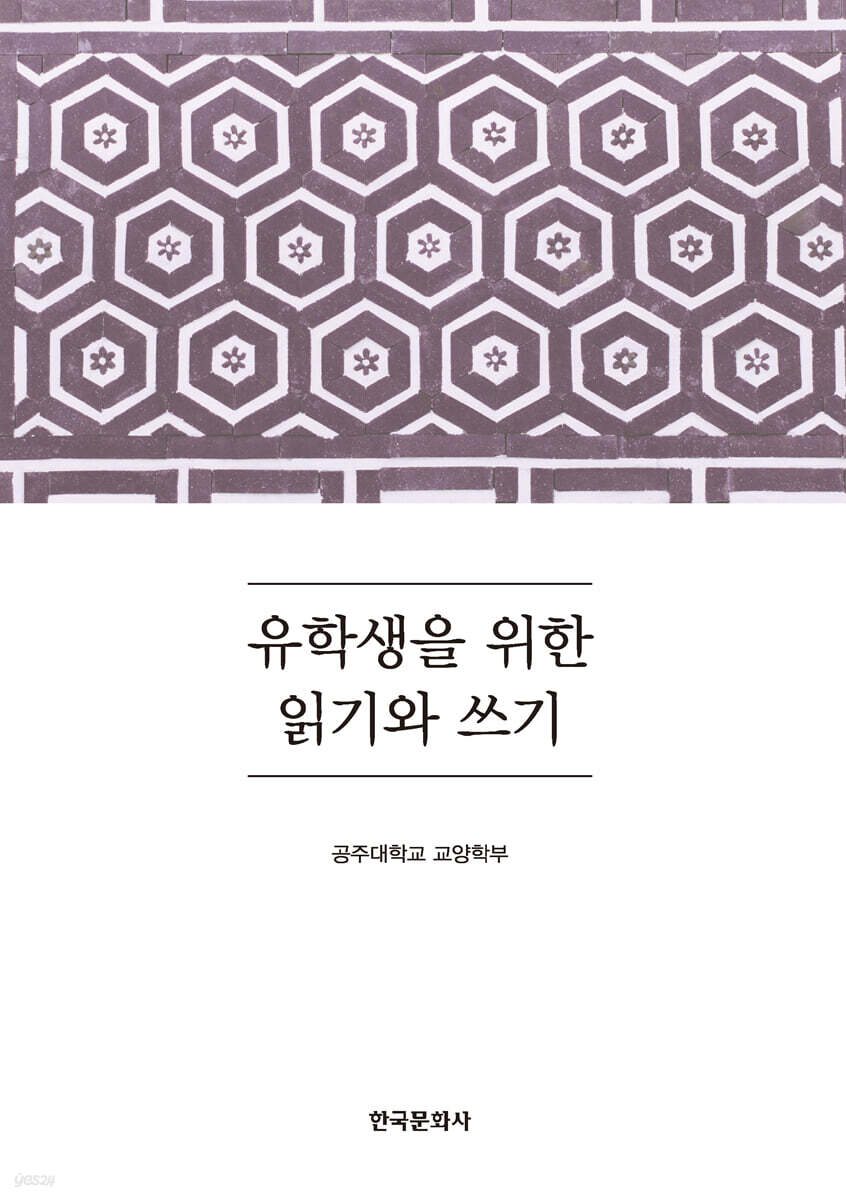
Reading and Writing for International Students
 |
Description
Book Introduction
『Reading and Writing for International Students』 consists of 13 units.
Each unit covers a variety of topics that students will encounter upon entering university, and one unit consists of reading and writing.
The structure of each unit is as follows:
Each unit is structured as Learning Objectives - Preparation - Vocabulary - Grammar and Expression - Reading - Writing.
― From the notes
Each unit covers a variety of topics that students will encounter upon entering university, and one unit consists of reading and writing.
The structure of each unit is as follows:
Each unit is structured as Learning Objectives - Preparation - Vocabulary - Grammar and Expression - Reading - Writing.
― From the notes
- You can preview some of the book's contents.
Preview
index
01 Course Registration
02 Orientation
03 Club
04 Major
05 New Job
06 History of Baekje
07 King Muryeong's Tomb and Baekje Gilt-Bronze Incense Burner
08 Korean Wave
09 Changes in teaching methods
10 One-person media
11. Foreigner Health Insurance
12 Student Welfare
13 The Thrill of First Love - Sonagi
02 Orientation
03 Club
04 Major
05 New Job
06 History of Baekje
07 King Muryeong's Tomb and Baekje Gilt-Bronze Incense Burner
08 Korean Wave
09 Changes in teaching methods
10 One-person media
11. Foreigner Health Insurance
12 Student Welfare
13 The Thrill of First Love - Sonagi
Publisher's Review
『Reading and Writing for International Students』 consists of 13 units.
Each unit covers a variety of topics that students will encounter upon entering university, and one unit consists of reading and writing.
The structure of each unit is as follows:
Each unit is structured as Learning Objectives - Preparation - Vocabulary - Grammar and Expression - Reading - Writing.
[Learning Objectives] presents the reading and writing skills that must be achieved in each unit.
In [Preparation], we've presented two topic-related questions to activate background knowledge and naturally connect it to the learning content. In [Vocabulary], we've presented topic-related vocabulary and vocabulary needed for reading and writing.
"Reading to Review Learned Vocabulary" presents short reading materials to demonstrate vocabulary usage in communication situations. [Grammar and Expressions] focuses on the semantic functions of grammar through easy vocabulary and sentence structures, and helps students improve their grammar skills through practice.
Additionally, when grammar and expressions are used for multiple semantic functions, example sentences are provided to help you understand their meaning within the context.
In [Reading], we implemented various reading forms that learners may encounter in real life as texts, and also presented reading texts expressed in spoken language, such as magazine interviews and emails.
Reading topics are structured to take into account learner circumstances and regional characteristics.
In particular, we have selected topics to provide information necessary for university life and to encourage discussion on various social issues. We have also actively reflected the cultural characteristics of the Gongju region to help students feel proud as cultural citizens.
[Writing] is structured so that you can complete a piece of writing in the planning-writing-revising stages.
We also provide practice by type to prepare for the TOPIK writing test.
'Finding Writing Material' guides you through the creation of content through mind maps, and can be used to develop your ability to explore, collect, and select information.
In 'Creating Content', we have introduced the structure of writing and have created a writing structure that allows you to naturally complete a piece of writing by writing according to the questions.
The process of writing on manuscript paper provided opportunities for self-editing at the vocabulary, paragraph, and writing level.
Each unit covers a variety of topics that students will encounter upon entering university, and one unit consists of reading and writing.
The structure of each unit is as follows:
Each unit is structured as Learning Objectives - Preparation - Vocabulary - Grammar and Expression - Reading - Writing.
[Learning Objectives] presents the reading and writing skills that must be achieved in each unit.
In [Preparation], we've presented two topic-related questions to activate background knowledge and naturally connect it to the learning content. In [Vocabulary], we've presented topic-related vocabulary and vocabulary needed for reading and writing.
"Reading to Review Learned Vocabulary" presents short reading materials to demonstrate vocabulary usage in communication situations. [Grammar and Expressions] focuses on the semantic functions of grammar through easy vocabulary and sentence structures, and helps students improve their grammar skills through practice.
Additionally, when grammar and expressions are used for multiple semantic functions, example sentences are provided to help you understand their meaning within the context.
In [Reading], we implemented various reading forms that learners may encounter in real life as texts, and also presented reading texts expressed in spoken language, such as magazine interviews and emails.
Reading topics are structured to take into account learner circumstances and regional characteristics.
In particular, we have selected topics to provide information necessary for university life and to encourage discussion on various social issues. We have also actively reflected the cultural characteristics of the Gongju region to help students feel proud as cultural citizens.
[Writing] is structured so that you can complete a piece of writing in the planning-writing-revising stages.
We also provide practice by type to prepare for the TOPIK writing test.
'Finding Writing Material' guides you through the creation of content through mind maps, and can be used to develop your ability to explore, collect, and select information.
In 'Creating Content', we have introduced the structure of writing and have created a writing structure that allows you to naturally complete a piece of writing by writing according to the questions.
The process of writing on manuscript paper provided opportunities for self-editing at the vocabulary, paragraph, and writing level.
GOODS SPECIFICS
- Publication date: September 10, 2021
- Format: Hardcover book binding method guide
- Page count, weight, size: 184 pages | 461g | 170*250*20mm
- ISBN13: 9791166850110
- ISBN10: 1166850110
You may also like
카테고리
korean


korean

![ELLE 엘르 스페셜 에디션 A형 : 12월 [2025]](http://librairie.coreenne.fr/cdn/shop/files/b8e27a3de6c9538896439686c6b0e8fb.jpg?v=1766436872&width=3840)


