

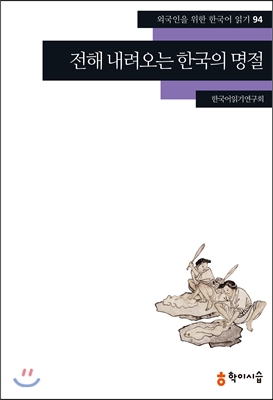
Korean holidays passed down through generations
 |
Description
Book Introduction
A holiday is a time to celebrate on a set date each year.
Traditional Korean holidays are determined by choosing auspicious days from the lunar calendar.
For many years, holidays have been a part of the lives of Koreans and have continued as community events.
Because Korean traditional holidays have been passed down as customs centered around an agricultural society, their meaning has often been weakened in modern times.
Currently, the biggest holidays in Korea are Lunar New Year and Chuseok.
On New Year's Day and Chuseok, people performed ancestral rites and visited ancestors' graves, prepared and shared food, and enjoyed folk games.
In addition, some traditional Korean holidays remain and continue to be celebrated in the lives of Korean people.
Traditional Korean holidays are determined by choosing auspicious days from the lunar calendar.
For many years, holidays have been a part of the lives of Koreans and have continued as community events.
Because Korean traditional holidays have been passed down as customs centered around an agricultural society, their meaning has often been weakened in modern times.
Currently, the biggest holidays in Korea are Lunar New Year and Chuseok.
On New Year's Day and Chuseok, people performed ancestral rites and visited ancestors' graves, prepared and shared food, and enjoyed folk games.
In addition, some traditional Korean holidays remain and continue to be celebrated in the lives of Korean people.
index
To those who read this book
Preview
Part 1: The Meaning and Customs of Holidays
1.
Traditional Korean holidays
2.
Lunar and solar calendars
Part 2: Korea's Three Major Holidays
1.
new year
2.
Dano
3.
Chuseok
Part 3: Remaining holiday customs
1.
First full moon of the lunar year and five-grain rice
2.
Korean ancestral rites and cold food
3.
Dongji Red Bean Porridge and New Calendar
Part 4: Stories about the Holidays
1.
The Lunar New Year Story: The Luminous Ghost Who Steals Shoes
2.
The Story of the First Full Moon of the Lunar New Year: The Medicinal Food Offered to the Crow
3.
Chuseok Story: The King Who Wants to Eat Songpyeon
References
Word list
Preview
Part 1: The Meaning and Customs of Holidays
1.
Traditional Korean holidays
2.
Lunar and solar calendars
Part 2: Korea's Three Major Holidays
1.
new year
2.
Dano
3.
Chuseok
Part 3: Remaining holiday customs
1.
First full moon of the lunar year and five-grain rice
2.
Korean ancestral rites and cold food
3.
Dongji Red Bean Porridge and New Calendar
Part 4: Stories about the Holidays
1.
The Lunar New Year Story: The Luminous Ghost Who Steals Shoes
2.
The Story of the First Full Moon of the Lunar New Year: The Medicinal Food Offered to the Crow
3.
Chuseok Story: The King Who Wants to Eat Songpyeon
References
Word list
Publisher's Review
This book is for foreigners studying Korean.
We've created a reading book that will help you improve your Korean skills while having fun reading.
It was created for foreigners studying in Korea, foreigners preparing for the Korean Language Proficiency Test, overseas Koreans whose primary language is not Korean, and parents and children from multicultural families learning Korean.
It's tailored to your Korean reading level.
We have rewritten widely read literary works in Korea to suit the abilities of Korean language learners.
We've adjusted the words and sentences to your reading level and explained the meanings of difficult words.
You can read without any problems even if you come across unfamiliar words.
Reading levels are divided into three levels.
You can choose a book that suits you and read it.
You can find all sentence forms in Korean.
There are 100 volumes in total.
It contains a variety of materials, including old tales, myths, classic novels, modern novels, fairy tales, poetry, essays, plays, scenarios, and letters.
You can also meet great Korean figures and aspects of Korean society today.
As you read each book, your Korean language skills will improve, allowing you to read more advanced books with ease.
You can learn Korean language and culture together.
It is designed to provide a broad understanding of Korean history and culture.
In the 50 volumes of 'Read This First ★', we have carefully selected illustrations and photos that can serve as background knowledge for the book.
The 50 volumes of 'Books to Read Later ★★' and 'Books to Read at the End ★★★' are richly filled with famous Korean figures and various aspects of Korean society.
It will serve as a foundation for a concrete understanding and further development of Korea's past, present, and future.
We've created a reading book that will help you improve your Korean skills while having fun reading.
It was created for foreigners studying in Korea, foreigners preparing for the Korean Language Proficiency Test, overseas Koreans whose primary language is not Korean, and parents and children from multicultural families learning Korean.
It's tailored to your Korean reading level.
We have rewritten widely read literary works in Korea to suit the abilities of Korean language learners.
We've adjusted the words and sentences to your reading level and explained the meanings of difficult words.
You can read without any problems even if you come across unfamiliar words.
Reading levels are divided into three levels.
You can choose a book that suits you and read it.
You can find all sentence forms in Korean.
There are 100 volumes in total.
It contains a variety of materials, including old tales, myths, classic novels, modern novels, fairy tales, poetry, essays, plays, scenarios, and letters.
You can also meet great Korean figures and aspects of Korean society today.
As you read each book, your Korean language skills will improve, allowing you to read more advanced books with ease.
You can learn Korean language and culture together.
It is designed to provide a broad understanding of Korean history and culture.
In the 50 volumes of 'Read This First ★', we have carefully selected illustrations and photos that can serve as background knowledge for the book.
The 50 volumes of 'Books to Read Later ★★' and 'Books to Read at the End ★★★' are richly filled with famous Korean figures and various aspects of Korean society.
It will serve as a foundation for a concrete understanding and further development of Korea's past, present, and future.
GOODS SPECIFICS
- Date of publication: December 20, 2013
- Page count, weight, size: 116 pages | 128*188*20mm
- ISBN13: 9791130420943
- ISBN10: 1130420949
You may also like
카테고리
korean


korean

![ELLE 엘르 스페셜 에디션 A형 : 12월 [2025]](http://librairie.coreenne.fr/cdn/shop/files/b8e27a3de6c9538896439686c6b0e8fb.jpg?v=1766436872&width=3840)


