

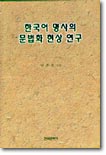
A Study on the Grammaticalization of Korean Nouns
 |
Description
index
[Korean summary]
1.
ingress
2.
Basic discussion on grammaticalization
2.1 Dependent nouns and grammaticalization
2.2 Preliminary discussion on grammaticalization
2.3 Terms related to grammarization
2.4 Mechanism of Grammaticalization
2.5 Three stages of grammaticalization
2.6 Conclusion
3.
Grammaticalization Stage 1
3.1 Being classified as an independent noun but becoming dependent
3.2 Completely dependent nouns from independent nouns
3.2.1 Native Korean dependent nouns
3.2.2 Chinese character dependent nouns
3.3 Conclusion
4.
Grammaticalization Stage 2
4.1 Folding structure appearing at the end
4.1.0 Formation process of the folded structure appearing in the ending part
4.1.1 'Ida' combination
4.1.2 'same' combination
4.1.3 'do' combination
4.1.4 'I want to' combination
4.1.5 'There is' combination
4.1.6 'Know' combination
4.1.7 Conclusion
4.2 Folding configuration appearing in the connecting part
4.2.0 Formation process of connective endings
4.2.1 Function of the connective ending of reason
4.2.2 Function of connective endings in situations
4.2.3 Function of the connective ending of the list
4.2.4 Purpose-based connective function
4.2.5 Time-based connective function
4.2.6 Similar connective ending function
4.2.7 Concession's connective ending function
4.2.8 Addition of connective ending function
4.2.9 Simultaneous connective ending function
4.2.10 Conclusion
4.3 The process of investigation
4.3.0 Formation process of the investigation
4.3.1 Investigation of spatial meaning
4.3.2 Investigation of limited meaning
4.3.3 Conclusion
4.4 Process of becoming an affix
4.4.0 Formation process of affixes
4.4.1 'etc.'
4.4.2 'Kkan/Tan/Hae'
4.5 Conclusion
5.
Grammaticalization Stage 3
5.1 Ending beautification
5.1.0 Formation process of endings
5.1.1 '-ㄹ겄'
5.1.2 '-neungeol/-eulgeol'
5.2 Speech-ending beautification
5.2.1 '-ㄹ테-'
5.3 Connective endings
5.3.1 Conjunctions in description
5.3.2 Connective endings of basis
5.4 Investigation
5.4.1 Investigation of spatial meaning
5.4.2 Investigation of limited meaning
5.5 Prefix
5.6 Conclusion
6.
Grammaticalization Rules and Characteristics of the Grammaticalization of Korean Nouns
6.1 Rules of Grammarization
6.2 Characteristics of Korean noun grammaticalization
7.
Conclusion
[Source]
[References]
1.
ingress
2.
Basic discussion on grammaticalization
2.1 Dependent nouns and grammaticalization
2.2 Preliminary discussion on grammaticalization
2.3 Terms related to grammarization
2.4 Mechanism of Grammaticalization
2.5 Three stages of grammaticalization
2.6 Conclusion
3.
Grammaticalization Stage 1
3.1 Being classified as an independent noun but becoming dependent
3.2 Completely dependent nouns from independent nouns
3.2.1 Native Korean dependent nouns
3.2.2 Chinese character dependent nouns
3.3 Conclusion
4.
Grammaticalization Stage 2
4.1 Folding structure appearing at the end
4.1.0 Formation process of the folded structure appearing in the ending part
4.1.1 'Ida' combination
4.1.2 'same' combination
4.1.3 'do' combination
4.1.4 'I want to' combination
4.1.5 'There is' combination
4.1.6 'Know' combination
4.1.7 Conclusion
4.2 Folding configuration appearing in the connecting part
4.2.0 Formation process of connective endings
4.2.1 Function of the connective ending of reason
4.2.2 Function of connective endings in situations
4.2.3 Function of the connective ending of the list
4.2.4 Purpose-based connective function
4.2.5 Time-based connective function
4.2.6 Similar connective ending function
4.2.7 Concession's connective ending function
4.2.8 Addition of connective ending function
4.2.9 Simultaneous connective ending function
4.2.10 Conclusion
4.3 The process of investigation
4.3.0 Formation process of the investigation
4.3.1 Investigation of spatial meaning
4.3.2 Investigation of limited meaning
4.3.3 Conclusion
4.4 Process of becoming an affix
4.4.0 Formation process of affixes
4.4.1 'etc.'
4.4.2 'Kkan/Tan/Hae'
4.5 Conclusion
5.
Grammaticalization Stage 3
5.1 Ending beautification
5.1.0 Formation process of endings
5.1.1 '-ㄹ겄'
5.1.2 '-neungeol/-eulgeol'
5.2 Speech-ending beautification
5.2.1 '-ㄹ테-'
5.3 Connective endings
5.3.1 Conjunctions in description
5.3.2 Connective endings of basis
5.4 Investigation
5.4.1 Investigation of spatial meaning
5.4.2 Investigation of limited meaning
5.5 Prefix
5.6 Conclusion
6.
Grammaticalization Rules and Characteristics of the Grammaticalization of Korean Nouns
6.1 Rules of Grammarization
6.2 Characteristics of Korean noun grammaticalization
7.
Conclusion
[Source]
[References]
GOODS SPECIFICS
- Date of issue: December 31, 1997
- Page count, weight, size: 316 pages | 148*210*30mm
- ISBN13: 9788977354661
- ISBN10: 8977354668
You may also like
카테고리
korean


korean

![ELLE 엘르 스페셜 에디션 A형 : 12월 [2025]](http://librairie.coreenne.fr/cdn/shop/files/b8e27a3de6c9538896439686c6b0e8fb.jpg?v=1766436872&width=3840)


