

Korean in Culture 1
 |
Description
Book Introduction
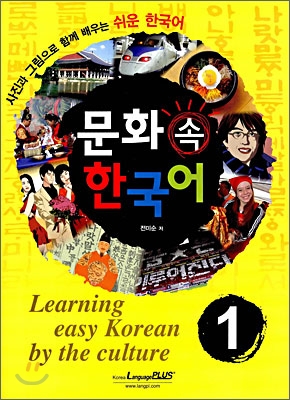
This book selects basic and essential cultural items that can be used to understand the overall culture of Korea, and includes various learner activities along with cultural content acquisition and confirmation, grammar and vocabulary practice.
This book, consisting of 25 chapters, is suitable for beginner and intermediate level learners.
However, if you are a complete beginner, you may be able to summarize the main points of the dialogue or utilize visual aids such as pictures and photographs.
As the book progresses, the volume of text increases and more specialized content is included to consider the level of difficulty as learners' language skills improve.
The cultural descriptions in each unit are in the form of dialogues.
The format of characters from Korea, China, and Japan asking and answering questions about major Korean cultural content will be interesting for learners and useful for exposing them to a variety of conversational texts.
This book, the first in the two-volume 'Korean in Culture' series, focuses on understanding and using Korean culture in general.
This book, consisting of 25 chapters, is suitable for beginner and intermediate level learners.
However, if you are a complete beginner, you may be able to summarize the main points of the dialogue or utilize visual aids such as pictures and photographs.
As the book progresses, the volume of text increases and more specialized content is included to consider the level of difficulty as learners' language skills improve.
The cultural descriptions in each unit are in the form of dialogues.
The format of characters from Korea, China, and Japan asking and answering questions about major Korean cultural content will be interesting for learners and useful for exposing them to a variety of conversational texts.
This book, the first in the two-volume 'Korean in Culture' series, focuses on understanding and using Korean culture in general.
- You can preview some of the book's contents.
Preview
index
When publishing a book
Textbook Introduction
Textbook composition table
Lesson 1: What kind of country is Korea?
Lesson 2: How do you say hello?
Lesson 3 What kind of food do you like?
Lesson 4 Have you ever ridden a train?
Lesson 5 I want to wear hanbok.
Lesson 6 What do you do on New Year's Day?
Lesson 7 I want to play Yut Nori.
Lesson 8 Come play at my house.
Lesson 9 Let's find it on the calendar.
Lesson 10: What is a stone grabber?
Lesson 11: Shall we sing a song?
Lesson 12 Where have you been?
Lesson 13: Is kimchi spicy?
Lesson 14 How much is this?
Lesson 15 Do you like movies?
Lesson 16 I want to go to the festival.
Lesson 17 What name do you like?
Lesson 18 Congratulations on your wedding.
Lesson 19: Going to school starting in March.
Lesson 20 History flows.
Lesson 21: You are a wonderful person.
Lesson 22 Have you been to Gyeongbokgung Palace?
Lesson 23: What are Korea's world heritage sites?
Lesson 24 Loyalty!
Lesson 25: The Story of Dangun
Model answer
Teacher's Guide
References
Textbook Introduction
Textbook composition table
Lesson 1: What kind of country is Korea?
Lesson 2: How do you say hello?
Lesson 3 What kind of food do you like?
Lesson 4 Have you ever ridden a train?
Lesson 5 I want to wear hanbok.
Lesson 6 What do you do on New Year's Day?
Lesson 7 I want to play Yut Nori.
Lesson 8 Come play at my house.
Lesson 9 Let's find it on the calendar.
Lesson 10: What is a stone grabber?
Lesson 11: Shall we sing a song?
Lesson 12 Where have you been?
Lesson 13: Is kimchi spicy?
Lesson 14 How much is this?
Lesson 15 Do you like movies?
Lesson 16 I want to go to the festival.
Lesson 17 What name do you like?
Lesson 18 Congratulations on your wedding.
Lesson 19: Going to school starting in March.
Lesson 20 History flows.
Lesson 21: You are a wonderful person.
Lesson 22 Have you been to Gyeongbokgung Palace?
Lesson 23: What are Korea's world heritage sites?
Lesson 24 Loyalty!
Lesson 25: The Story of Dangun
Model answer
Teacher's Guide
References
Publisher's Review
Up until now, various integrated Korean language textbooks have been published.
However, despite the growing importance and interest in Korean culture, there has been a severe shortage of culturally focused teaching materials.
This textbook was published to meet the needs and demands of learners who wish to learn Korean culture in this current reality.
'Korean in Culture' consists of volumes 1 and 2.
This textbook, Volume 1, focuses on understanding and using Korean culture in general, while Volume 2 will be a language and culture textbook centered on Korean language related to culture.
By faithfully studying the contents of these two cultural textbooks, you will develop a keen understanding of Korean culture and, furthermore, your Korean language skills will naturally improve.
■ Composition and Features
The primary purpose of this textbook is to help students understand and acquire Korean culture, and its secondary purpose is to develop fluent Korean communication skills based on knowledge of Korean culture.
The features of this textbook are as follows:
First, we have selected basic and essential cultural items that can help students understand Korean culture in general, and have provided various activities for learners to acquire and confirm cultural content, practice grammar and vocabulary, and more.
Second, it consists of a total of 25 subjects.
Basically, it takes about 3 to 4 hours per fruit.
Third, it is suitable for beginner to intermediate level learners, but if you are a complete beginner, you can summarize the key points of the dialogue or use visual aids such as pictures and photos.
As we move towards the latter half, we have increased the amount of text and included specialized content to consider the level of difficulty according to the learner's improved language skills.
Fourth, the cultural descriptions in each unit are in the form of dialogues.
Characters from Korea, China, and Japan ask and answer questions about major Korean cultural topics.
This is useful for students to get interested and exposed to a variety of conversational texts.
Fifth, the teacher's guide in the appendix contains essential information that teachers need to know for effective cultural lessons.
And we have attached the materials needed for the class, class extension activities, and supplementary content.
The structure of this book is as follows:
[Let's Ask] is an introductory step that stimulates learners' interest by asking questions related to the topic.
In 'A Moment', you can learn the terms that appear in the text by connecting pictures, photos, or simple suggested words to the corresponding vocabulary.
In [Let's Learn], you can understand the learning content by reading dialogues or listening to the teacher's explanations using visual aids.
[Let's Check] contains verification questions related to the text, allowing you to acquire and check the knowledge you have acquired.
[Let's Practice] includes verification questions related to the text, allowing you to check and confirm your acquired knowledge.
In [Let's Do It], we give practical tasks centered on learner activities.
[Let's Remember] allows you to check and organize the key contents.
However, despite the growing importance and interest in Korean culture, there has been a severe shortage of culturally focused teaching materials.
This textbook was published to meet the needs and demands of learners who wish to learn Korean culture in this current reality.
'Korean in Culture' consists of volumes 1 and 2.
This textbook, Volume 1, focuses on understanding and using Korean culture in general, while Volume 2 will be a language and culture textbook centered on Korean language related to culture.
By faithfully studying the contents of these two cultural textbooks, you will develop a keen understanding of Korean culture and, furthermore, your Korean language skills will naturally improve.
■ Composition and Features
The primary purpose of this textbook is to help students understand and acquire Korean culture, and its secondary purpose is to develop fluent Korean communication skills based on knowledge of Korean culture.
The features of this textbook are as follows:
First, we have selected basic and essential cultural items that can help students understand Korean culture in general, and have provided various activities for learners to acquire and confirm cultural content, practice grammar and vocabulary, and more.
Second, it consists of a total of 25 subjects.
Basically, it takes about 3 to 4 hours per fruit.
Third, it is suitable for beginner to intermediate level learners, but if you are a complete beginner, you can summarize the key points of the dialogue or use visual aids such as pictures and photos.
As we move towards the latter half, we have increased the amount of text and included specialized content to consider the level of difficulty according to the learner's improved language skills.
Fourth, the cultural descriptions in each unit are in the form of dialogues.
Characters from Korea, China, and Japan ask and answer questions about major Korean cultural topics.
This is useful for students to get interested and exposed to a variety of conversational texts.
Fifth, the teacher's guide in the appendix contains essential information that teachers need to know for effective cultural lessons.
And we have attached the materials needed for the class, class extension activities, and supplementary content.
The structure of this book is as follows:
[Let's Ask] is an introductory step that stimulates learners' interest by asking questions related to the topic.
In 'A Moment', you can learn the terms that appear in the text by connecting pictures, photos, or simple suggested words to the corresponding vocabulary.
In [Let's Learn], you can understand the learning content by reading dialogues or listening to the teacher's explanations using visual aids.
[Let's Check] contains verification questions related to the text, allowing you to acquire and check the knowledge you have acquired.
[Let's Practice] includes verification questions related to the text, allowing you to check and confirm your acquired knowledge.
In [Let's Do It], we give practical tasks centered on learner activities.
[Let's Remember] allows you to check and organize the key contents.
GOODS SPECIFICS
- Date of issue: August 10, 2008
- Page count, weight, size: 174 pages | 565g | 188*257*20mm
- ISBN13: 9788955187205
- ISBN10: 8955187203
You may also like
카테고리
korean


korean

![ELLE 엘르 스페셜 에디션 A형 : 12월 [2025]](http://librairie.coreenne.fr/cdn/shop/files/b8e27a3de6c9538896439686c6b0e8fb.jpg?v=1766436872&width=3840)


