

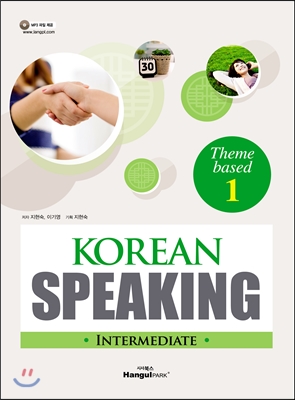
Korean Speaking Intermediate Theme based 1
 |
Description
Book Introduction
『Korean Speaking』 Intermediate Volume 1, designed to improve Korean language learners' conversational skills.
This is an intermediate-level textbook designed to help you learn key expressions on topics such as weather, health, career path, and love.
Learners can acquire the necessary expressions in situations related to the topic.
Volumes 1 and 2 focus on everyday topics that revolve around 'me', while Volumes 3 and 4 focus on topics related to social life. Through these, you can develop communication skills to communicate and exchange information on various topics.
Each key expression is accompanied by explanations of grammatical form, usage, intonation, and tone to help you improve your ability to speak accurately and naturally.
The explanations include English translations and practice problems to help students practice each expression, making it easy for them to study on their own.
There are also various activities that can be used in speaking classes, so Korean teachers can easily utilize them.
This is an intermediate-level textbook designed to help you learn key expressions on topics such as weather, health, career path, and love.
Learners can acquire the necessary expressions in situations related to the topic.
Volumes 1 and 2 focus on everyday topics that revolve around 'me', while Volumes 3 and 4 focus on topics related to social life. Through these, you can develop communication skills to communicate and exchange information on various topics.
Each key expression is accompanied by explanations of grammatical form, usage, intonation, and tone to help you improve your ability to speak accurately and naturally.
The explanations include English translations and practice problems to help students practice each expression, making it easy for them to study on their own.
There are also various activities that can be used in speaking classes, so Korean teachers can easily utilize them.
index
In publishing this book
How to use this book
-Meeting
01 Introduction
02 Greetings
03 Greetings
04 Promise
05 Age
06 Title
07 Invitation/Visit
-Leisure activities
08 Performance
Book 09
10 Music
Exercise 11
12 Outdoor Activities
13 Games and Entertainment
14 Volunteer Activities
-shopping
15 Choose an item
16 calculations
17 Packaging
18 Delivery
19 Exchange/Refund
20 Phone/Internet Shopping
21 Sale
-travel
22 Plan
23 Information gathering
24 reservations
25 Tourism
26 Accommodations
27 photos
28 Epilogue
-traffic
29 Finding the way
30 bus
31 subway
32 Taxi
33 airplanes
34 Traffic conditions
35 Traffic Laws
How to use this book
-Meeting
01 Introduction
02 Greetings
03 Greetings
04 Promise
05 Age
06 Title
07 Invitation/Visit
-Leisure activities
08 Performance
Book 09
10 Music
Exercise 11
12 Outdoor Activities
13 Games and Entertainment
14 Volunteer Activities
-shopping
15 Choose an item
16 calculations
17 Packaging
18 Delivery
19 Exchange/Refund
20 Phone/Internet Shopping
21 Sale
-travel
22 Plan
23 Information gathering
24 reservations
25 Tourism
26 Accommodations
27 photos
28 Epilogue
-traffic
29 Finding the way
30 bus
31 subway
32 Taxi
33 airplanes
34 Traffic conditions
35 Traffic Laws
Publisher's Review
Unit composition
▶ Key expressions
- Select two frequently used expressions according to the topic of each unit and present and explain them.
Rather than overemphasizing the form, the title expression focuses on usability by presenting a representative form, and when providing examples, each form is presented evenly.
Each core expression provides two conversational sentences in which the listener and speaker take turns speaking, and three colloquial sentences that the speaker can use freely.
These core expressions are then explained in terms of meaning, form, function, and pragmatics, and explanations for intonation and tone are also provided when these are important in determining meaning.
Through this, learners will be exposed to a variety of expressions used in specific topics and communication situations, and will be able to understand how Korean is used in real-life communication situations.
▶ Expressions by situation
- Frequently used expressions in representative situations for each topic that Korean language learners are likely to encounter are presented grouped by content.
The content is generally divided into two parts, and situational expressions are provided along with translations to allow for a variety of speaking practice that fits the topic of each unit.
Situational expressions are presented by making the most of colloquial expressions such as exclamations, contractions, interjections, and repetitions to ensure the most realistic and natural speech.
In addition, translations and audio files are provided for each expression to help you understand the exact meaning and improve your speaking skills.
▶ Practice
- Practice speaking by replacing or converting given words or sentences into sentences that include the target spoken grammar.
This allows us to break down the language elements involved in each situation and relate them to what is being said.
The practice questions are designed to help students develop spontaneous and automated conversation skills by giving them 7 to 10 cue words related to the topic in front of the key expressions, allowing them to practice the targeted spoken grammar.
Helps expand core expressions through practice with a variety of vocabulary and allomorphs.
▶ Activities
- It is designed to enable students to actually carry out meaningful and practical oral communication using the situations, functions, and target spoken grammar specified in each unit, assuming two or more conversation participants.
It presents a variety of speaking styles, including role-playing, presentations, and interviews, allowing teachers to adapt the material to their classroom environment. It also provides a list of language input resources teachers can use.
This list of materials allows teachers to selectively utilize supplementary content or teaching methods that can be utilized when necessary.
That is, it includes various teaching methods that can be applied when a variable arises while the teacher is teaching according to the order of the textbook.
Some activities are not confined to the classroom, but rather offer practical application in real-world contexts, enhancing usability.
■ Features
『Korean Speaking Intermediate - Theme-based』1~4 is divided into 20 major topics for spoken communication, which are further subdivided into 140 subtopics, and each volume is divided into 35 units.
Therefore, a total of 140 representative speaking topics and 280 spoken grammar items were presented as heading expressions.
Volumes 5 and 6 are the 'Personal Edition' and mainly deal with everyday topics that arise around 'me', while Volumes 7 and 8 are the 'Society Edition' and mainly include topics that can arise in social relationships rather than everyday topics.
A 'topic' is a central issue when two or more conversation participants are communicating, usually the weather,
The chapters are organized into topics such as health, career, and love.
It provides a dynamic and open means of communicating and exchanging information with diverse members of society around a topic.
This textbook aims to increase ease of use by presenting typical and common communication topics necessary for intermediate-level Korean language learners in a detailed manner.
Each unit consists of 'Key Expressions - Situational Expressions - Practice - Activity'.
It consists of four stages of 'Dong'.
Additionally, important grammar explanations and key expressions have been translated to enhance learners' understanding, and the practice problems are simple and repetitive, making self-study possible.
▶ Key expressions
- Select two frequently used expressions according to the topic of each unit and present and explain them.
Rather than overemphasizing the form, the title expression focuses on usability by presenting a representative form, and when providing examples, each form is presented evenly.
Each core expression provides two conversational sentences in which the listener and speaker take turns speaking, and three colloquial sentences that the speaker can use freely.
These core expressions are then explained in terms of meaning, form, function, and pragmatics, and explanations for intonation and tone are also provided when these are important in determining meaning.
Through this, learners will be exposed to a variety of expressions used in specific topics and communication situations, and will be able to understand how Korean is used in real-life communication situations.
▶ Expressions by situation
- Frequently used expressions in representative situations for each topic that Korean language learners are likely to encounter are presented grouped by content.
The content is generally divided into two parts, and situational expressions are provided along with translations to allow for a variety of speaking practice that fits the topic of each unit.
Situational expressions are presented by making the most of colloquial expressions such as exclamations, contractions, interjections, and repetitions to ensure the most realistic and natural speech.
In addition, translations and audio files are provided for each expression to help you understand the exact meaning and improve your speaking skills.
▶ Practice
- Practice speaking by replacing or converting given words or sentences into sentences that include the target spoken grammar.
This allows us to break down the language elements involved in each situation and relate them to what is being said.
The practice questions are designed to help students develop spontaneous and automated conversation skills by giving them 7 to 10 cue words related to the topic in front of the key expressions, allowing them to practice the targeted spoken grammar.
Helps expand core expressions through practice with a variety of vocabulary and allomorphs.
▶ Activities
- It is designed to enable students to actually carry out meaningful and practical oral communication using the situations, functions, and target spoken grammar specified in each unit, assuming two or more conversation participants.
It presents a variety of speaking styles, including role-playing, presentations, and interviews, allowing teachers to adapt the material to their classroom environment. It also provides a list of language input resources teachers can use.
This list of materials allows teachers to selectively utilize supplementary content or teaching methods that can be utilized when necessary.
That is, it includes various teaching methods that can be applied when a variable arises while the teacher is teaching according to the order of the textbook.
Some activities are not confined to the classroom, but rather offer practical application in real-world contexts, enhancing usability.
■ Features
『Korean Speaking Intermediate - Theme-based』1~4 is divided into 20 major topics for spoken communication, which are further subdivided into 140 subtopics, and each volume is divided into 35 units.
Therefore, a total of 140 representative speaking topics and 280 spoken grammar items were presented as heading expressions.
Volumes 5 and 6 are the 'Personal Edition' and mainly deal with everyday topics that arise around 'me', while Volumes 7 and 8 are the 'Society Edition' and mainly include topics that can arise in social relationships rather than everyday topics.
A 'topic' is a central issue when two or more conversation participants are communicating, usually the weather,
The chapters are organized into topics such as health, career, and love.
It provides a dynamic and open means of communicating and exchanging information with diverse members of society around a topic.
This textbook aims to increase ease of use by presenting typical and common communication topics necessary for intermediate-level Korean language learners in a detailed manner.
Each unit consists of 'Key Expressions - Situational Expressions - Practice - Activity'.
It consists of four stages of 'Dong'.
Additionally, important grammar explanations and key expressions have been translated to enhance learners' understanding, and the practice problems are simple and repetitive, making self-study possible.
GOODS SPECIFICS
- Date of issue: January 5, 2015
- Page count, weight, size: 148 pages | 418g | 188*257*8mm
- ISBN13: 9788955182545
- ISBN10: 8955182546
You may also like
카테고리
korean


korean

![GQ KOREA Mark (Monthly): December [2025]](http://librairie.coreenne.fr/cdn/shop/files/8ef265dbbfbf186523ed75ba7319009d.jpg?v=1765340328&width=3840)


