

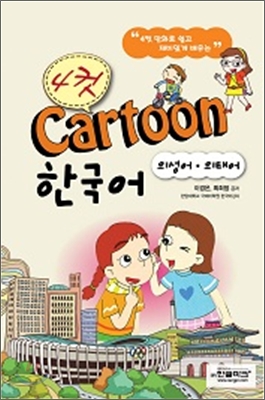
4-panel cartoon Korean
 |
Description
Book Introduction
The purpose of this book is to stimulate interest in learning Korean by having foreign learners enjoy studying the diverse onomatopoeia and mimetic words that are characteristic of the Korean language.
It is designed to help foreigners easily understand Korean by using cartoons.
Onomatopoeia and mimetic words are mostly words related to the actions or facial expressions of people, or the movements or shapes of objects.
Therefore, comics are very useful as a material for teaching onomatopoeia and mimetic words.
Even foreign learners who are not fluent in Korean can infer the meaning of vocabulary through pictures, so it is possible to teach not only vocabulary but also Korean culture.
Most Korean language courses present onomatopoeia and mimetic words at the intermediate level or higher, but if presented using comics, learning is possible from the beginner level.
This book helps beginner and intermediate learners interested in Korean onomatopoeia and mimetic words to study happily on their own.
It is designed to help foreigners easily understand Korean by using cartoons.
Onomatopoeia and mimetic words are mostly words related to the actions or facial expressions of people, or the movements or shapes of objects.
Therefore, comics are very useful as a material for teaching onomatopoeia and mimetic words.
Even foreign learners who are not fluent in Korean can infer the meaning of vocabulary through pictures, so it is possible to teach not only vocabulary but also Korean culture.
Most Korean language courses present onomatopoeia and mimetic words at the intermediate level or higher, but if presented using comics, learning is possible from the beginner level.
This book helps beginner and intermediate learners interested in Korean onomatopoeia and mimetic words to study happily on their own.
- You can preview some of the book's contents.
Preview
index
preface
Note
Characters
time
Ⅰ.
person
① When eating
② When sleeping
③ When you laugh
④ When crying
⑤ When speaking
⑥ When moving
⑦ When walking
⑧ Body sensations and conditions
⑨ Psychological state
Ⅱ.
objects
Ⅲ.
nature
Ⅳ.
animal cries
Correct answer
Search
Note
Characters
time
Ⅰ.
person
① When eating
② When sleeping
③ When you laugh
④ When crying
⑤ When speaking
⑥ When moving
⑦ When walking
⑧ Body sensations and conditions
⑨ Psychological state
Ⅱ.
objects
Ⅲ.
nature
Ⅳ.
animal cries
Correct answer
Search
Publisher's Review
Composition and Features
In this book, 95 onomatopoeia and mimetic words are classified by meaning.
First, it was divided into large themes such as people, objects, nature, and animals, and in the case of people, it was further divided into smaller themes based on movements and psychological states.
At the end of each topic, there are practice problems so that students can review their understanding.
You can see the situations in which onomatopoeia and mimetic words are used through four-panel cartoons.
The content of the cartoon depicts a family and various situations that occur around them.
The structure of the page presents the target onomatopoeia and mimetic words at the top of the left page, and a four-panel cartoon is expressed below it.
On the right, the meanings, usage forms, and various examples of onomatopoeia and mimetic words are shown.
'Vocabulary and Expressions' is translated into English, Japanese, and Chinese.
Lastly, the magnifying glass in the lower right corner shows frequently used expressions with the target onomatopoeia, similar onomatopoeia, and things to be careful of when using them.
In this book, 95 onomatopoeia and mimetic words are classified by meaning.
First, it was divided into large themes such as people, objects, nature, and animals, and in the case of people, it was further divided into smaller themes based on movements and psychological states.
At the end of each topic, there are practice problems so that students can review their understanding.
You can see the situations in which onomatopoeia and mimetic words are used through four-panel cartoons.
The content of the cartoon depicts a family and various situations that occur around them.
The structure of the page presents the target onomatopoeia and mimetic words at the top of the left page, and a four-panel cartoon is expressed below it.
On the right, the meanings, usage forms, and various examples of onomatopoeia and mimetic words are shown.
'Vocabulary and Expressions' is translated into English, Japanese, and Chinese.
Lastly, the magnifying glass in the lower right corner shows frequently used expressions with the target onomatopoeia, similar onomatopoeia, and things to be careful of when using them.
GOODS SPECIFICS
- Date of issue: July 15, 2011
- Page count, weight, size: 216 pages | 414g | 152*225*20mm
- ISBN13: 9788955189490
- ISBN10: 8955189494
You may also like
카테고리
korean


korean

![ELLE 엘르 스페셜 에디션 A형 : 12월 [2025]](http://librairie.coreenne.fr/cdn/shop/files/b8e27a3de6c9538896439686c6b0e8fb.jpg?v=1766436872&width=3840)


