

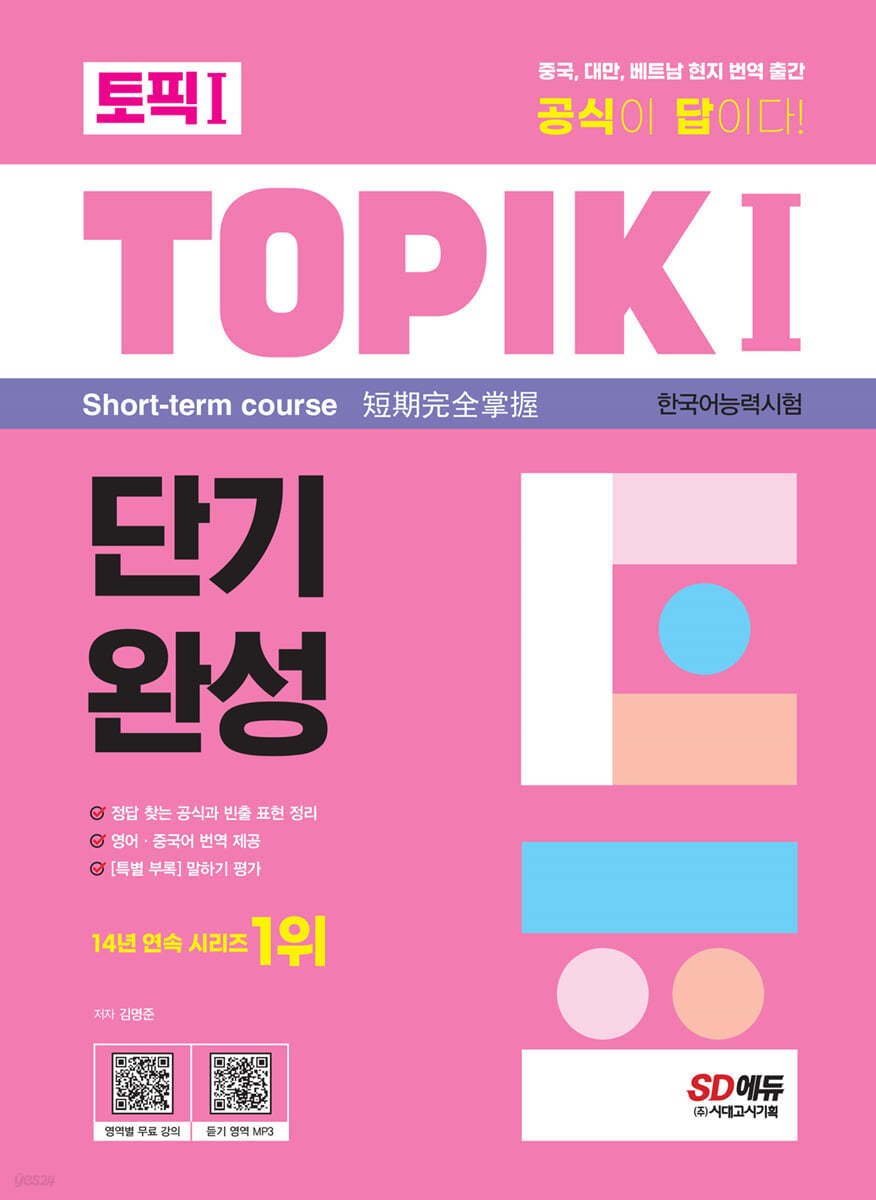
TOPIK I (Test of Proficiency in Korean) Short-term Completion + Free Videos
 |
Description
Book Introduction
Free video lectures directly from the author [sdedu.co.kr/plus]
First, we have included the TOPIK I evaluation framework and official analysis of past exam questions.
Second, explanations in Korean, English, and Chinese make it easy for foreign learners to understand.
Third, you can quickly find the correct answer with solution methods and formulas for each area and type.
Fourth, you can check what you have learned with practice problems that reflect the type of questions asked.
Fifth, you can systematically study vocabulary and grammar that frequently appear on exams.
Sixth, you can check the types of questions on the newly implemented TOPIK speaking test.
First, we have included the TOPIK I evaluation framework and official analysis of past exam questions.
Second, explanations in Korean, English, and Chinese make it easy for foreign learners to understand.
Third, you can quickly find the correct answer with solution methods and formulas for each area and type.
Fourth, you can check what you have learned with practice problems that reflect the type of questions asked.
Fifth, you can systematically study vocabulary and grammar that frequently appear on exams.
Sixth, you can check the types of questions on the newly implemented TOPIK speaking test.
- You can preview some of the book's contents.
Preview
index
[Part 0] Previous Questions
1. TOPIK I Evaluation Framework Guide
2.
The key points of the exam are visible when you know the formula.
[Part 1] Listening Section
Type 1.
Answer 'yes/no'
- Official 1.
Questions using 'noun + ieyo (ieyo)'
- Official 2.
Asking questions with adjectives
- Official 3.
Asking questions with verbs
Type 2.
Answer the question
- Official 4.
Expressions for asking about people (who / who + particle)
- Official 5.
Expressions for asking about time (when / what time + particle) / what month + particle)
- Official 6.
Expressions for asking about location (where + particle)
- Official 7.
Expressions for asking what (what / what / what / which / which)
- Official 8.
Expressions for asking how (how)
- Official 9.
Expression asking for reason or cause (why)
- Official 10.
Expressions for asking about quantity or degree (how much / how much is it)
- Official 11.
Expressions asking for thoughts or feelings (how is it / how are you)
Type 3.
Choose the answer that best suits the situation
- Official 12.
The problem of choosing a greeting situation
- Official 13.
A question about choosing a situation for a request or favor
- Official 14.
The problem of choosing a situation to check the location on the phone
- Official 15.
The problem of choosing a situation for praise or congratulation and gratitude
- Official 16.
The problem of choosing a situation for apology or sorry
Type 4.
Choosing a location
- Official 17.
The problem of choosing a place for conversation
Type 5.
Choosing a topic
- Official 18.
The problem of choosing a topic for conversation
Type 6.
Choose a picture
- Official 19.
Listen and choose the appropriate picture
Type 7.
Choose something similar to the content
- Official 20.
Pick something similar to the content in a short conversation
- Official 21.
Picking the same content from a long conversation
Type 8.
Choosing a central idea
- Official 22.
The problem of choosing a central idea
Type 9.
Listen and answer two questions
- Official 23.
Listen to the conversation and answer two questions
[Part 2] Reading Area
Type 1.
Choosing a topic
- Official 1.
The problem of choosing a topic
Type 2.
Choose the word that fills in the blank
- Official 2.
Problem (1) of filling in words (nouns, verbs, adjectives, adverbs) in the blanks
- Official 3.
Problem (2) of filling in words (particles) in the blanks
Type 3.
Find out the details
- Official 4.
Understanding the details of practical questions
Type 4.
Choose something similar to the content
- Official 5.
Choose something similar to the content
Type 5.
Choosing a central idea
- Official 6.
Choosing a central idea
Type 6.
Read the passage and answer two questions (1)
- Official 7.
Selecting phrases (grammar) to fill in the blanks (1) + Understanding the details
- Official 8.
Select the phrase (conjunctive adverb) to fill in the blank (2)
- Official 9.
Choosing the phrase (adverb) to fill in the blank (3)
- Official 10.
Understanding the topic
Type 7.
Arrange in order
- Official 11.
Arrange in order
Type 8.
Read the passage and answer two questions (2)
- Official 12.
Choose a sentence to fill in the blank + understand the details
- Official 13.
Understanding the purpose of the text
- Official 14.
Choose a phrase to fill in the blank + understand the details
[Special Appendix] Speaking Evaluation
1.
Exam Information
2.
Type Guide
1. TOPIK I Evaluation Framework Guide
2.
The key points of the exam are visible when you know the formula.
[Part 1] Listening Section
Type 1.
Answer 'yes/no'
- Official 1.
Questions using 'noun + ieyo (ieyo)'
- Official 2.
Asking questions with adjectives
- Official 3.
Asking questions with verbs
Type 2.
Answer the question
- Official 4.
Expressions for asking about people (who / who + particle)
- Official 5.
Expressions for asking about time (when / what time + particle) / what month + particle)
- Official 6.
Expressions for asking about location (where + particle)
- Official 7.
Expressions for asking what (what / what / what / which / which)
- Official 8.
Expressions for asking how (how)
- Official 9.
Expression asking for reason or cause (why)
- Official 10.
Expressions for asking about quantity or degree (how much / how much is it)
- Official 11.
Expressions asking for thoughts or feelings (how is it / how are you)
Type 3.
Choose the answer that best suits the situation
- Official 12.
The problem of choosing a greeting situation
- Official 13.
A question about choosing a situation for a request or favor
- Official 14.
The problem of choosing a situation to check the location on the phone
- Official 15.
The problem of choosing a situation for praise or congratulation and gratitude
- Official 16.
The problem of choosing a situation for apology or sorry
Type 4.
Choosing a location
- Official 17.
The problem of choosing a place for conversation
Type 5.
Choosing a topic
- Official 18.
The problem of choosing a topic for conversation
Type 6.
Choose a picture
- Official 19.
Listen and choose the appropriate picture
Type 7.
Choose something similar to the content
- Official 20.
Pick something similar to the content in a short conversation
- Official 21.
Picking the same content from a long conversation
Type 8.
Choosing a central idea
- Official 22.
The problem of choosing a central idea
Type 9.
Listen and answer two questions
- Official 23.
Listen to the conversation and answer two questions
[Part 2] Reading Area
Type 1.
Choosing a topic
- Official 1.
The problem of choosing a topic
Type 2.
Choose the word that fills in the blank
- Official 2.
Problem (1) of filling in words (nouns, verbs, adjectives, adverbs) in the blanks
- Official 3.
Problem (2) of filling in words (particles) in the blanks
Type 3.
Find out the details
- Official 4.
Understanding the details of practical questions
Type 4.
Choose something similar to the content
- Official 5.
Choose something similar to the content
Type 5.
Choosing a central idea
- Official 6.
Choosing a central idea
Type 6.
Read the passage and answer two questions (1)
- Official 7.
Selecting phrases (grammar) to fill in the blanks (1) + Understanding the details
- Official 8.
Select the phrase (conjunctive adverb) to fill in the blank (2)
- Official 9.
Choosing the phrase (adverb) to fill in the blank (3)
- Official 10.
Understanding the topic
Type 7.
Arrange in order
- Official 11.
Arrange in order
Type 8.
Read the passage and answer two questions (2)
- Official 12.
Choose a sentence to fill in the blank + understand the details
- Official 13.
Understanding the purpose of the text
- Official 14.
Choose a phrase to fill in the blank + understand the details
[Special Appendix] Speaking Evaluation
1.
Exam Information
2.
Type Guide
Detailed image

Publisher's Review
Complete TOPIK in a short period of time with the author's special formula solution!
'TOPIK Short-Term Completion' is a textbook that guides foreigners studying Korean to quickly find the correct answer by understanding the question types of the Test of Proficiency in Korean (TOPIK) and applying formulas.
In particular, we aimed to improve the understanding of foreign test takers through English and Chinese translations.
First, understand the 'representative types' and 'solution methods' presented for each area, and then study the 'formulas' according to the corresponding solution methods.
Review what you've studied by solving 'practice problems' and memorize 'important vocabulary and grammar' organized by type.
Lastly, check whether you understand the formula correctly by looking at the analysis table of past exam questions.
You can also check the speaking test trend and study methods through a special appendix, and if you visit the Shidae Gosi website, you can prepare for the test more easily and quickly by receiving listening MP3 files and the author's free video lectures.
To those who love Korea and the Korean language, we hope that you will walk the path to passing the exam with 『Korean Proficiency Test TOPIK Ⅰ Short-Term Completion』.
'TOPIK Short-Term Completion' is a textbook that guides foreigners studying Korean to quickly find the correct answer by understanding the question types of the Test of Proficiency in Korean (TOPIK) and applying formulas.
In particular, we aimed to improve the understanding of foreign test takers through English and Chinese translations.
First, understand the 'representative types' and 'solution methods' presented for each area, and then study the 'formulas' according to the corresponding solution methods.
Review what you've studied by solving 'practice problems' and memorize 'important vocabulary and grammar' organized by type.
Lastly, check whether you understand the formula correctly by looking at the analysis table of past exam questions.
You can also check the speaking test trend and study methods through a special appendix, and if you visit the Shidae Gosi website, you can prepare for the test more easily and quickly by receiving listening MP3 files and the author's free video lectures.
To those who love Korea and the Korean language, we hope that you will walk the path to passing the exam with 『Korean Proficiency Test TOPIK Ⅰ Short-Term Completion』.
GOODS SPECIFICS
- Date of issue: March 6, 2023
- Page count, weight, size: 276 pages | 190*260*20mm
- ISBN13: 9791138335737
- ISBN10: 1138335738
You may also like
카테고리
korean


korean

![GQ KOREA Mark (Monthly): December [2025]](http://librairie.coreenne.fr/cdn/shop/files/8ef265dbbfbf186523ed75ba7319009d.jpg?v=1765340328&width=3840)


