

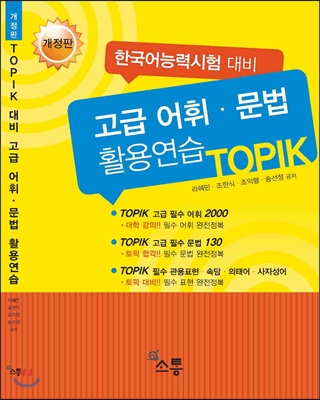
Advanced vocabulary and grammar practice for TOPIK preparation
 |
Description
Book Introduction
This book was developed for international students aiming to pass the Advanced Levels 5 and 6 of the Test of Proficiency in Korean (TOPIK). It is structured to provide intensive practice in "Advanced Vocabulary" and "Advanced Grammar."
In the first area, “Vocabulary Utilization Practice,” approximately 350 academic vocabulary words that are essential to know in college courses were selected as target vocabulary, divided into 22 sections, and practice using the corresponding vocabulary was conducted.
In the first area, “Vocabulary Utilization Practice,” approximately 350 academic vocabulary words that are essential to know in college courses were selected as target vocabulary, divided into 22 sections, and practice using the corresponding vocabulary was conducted.
index
Vocabulary Usage Practice 1-22
Grammar Usage Practice 1-130
supplement
Vocabulary Usage Practice Answers
Grammar Usage Practice Answers
Grammar Check Learning Answers
Vocabulary index
Grammar Usage Practice 1-130
supplement
Vocabulary Usage Practice Answers
Grammar Usage Practice Answers
Grammar Check Learning Answers
Vocabulary index
Publisher's Review
1.
This book was developed for international students who are studying to obtain the Advanced Level 5 or 6 of the Test of Proficiency in Korean.
2.
This book is designed to provide intensive practice in “Advanced Vocabulary” and “Advanced Grammar.”
3.
In the first section of this book, “Vocabulary Utilization Practice,” approximately 350 academic vocabulary words that are essential for university courses are selected as target vocabulary, divided into 22 sections, and practice using the corresponding vocabulary is provided.
4.
In addition to the target vocabulary, 〈Vocabulary Utilization Practice 1-22〉 contains advanced new vocabulary in example sentences for vocabulary utilization practice. If you study this faithfully, you can learn a total of about 700 advanced vocabulary words, including the target vocabulary.
5.
〈Vocabulary Usage Practice〉 consists of three types of practice problems.
In problem type 1, you need to find the meaning explanation that matches the five selected words and connect them with a line.
The goal is to accelerate your Korean language learning by developing the habit of thinking about and explaining target vocabulary in Korean.
6.
In the second type of problem in “Vocabulary Utilization Practice,” “Example” was composed of only [noun] or [adverb] vocabulary.
Unlike [verbs] or [adjectives], [nouns] and [adverbs] are words that are not used in conjunction with other grammar or particle endings in a sentence.
It is structured so that you can access target vocabulary by understanding the context of the sentence.
7.
〈Vocabulary Usage Practice〉 Problem type 3 consists of only [verbs] or [adjectives] in the 〈Options〉 and is designed to be used in combination with other grammatical elements.
By providing students with the opportunity to freely use what they have learned to create and write various answers, writing skills are also developed.
8.
The second section of this book, “Grammar Utilization Practice,” presents 130 carefully selected grammar items that frequently appear in the advanced Korean language proficiency test questions.
9.
For each grammar item, two ‘non-conversational sentence examples’ and one ‘conversational sentence example’ are provided in ‘Examples’.
And as practice problems, five dialogues were provided for each grammar item, and learners were asked to fill in the blanks using the corresponding grammar.
However, in the case of written language grammar, it is presented as examples rather than conversational sentences to distinguish it from spoken language grammar.
10.
The exercises for each grammar are organized so that they do not exceed one page.
This is because, for some advanced grammars, they are not often used widely with various words.
11.
None of the five practice dialogues ask you to create a completely open dialogue.
Unlike beginner or intermediate grammar, there are many grammar items that are not frequently used in everyday conversation, so even if you create example sentences, there is a high chance that the conversation will turn out awkward.
12.
Below the practice problems on each page, there is a section called “Grammar Tip” that provides information to help you understand grammar, along with a brief explanation of the grammar used.
13.
Every time you learn 10 grammar points, you can review and organize them by adding “confirmation learning.”
Problem type 1 is a question that asks you to find an appropriate sentence structure to fit into an example sentence, and problem type 2 is a question that asks you to complete a sentence by connecting lines. This question was designed to allow learners to review and check in a short period of time with a relatively light mind.
14.
At the back of the book, there is an appendix with the correct answers to each practice problem.
This is to enable learners to study on their own.
15.
Even in the case of open questions that could have multiple answers, such as question 3 in <Vocabulary Usage Practice>, the ‘correct answer’ was provided.
However, please understand that this answer is only an example.
Because open questions can have many different answers.
I hope that teachers understand this and carefully review each student's answer. I also hope that students do not think that their answers are wrong just because they are different from those on the answer sheet, but rather make sure to have the teacher check them while studying.
16.
In addition to the approximately 700 advanced vocabulary words in the “Vocabulary Usage Practice” section at the beginning of the book, including the vocabulary words in the grammar usage practice section, you will learn a total of over 2,000 advanced vocabulary words.
At the back of this book, a vocabulary list is provided, arranged in alphabetical order and numbered on the pages to make it easier for learners to find the words.
Rather than just listing words, frequently used expressions combined with words are also presented as subordinate terms.
However, it should be noted that the approximately 350 academic vocabulary words presented as target vocabulary in “Vocabulary Utilization Practice” and the approximately 350 vocabulary words presented in the vocabulary practice problems and included in the “New Words” list are not included in the “Vocabulary Index” at the back of the book.
This book was developed for international students who are studying to obtain the Advanced Level 5 or 6 of the Test of Proficiency in Korean.
2.
This book is designed to provide intensive practice in “Advanced Vocabulary” and “Advanced Grammar.”
3.
In the first section of this book, “Vocabulary Utilization Practice,” approximately 350 academic vocabulary words that are essential for university courses are selected as target vocabulary, divided into 22 sections, and practice using the corresponding vocabulary is provided.
4.
In addition to the target vocabulary, 〈Vocabulary Utilization Practice 1-22〉 contains advanced new vocabulary in example sentences for vocabulary utilization practice. If you study this faithfully, you can learn a total of about 700 advanced vocabulary words, including the target vocabulary.
5.
〈Vocabulary Usage Practice〉 consists of three types of practice problems.
In problem type 1, you need to find the meaning explanation that matches the five selected words and connect them with a line.
The goal is to accelerate your Korean language learning by developing the habit of thinking about and explaining target vocabulary in Korean.
6.
In the second type of problem in “Vocabulary Utilization Practice,” “Example” was composed of only [noun] or [adverb] vocabulary.
Unlike [verbs] or [adjectives], [nouns] and [adverbs] are words that are not used in conjunction with other grammar or particle endings in a sentence.
It is structured so that you can access target vocabulary by understanding the context of the sentence.
7.
〈Vocabulary Usage Practice〉 Problem type 3 consists of only [verbs] or [adjectives] in the 〈Options〉 and is designed to be used in combination with other grammatical elements.
By providing students with the opportunity to freely use what they have learned to create and write various answers, writing skills are also developed.
8.
The second section of this book, “Grammar Utilization Practice,” presents 130 carefully selected grammar items that frequently appear in the advanced Korean language proficiency test questions.
9.
For each grammar item, two ‘non-conversational sentence examples’ and one ‘conversational sentence example’ are provided in ‘Examples’.
And as practice problems, five dialogues were provided for each grammar item, and learners were asked to fill in the blanks using the corresponding grammar.
However, in the case of written language grammar, it is presented as examples rather than conversational sentences to distinguish it from spoken language grammar.
10.
The exercises for each grammar are organized so that they do not exceed one page.
This is because, for some advanced grammars, they are not often used widely with various words.
11.
None of the five practice dialogues ask you to create a completely open dialogue.
Unlike beginner or intermediate grammar, there are many grammar items that are not frequently used in everyday conversation, so even if you create example sentences, there is a high chance that the conversation will turn out awkward.
12.
Below the practice problems on each page, there is a section called “Grammar Tip” that provides information to help you understand grammar, along with a brief explanation of the grammar used.
13.
Every time you learn 10 grammar points, you can review and organize them by adding “confirmation learning.”
Problem type 1 is a question that asks you to find an appropriate sentence structure to fit into an example sentence, and problem type 2 is a question that asks you to complete a sentence by connecting lines. This question was designed to allow learners to review and check in a short period of time with a relatively light mind.
14.
At the back of the book, there is an appendix with the correct answers to each practice problem.
This is to enable learners to study on their own.
15.
Even in the case of open questions that could have multiple answers, such as question 3 in <Vocabulary Usage Practice>, the ‘correct answer’ was provided.
However, please understand that this answer is only an example.
Because open questions can have many different answers.
I hope that teachers understand this and carefully review each student's answer. I also hope that students do not think that their answers are wrong just because they are different from those on the answer sheet, but rather make sure to have the teacher check them while studying.
16.
In addition to the approximately 700 advanced vocabulary words in the “Vocabulary Usage Practice” section at the beginning of the book, including the vocabulary words in the grammar usage practice section, you will learn a total of over 2,000 advanced vocabulary words.
At the back of this book, a vocabulary list is provided, arranged in alphabetical order and numbered on the pages to make it easier for learners to find the words.
Rather than just listing words, frequently used expressions combined with words are also presented as subordinate terms.
However, it should be noted that the approximately 350 academic vocabulary words presented as target vocabulary in “Vocabulary Utilization Practice” and the approximately 350 vocabulary words presented in the vocabulary practice problems and included in the “New Words” list are not included in the “Vocabulary Index” at the back of the book.
GOODS SPECIFICS
- Date of issue: September 25, 2015
- Page count, weight, size: 244 pages | 540g | 188*254*20mm
- ISBN13: 9788993454604
- ISBN10: 8993454604
You may also like
카테고리
korean


korean

![GQ KOREA Mark (Monthly): December [2025]](http://librairie.coreenne.fr/cdn/shop/files/8ef265dbbfbf186523ed75ba7319009d.jpg?v=1765340328&width=3840)


