

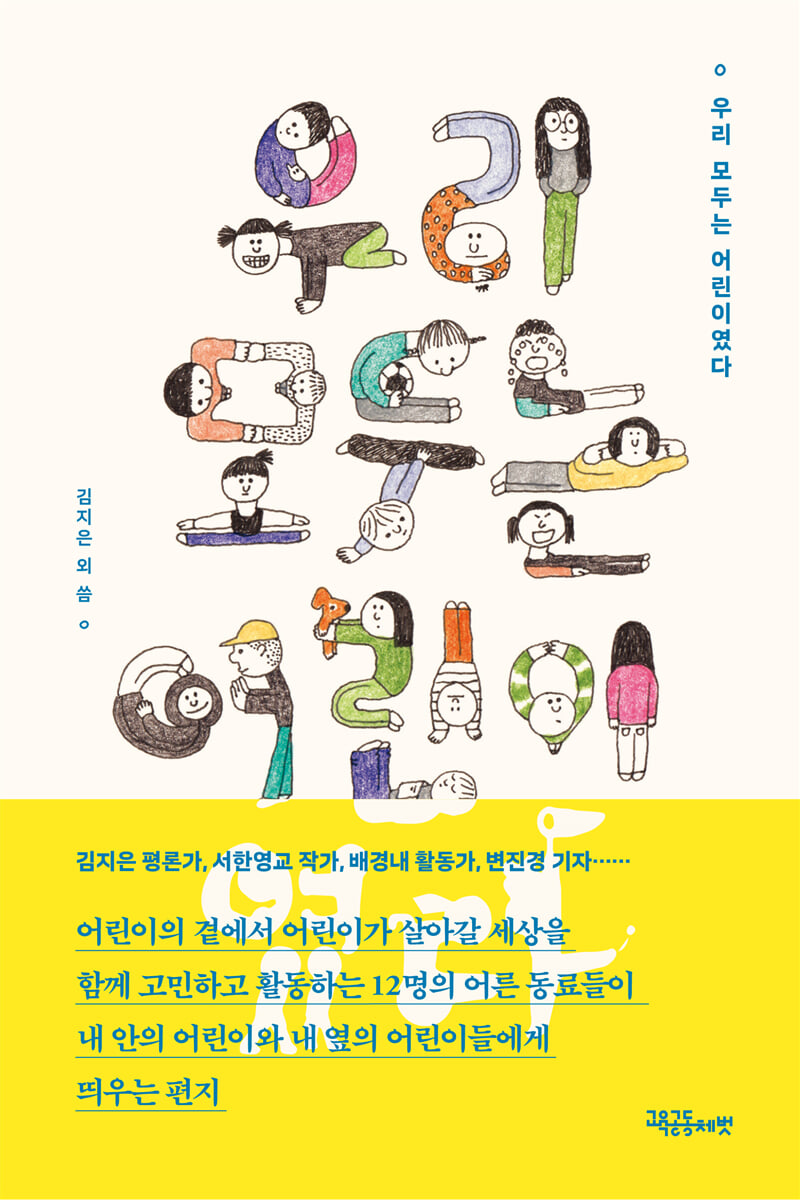
We were all children
 |
Description
Book Introduction
Critic Kim Ji-eun, writer Seo Han-yeong-gyo, activist Baek Gyeong-nae, reporter Byeon Jin-gyeong…
We work with children to think about and create a better world for them to live in.
12 adult colleagues
To the child inside me and the children next to me
floating letter
What kind of beings are children in our society?
In an era of unprecedented low birth rates, while on the one hand we revere the young, on the other hand we see widespread exclusion and discrimination against children.
An urban environment with no room to run and play, excessive academic stress, no-kids zones that blatantly exclude children, and a home and school atmosphere that views childcare and parenting as a burden…
Beyond our society's dualistic view of children and its aversion to them, this collection of twelve stories is written by adults, hoping that the childhoods we all experienced could be a little warmer and happier, for their young colleagues.
The authors of this book speak with one voice.
“A society that cares for and respects the weakest is a society for all.
“We were all children and we still live as children.”
We work with children to think about and create a better world for them to live in.
12 adult colleagues
To the child inside me and the children next to me
floating letter
What kind of beings are children in our society?
In an era of unprecedented low birth rates, while on the one hand we revere the young, on the other hand we see widespread exclusion and discrimination against children.
An urban environment with no room to run and play, excessive academic stress, no-kids zones that blatantly exclude children, and a home and school atmosphere that views childcare and parenting as a burden…
Beyond our society's dualistic view of children and its aversion to them, this collection of twelve stories is written by adults, hoping that the childhoods we all experienced could be a little warmer and happier, for their young colleagues.
The authors of this book speak with one voice.
“A society that cares for and respects the weakest is a society for all.
“We were all children and we still live as children.”
- You can preview some of the book's contents.
Preview
index
In publishing the book
Opening
Mom at ten, I at ten | Sobok
Part 1 | The Idea of Childhood
There is no love that only gives
On the Healing That Comes from Unconditional Love | Jang Hee-sook
Children I know who I would like to include in my 'Children' stories
- When talking about disabilities, let's not forget 'children'.
When talking about children, let's not forget about 'disability' | Gong Jin-ha
democracy of opinion
To a World That Has Lost Its Wonders | Seo Han-yeong
Part 2 | We Live with Children
Holding a young being, here and now
- For me, human rights activism is about defending the child within me | Background
“It’s not your fault.”
- Because I haven't forgotten my childhood/teenage years | Hyun Yu-rim
Children's World: Encountering the Body and Play
Children are in our bodies' past and present | Kim Yun-il
Part 3 | Living with Children
Soft Child, Hard World
- Children of various ages, in various regions, with various appearances | Byun Jin-kyung
Why Children's Rights Are Everyone's Rights
Children's Rights: A Comfort to All and a Warmth to the World | Kim Hee-jin
If anything happens, run to the book!
- Children, Books, and Literature | Kim Ji-eun
Growing with every moment we spend together
Pedagogy of Mutual Care | Kim Jung-mi
Closing
A letter from a mountain village grandfather to children on Children's Day
To Young Friends Who Have Lost Nature | Seo Jeong-hong
Opening
Mom at ten, I at ten | Sobok
Part 1 | The Idea of Childhood
There is no love that only gives
On the Healing That Comes from Unconditional Love | Jang Hee-sook
Children I know who I would like to include in my 'Children' stories
- When talking about disabilities, let's not forget 'children'.
When talking about children, let's not forget about 'disability' | Gong Jin-ha
democracy of opinion
To a World That Has Lost Its Wonders | Seo Han-yeong
Part 2 | We Live with Children
Holding a young being, here and now
- For me, human rights activism is about defending the child within me | Background
“It’s not your fault.”
- Because I haven't forgotten my childhood/teenage years | Hyun Yu-rim
Children's World: Encountering the Body and Play
Children are in our bodies' past and present | Kim Yun-il
Part 3 | Living with Children
Soft Child, Hard World
- Children of various ages, in various regions, with various appearances | Byun Jin-kyung
Why Children's Rights Are Everyone's Rights
Children's Rights: A Comfort to All and a Warmth to the World | Kim Hee-jin
If anything happens, run to the book!
- Children, Books, and Literature | Kim Ji-eun
Growing with every moment we spend together
Pedagogy of Mutual Care | Kim Jung-mi
Closing
A letter from a mountain village grandfather to children on Children's Day
To Young Friends Who Have Lost Nature | Seo Jeong-hong
Into the book
Hundreds of adults work together to protect these babies, who have entrusted their entire 24 hours to others.
Not only the adoption center staff, but also the aunts and uncles who come and go at different times, there are close to 200 people a week.
There are also adults who deliver baby food, drive them to the hospital, and wash, dry, and organize the mountains of clothes, blankets, and towels that come out every day.
I do hair, provide home visits, put rice cakes on the 100th day or first birthday table, take pictures, repair the house… … .
The hands needed for a human being to grow are filled with the close cooperation of many people.
Even though two hours of service may seem insignificant, I find comfort in the thought that this care for one child is like a gigantic "cooperative sewing."
We are creating a large patchwork called ‘Baby’s Growth’ together, one stitch at a time.
Even if they cannot fully fulfill the role of parents, all adults who truly wish for the happiness of the baby can be said to be social guardians in that they take care of the baby together.
---From "Jang Hee-sook, 'There is no love that only gives'"
As was the case at the museum, I was often 'kindly' turned away in many places for safety and health reasons.
It's really frustrating that the places where I get rejected the most are playgrounds, kids cafes, kindergartens, and schools.
Children are rejected from their favorite places, the places they can only go when they are children.
I don't think he did it with any bad intentions.
It may be because we cannot imagine children with different bodies or with various disabilities.
The students I meet have two identities: "disabled" and "child," but many seem to focus more on the fact that they have a disability than on the fact that they are a child.
---From "Gong Jin-ha, "Children I Know Who I Want to Include in 'Children' Stories"
On Children's Day 2022, a press conference was held in front of the National Assembly to declare "Children's Day for the Elimination of Discrimination."
Children shouted, “Don’t discriminate against me because I’m a child” to a society that ignores and discriminates against me because I’m young.
Not as children who are treated as the property of their parents or as appendages of adults, but as inhabitants of the Earth who live 'together' in the same era.
Not just as objects of protection and nurturing, but as citizens who learn how to 'be together'.
For over 100 years, we have been demanding that we be regarded not as a future dream tree constantly delayed from the present, but as a partner who creates the future 'together'.
---From "Seo Han-yeong-gyo, "Democracy of Inquiry"
If there's a universal reason we should remember that everyone was once a child, I believe it's that we must never forget the experience of being placed in the vulnerable position represented by "children," of living in a world assigned to us regardless of our own choices.
A person who, whether good or bad, had to depend absolutely on the resources and generosity he bestowed.
A person who was worried that conditions that I could not change would become reasons for me to be rejected.
A person who is more vulnerable because he or she craves recognition and care.
A person who was anxious in a world full of unfamiliar things he was doing for the first time, worried that a mistake might become an excuse for his recognition or support to be withdrawn.
A person who had to live under the same roof as someone who could hit me at any time.
It is because of that ‘young me’ and the time I spent as a child that I am who I am today.
It is not that we were once children, but that life continues with that young existence in our hearts.
---From "Background, 〈Holding a Young Being, Here and Now〉"
When I see a scene in the street or in a public place where a child is being scolded loudly or spoken to informally, I immediately freeze.
When I see people getting irritated and angry at children without any reason, I find myself cringing without realizing it.
And on the other hand, I feel ashamed and guilty for not being able to take the side of the child who was being unfairly treated rudely and pretending not to know about it.
Every time that happens, it feels like small but heavy stones are piling up in my chest.
Maybe it's because of this feeling that I want to stay in school.
Being in school allows me to be a little more proactive in what happens to students than I would be on the streets.
We can't change all the unethical behaviors in schools, but we can at least ask students in stressful situations and take a moment to stand by their side.
You can talk to a student who is isolated and tell them it's not their fault.
---「Hyun Yu-rim, from “It’s Not Your Fault”」
What if all children, now adults, could approach movement from this perspective of play?
There is no child who does not like to move from the beginning.
After coming into the world and not knowing whether their body was their own, children begin to roll over, crawl, and walk.
And constantly moving, reaching out to those who love and protect you, exploring a world full of wonders with your whole body.
Reach out to the being you are attached to and find what you need.
An experience where the body moves according to the desire to connect and curiosity about the world.
The memory of such movements is engraved on everyone's body.
But as we grow up, we become more and more distant from each other in our movements.
This is because we accumulate experiences in which the value of our bodies is judged based on a muscular, cool body or a strong body that is good at sports.
Movement thus increasingly becomes the domain of certain people who are 'good at using' their bodies.
The girl, who used to run around so much that her face was covered in sweat as if she had just washed her face, said that she started to worry about the belly fat that was visible when she hung from the horizontal bar around the time she entered the upper grades of elementary school.
The boy, who had been exploring his fears at his own pace and carefully observing his opponents, became angry at the ridicule, saying, "You're a boy, can't you do that?" and distanced himself from sports.
---From "Kim Yun-il, "The World of Children Encountered through Body and Play"
Phrases like “regional extinction” and “lowest birth rate in the world” no longer have much impact on members of society.
I think I've kind of given up now.
Despite the daily stream of government announcements and media articles emphasizing the crisis, the world seems to be going on as vibrantly as before, and I've become numb to it.
But I feel the shock with a simpler proposition.
The children disappear.
I have experienced this chilling truth firsthand, not in a shameful way, but very clearly, during my 15 years as a journalist.
It is not only in rural and fishing villages where children have already disappeared that the population is declining.
When I heard a merchant near the school zone where a child died shouting, “Is it right to make adults feel this uncomfortable just because one child died?” When I met an elementary school student stuffing a hamburger into his mouth while dragging a heavy carrier bag full of high school workbooks at 10:30 at night in the Daechi-dong academy district, When I read the hellish comment section of a portal site filled with hundreds of horrific comments telling children from immigrant and refugee families to “stop wasting taxes and go back to your country,” I was witnessing a scene in our society where children were being “deleted” one by one.
Then one day, they will all disappear and the whole world will become the 'No Kids Zone' you've been longing for, he said, sarcastically sneering into the air.
---From “Soft Child, Hard World” by Jin-Kyung Byun
It is often said that children should grow up playing and be happy.
The problem is that happiness is rarely explained from a child's perspective.
Children are the masters of their own lives, and the definition of happiness is provided by the adults surrounding them.
It means that you have to study hard, go to a top university, and have a stable job.
The goal of life is to be set for adulthood, and childhood is treated as a period of preparation for the future.
That is why the term “children’s rights” made my heart pound.
Because childhood is not seen as a process for achieving later achievements, but rather as a properly important stage of life.
---From "Kim Hee-jin, "Why Children's Rights Are Everyone's Human Rights"
Freedom for children is impossible without freedom for books.
If censorship begins in children's books, it is likely to lead to censorship of other books.
Children who become accustomed to censorship grow into involuntary adults who accept censorship.
Censorship that begins with books on gender equality could lead to censorship of other books that deal with various philosophies and social cultures.
Why do censors target children's books as their first priority? Because children, with limited opportunities to speak as readers, are the most vulnerable to isolation from the reading culture ecosystem.
The child, unaware of the attempts at censorship surrounding him, suddenly discovers this when his beloved book disappears from the bookshelf one day.
Through a few administrative actions, he is instantly cut off from the very existence of the books he would have probably wanted to read, books he would have enjoyed reading in the future.
We cannot raise children to be global citizens in a controlled reading environment.
For children, books are a classroom in themselves where they learn about democracy and diversity.
---From "Kim Ji-eun, 'If Something Happens, Run to the Book!'"
As with all care, child care is particularly important because the relationship between the caregiver and the care recipient is crucial.
Care doesn't just mean keeping children safe somewhere when adults aren't around.
All humans, no, all living beings, cannot survive without interdependence and without being cared for by someone.
The process of care coincides with the process of socialization.
In fact, care and education cannot be separated by a sharp line, like cutting tofu with a knife.
What the state-run care and education have in common is that they do not include ‘humans.’
I believe that care should not be confined within the walls of a school.
Children should be protected and taught the common good within the space in which they live.
And in doing so, you can grow as a citizen.
---From "Kim Jung-mi, Growing in Every Moment We Spend Together"
My grandfather said that he thought a lot while writing and reading 'The World We Dream of' together.
'How should we live so that we can leave a clean and beautiful world for our children?' They say that good imagination can create a good world.
So, starting today, I'm going to start imagining good things.
And I will do my best to move forward in the given position so that that imagination can become reality.
As we move forward, there will be times when we feel tired and worn out, but each time, we will think of each other growing like corn.
Because we need to fix the world created by foolish adults who have been living recklessly, oblivious to where they are going, obsessed with money and convenience.
Because among the foolish adults, there is also my grandfather.
Not only the adoption center staff, but also the aunts and uncles who come and go at different times, there are close to 200 people a week.
There are also adults who deliver baby food, drive them to the hospital, and wash, dry, and organize the mountains of clothes, blankets, and towels that come out every day.
I do hair, provide home visits, put rice cakes on the 100th day or first birthday table, take pictures, repair the house… … .
The hands needed for a human being to grow are filled with the close cooperation of many people.
Even though two hours of service may seem insignificant, I find comfort in the thought that this care for one child is like a gigantic "cooperative sewing."
We are creating a large patchwork called ‘Baby’s Growth’ together, one stitch at a time.
Even if they cannot fully fulfill the role of parents, all adults who truly wish for the happiness of the baby can be said to be social guardians in that they take care of the baby together.
---From "Jang Hee-sook, 'There is no love that only gives'"
As was the case at the museum, I was often 'kindly' turned away in many places for safety and health reasons.
It's really frustrating that the places where I get rejected the most are playgrounds, kids cafes, kindergartens, and schools.
Children are rejected from their favorite places, the places they can only go when they are children.
I don't think he did it with any bad intentions.
It may be because we cannot imagine children with different bodies or with various disabilities.
The students I meet have two identities: "disabled" and "child," but many seem to focus more on the fact that they have a disability than on the fact that they are a child.
---From "Gong Jin-ha, "Children I Know Who I Want to Include in 'Children' Stories"
On Children's Day 2022, a press conference was held in front of the National Assembly to declare "Children's Day for the Elimination of Discrimination."
Children shouted, “Don’t discriminate against me because I’m a child” to a society that ignores and discriminates against me because I’m young.
Not as children who are treated as the property of their parents or as appendages of adults, but as inhabitants of the Earth who live 'together' in the same era.
Not just as objects of protection and nurturing, but as citizens who learn how to 'be together'.
For over 100 years, we have been demanding that we be regarded not as a future dream tree constantly delayed from the present, but as a partner who creates the future 'together'.
---From "Seo Han-yeong-gyo, "Democracy of Inquiry"
If there's a universal reason we should remember that everyone was once a child, I believe it's that we must never forget the experience of being placed in the vulnerable position represented by "children," of living in a world assigned to us regardless of our own choices.
A person who, whether good or bad, had to depend absolutely on the resources and generosity he bestowed.
A person who was worried that conditions that I could not change would become reasons for me to be rejected.
A person who is more vulnerable because he or she craves recognition and care.
A person who was anxious in a world full of unfamiliar things he was doing for the first time, worried that a mistake might become an excuse for his recognition or support to be withdrawn.
A person who had to live under the same roof as someone who could hit me at any time.
It is because of that ‘young me’ and the time I spent as a child that I am who I am today.
It is not that we were once children, but that life continues with that young existence in our hearts.
---From "Background, 〈Holding a Young Being, Here and Now〉"
When I see a scene in the street or in a public place where a child is being scolded loudly or spoken to informally, I immediately freeze.
When I see people getting irritated and angry at children without any reason, I find myself cringing without realizing it.
And on the other hand, I feel ashamed and guilty for not being able to take the side of the child who was being unfairly treated rudely and pretending not to know about it.
Every time that happens, it feels like small but heavy stones are piling up in my chest.
Maybe it's because of this feeling that I want to stay in school.
Being in school allows me to be a little more proactive in what happens to students than I would be on the streets.
We can't change all the unethical behaviors in schools, but we can at least ask students in stressful situations and take a moment to stand by their side.
You can talk to a student who is isolated and tell them it's not their fault.
---「Hyun Yu-rim, from “It’s Not Your Fault”」
What if all children, now adults, could approach movement from this perspective of play?
There is no child who does not like to move from the beginning.
After coming into the world and not knowing whether their body was their own, children begin to roll over, crawl, and walk.
And constantly moving, reaching out to those who love and protect you, exploring a world full of wonders with your whole body.
Reach out to the being you are attached to and find what you need.
An experience where the body moves according to the desire to connect and curiosity about the world.
The memory of such movements is engraved on everyone's body.
But as we grow up, we become more and more distant from each other in our movements.
This is because we accumulate experiences in which the value of our bodies is judged based on a muscular, cool body or a strong body that is good at sports.
Movement thus increasingly becomes the domain of certain people who are 'good at using' their bodies.
The girl, who used to run around so much that her face was covered in sweat as if she had just washed her face, said that she started to worry about the belly fat that was visible when she hung from the horizontal bar around the time she entered the upper grades of elementary school.
The boy, who had been exploring his fears at his own pace and carefully observing his opponents, became angry at the ridicule, saying, "You're a boy, can't you do that?" and distanced himself from sports.
---From "Kim Yun-il, "The World of Children Encountered through Body and Play"
Phrases like “regional extinction” and “lowest birth rate in the world” no longer have much impact on members of society.
I think I've kind of given up now.
Despite the daily stream of government announcements and media articles emphasizing the crisis, the world seems to be going on as vibrantly as before, and I've become numb to it.
But I feel the shock with a simpler proposition.
The children disappear.
I have experienced this chilling truth firsthand, not in a shameful way, but very clearly, during my 15 years as a journalist.
It is not only in rural and fishing villages where children have already disappeared that the population is declining.
When I heard a merchant near the school zone where a child died shouting, “Is it right to make adults feel this uncomfortable just because one child died?” When I met an elementary school student stuffing a hamburger into his mouth while dragging a heavy carrier bag full of high school workbooks at 10:30 at night in the Daechi-dong academy district, When I read the hellish comment section of a portal site filled with hundreds of horrific comments telling children from immigrant and refugee families to “stop wasting taxes and go back to your country,” I was witnessing a scene in our society where children were being “deleted” one by one.
Then one day, they will all disappear and the whole world will become the 'No Kids Zone' you've been longing for, he said, sarcastically sneering into the air.
---From “Soft Child, Hard World” by Jin-Kyung Byun
It is often said that children should grow up playing and be happy.
The problem is that happiness is rarely explained from a child's perspective.
Children are the masters of their own lives, and the definition of happiness is provided by the adults surrounding them.
It means that you have to study hard, go to a top university, and have a stable job.
The goal of life is to be set for adulthood, and childhood is treated as a period of preparation for the future.
That is why the term “children’s rights” made my heart pound.
Because childhood is not seen as a process for achieving later achievements, but rather as a properly important stage of life.
---From "Kim Hee-jin, "Why Children's Rights Are Everyone's Human Rights"
Freedom for children is impossible without freedom for books.
If censorship begins in children's books, it is likely to lead to censorship of other books.
Children who become accustomed to censorship grow into involuntary adults who accept censorship.
Censorship that begins with books on gender equality could lead to censorship of other books that deal with various philosophies and social cultures.
Why do censors target children's books as their first priority? Because children, with limited opportunities to speak as readers, are the most vulnerable to isolation from the reading culture ecosystem.
The child, unaware of the attempts at censorship surrounding him, suddenly discovers this when his beloved book disappears from the bookshelf one day.
Through a few administrative actions, he is instantly cut off from the very existence of the books he would have probably wanted to read, books he would have enjoyed reading in the future.
We cannot raise children to be global citizens in a controlled reading environment.
For children, books are a classroom in themselves where they learn about democracy and diversity.
---From "Kim Ji-eun, 'If Something Happens, Run to the Book!'"
As with all care, child care is particularly important because the relationship between the caregiver and the care recipient is crucial.
Care doesn't just mean keeping children safe somewhere when adults aren't around.
All humans, no, all living beings, cannot survive without interdependence and without being cared for by someone.
The process of care coincides with the process of socialization.
In fact, care and education cannot be separated by a sharp line, like cutting tofu with a knife.
What the state-run care and education have in common is that they do not include ‘humans.’
I believe that care should not be confined within the walls of a school.
Children should be protected and taught the common good within the space in which they live.
And in doing so, you can grow as a citizen.
---From "Kim Jung-mi, Growing in Every Moment We Spend Together"
My grandfather said that he thought a lot while writing and reading 'The World We Dream of' together.
'How should we live so that we can leave a clean and beautiful world for our children?' They say that good imagination can create a good world.
So, starting today, I'm going to start imagining good things.
And I will do my best to move forward in the given position so that that imagination can become reality.
As we move forward, there will be times when we feel tired and worn out, but each time, we will think of each other growing like corn.
Because we need to fix the world created by foolish adults who have been living recklessly, oblivious to where they are going, obsessed with money and convenience.
Because among the foolish adults, there is also my grandfather.
---From "Seo Jeong-hong, "A Letter to Children from a Mountain Grandfather Born on Children's Day"
Publisher's Review
In Korean society, discourse about children is excessively thin and flat.
Although over 100 years have passed since the promulgation of the Children's Day Declaration, which can be considered the world's first "Declaration of the Rights of the Child," it is difficult to find any books of thought or research that focus on children themselves, rather than their protection or growth.
As discourse is poor, the perspective and perception of children are also formalized.
As low birth rates emerge as a serious social problem, children are treated as precious beings who deserve to be treated with respect, but it is difficult to find spaces that welcome children.
Spaces allowing for rest or play are scarce, and cafes and restaurants openly advertise 'no kids zones'.
What about at school?
Even as many schools close or scale down due to declining student numbers, discussions on the human rights and care of students (children and adolescents) are becoming increasingly narrow.
The severity of the learning labor that causes suffering to many children and adolescents only increases with each passing day.
Is it any different at home?
Children are infinitely cute and lovable beings, but at other times they can also be infinitely burdensome or beings we want to ignore.
It is very likely that parenting will be labeled as ‘single-parenting’ and objectified.
This book deepens and broadens the horizons of discourse on children through the writings of authors who have long been interested in and active in the lives and culture of children.
This book is divided into three parts.
Part 1, 'The Idea of Children', provides perspectives and philosophies on how to view children.
“There is no love that only gives” is the story of Jang Hee-sook, who volunteers at an adoption center.
Drawing on her experience as a teacher at a youth night school and alternative school and as a volunteer at an adoption agency, she says that care is not something that is provided unilaterally, but rather an interdependent act.
“Children I Know Who I Want to Include in ‘Children’ Stories,” written by Gong Jin-ha, a special education teacher, brings children with disabilities, who we don’t usually think of when we think of ‘children,’ into the discussion.
When the emphasis is placed on 'children', the specificity of disability is not taken into account, and when the emphasis is placed on 'disability', the universality of children is not taken into account. This is a painful point to make, but it also provides an opportunity to expand the horizon of our perception.
In “Democracy of the Heart,” author Seo Han-yeong criticizes our society’s dual and contradictory attitude toward children and asserts the uniqueness of children.
Children are not the property of their parents, objects of protection and nurturing, or future dream trees, but rather, as citizens who live 'together' on Earth in the same era, learning how to 'be together,' and as companions who 'create' the future 'together.'
Part 2, 'We Live with Children in Our Arms', reminds us that we were once children and that we still live with children in our arms.
In “Embracing a Child, Here and Now,” human rights activist Baek Kyung-nae confesses that her childhood experiences shaped her into a human rights activist, saying, “For me, human rights activism is about defending the child within me.”
Hyun Yu-rim tells the story of how she never forgot the human rights violations she experienced at school as a child and youth, and how she returned to school as a teacher to stand by the children's side.
The title of the article, “It’s Not Your Fault,” is also a comfort to all of us who, as children, had to exist helplessly in the face of various violence and dangers both inside and outside of school.
Kim Yun-il, a play/education researcher and activist for the Change of the Moon Movement, says in “The World of Children Encountered through Body and Play” that children exist in the past and present of our bodies.
It suggests how we can recover the sense of body that we lost in the process of the body being objectified and instrumentalized, and what kind of play can foster the strength to live.
All three articles are impressive narratives of how adults who grew up not forgetting their childhood and adolescence became strong companions by their children's side.
Part 3 deals with concerns about ‘a society that lives with children.’
Reporter Jin-kyung Byun (Soft Children, Hard World), who has harshly criticized social structural problems through in-depth articles on incidents related to children, calls for looking at social problems from “a child’s perspective.”
In a reality where children are flocking to increasingly narrow islands and those islands are getting smaller, he says we need to imagine a society where “various children exist in diverse areas, with diverse appearances.”
Kim Hee-jin, a children's rights lawyer ("Why Children's Rights Are Everyone's Rights") emphasizes the implications of "children's rights," which recognize childhood as an important stage of life rather than a process for achieving later achievements, and says that a world where the human rights of the smallest being are respected is a world where the human rights of all are respected.
When thinking about the future of children, the phrase "I strive to use my legal knowledge not as a means of struggle with a winning or losing outcome, but to practice the values of mediation and cooperation" makes us reflect on how our society instrumentalizes children in many cases.
In "If Something Happens, Run to Books!", children's and youth literature critic Kim Ji-eun discusses the position of children readers, who can easily be isolated from the reading culture ecosystem, and discusses how to restore the relationship between children and books.
The author, who says that books are a classroom in itself where children learn about democracy and diversity, emphasizes once again that the freedom of books is the freedom of children.
“Growing in Every Moment We Spend Together” is a piece written by author Kim Jung-mi, who has been implementing the pedagogy of mutual care for a long time through the Little School by the Railroad.
He criticizes the reality that children are excluded from discussions about care, and emphasizes that care for children should not be confined within the school walls.
The care the author speaks of is not simply about keeping children safe, but is realized when children help, share, and work together with one another.
The beginning and end of the book are composed using comics and poetry.
The cartoon that opens this book is the work of Sobok, who has delicately captured and expressed the hearts and emotions of children.
“Mom at Ten, Me at Ten,” which cross-references my story from when I was ten with my child at ten, is also a message of encouragement to the many adults in this country who are practicing “becoming better parents.”
The last piece by poet Seo Jeong-hong is a story to young friends who have lost touch with nature.
In “A Letter from a Mountain Grandfather Born on Children’s Day to Children,” the author reminds us of the values we have lost in the pursuit of money and convenience, and concretizes “good imagination” for creating a “good world” through a list of “The World We Dream of.”
In the face of contradictory and ambivalent views of children, a reality where their uniqueness is respected and they are able to develop their own voices still seems far away.
However, as the discourse on children becomes more diverse and richer, our society's perception will also gradually change.
I hope this book can be the beginning.
Although over 100 years have passed since the promulgation of the Children's Day Declaration, which can be considered the world's first "Declaration of the Rights of the Child," it is difficult to find any books of thought or research that focus on children themselves, rather than their protection or growth.
As discourse is poor, the perspective and perception of children are also formalized.
As low birth rates emerge as a serious social problem, children are treated as precious beings who deserve to be treated with respect, but it is difficult to find spaces that welcome children.
Spaces allowing for rest or play are scarce, and cafes and restaurants openly advertise 'no kids zones'.
What about at school?
Even as many schools close or scale down due to declining student numbers, discussions on the human rights and care of students (children and adolescents) are becoming increasingly narrow.
The severity of the learning labor that causes suffering to many children and adolescents only increases with each passing day.
Is it any different at home?
Children are infinitely cute and lovable beings, but at other times they can also be infinitely burdensome or beings we want to ignore.
It is very likely that parenting will be labeled as ‘single-parenting’ and objectified.
This book deepens and broadens the horizons of discourse on children through the writings of authors who have long been interested in and active in the lives and culture of children.
This book is divided into three parts.
Part 1, 'The Idea of Children', provides perspectives and philosophies on how to view children.
“There is no love that only gives” is the story of Jang Hee-sook, who volunteers at an adoption center.
Drawing on her experience as a teacher at a youth night school and alternative school and as a volunteer at an adoption agency, she says that care is not something that is provided unilaterally, but rather an interdependent act.
“Children I Know Who I Want to Include in ‘Children’ Stories,” written by Gong Jin-ha, a special education teacher, brings children with disabilities, who we don’t usually think of when we think of ‘children,’ into the discussion.
When the emphasis is placed on 'children', the specificity of disability is not taken into account, and when the emphasis is placed on 'disability', the universality of children is not taken into account. This is a painful point to make, but it also provides an opportunity to expand the horizon of our perception.
In “Democracy of the Heart,” author Seo Han-yeong criticizes our society’s dual and contradictory attitude toward children and asserts the uniqueness of children.
Children are not the property of their parents, objects of protection and nurturing, or future dream trees, but rather, as citizens who live 'together' on Earth in the same era, learning how to 'be together,' and as companions who 'create' the future 'together.'
Part 2, 'We Live with Children in Our Arms', reminds us that we were once children and that we still live with children in our arms.
In “Embracing a Child, Here and Now,” human rights activist Baek Kyung-nae confesses that her childhood experiences shaped her into a human rights activist, saying, “For me, human rights activism is about defending the child within me.”
Hyun Yu-rim tells the story of how she never forgot the human rights violations she experienced at school as a child and youth, and how she returned to school as a teacher to stand by the children's side.
The title of the article, “It’s Not Your Fault,” is also a comfort to all of us who, as children, had to exist helplessly in the face of various violence and dangers both inside and outside of school.
Kim Yun-il, a play/education researcher and activist for the Change of the Moon Movement, says in “The World of Children Encountered through Body and Play” that children exist in the past and present of our bodies.
It suggests how we can recover the sense of body that we lost in the process of the body being objectified and instrumentalized, and what kind of play can foster the strength to live.
All three articles are impressive narratives of how adults who grew up not forgetting their childhood and adolescence became strong companions by their children's side.
Part 3 deals with concerns about ‘a society that lives with children.’
Reporter Jin-kyung Byun (Soft Children, Hard World), who has harshly criticized social structural problems through in-depth articles on incidents related to children, calls for looking at social problems from “a child’s perspective.”
In a reality where children are flocking to increasingly narrow islands and those islands are getting smaller, he says we need to imagine a society where “various children exist in diverse areas, with diverse appearances.”
Kim Hee-jin, a children's rights lawyer ("Why Children's Rights Are Everyone's Rights") emphasizes the implications of "children's rights," which recognize childhood as an important stage of life rather than a process for achieving later achievements, and says that a world where the human rights of the smallest being are respected is a world where the human rights of all are respected.
When thinking about the future of children, the phrase "I strive to use my legal knowledge not as a means of struggle with a winning or losing outcome, but to practice the values of mediation and cooperation" makes us reflect on how our society instrumentalizes children in many cases.
In "If Something Happens, Run to Books!", children's and youth literature critic Kim Ji-eun discusses the position of children readers, who can easily be isolated from the reading culture ecosystem, and discusses how to restore the relationship between children and books.
The author, who says that books are a classroom in itself where children learn about democracy and diversity, emphasizes once again that the freedom of books is the freedom of children.
“Growing in Every Moment We Spend Together” is a piece written by author Kim Jung-mi, who has been implementing the pedagogy of mutual care for a long time through the Little School by the Railroad.
He criticizes the reality that children are excluded from discussions about care, and emphasizes that care for children should not be confined within the school walls.
The care the author speaks of is not simply about keeping children safe, but is realized when children help, share, and work together with one another.
The beginning and end of the book are composed using comics and poetry.
The cartoon that opens this book is the work of Sobok, who has delicately captured and expressed the hearts and emotions of children.
“Mom at Ten, Me at Ten,” which cross-references my story from when I was ten with my child at ten, is also a message of encouragement to the many adults in this country who are practicing “becoming better parents.”
The last piece by poet Seo Jeong-hong is a story to young friends who have lost touch with nature.
In “A Letter from a Mountain Grandfather Born on Children’s Day to Children,” the author reminds us of the values we have lost in the pursuit of money and convenience, and concretizes “good imagination” for creating a “good world” through a list of “The World We Dream of.”
In the face of contradictory and ambivalent views of children, a reality where their uniqueness is respected and they are able to develop their own voices still seems far away.
However, as the discourse on children becomes more diverse and richer, our society's perception will also gradually change.
I hope this book can be the beginning.
GOODS SPECIFICS
- Date of issue: September 30, 2024
- Page count, weight, size: 300 pages | 354g | 140*210*16mm
- ISBN13: 9788968801884
You may also like
카테고리
korean


korean

![ELLE 엘르 스페셜 에디션 A형 : 12월 [2025]](http://librairie.coreenne.fr/cdn/shop/files/b8e27a3de6c9538896439686c6b0e8fb.jpg?v=1766436872&width=3840)


