

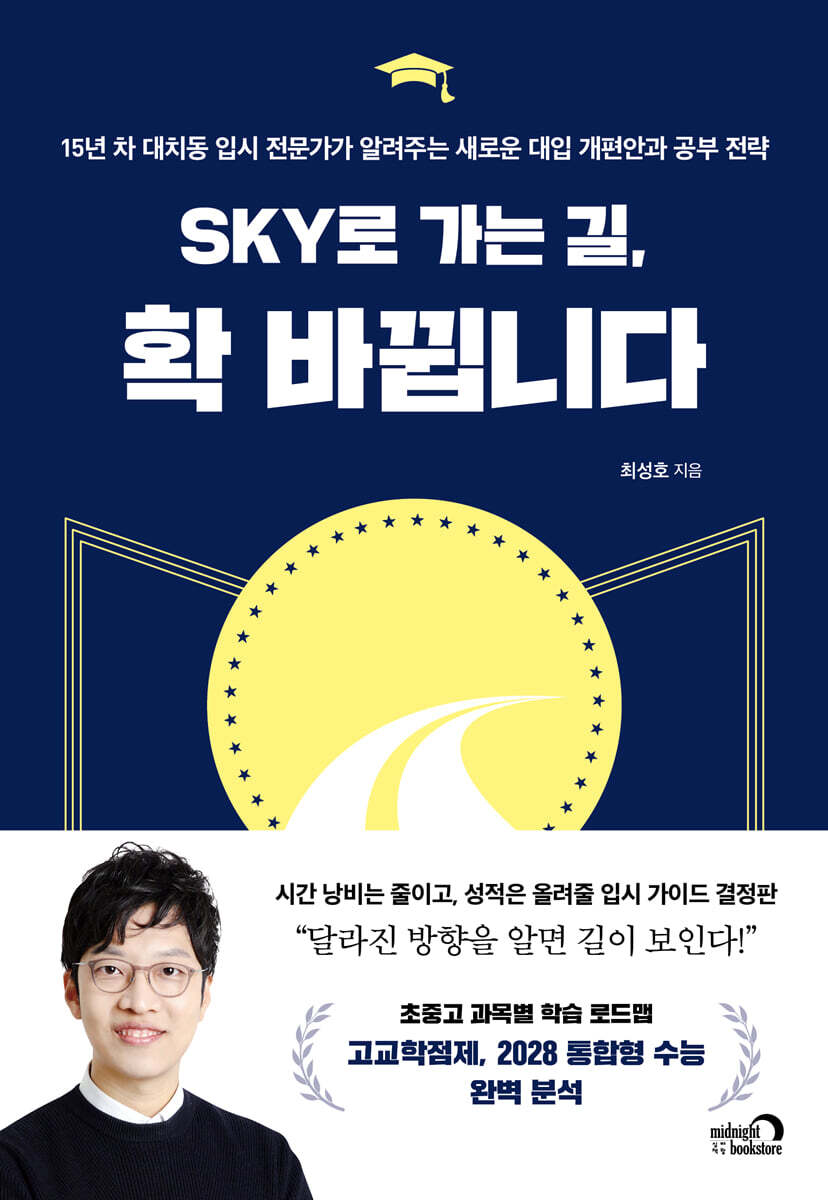
The road to SKY has changed dramatically.
 |
Description
Book Introduction
A 15-year veteran Daechi-dong entrance exam expert tells you
New college entrance exam reform plan and customized study strategies
“Parents’ information power is their children’s study power!”
The definitive college entrance exam guide that will reduce wasted time and definitely improve your grades.
Director Choi Seong-ho, who has been providing college entrance exam guidance in Daechi-dong for 15 years and has produced students who have been accepted to prestigious universities including SKY and medical schools every year, explains, "Although college entrance exam information may seem most important to high school seniors, it is actually parents with elementary and middle school children who need to know about the college entrance exam."
Because true skills aren't created overnight.
But the younger your child is, the more difficult and distant the entrance exam seems.
The purpose of this book is to address this dissonance and lack of information.
In fact, in our country, there is a tendency to avoid specifying college goals for young children too early.
Because it feels like parents are putting excessive demands on their children's education.
However, if you know about the entrance exam, education becomes easier.
You can provide your child with an educational method that is suitable for him or her and choose an appropriate academy.
Furthermore, if you know about the entrance exam, you can reduce unnecessary private education, avoid being swayed by promotional advertisements, and achieve success in the entrance exam with your child without giving up on the educational perspective.
This is why you need to understand the entrance exam properly to invest wisely in education.
Daechi-dong is known as the number one college entrance exam area in Korea.
In the past, Daechi-dong was famous for lectures by top instructors, but now it is building a reputation for 'Daechi-dong consulting' provided by top entrance exam experts.
What are the key elements of this consulting? They are "information power" and "study skills."
This book is largely divided into two parts.
Part 1 deals with ‘parents’ information power’, and Part 2 deals with ‘children’s study power’.
Part 1 presents clear directions to parents who desperately need high-quality college entrance exam information and students who are busy preparing for the exam, as educational issues such as the 'High School Credit System', which will be fully implemented starting in 2025, and the '2028 College Entrance Exam Reform' are pouring in.
Part 2 provides advice on how to foster your child's study skills to develop solid academic skills, along with subject-specific learning strategies and roadmaps tailored to the college entrance exam, to help them achieve successful results without wavering even in the changing college entrance exam environment.
In this age of chaos, we need the wisdom to catch two rabbits at once: college entrance exams and education.
This book contains all the know-how you need to experience Daechi-dong consulting firsthand, tailored to the rapidly changing college entrance exam landscape.
Although not all Korean students and parents can experience Daechi-dong Consulting firsthand, this book will provide a taste and experience of its essence.
New college entrance exam reform plan and customized study strategies
“Parents’ information power is their children’s study power!”
The definitive college entrance exam guide that will reduce wasted time and definitely improve your grades.
Director Choi Seong-ho, who has been providing college entrance exam guidance in Daechi-dong for 15 years and has produced students who have been accepted to prestigious universities including SKY and medical schools every year, explains, "Although college entrance exam information may seem most important to high school seniors, it is actually parents with elementary and middle school children who need to know about the college entrance exam."
Because true skills aren't created overnight.
But the younger your child is, the more difficult and distant the entrance exam seems.
The purpose of this book is to address this dissonance and lack of information.
In fact, in our country, there is a tendency to avoid specifying college goals for young children too early.
Because it feels like parents are putting excessive demands on their children's education.
However, if you know about the entrance exam, education becomes easier.
You can provide your child with an educational method that is suitable for him or her and choose an appropriate academy.
Furthermore, if you know about the entrance exam, you can reduce unnecessary private education, avoid being swayed by promotional advertisements, and achieve success in the entrance exam with your child without giving up on the educational perspective.
This is why you need to understand the entrance exam properly to invest wisely in education.
Daechi-dong is known as the number one college entrance exam area in Korea.
In the past, Daechi-dong was famous for lectures by top instructors, but now it is building a reputation for 'Daechi-dong consulting' provided by top entrance exam experts.
What are the key elements of this consulting? They are "information power" and "study skills."
This book is largely divided into two parts.
Part 1 deals with ‘parents’ information power’, and Part 2 deals with ‘children’s study power’.
Part 1 presents clear directions to parents who desperately need high-quality college entrance exam information and students who are busy preparing for the exam, as educational issues such as the 'High School Credit System', which will be fully implemented starting in 2025, and the '2028 College Entrance Exam Reform' are pouring in.
Part 2 provides advice on how to foster your child's study skills to develop solid academic skills, along with subject-specific learning strategies and roadmaps tailored to the college entrance exam, to help them achieve successful results without wavering even in the changing college entrance exam environment.
In this age of chaos, we need the wisdom to catch two rabbits at once: college entrance exams and education.
This book contains all the know-how you need to experience Daechi-dong consulting firsthand, tailored to the rapidly changing college entrance exam landscape.
Although not all Korean students and parents can experience Daechi-dong Consulting firsthand, this book will provide a taste and experience of its essence.
- You can preview some of the book's contents.
Preview
index
prolog
Part 1: Daechi-dong's 1% Information Power
Chapter 1: The Power of Reading the Changed Entrance Exam
01 You need good information skills to succeed in the college entrance exam.
02 Reasons why students born in 2009 should pay attention to the college entrance exam
03 If you know the CSAT, you can see the future.
Chapter 2: Your Grades Will Change: Understanding the High School Credit System
01 Understanding the High School Credit System
02 Controversy Surrounding the High School Credit System
03 The impact of the introduction of the 5-grade internal grade system on college entrance exams
04 Developing a Customized Strategy for the High School Credit System
Chapter 3: The College Scholastic Ability Test (CSAT) Is Changing: The Key Points of the 2028 College Entrance Exam Reform Plan
01 The first integrated liberal arts and science college entrance exam
02 The protagonists of the 2028 college entrance reform plan: Mathematics and Inquiry
03 Studying Society and Science through Integration
04 How to prepare for the integrated CSAT?
Chapter 4: Exams Are Changing: The IB and the Introduction of Essay-Based Education
01 Concerns about future education
02 Entrance Exams and IB Education
03 Expectations and Concerns Surrounding IB Education
Chapter 5: The Core of the Primary, Middle, and High School Entrance Exam Roadmap
01 How to Draw Your Child's Own College Entrance Exam Roadmap
02 Elementary: Developing Good Study Habits
03 Middle School: Choosing the Right Study Method and High School
04 High School: Developing a Three-Dimensional Admissions Strategy
Part 2 Daechi-dong 1% study ability
Chapter 6: The Secret to Studying That Will Surely Lead to Passing
01 Real Study of Daechi-dong Children
02 Characteristics of fake study
03 Six Key Factors That Determine Study Ability
Chapter 7: Customized Subject-Specific Study Strategies for College Entrance Exams
01 Reading to develop thinking skills
02 Korean language to develop reading comprehension skills
03 Mathematics that develops applied power
04 English that develops communication skills
05 Society and Science that Cultivate the Power of Inquiry
06 Argumentation that develops persuasive power
Epilogue
Part 1: Daechi-dong's 1% Information Power
Chapter 1: The Power of Reading the Changed Entrance Exam
01 You need good information skills to succeed in the college entrance exam.
02 Reasons why students born in 2009 should pay attention to the college entrance exam
03 If you know the CSAT, you can see the future.
Chapter 2: Your Grades Will Change: Understanding the High School Credit System
01 Understanding the High School Credit System
02 Controversy Surrounding the High School Credit System
03 The impact of the introduction of the 5-grade internal grade system on college entrance exams
04 Developing a Customized Strategy for the High School Credit System
Chapter 3: The College Scholastic Ability Test (CSAT) Is Changing: The Key Points of the 2028 College Entrance Exam Reform Plan
01 The first integrated liberal arts and science college entrance exam
02 The protagonists of the 2028 college entrance reform plan: Mathematics and Inquiry
03 Studying Society and Science through Integration
04 How to prepare for the integrated CSAT?
Chapter 4: Exams Are Changing: The IB and the Introduction of Essay-Based Education
01 Concerns about future education
02 Entrance Exams and IB Education
03 Expectations and Concerns Surrounding IB Education
Chapter 5: The Core of the Primary, Middle, and High School Entrance Exam Roadmap
01 How to Draw Your Child's Own College Entrance Exam Roadmap
02 Elementary: Developing Good Study Habits
03 Middle School: Choosing the Right Study Method and High School
04 High School: Developing a Three-Dimensional Admissions Strategy
Part 2 Daechi-dong 1% study ability
Chapter 6: The Secret to Studying That Will Surely Lead to Passing
01 Real Study of Daechi-dong Children
02 Characteristics of fake study
03 Six Key Factors That Determine Study Ability
Chapter 7: Customized Subject-Specific Study Strategies for College Entrance Exams
01 Reading to develop thinking skills
02 Korean language to develop reading comprehension skills
03 Mathematics that develops applied power
04 English that develops communication skills
05 Society and Science that Cultivate the Power of Inquiry
06 Argumentation that develops persuasive power
Epilogue
Detailed image

Into the book
College entrance exams must be approached strategically.
For children in middle school or lower, the goal of college entrance exams is not really that important.
Anyway, I don't know many universities and I don't really worry about the entrance exam.
You just have to study hard.
But parents are different.
To approach college entrance exams strategically, parents must first clearly and specifically define their child's college entrance exam goals.
Parents' clear college entrance exam goals are also important from an educational investment perspective.
This is because education and entrance exams require not only the child's effort but also the parents' money and time.
---「Chapter 1 02.
From “Reasons to Pay Attention to the College Entrance Examination for Students Born in 2009”
How will math study change for students preparing for the 2028 CSAT? First, how quickly they progressed through the prerequisites won't matter.
Since Calculus II (formerly Calculus) and Geometry have been removed from the CSAT, there is now less reason to take math at the level of a second or third year high school student.
Of course, this subject will be included in the scope of the internal exam, but even that will be reduced to a 5-grade system, so the pace of math prerequisites will be much slower.
Therefore, what is more important than the precedent is the deepening.
From the examiner's perspective, in order to create a variety of application problems within a limited scope, they have no choice but to create problems that combine and modify basic concepts in various ways.
Test takers need to have a solid understanding of the basic mathematical concepts involved in these transformation problems and the mathematical thinking skills to come up with solutions.
---「Chapter 3 02.
From "Mathematics and Exploration: The Protagonist of the 2028 College Entrance Reform Plan"
How should I create an entrance exam roadmap? First, the roadmap should be as simple as possible.
If you try to include too much information, you'll end up with unclear direction.
The more boldly you omit surrounding information, like pruning branches, the clearer your entrance exam goals will become.
There are many different types of study.
In particular, it is important to distinguish between studies that are helpful in life in general and studies that are specifically helpful for college entrance exams.
I recommend drawing up an entrance exam roadmap that limits your studies to those directly related to the entrance exam.
To do that, you need to target a university or department, not a job.
In other words, we must distinguish between career path and advancement.
The path is impossible to predict accurately, there are too many variables.
But the question of advancement is relatively simple.
So, it is a good idea to first set specific goals for your future studies.
---「Chapter 5 01.
From “How to Draw Your Child’s Own College Entrance Exam Roadmap”
Writing a study journal is the beginning of a habit of reflecting on myself.
Before going to bed, if you practice spending at least 10 minutes thinking about what you studied that day, how you studied it, and why you studied it, you'll come up with ideas to further develop or deepen your study.
I also make a firm resolution to have a better day tomorrow.
Another benefit of a study journal is that it makes the abstract idea that studying is an effort you do for yourself, not for others, come across as very concrete.
As I look back on my daily efforts, I feel more proud and want to do better.
Furthermore, I realized that it was ultimately I who rewarded myself for my hard work in studying.
---「Chapter 5 03.
Among the “6 key factors that determine study ability”
It's worth noting a pattern that Seoul National University admitted students frequently see when mentioning classics in their reading portfolios.
It is an attempt to 'dare' to refute or twist the claims or thoughts of great thinkers.
Of course, criticism made without proper understanding can be toxic.
However, the value of a properly understood classic does not lie in unconditionally accepting its ideas or claims, but rather in developing critical thinking skills that go a step further.
For example, if you read The Structure of Scientific Revolutions and came to the conclusion that all knowledge systems are relative and chosen by those in power, you might ask yourself how we can maintain the authority of 'truth' or 'knowledge' and teach it.
For children in middle school or lower, the goal of college entrance exams is not really that important.
Anyway, I don't know many universities and I don't really worry about the entrance exam.
You just have to study hard.
But parents are different.
To approach college entrance exams strategically, parents must first clearly and specifically define their child's college entrance exam goals.
Parents' clear college entrance exam goals are also important from an educational investment perspective.
This is because education and entrance exams require not only the child's effort but also the parents' money and time.
---「Chapter 1 02.
From “Reasons to Pay Attention to the College Entrance Examination for Students Born in 2009”
How will math study change for students preparing for the 2028 CSAT? First, how quickly they progressed through the prerequisites won't matter.
Since Calculus II (formerly Calculus) and Geometry have been removed from the CSAT, there is now less reason to take math at the level of a second or third year high school student.
Of course, this subject will be included in the scope of the internal exam, but even that will be reduced to a 5-grade system, so the pace of math prerequisites will be much slower.
Therefore, what is more important than the precedent is the deepening.
From the examiner's perspective, in order to create a variety of application problems within a limited scope, they have no choice but to create problems that combine and modify basic concepts in various ways.
Test takers need to have a solid understanding of the basic mathematical concepts involved in these transformation problems and the mathematical thinking skills to come up with solutions.
---「Chapter 3 02.
From "Mathematics and Exploration: The Protagonist of the 2028 College Entrance Reform Plan"
How should I create an entrance exam roadmap? First, the roadmap should be as simple as possible.
If you try to include too much information, you'll end up with unclear direction.
The more boldly you omit surrounding information, like pruning branches, the clearer your entrance exam goals will become.
There are many different types of study.
In particular, it is important to distinguish between studies that are helpful in life in general and studies that are specifically helpful for college entrance exams.
I recommend drawing up an entrance exam roadmap that limits your studies to those directly related to the entrance exam.
To do that, you need to target a university or department, not a job.
In other words, we must distinguish between career path and advancement.
The path is impossible to predict accurately, there are too many variables.
But the question of advancement is relatively simple.
So, it is a good idea to first set specific goals for your future studies.
---「Chapter 5 01.
From “How to Draw Your Child’s Own College Entrance Exam Roadmap”
Writing a study journal is the beginning of a habit of reflecting on myself.
Before going to bed, if you practice spending at least 10 minutes thinking about what you studied that day, how you studied it, and why you studied it, you'll come up with ideas to further develop or deepen your study.
I also make a firm resolution to have a better day tomorrow.
Another benefit of a study journal is that it makes the abstract idea that studying is an effort you do for yourself, not for others, come across as very concrete.
As I look back on my daily efforts, I feel more proud and want to do better.
Furthermore, I realized that it was ultimately I who rewarded myself for my hard work in studying.
---「Chapter 5 03.
Among the “6 key factors that determine study ability”
It's worth noting a pattern that Seoul National University admitted students frequently see when mentioning classics in their reading portfolios.
It is an attempt to 'dare' to refute or twist the claims or thoughts of great thinkers.
Of course, criticism made without proper understanding can be toxic.
However, the value of a properly understood classic does not lie in unconditionally accepting its ideas or claims, but rather in developing critical thinking skills that go a step further.
For example, if you read The Structure of Scientific Revolutions and came to the conclusion that all knowledge systems are relative and chosen by those in power, you might ask yourself how we can maintain the authority of 'truth' or 'knowledge' and teach it.
---「Chapter 7 01.
From “Reading that develops thinking power”
From “Reading that develops thinking power”
Publisher's Review
“Wise parents study for the entrance exam first!”
From the 2025 high school credit system to the 2028 college entrance exam reform
The key changes to 'school grades, college entrance exams, and exams' in the future
With the flood of educational and college entrance exam information, why do we still feel inadequate and view the college entrance exam as daunting? As the saying goes, "There's no water to drink during a flood."
It means that although there is a lot of visible muddy water, there is none that can be drunk.
We need a cup of purified, clean water that we can drink right away, not a truckload of dirty, undrinkable water.
In other words, what matters is not the quantity of information, but its quality.
Too much unnecessary or inaccurate information can actually hinder proper decision-making.
Most of the educational information we trust is mixed with advertising and exaggerated information aimed at making money, so we need to be able to discern the good information from the bad.
Ultimately, what we need is not the information itself, but the 'eye' to interpret the gems of information among various pieces of information.
This is the real power of information.
The second half of 2023 saw a series of significant announcements that would fundamentally change the paradigm of education and college entrance exams in South Korea.
The most important of these is, without a doubt, the Ministry of Education's '2028 College Entrance Examination Reform Plan.'
There are two main points.
First, the introduction of the high school credit system will significantly change the way grades are calculated.
Relative evaluation will be maintained, but the evaluation criteria will change from a 9-grade system to a 5-grade system, and it will become easier to receive a 1st grade.
The following is an integrated college entrance exam.
Electives will disappear from all subjects, including math, science, and social studies.
Regardless of whether they are in the humanities or sciences, everyone solves the same problems and receives grades based on the same criteria.
In this way, not only the 'internal grades and the CSAT' but also the 'examination' method, such as the introduction of essay-based public education, is expected to change.
So what should we prepare and how?
You need to understand the drastic changes in the future regarding 'school grades, college entrance exams, and exams' and establish your own standards that will not be shaken by the vast amount of information.
This book introduces the core of the evolving college entrance exam environment and provides step-by-step instructions on how to develop the optimal strategy for each individual's situation.
Beyond simply providing college entrance exam information, this guideline sets the overall educational direction and will help parents and children overcome vague anxiety by providing them with confidence and assurance.
“One well-planned strategy is worth ten academies!”
The learning know-how of the top 1% of Daechi-dong students
Customized study methods for each subject in elementary, middle, and high school
The college entrance reform plan serves as a compass that shows direction.
However, it may be difficult to reach the exact destination with this compass alone.
Therefore, we need a map that can help us clearly identify our destination and design a specific route.
This goes beyond simply providing direction, and plays a crucial role in setting specific goals and developing step-by-step plans to achieve them.
This is the 'entrance exam roadmap'.
This book explains how to create your child's own college entrance exam roadmap and the key points of each roadmap, allowing you to identify and put into practice the areas you need to study more, areas where you lack information, and the skills you need to gradually develop in the future.
Additionally, it divides the factors that determine a child's study ability into six categories and allows self-diagnosis for each factor, allowing the child to assess their level and improve their study ability according to solutions.
In addition, it includes practical information and study tips, such as customized subject-by-subject study strategies for entrance exams, 'the reading portfolio of a student who was accepted to Seoul National University, the standard for appropriate math pre-course progress, English strategies for both school grades and the CSAT, drawing a schema map for studying inquiry subjects, a social studies study method that studies concepts and cases as one body, and secrets to developing essay writing skills and interview skills at the same time', to help you efficiently move toward your desired goals without wasting time and effort.
There will be a lot of confusion and trial and error during the college entrance exam reform process.
But opportunities sprout in crisis.
In the midst of great change, we must calmly seize the opportunities that arise.
It's important to understand not just the changes in college admissions, but also the impact they have on your child.
This book will serve as your optimal navigation whenever you find yourself at a crossroads: what information is helpful, what preparations you need, and what educational choices you should make.
From the 2025 high school credit system to the 2028 college entrance exam reform
The key changes to 'school grades, college entrance exams, and exams' in the future
With the flood of educational and college entrance exam information, why do we still feel inadequate and view the college entrance exam as daunting? As the saying goes, "There's no water to drink during a flood."
It means that although there is a lot of visible muddy water, there is none that can be drunk.
We need a cup of purified, clean water that we can drink right away, not a truckload of dirty, undrinkable water.
In other words, what matters is not the quantity of information, but its quality.
Too much unnecessary or inaccurate information can actually hinder proper decision-making.
Most of the educational information we trust is mixed with advertising and exaggerated information aimed at making money, so we need to be able to discern the good information from the bad.
Ultimately, what we need is not the information itself, but the 'eye' to interpret the gems of information among various pieces of information.
This is the real power of information.
The second half of 2023 saw a series of significant announcements that would fundamentally change the paradigm of education and college entrance exams in South Korea.
The most important of these is, without a doubt, the Ministry of Education's '2028 College Entrance Examination Reform Plan.'
There are two main points.
First, the introduction of the high school credit system will significantly change the way grades are calculated.
Relative evaluation will be maintained, but the evaluation criteria will change from a 9-grade system to a 5-grade system, and it will become easier to receive a 1st grade.
The following is an integrated college entrance exam.
Electives will disappear from all subjects, including math, science, and social studies.
Regardless of whether they are in the humanities or sciences, everyone solves the same problems and receives grades based on the same criteria.
In this way, not only the 'internal grades and the CSAT' but also the 'examination' method, such as the introduction of essay-based public education, is expected to change.
So what should we prepare and how?
You need to understand the drastic changes in the future regarding 'school grades, college entrance exams, and exams' and establish your own standards that will not be shaken by the vast amount of information.
This book introduces the core of the evolving college entrance exam environment and provides step-by-step instructions on how to develop the optimal strategy for each individual's situation.
Beyond simply providing college entrance exam information, this guideline sets the overall educational direction and will help parents and children overcome vague anxiety by providing them with confidence and assurance.
“One well-planned strategy is worth ten academies!”
The learning know-how of the top 1% of Daechi-dong students
Customized study methods for each subject in elementary, middle, and high school
The college entrance reform plan serves as a compass that shows direction.
However, it may be difficult to reach the exact destination with this compass alone.
Therefore, we need a map that can help us clearly identify our destination and design a specific route.
This goes beyond simply providing direction, and plays a crucial role in setting specific goals and developing step-by-step plans to achieve them.
This is the 'entrance exam roadmap'.
This book explains how to create your child's own college entrance exam roadmap and the key points of each roadmap, allowing you to identify and put into practice the areas you need to study more, areas where you lack information, and the skills you need to gradually develop in the future.
Additionally, it divides the factors that determine a child's study ability into six categories and allows self-diagnosis for each factor, allowing the child to assess their level and improve their study ability according to solutions.
In addition, it includes practical information and study tips, such as customized subject-by-subject study strategies for entrance exams, 'the reading portfolio of a student who was accepted to Seoul National University, the standard for appropriate math pre-course progress, English strategies for both school grades and the CSAT, drawing a schema map for studying inquiry subjects, a social studies study method that studies concepts and cases as one body, and secrets to developing essay writing skills and interview skills at the same time', to help you efficiently move toward your desired goals without wasting time and effort.
There will be a lot of confusion and trial and error during the college entrance exam reform process.
But opportunities sprout in crisis.
In the midst of great change, we must calmly seize the opportunities that arise.
It's important to understand not just the changes in college admissions, but also the impact they have on your child.
This book will serve as your optimal navigation whenever you find yourself at a crossroads: what information is helpful, what preparations you need, and what educational choices you should make.
GOODS SPECIFICS
- Date of issue: September 2, 2024
- Page count, weight, size: 320 pages | 504g | 145*210*30mm
- ISBN13: 9791158733148
- ISBN10: 1158733143
You may also like
카테고리
korean


korean

![GQ KOREA Mark (Monthly): December [2025]](http://librairie.coreenne.fr/cdn/shop/files/8ef265dbbfbf186523ed75ba7319009d.jpg?v=1765340328&width=3840)


