

Parents' vocabulary
 |
Description
Book Introduction
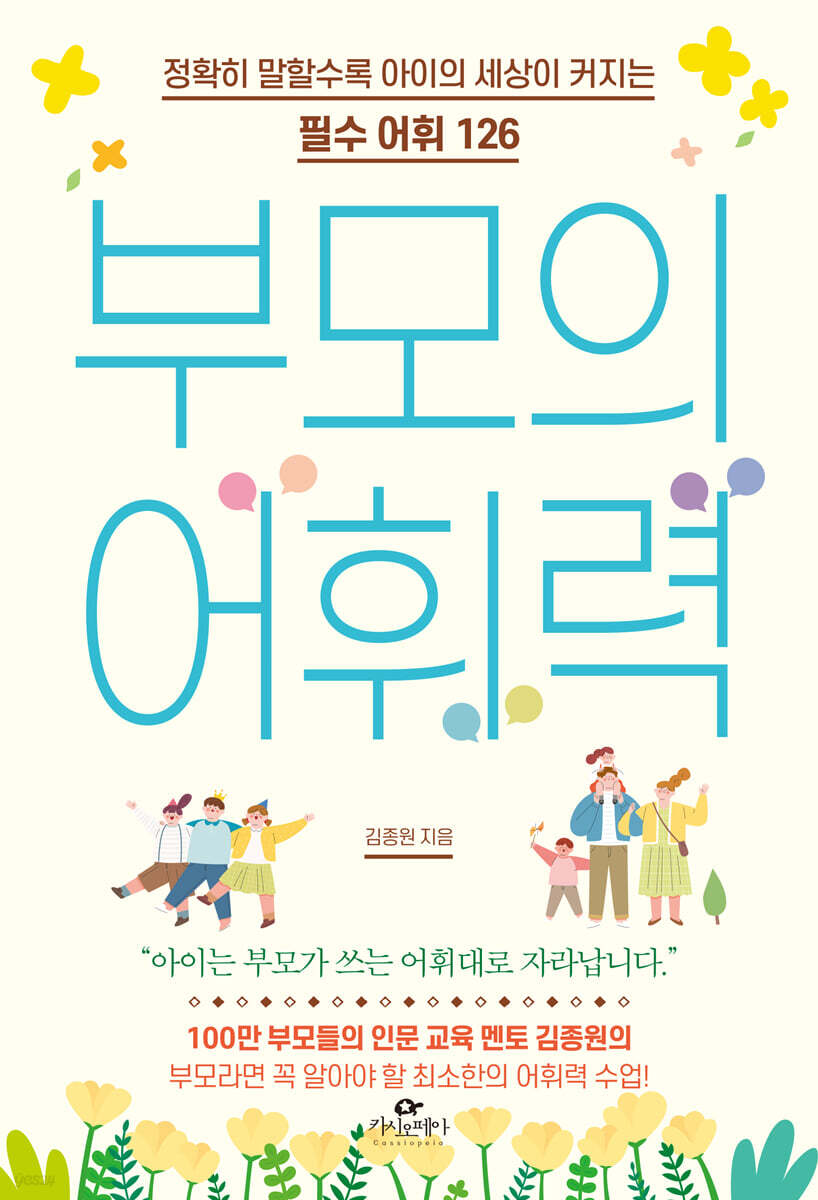
“Children grow up according to the vocabulary their parents use.” Kim Jong-won, a humanities education mentor for 500,000 parents Minimum vocabulary lessons for parents! "Parents' Vocabulary" is a vocabulary study book that compiles 126 essential vocabulary words that all parents must know, carefully selected by author Jongwon Kim, a humanities education expert chosen by 500,000 parents in Korea. He has been widely promoting the importance of parents' words and conversation skills based on a humanistic foundation, but in this book, he says that parents must first study vocabulary. Why? A parent's vocabulary is the child's first framework for perceiving the world. However, if a few words like 'huh' and 'daebak' monopolize daily life, or if you communicate with your child using words that are easy to confuse and use incorrectly, such as 'honnae-da' and 'alereoda', then in the end, parents will not be able to properly discipline their children, and children will not be able to listen to and understand their parents' words accurately. This book contains only the expressions that parents often find confusing and the minimum vocabulary that all parents raising children must know. Chapter 1 contains everyday vocabulary that can change a child's attitude and behavior, Chapter 2 contains emotional vocabulary that can help understand a child's mind, and the last Chapter 3 contains thinking vocabulary that can guide a child on the path of intellectual thinking. The vocabulary checklist allows parents to review their own vocabulary first, understand the definitions of multiple words, including synonyms and antonyms, and apply them effectively in real life through everyday examples, example sentences, and transcription pages. A parent's vocabulary changes a child's world. If you want to speak good words to your child, and furthermore, if you want to increase his vocabulary, you must first ensure that your vocabulary is not impoverished. Conversations based on accurate, correct, and rich vocabulary will broaden your child's thinking and deepen and strengthen your relationship with him. |
- You can preview some of the book's contents.
Preview
index
Prologue Why do parents need to study vocabulary?
Parents' Vocabulary Checklist: What kind of words do I usually use with my child?
Chapter 1 [Everyday Vocabulary] Changing just one word you use every day can change your child's attitude and behavior.
Good work/I'm proud of you
Take the lead
quickly/enough
argue/coordinate
It's cheap/reasonable
Moderately/satisfactorily
scold/inform
*Take note and engrave it in your heart
Be surprised/amazed
be active/show off
To correct/correct
small/small
Different/wrong
Because of/thanks to
born with/skill
Foolish/immature
*Take note and engrave it in your heart
So/really
Be careful/slow
to pass over/to count
Eat/Enjoy
react/respond
Embarrassed/absurd
Awesome/great
Because/that's it
*Take note and engrave it in your heart
Chapter 2 [Emotional Vocabulary] Warms up conversations and helps you understand your child's feelings.
emotional
calm/quiet
be leisurely/sluggish
Clumsy/unfamiliar
Be jealous/envious
Confident/Arrogant
Refreshing/Relief
*Take note and engrave it in your heart
delicate/sensitive
I'm embarrassed/shy
Excited/anxious
Rigid/old-fashioned
Feeling discouraged/lethargic
It's a pity/disappointing
I feel wronged/angry
*Take note and engrave it in your heart
self-esteem/confidence
unpleasant/inconvenient
regret/reflect
Empathy/sympathy
worry/worry
Lonely/solitary *write it down and engrave it in your heart
Chapter 3 [Thinking Vocabulary] Expanding a child's world and guiding them toward more intellectual thinking.
blankly/thinking
criticize/blame
Optimistic/optimistic
Complex/diverse
Be conscious/watch
tore/capture
feel/realize
*Take note and engrave it in your heart
Horse tail/horse practice
Search/Explore
Greed/desire
But/But
explain/persuade
equal/fair
*Take note and engrave it in your heart
nagging/advising
intervene/meddle
individualism/egoism
pioneer/develop
compete/check
appropriate/suitable
distinguish/discriminate
*Take note and engrave it in your heart
Parents' Vocabulary Checklist: What kind of words do I usually use with my child?
Chapter 1 [Everyday Vocabulary] Changing just one word you use every day can change your child's attitude and behavior.
Good work/I'm proud of you
Take the lead
quickly/enough
argue/coordinate
It's cheap/reasonable
Moderately/satisfactorily
scold/inform
*Take note and engrave it in your heart
Be surprised/amazed
be active/show off
To correct/correct
small/small
Different/wrong
Because of/thanks to
born with/skill
Foolish/immature
*Take note and engrave it in your heart
So/really
Be careful/slow
to pass over/to count
Eat/Enjoy
react/respond
Embarrassed/absurd
Awesome/great
Because/that's it
*Take note and engrave it in your heart
Chapter 2 [Emotional Vocabulary] Warms up conversations and helps you understand your child's feelings.
emotional
calm/quiet
be leisurely/sluggish
Clumsy/unfamiliar
Be jealous/envious
Confident/Arrogant
Refreshing/Relief
*Take note and engrave it in your heart
delicate/sensitive
I'm embarrassed/shy
Excited/anxious
Rigid/old-fashioned
Feeling discouraged/lethargic
It's a pity/disappointing
I feel wronged/angry
*Take note and engrave it in your heart
self-esteem/confidence
unpleasant/inconvenient
regret/reflect
Empathy/sympathy
worry/worry
Lonely/solitary *write it down and engrave it in your heart
Chapter 3 [Thinking Vocabulary] Expanding a child's world and guiding them toward more intellectual thinking.
blankly/thinking
criticize/blame
Optimistic/optimistic
Complex/diverse
Be conscious/watch
tore/capture
feel/realize
*Take note and engrave it in your heart
Horse tail/horse practice
Search/Explore
Greed/desire
But/But
explain/persuade
equal/fair
*Take note and engrave it in your heart
nagging/advising
intervene/meddle
individualism/egoism
pioneer/develop
compete/check
appropriate/suitable
distinguish/discriminate
*Take note and engrave it in your heart
Detailed image

Into the book
Even if a child with outstanding abilities achieves good results, if parents fail to provide appropriate words, the child will ultimately be unable to properly express himself or herself in situations, contexts, and with others.
Ultimately, a child's level will inevitably drop to match the parent's vocabulary level.
---From the "Prologue"
The expression 'good job' is a good word to use when a child has put in effort and put in the effort to do something of his or her own choosing, and the expression 'good job' is a great word to use when a child has achieved better-than-expected results in a difficult and challenging situation, and it can be a great encouragement to the child.
The thing to remember here is that you should never say "good job" to a child when they have to do something.
---「Chapter 1.
From "Everyday Vocabulary"
There is no parent who does not know that the words 'hurry hurry' do not have a good influence on children.
It's just that I can't put it into practice.
Why is that? It's simple.
I have no choice but to use it because I can't find a word to replace 'hurry hurry'.
Especially in the morning, the word 'quickly' comes out of my mouth incessantly, as if I were breathing.
We need to think about what the essence is.
Why do we tell children to hurry and move? It's because they haven't prepared adequately beforehand.
If you've done enough preparation for school the day before, you'll feel a little more relaxed this morning.
---「Chapter 1.
From "Everyday Vocabulary"
The important thing to remember is that being relaxed doesn't mean being slow.
Rather, leisure is a calmness that comes from being able to properly control and plan one's day and time, and it is a word that expresses the appearance of living a leisurely and comfortable daily life.
Another important thing to remember is that you shouldn't use the word "relaxed" in a sarcastic way.
Then the child will think badly of a leisurely day.
---「Chapter 2.
From "Emotional Vocabulary"
The word 'unfamiliar' means a state of having no experience at all, having never seen or done something before, and the word 'clumsy' means a state of having experience but not being able to repeat it to the point of becoming familiar with it.
Simply put, when a child encounters something for the first time, the word 'unfamiliar' can be used, and after that, the word 'clumsy' can be used.
---「Chapter 2.
From "Emotional Vocabulary"
If your child is excited about meeting new friends at the start of the new school year, what if you said something like, "Are you anxious about meeting new friends?" The child might not understand the context of such a comment, and might even perceive meeting new friends as something unsettling.
To a child who is full of hope, you should give them a good feeling by saying, "I'm excited," and to a child who is worried, you should give them encouragement and comfort by saying, "I'm anxious."
---「Chapter 2.
From "Emotional Vocabulary"
The word 'complex' means that different desires or relationships are intertwined and must be 'unraveled', and the word 'diverse' means that there are many options in front of me and I must 'choose the one' that is best for me.
Even a single word has such deep meaning.
If you don't know, you can't see it, but if you know, a world you never imagined opens up.
When a child needs to solve a complex problem, use the word "complex." When a child needs to choose one, use the word "diverse." This will help the child properly understand the meaning and wisely resolve the situation before him.
---「Chapter 3.
From "Thinking Vocabulary"
When a child nitpicks, refutes every word their parents say, or asserts their own opinion, it is evidence that their brain is growing rapidly.
The one who really needs help is not the child who is nitpicking, but the child who cannot answer any questions or express his or her own thoughts.
Being able to grasp the tail of a horse is a very positive sign that your brain and inner self are growing well.
So, it is better to approach it as if you are ‘practicing your speech’ rather than ‘catching on to the tail’.
Ultimately, a child's level will inevitably drop to match the parent's vocabulary level.
---From the "Prologue"
The expression 'good job' is a good word to use when a child has put in effort and put in the effort to do something of his or her own choosing, and the expression 'good job' is a great word to use when a child has achieved better-than-expected results in a difficult and challenging situation, and it can be a great encouragement to the child.
The thing to remember here is that you should never say "good job" to a child when they have to do something.
---「Chapter 1.
From "Everyday Vocabulary"
There is no parent who does not know that the words 'hurry hurry' do not have a good influence on children.
It's just that I can't put it into practice.
Why is that? It's simple.
I have no choice but to use it because I can't find a word to replace 'hurry hurry'.
Especially in the morning, the word 'quickly' comes out of my mouth incessantly, as if I were breathing.
We need to think about what the essence is.
Why do we tell children to hurry and move? It's because they haven't prepared adequately beforehand.
If you've done enough preparation for school the day before, you'll feel a little more relaxed this morning.
---「Chapter 1.
From "Everyday Vocabulary"
The important thing to remember is that being relaxed doesn't mean being slow.
Rather, leisure is a calmness that comes from being able to properly control and plan one's day and time, and it is a word that expresses the appearance of living a leisurely and comfortable daily life.
Another important thing to remember is that you shouldn't use the word "relaxed" in a sarcastic way.
Then the child will think badly of a leisurely day.
---「Chapter 2.
From "Emotional Vocabulary"
The word 'unfamiliar' means a state of having no experience at all, having never seen or done something before, and the word 'clumsy' means a state of having experience but not being able to repeat it to the point of becoming familiar with it.
Simply put, when a child encounters something for the first time, the word 'unfamiliar' can be used, and after that, the word 'clumsy' can be used.
---「Chapter 2.
From "Emotional Vocabulary"
If your child is excited about meeting new friends at the start of the new school year, what if you said something like, "Are you anxious about meeting new friends?" The child might not understand the context of such a comment, and might even perceive meeting new friends as something unsettling.
To a child who is full of hope, you should give them a good feeling by saying, "I'm excited," and to a child who is worried, you should give them encouragement and comfort by saying, "I'm anxious."
---「Chapter 2.
From "Emotional Vocabulary"
The word 'complex' means that different desires or relationships are intertwined and must be 'unraveled', and the word 'diverse' means that there are many options in front of me and I must 'choose the one' that is best for me.
Even a single word has such deep meaning.
If you don't know, you can't see it, but if you know, a world you never imagined opens up.
When a child needs to solve a complex problem, use the word "complex." When a child needs to choose one, use the word "diverse." This will help the child properly understand the meaning and wisely resolve the situation before him.
---「Chapter 3.
From "Thinking Vocabulary"
When a child nitpicks, refutes every word their parents say, or asserts their own opinion, it is evidence that their brain is growing rapidly.
The one who really needs help is not the child who is nitpicking, but the child who cannot answer any questions or express his or her own thoughts.
Being able to grasp the tail of a horse is a very positive sign that your brain and inner self are growing well.
So, it is better to approach it as if you are ‘practicing your speech’ rather than ‘catching on to the tail’.
---「Chapter 3.
From "Thinking Vocabulary"
From "Thinking Vocabulary"
Publisher's Review
“Parents’ vocabulary determines the size of their children’s thinking!”
If you are a parent who wants to speak accurately and correctly to your child,
A book containing 126 essential vocabulary words for everyday life.
“There are many times when I suddenly can’t think of a word.”, “My kids only say things like ‘so boring’ and ‘so beneficial.’”, “I want to speak kindly and nicely to my kids, but it’s hard.”, “I end up telling my kids, ‘I get it!’” These are common experiences that parents and children have in their daily lives.
Many parents hesitate and cannot express their thoughts properly, or they are busy issuing orders because they do not know how to discipline their children.
Also, children often use abbreviations and new words, or end conversations without fully understanding what their parents are saying.
But did you know that these concerns may be due to vocabulary?
"Parents' Vocabulary" is a book on parenting that contains 126 parental vocabulary words carefully selected by Kim Jong-won, a bestselling author in the field of child education and a reliable humanities education mentor for 500,000 parents.
He has been dedicated to sharing the surprising fact, discovered through 20 years of intense research and practice, that parents' words, grounded in the humanities, can dramatically increase a child's potential.
Having written over 100 books over the past 30 years, given over 100 lectures annually, and communicated directly with over 10,000 parents, he has come to realize yet another important truth: a parent's vocabulary has a decisive impact on their conversations and relationships with their children.
For example, parents who cannot distinguish between 'scolding' and 'informing' are likely to meddle when they should, or pass over things when they should.
Parents who cannot distinguish between being 'active' and 'being pushy' often label their active children as pushy.
We may mistakenly say, “You’re really slow” to a child who is “carefully” thinking about his or her opinion, or “You seem very anxious right now” to a child who is “excited” about trying something new.
It is limiting or evaluating a child's value based on the parent's vocabulary.
As the vocabulary parents use on a daily basis has a significant impact on their children's thinking and attitude towards life, this book explains how important it is for parents to know vocabulary well and speak accurately.
“If you change just one word of vocabulary used every day, your child’s world will change completely.”
From definitions of confusing vocabulary, everyday examples, and examples
Even a vocabulary checklist and a transcription page!
Vocabulary study that changes children's behavior and enriches parents' speech
This book is composed of three chapters and contains only the minimum vocabulary that parents raising children must know.
Chapter 1 contains everyday vocabulary that can change a child's attitude and behavior, Chapter 2 contains emotional vocabulary that can help understand a child's mind, and the last Chapter 3 contains thinking vocabulary that can guide a child on the path of intellectual thinking.
Parents can first check their children's vocabulary with a vocabulary checklist that includes easy-to-confuse synonyms and antonyms.
You can understand the exact meaning by looking at the dictionary definition, and you can use the vocabulary in real life through word usage, everyday examples, and example sentences.
We also provided space for copying throughout the book, so that students could read and copy example sentences containing previously mentioned vocabulary once more, allowing them to fully embody the vocabulary they had acquired in their own language.
Knowing vocabulary and speaking correctly means being able to feel and think accurately.
And the more precisely you speak, the bigger the child's world becomes.
If you want to give your child the words they need at the right time and discipline them properly, if you want to change their attitude and behavior, if you want to understand their heart and speak to them warmly, if you want to discover their potential and expand their world of knowledge, then right now is the time for parents to desperately study vocabulary.
If parents first familiarize their children with the concept of vocabulary in everyday life, and then teach them the subtleties of language while helping them use vocabulary appropriately, the child's world can change completely.
Let's learn the meaning of vocabulary that we knew but didn't know properly through this book.
And let us put it all inside us through the wonderful intellectual tools of reading and writing.
If you follow the practical and well-structured book and practice a little bit every day, you will experience a miraculous moment where your child's thinking grows and your speech becomes richer.
If you are a parent who wants to speak accurately and correctly to your child,
A book containing 126 essential vocabulary words for everyday life.
“There are many times when I suddenly can’t think of a word.”, “My kids only say things like ‘so boring’ and ‘so beneficial.’”, “I want to speak kindly and nicely to my kids, but it’s hard.”, “I end up telling my kids, ‘I get it!’” These are common experiences that parents and children have in their daily lives.
Many parents hesitate and cannot express their thoughts properly, or they are busy issuing orders because they do not know how to discipline their children.
Also, children often use abbreviations and new words, or end conversations without fully understanding what their parents are saying.
But did you know that these concerns may be due to vocabulary?
"Parents' Vocabulary" is a book on parenting that contains 126 parental vocabulary words carefully selected by Kim Jong-won, a bestselling author in the field of child education and a reliable humanities education mentor for 500,000 parents.
He has been dedicated to sharing the surprising fact, discovered through 20 years of intense research and practice, that parents' words, grounded in the humanities, can dramatically increase a child's potential.
Having written over 100 books over the past 30 years, given over 100 lectures annually, and communicated directly with over 10,000 parents, he has come to realize yet another important truth: a parent's vocabulary has a decisive impact on their conversations and relationships with their children.
For example, parents who cannot distinguish between 'scolding' and 'informing' are likely to meddle when they should, or pass over things when they should.
Parents who cannot distinguish between being 'active' and 'being pushy' often label their active children as pushy.
We may mistakenly say, “You’re really slow” to a child who is “carefully” thinking about his or her opinion, or “You seem very anxious right now” to a child who is “excited” about trying something new.
It is limiting or evaluating a child's value based on the parent's vocabulary.
As the vocabulary parents use on a daily basis has a significant impact on their children's thinking and attitude towards life, this book explains how important it is for parents to know vocabulary well and speak accurately.
“If you change just one word of vocabulary used every day, your child’s world will change completely.”
From definitions of confusing vocabulary, everyday examples, and examples
Even a vocabulary checklist and a transcription page!
Vocabulary study that changes children's behavior and enriches parents' speech
This book is composed of three chapters and contains only the minimum vocabulary that parents raising children must know.
Chapter 1 contains everyday vocabulary that can change a child's attitude and behavior, Chapter 2 contains emotional vocabulary that can help understand a child's mind, and the last Chapter 3 contains thinking vocabulary that can guide a child on the path of intellectual thinking.
Parents can first check their children's vocabulary with a vocabulary checklist that includes easy-to-confuse synonyms and antonyms.
You can understand the exact meaning by looking at the dictionary definition, and you can use the vocabulary in real life through word usage, everyday examples, and example sentences.
We also provided space for copying throughout the book, so that students could read and copy example sentences containing previously mentioned vocabulary once more, allowing them to fully embody the vocabulary they had acquired in their own language.
Knowing vocabulary and speaking correctly means being able to feel and think accurately.
And the more precisely you speak, the bigger the child's world becomes.
If you want to give your child the words they need at the right time and discipline them properly, if you want to change their attitude and behavior, if you want to understand their heart and speak to them warmly, if you want to discover their potential and expand their world of knowledge, then right now is the time for parents to desperately study vocabulary.
If parents first familiarize their children with the concept of vocabulary in everyday life, and then teach them the subtleties of language while helping them use vocabulary appropriately, the child's world can change completely.
Let's learn the meaning of vocabulary that we knew but didn't know properly through this book.
And let us put it all inside us through the wonderful intellectual tools of reading and writing.
If you follow the practical and well-structured book and practice a little bit every day, you will experience a miraculous moment where your child's thinking grows and your speech becomes richer.
GOODS SPECIFICS
- Date of issue: June 17, 2024
- Page count, weight, size: 312 pages | 466g | 140*205*30mm
- ISBN13: 9791168271999
- ISBN10: 1168271991
You may also like
카테고리
korean


korean

![GQ KOREA Mark (Monthly): December [2025]](http://librairie.coreenne.fr/cdn/shop/files/8ef265dbbfbf186523ed75ba7319009d.jpg?v=1765340328&width=3840)


