

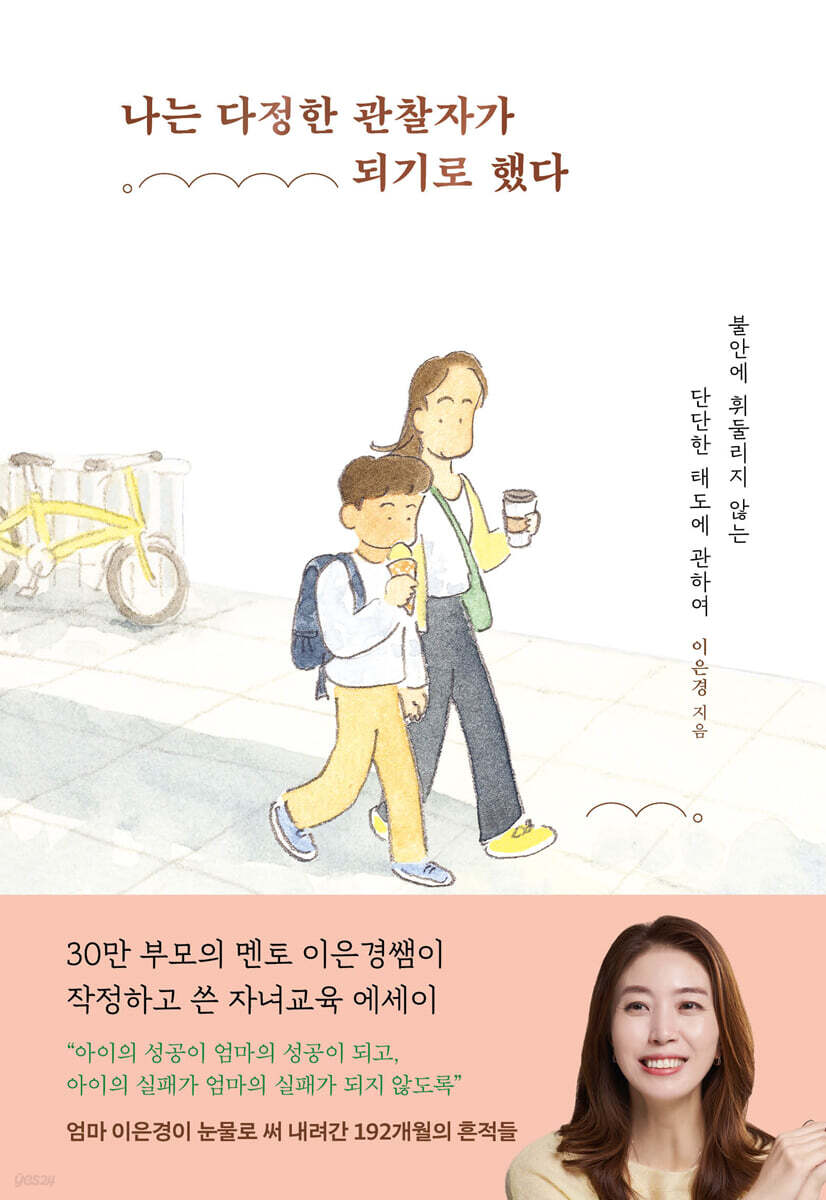
I decided to be a caring observer.
 |
Description
Book Introduction
- A word from MD
-
Essay on child education by Eun-kyung Lee, mentor to 300,000 parentsFrom a top-performing first son to a slow learner with an intellectual disability, this book honestly and realistically captures the concerns and challenges of parenting from working mom Eun-kyung Lee, who raises two sons in different ages.
It emphasizes the importance of maintaining an appropriate distance between mother and child, and suggests a way for mother and child to grow together.
May 24, 2024. Baek Jeong-min, PD of Home Life
* Wise Elementary Life YouTube cumulative views: 30 million
An essay on child education written with determination by Eun-kyung Lee, a mentor to 300,000 parents.
On a firm attitude that is not swayed by anxiety
"How do education experts raise children?" Teacher Eun-kyung Lee, also known as Teacher Lee, is an education expert with over 30 million cumulative views and is a bestselling author who has published numerous child education and study books.
She is especially famous for communicating with parents almost in real time and answering their questions with the familiarity of a neighborly older sister.
This book is written in essay format, gathering topics that the author was interested in while meeting with mothers of the same age online and offline and sharing their concerns.
The reason why Teacher Lee Eun-kyung's teaching method resonates so deeply with parents is not only because of educational theory but also because of her direct experience as an elementary school teacher, but also because the author is a mother of two children.
Teacher Eun-kyung Lee is a working mom raising her first child, who always achieves top grades, and her second child, who is a slow learner with an intellectual disability.
Raising two sons, each as old as a child, the author had to go through a more sensitive and anxious time than anyone else.
Having experienced all the ups and downs of parenting, the author's story resonates with almost all mothers.
The author says he wrote this book because he thought it would be most helpful to show mothers directly 'how to raise children.'
The author's story is more honest and real than any other writing.
Even without any theoretical knowledge or teachings, if you laugh and cry at the author's episodes, you will naturally think about what role parents should play.
An essay on child education written with determination by Eun-kyung Lee, a mentor to 300,000 parents.
On a firm attitude that is not swayed by anxiety
"How do education experts raise children?" Teacher Eun-kyung Lee, also known as Teacher Lee, is an education expert with over 30 million cumulative views and is a bestselling author who has published numerous child education and study books.
She is especially famous for communicating with parents almost in real time and answering their questions with the familiarity of a neighborly older sister.
This book is written in essay format, gathering topics that the author was interested in while meeting with mothers of the same age online and offline and sharing their concerns.
The reason why Teacher Lee Eun-kyung's teaching method resonates so deeply with parents is not only because of educational theory but also because of her direct experience as an elementary school teacher, but also because the author is a mother of two children.
Teacher Eun-kyung Lee is a working mom raising her first child, who always achieves top grades, and her second child, who is a slow learner with an intellectual disability.
Raising two sons, each as old as a child, the author had to go through a more sensitive and anxious time than anyone else.
Having experienced all the ups and downs of parenting, the author's story resonates with almost all mothers.
The author says he wrote this book because he thought it would be most helpful to show mothers directly 'how to raise children.'
The author's story is more honest and real than any other writing.
Even without any theoretical knowledge or teachings, if you laugh and cry at the author's episodes, you will naturally think about what role parents should play.
- You can preview some of the book's contents.
Preview
index
Prologue: What's Best for My Child
Chapter 1.
Affectionate Observer: Keeping a Close Distance
A child standing alone among the commotion of children
If a child doesn't swallow his mother's words, he won't grow up.
Another meaning of failure is experience and process
Living as a lonely mother
Chapter 2.
"Kill the Kid Next Door": Comparison
Kill the kid next door.
Don't kill that mother, I didn't ask her about her unit test scores.
What I Learned in Canada After Selling My House
“Why are you so determined to send your son to Seoul National University?”
A middle school student is praised for being a middle school student.
Isn't the college entrance exam an unfair competition anyway?
Chapter 3.
Everyone gets hurt and grows: Waiting
What's the most common question education YouTubers get asked?
“I’m not that kind of mother.
“I won’t force you to study.”
Mom's sensitivity to levels and scores stems from ignorance, not greed.
Our child could be golden too
Because nothing can replace what a child experiences.
Chapter 4.
Attitude is more important than sincerity: kindness
Anyone can become a 'truth' if they are not aware of it.
A child swallowed 14 pills, a two-week supply.
The day my second child scored 69 on the Wechsler Intelligence Scale
The greatest sense of security you can give your child = Mom is on your side
Children also observe their parents.
Chapter 5.
What Kind of Mom Will You Be?: Growing Up
“You’re my parents.
It's natural because they are parents.
“Because we are parents”
Approach with attitude, not emotion
May your success be my success, and may your failure not be my failure.
My way of loving is 'sincerity'
Lee Hye-jin and Lee Ji-yeon
Epilogue To my dear and affectionate observers
Chapter 1.
Affectionate Observer: Keeping a Close Distance
A child standing alone among the commotion of children
If a child doesn't swallow his mother's words, he won't grow up.
Another meaning of failure is experience and process
Living as a lonely mother
Chapter 2.
"Kill the Kid Next Door": Comparison
Kill the kid next door.
Don't kill that mother, I didn't ask her about her unit test scores.
What I Learned in Canada After Selling My House
“Why are you so determined to send your son to Seoul National University?”
A middle school student is praised for being a middle school student.
Isn't the college entrance exam an unfair competition anyway?
Chapter 3.
Everyone gets hurt and grows: Waiting
What's the most common question education YouTubers get asked?
“I’m not that kind of mother.
“I won’t force you to study.”
Mom's sensitivity to levels and scores stems from ignorance, not greed.
Our child could be golden too
Because nothing can replace what a child experiences.
Chapter 4.
Attitude is more important than sincerity: kindness
Anyone can become a 'truth' if they are not aware of it.
A child swallowed 14 pills, a two-week supply.
The day my second child scored 69 on the Wechsler Intelligence Scale
The greatest sense of security you can give your child = Mom is on your side
Children also observe their parents.
Chapter 5.
What Kind of Mom Will You Be?: Growing Up
“You’re my parents.
It's natural because they are parents.
“Because we are parents”
Approach with attitude, not emotion
May your success be my success, and may your failure not be my failure.
My way of loving is 'sincerity'
Lee Hye-jin and Lee Ji-yeon
Epilogue To my dear and affectionate observers
Detailed image
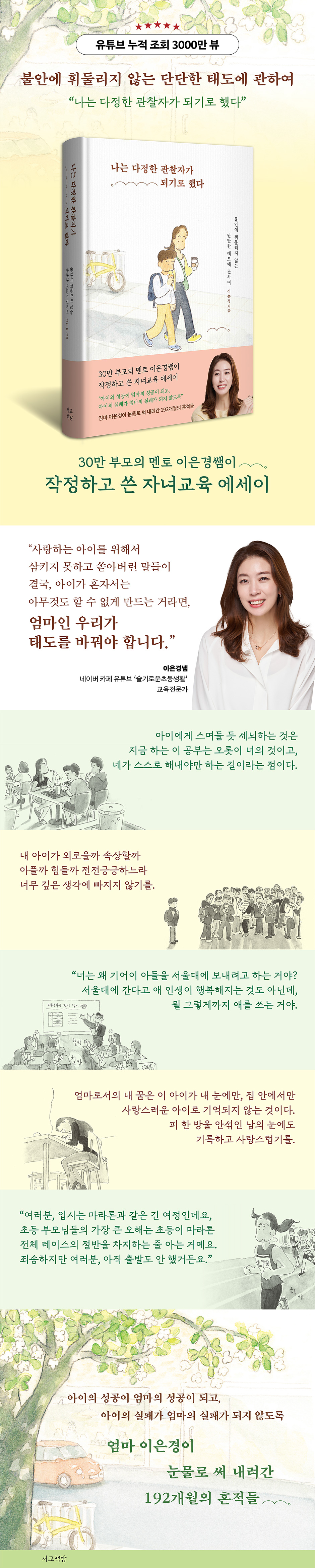
Into the book
Let's not get too lost in thought worrying about whether our child is lonely, upset, sick, or having a hard time, or spend too much energy monitoring and eliminating those who make our child uncomfortable in real time.
I hope that the energy saved in this way will be used to understand and encourage the trials and errors, mistakes, and failures that our family, neighbors, colleagues, and students experience as they struggle through life.
Because that will ultimately be what's best for my child.
So, from now on, I will confess my mistakes and failures one by one.
I believe that you will watch over me with loving eyes and encourage me.
I am confident that this will ultimately be the best for all of our children.
--- p.14~15
A Friendly Observer
A type of parent who looks at their child with warm eyes and speaks appropriate and affectionate words according to the situation, but rather than doing things for the child or stepping forward to help, they give the child time and opportunity to do things on their own.
He is very aware of the difficult situation his child is in, but does not solve it.
Encourage your child's slow, long process of trying to resolve the situation, and if they ask for help, offer at least a little advice and endless encouragement.
Even when discovering people or situations that are causing difficulties for the child, rather than quickly removing them, the emphasis is on the experience of unraveling relationships and developing the ability to resolve situations.
--- p.36
In our family where I work as a parent, if we look at it with the goal of 'not producing even a single golden child,' parenting becomes quite simple.
Your child will do something wrong today, and your parenting goal should be to prevent it from happening again.
I hope the method doesn't involve getting very angry and punishing the child harshly, making him cry in fear.
No one but the mother can figure out which facial expressions, rules, and tone of voice indicate that the child is relatively cooperative and apply them to subsequent discipline.
Since each mother and each child is delicately different, it is difficult for any expert to give hasty advice.
--- p.153
My side.
Isn't the greatest sense of security a mother can, and should, give her child the unwavering belief that "that lady is on my side?" Difficulties are inherent in solving the challenges presented to each individual's life, and in those moments, whether a child has "my side" becomes a crucial factor.
People who have their backs and those who don't have them show different attitudes when faced with a high wall that seems impossible to overcome.
To easily and clearly distinguish between those on your side and those on yours, just think about the mistakes and failures you've experienced in the past.
In situations of mistakes and failures, the same side finds a way out, while the other side pushes them.
As a child grows, he or she will make tiresome mistakes and fail repeatedly, and at such times, the mother can choose whether to be the one who scolds, nags, and pressures the child, or to put their heads together and think together to find a solution.
--- p.206~207
I have now become someone who clearly understands that even as parents, there is no such thing as a given, and that no matter what role you take on, the strength to fulfill that role is not the same.
There was never a time when it was something that anyone could or should do as a parent.
I just assumed it was something natural because my parents did it silently, but for most parents, every little thing they do every day, from the small laundry to the astronomical cost of education, is truly extraordinary and special.
I hope people don't take my day as a mother for granted, saying it's something everyone else does.
Let's praise ourselves as mothers by listing the everyday things we take for granted because we are mothers.
It's a night when I want to look back and comfort myself as a mother who does her best to complete the annoying, difficult, and heavy tasks that I would rather avoid if possible.
--- p.219
Approach with attitude, not emotion.
It's difficult to fully handle the long journey of parenting just by being immersed in that feeling of love and ecstasy.
That's too long, and the kids are just too damn disobedient.
If you deal with emotions, they will soon cool down or lose their way.
Because a child is growing and changing every day, it is impossible to always give that child an overwhelming sense of fulfillment.
So we hope that motherhood is an attitude, not an emotion, a way of life.
I hope that the energy saved in this way will be used to understand and encourage the trials and errors, mistakes, and failures that our family, neighbors, colleagues, and students experience as they struggle through life.
Because that will ultimately be what's best for my child.
So, from now on, I will confess my mistakes and failures one by one.
I believe that you will watch over me with loving eyes and encourage me.
I am confident that this will ultimately be the best for all of our children.
--- p.14~15
A Friendly Observer
A type of parent who looks at their child with warm eyes and speaks appropriate and affectionate words according to the situation, but rather than doing things for the child or stepping forward to help, they give the child time and opportunity to do things on their own.
He is very aware of the difficult situation his child is in, but does not solve it.
Encourage your child's slow, long process of trying to resolve the situation, and if they ask for help, offer at least a little advice and endless encouragement.
Even when discovering people or situations that are causing difficulties for the child, rather than quickly removing them, the emphasis is on the experience of unraveling relationships and developing the ability to resolve situations.
--- p.36
In our family where I work as a parent, if we look at it with the goal of 'not producing even a single golden child,' parenting becomes quite simple.
Your child will do something wrong today, and your parenting goal should be to prevent it from happening again.
I hope the method doesn't involve getting very angry and punishing the child harshly, making him cry in fear.
No one but the mother can figure out which facial expressions, rules, and tone of voice indicate that the child is relatively cooperative and apply them to subsequent discipline.
Since each mother and each child is delicately different, it is difficult for any expert to give hasty advice.
--- p.153
My side.
Isn't the greatest sense of security a mother can, and should, give her child the unwavering belief that "that lady is on my side?" Difficulties are inherent in solving the challenges presented to each individual's life, and in those moments, whether a child has "my side" becomes a crucial factor.
People who have their backs and those who don't have them show different attitudes when faced with a high wall that seems impossible to overcome.
To easily and clearly distinguish between those on your side and those on yours, just think about the mistakes and failures you've experienced in the past.
In situations of mistakes and failures, the same side finds a way out, while the other side pushes them.
As a child grows, he or she will make tiresome mistakes and fail repeatedly, and at such times, the mother can choose whether to be the one who scolds, nags, and pressures the child, or to put their heads together and think together to find a solution.
--- p.206~207
I have now become someone who clearly understands that even as parents, there is no such thing as a given, and that no matter what role you take on, the strength to fulfill that role is not the same.
There was never a time when it was something that anyone could or should do as a parent.
I just assumed it was something natural because my parents did it silently, but for most parents, every little thing they do every day, from the small laundry to the astronomical cost of education, is truly extraordinary and special.
I hope people don't take my day as a mother for granted, saying it's something everyone else does.
Let's praise ourselves as mothers by listing the everyday things we take for granted because we are mothers.
It's a night when I want to look back and comfort myself as a mother who does her best to complete the annoying, difficult, and heavy tasks that I would rather avoid if possible.
--- p.219
Approach with attitude, not emotion.
It's difficult to fully handle the long journey of parenting just by being immersed in that feeling of love and ecstasy.
That's too long, and the kids are just too damn disobedient.
If you deal with emotions, they will soon cool down or lose their way.
Because a child is growing and changing every day, it is impossible to always give that child an overwhelming sense of fulfillment.
So we hope that motherhood is an attitude, not an emotion, a way of life.
--- p.239~240
Publisher's Review
Will you run to every difficult situation?
Should we just stand back and watch our child's challenges?
This decision now will determine not only the mother's life, but also the child's entire life.
“I’m so mad because my friend said something bad about my child!”
“My child didn’t do anything wrong, but the teacher yelled at him and got angry!”
“All the other kids have started doing good deeds.
“Of course our child should do it too, right?”
Mothers have a lot to worry about, including their children's friendships, school life, and academics.
This type of worry counseling is a regular post on local mom cafes.
Then, comments start appearing saying that they will provide a solution, followed by empathetic comments saying that they had a hard time going through the same thing.
However, on the other hand, with the various educational issues intertwined, mothers of this era have been reduced to a symbol of sensitivity that should not be touched, with the evaluations that follow, such as, "Do they only think their own children are precious?", "They are too sensitive", and "They are strange mothers."
The author cited this unfortunate state of affairs and pointed out why mothers have become so sensitive and anxious.
In an era of low birth rates, with a 0.68% birth rate, how come these courageous women, determined to become mothers and willing to take on the burden of giving birth and raising children, are so anxious and increasingly sensitive every day? Why do women, once resilient, mature, and courageous as adults, become so anxious about even the smallest things after becoming mothers? After much thought and reflection, the author attributes this to mothers' failure to maintain an appropriate distance from their children.
As times change rapidly and the form of education changes, the number of things a mother has to take care of has increased like a mountain.
However, a mother's role in her busy daily life is not limited to cooking meals, grading workbooks, and attending academy information sessions.
The author finds the answer in 'The Role of a Mother' to how both mother and child can escape anxiety and move on to the path of mature growth.
“Your success becomes my success,
“So that your failure does not become my failure.”
Traces of 192 months, written in tears by mother Lee Eun-kyung.
What kind of mother is Teacher Lee Eun-kyung? As an education expert who started out as an elementary school teacher and is now actively working as an educational instructor, I'm curious to know how she raises her children.
As one of the hottest education experts these days, he appears on radio and talk concerts and even takes care of his health by running marathons, making him seem very elegant.
With her two children already in high school and middle school, she seems to have the composure of a seasoned mother.
But is that really true? The author's intimate glimpse into her daily life, revealed through Instagram, is surprisingly honest and candid, drawing strong empathy from mothers.
That's why so many mothers have been waiting for this book.
The author has two sons.
My eldest child is a high school student who excels at studying and makes my mother passionate about education, and my second child is a middle school student with a disability that requires ongoing treatment.
This book differs from existing books in that it writes about the author's most difficult and agonizing experiences while raising two children.
The first episode, in which I follow my middle school-aged second child, wearing a beanie and sunglasses, to make sure he arrives safely while he goes to his off-campus study activity site alone, is already heartbreaking.
Even if you are not in the same situation as the author, any mother cannot help but feel anxious every moment her child steps out into the world alone.
But when you learn why the author didn't hold the child's hand and walk with him, why he didn't make him skip class and stay home, you understand what "affectionate observer" really means.
Mom Lee Eun-kyung is busy.
Thanks to my son, who is the student body president, I attend the steering committee meeting wearing a jacket.
Then, after receiving an urgent call from the second child, he heads straight to the help desk classroom.
I board the subway to Daechi-dong to find out about my first child's academy, but I spend the whole ride talking to my second child's speech and cognitive therapy teachers.
But the author, a 'caring observer', doesn't let helping children become the whole of her daily life.
'So that your success becomes my success, and your failure does not become my failure', while the child struggles to achieve his or her own goal, the mother runs towards her own goal.
This book is an essay containing episodes from the author's daily life, and at the same time, it is an educational book about the role and attitude of a mother.
If the countless efforts we take for granted for the sake of our beloved child are ultimately what makes them unable to do anything on their own and unable to live as adults, then we, as mothers, must change our attitude.
When feelings become attitudes and sincerity becomes education, we can see positive changes in the lives of mothers and children.
And the moment it is revealed that the two children who watched over their mother so that she could live like a mother were also 'affectionate observers', you will be deeply moved by the message that runs through this book.
All of you reading this have grown up under someone's loving gaze.
Now it's my turn as a mother to be a caring observer.
Should we just stand back and watch our child's challenges?
This decision now will determine not only the mother's life, but also the child's entire life.
“I’m so mad because my friend said something bad about my child!”
“My child didn’t do anything wrong, but the teacher yelled at him and got angry!”
“All the other kids have started doing good deeds.
“Of course our child should do it too, right?”
Mothers have a lot to worry about, including their children's friendships, school life, and academics.
This type of worry counseling is a regular post on local mom cafes.
Then, comments start appearing saying that they will provide a solution, followed by empathetic comments saying that they had a hard time going through the same thing.
However, on the other hand, with the various educational issues intertwined, mothers of this era have been reduced to a symbol of sensitivity that should not be touched, with the evaluations that follow, such as, "Do they only think their own children are precious?", "They are too sensitive", and "They are strange mothers."
The author cited this unfortunate state of affairs and pointed out why mothers have become so sensitive and anxious.
In an era of low birth rates, with a 0.68% birth rate, how come these courageous women, determined to become mothers and willing to take on the burden of giving birth and raising children, are so anxious and increasingly sensitive every day? Why do women, once resilient, mature, and courageous as adults, become so anxious about even the smallest things after becoming mothers? After much thought and reflection, the author attributes this to mothers' failure to maintain an appropriate distance from their children.
As times change rapidly and the form of education changes, the number of things a mother has to take care of has increased like a mountain.
However, a mother's role in her busy daily life is not limited to cooking meals, grading workbooks, and attending academy information sessions.
The author finds the answer in 'The Role of a Mother' to how both mother and child can escape anxiety and move on to the path of mature growth.
“Your success becomes my success,
“So that your failure does not become my failure.”
Traces of 192 months, written in tears by mother Lee Eun-kyung.
What kind of mother is Teacher Lee Eun-kyung? As an education expert who started out as an elementary school teacher and is now actively working as an educational instructor, I'm curious to know how she raises her children.
As one of the hottest education experts these days, he appears on radio and talk concerts and even takes care of his health by running marathons, making him seem very elegant.
With her two children already in high school and middle school, she seems to have the composure of a seasoned mother.
But is that really true? The author's intimate glimpse into her daily life, revealed through Instagram, is surprisingly honest and candid, drawing strong empathy from mothers.
That's why so many mothers have been waiting for this book.
The author has two sons.
My eldest child is a high school student who excels at studying and makes my mother passionate about education, and my second child is a middle school student with a disability that requires ongoing treatment.
This book differs from existing books in that it writes about the author's most difficult and agonizing experiences while raising two children.
The first episode, in which I follow my middle school-aged second child, wearing a beanie and sunglasses, to make sure he arrives safely while he goes to his off-campus study activity site alone, is already heartbreaking.
Even if you are not in the same situation as the author, any mother cannot help but feel anxious every moment her child steps out into the world alone.
But when you learn why the author didn't hold the child's hand and walk with him, why he didn't make him skip class and stay home, you understand what "affectionate observer" really means.
Mom Lee Eun-kyung is busy.
Thanks to my son, who is the student body president, I attend the steering committee meeting wearing a jacket.
Then, after receiving an urgent call from the second child, he heads straight to the help desk classroom.
I board the subway to Daechi-dong to find out about my first child's academy, but I spend the whole ride talking to my second child's speech and cognitive therapy teachers.
But the author, a 'caring observer', doesn't let helping children become the whole of her daily life.
'So that your success becomes my success, and your failure does not become my failure', while the child struggles to achieve his or her own goal, the mother runs towards her own goal.
This book is an essay containing episodes from the author's daily life, and at the same time, it is an educational book about the role and attitude of a mother.
If the countless efforts we take for granted for the sake of our beloved child are ultimately what makes them unable to do anything on their own and unable to live as adults, then we, as mothers, must change our attitude.
When feelings become attitudes and sincerity becomes education, we can see positive changes in the lives of mothers and children.
And the moment it is revealed that the two children who watched over their mother so that she could live like a mother were also 'affectionate observers', you will be deeply moved by the message that runs through this book.
All of you reading this have grown up under someone's loving gaze.
Now it's my turn as a mother to be a caring observer.
GOODS SPECIFICS
- Date of issue: May 30, 2024
- Format: Hardcover book binding method guide
- Page count, weight, size: 288 pages | 442g | 130*190*20mm
- ISBN13: 9791198752406
- ISBN10: 1198752408
You may also like
카테고리
korean


korean

![ELLE 엘르 스페셜 에디션 A형 : 12월 [2025]](http://librairie.coreenne.fr/cdn/shop/files/b8e27a3de6c9538896439686c6b0e8fb.jpg?v=1766436872&width=3840)


