

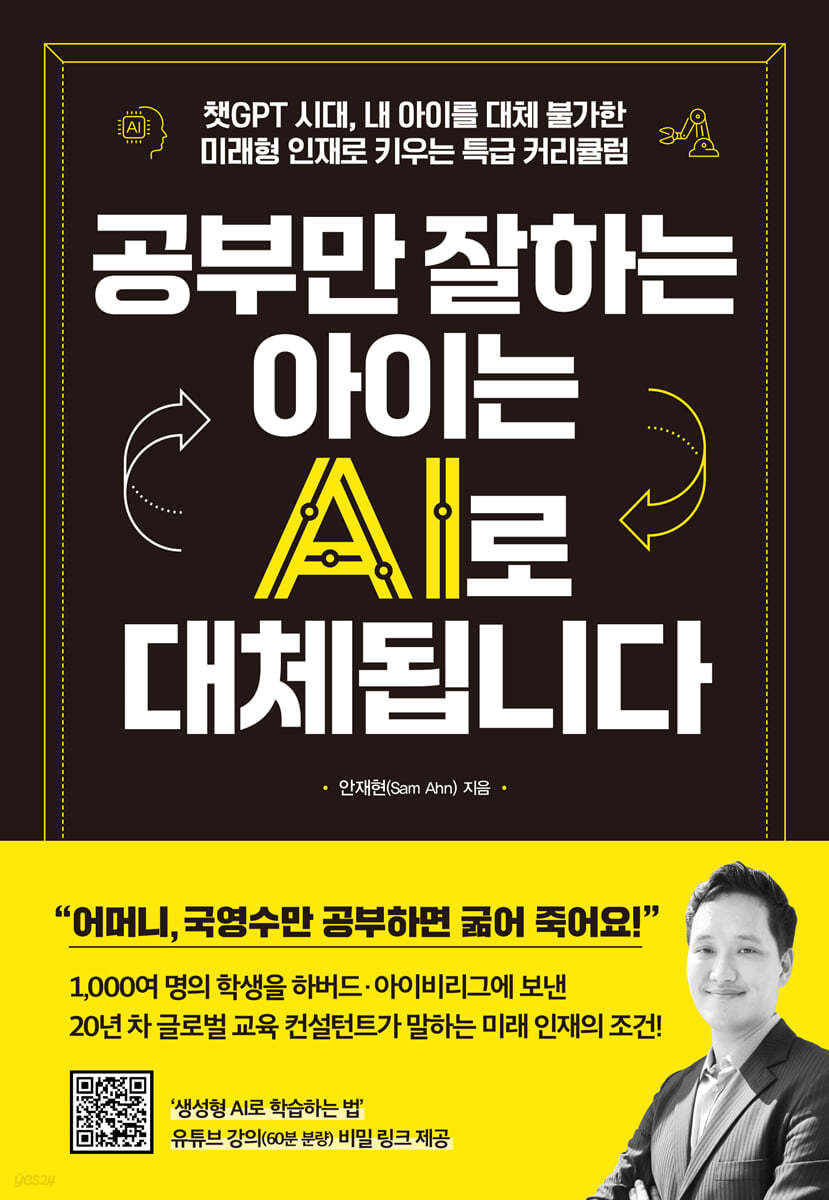
Children who are only good at studying will be replaced by AI.
 |
Description
Book Introduction
How should I raise my children in an age where AI rules the world? Sent over 1,000 students to Harvard and Ivy League schools A Global Education Consultant with 20 Years of Experience Discusses the Qualities of Future Talent "Children who are only good at studying will be replaced by AI" is a book written by the author, a global education consultant with 20 years of experience and an expert in future education, that contains know-how on how to help our children grow into future talents. According to the author, the admission standards for prestigious American universities, including Harvard University, are changing. Even for students with excellent qualifications, it has become difficult to receive an acceptance letter. So, what criteria do these universities, leading global educational trends, use to select students? The most important qualities they prioritize in recruiting new students are no longer outstanding high school grades, a diverse history of on- and off-campus activities, or high SAT scores. The factors that determine success or failure in admission to prestigious American universities are personal qualities commonly referred to as "soft skills." In other words, these were personal characteristics that could not be quantified, such as patience, perseverance, creativity, communication skills, and the ability to cooperate, but which served as the foundation for creating innovative products or services that changed the world. These soft skills are also essential qualities for our children to cultivate in an era where artificial intelligence and robots are replacing human jobs. Artificial intelligence has already surpassed human ability to find the right answer to a given problem. We have entered an era where our children's future competitiveness cannot be found solely in their ability to study well. "Children Who Only Study Well Will Be Replaced by AI" is a book on parenting that provides insight into what kind of studying our children truly need, based on the author's accumulated experience as an educator and his own experiences in a diverse spectrum of global educational settings, including admissions to prestigious American universities, prestigious American boarding schools, and the Korean and Chinese education markets. In the latter part of the book, practicality is enhanced by presenting a diverse AI curriculum that parents and children can use together at home using ChatGPT, a representative generative AI. For example, planning a trip with your child using ChatGPT, creating a book by generating text and images using ChatGPT, etc. By learning and utilizing ChatGPT with your child, following the author's guide, you will not only develop the ability to ask good questions to your child, but you will also build confidence and knowledge about new technologies. This is a must-read for future education that offers refreshing and clear solutions to parents who are skeptical about the indiscriminate pre-learning craze and to parents who want to help their children develop true skills for the future. |
- You can preview some of the book's contents.
Preview
index
Prologue: If you were from the future, what kind of education would you give your child?
Part 1: Changing Trends in Global Education
Chapter 1 | Harvard Doesn't Want Model Students
· Harvard, where even perfect SAT scores are not accepted
· There are different types of people who get into the Ivy League.
· Why should we focus on 'personal characteristics'?
Chapter 2 | What Are We Studying Now?
· Insights gained from working at the forefront of global education
· The changing trends seen at America's top elite boarding schools
Discovering the Future Direction of Education: Minerva University and the University of Israel
· What is the state of education in Korea today?
Chapter 3 | The Talent We Need Now
· Changemakers are changing the world.
· Competitiveness that extends to the world, global sensitivity
· A startup mindset that is not afraid of failure
· Soft skills, the 6Cs, are becoming increasingly important.
· Does your child have a sustainable vision?
It's never too late to prepare for change.
Part 2: Curriculum to Raise Our Children into Future Talents
Chapter 4 | 5 Ways to Create Change Makers
· The starting point of future education is to change the table setting.
Team Projects: You can't be a changemaker without collaboration.
Design Thinking: A Superior Way of Thinking That Drives Innovation
· Game system: A powerful tool that motivates children.
Grit: The final puzzle piece to complete the Changemaker.
Chapter 5 | A Practical AI Curriculum You Can Easily Do at Home
Our children's future with artificial intelligence
· Plan a trip with your child using ChatGPT
· Create your child's first book with ChatGPT
· Just knowing how to use Google effectively will help develop your child's future capabilities.
Epilogue: A Teaching Method That Never Fails, No Matter How the World Changes
Part 1: Changing Trends in Global Education
Chapter 1 | Harvard Doesn't Want Model Students
· Harvard, where even perfect SAT scores are not accepted
· There are different types of people who get into the Ivy League.
· Why should we focus on 'personal characteristics'?
Chapter 2 | What Are We Studying Now?
· Insights gained from working at the forefront of global education
· The changing trends seen at America's top elite boarding schools
Discovering the Future Direction of Education: Minerva University and the University of Israel
· What is the state of education in Korea today?
Chapter 3 | The Talent We Need Now
· Changemakers are changing the world.
· Competitiveness that extends to the world, global sensitivity
· A startup mindset that is not afraid of failure
· Soft skills, the 6Cs, are becoming increasingly important.
· Does your child have a sustainable vision?
It's never too late to prepare for change.
Part 2: Curriculum to Raise Our Children into Future Talents
Chapter 4 | 5 Ways to Create Change Makers
· The starting point of future education is to change the table setting.
Team Projects: You can't be a changemaker without collaboration.
Design Thinking: A Superior Way of Thinking That Drives Innovation
· Game system: A powerful tool that motivates children.
Grit: The final puzzle piece to complete the Changemaker.
Chapter 5 | A Practical AI Curriculum You Can Easily Do at Home
Our children's future with artificial intelligence
· Plan a trip with your child using ChatGPT
· Create your child's first book with ChatGPT
· Just knowing how to use Google effectively will help develop your child's future capabilities.
Epilogue: A Teaching Method That Never Fails, No Matter How the World Changes
Detailed image
.jpg)
Into the book
As the ChatGPT case shows, the future belongs to AI.
If our parents' generation were digital immigrants who experienced the transition from analog technology to the digital world, today's children are digital natives who have lived in the digital world from birth.
If the digital immigrant parent generation, instead of learning and embracing the trends of the new era, only forces their children to embrace the ideas they considered valuable in our time, based on memories of their own upbringing, the competitiveness of children raised by such parents will be greatly weakened in the digital age.
---From the "Prologue"
Top-tier universities in the United States, such as Harvard, do not want students with outstanding academic qualifications.
They strive to discover, beyond academic qualifications, people who are willing to take risks and who can change the game.
Mark Zuckerberg, founder and CEO of Meta (formerly Facebook), Bill Gates, founder of Microsoft, and Elon Musk, founder and CEO of Tesla, are people who are close to the type of talent they want.
What they have in common is that they are people who read the changing times and lead the trend of the times by developing new technologies and new platforms one step ahead.
In other words, they were not people who simply studied the way everyone else did to reach and pass the standards already set, but people who, with creativity, courage, drive, and problem-solving skills, became the center of change in the world.
---From "There are some people who are accepted to the Ivy League"
In Anglo-American societies, even if you fail, you are generally given a chance to get back up again.
He is also very tolerant of failure.
For example, 'FailCon', which started in 2009 in Silicon Valley, San Francisco, is a representative example.
Failcon is a place where entrepreneurs, investors, and other business people gather to share their failure experiences, analyze the reasons for failure, and discuss solutions.
By revealing and sharing failures rather than hiding them, we can see a social atmosphere that encourages opportunities for a new leap forward.
On the other hand, in Korea, a single failure can be a huge economic and social obstacle.
It is thought that the fact that a significant number of students prefer professional careers such as civil servants, teachers, doctors, or lawyers is also an extension of this.
---From "Discovering the Direction of Future Education: Minerva University and Israeli Universities"
While it is true that English proficiency is a necessary condition for becoming a global talent (in terms of communication), we must not forget that being "good at English" does not mean high English test scores or fluent pronunciation.
Even if you are not fluent, if you have clear and attractive thoughts of your own, the world will take notice.
English is merely a vessel to contain and express such thoughts.
In reality, if you go abroad, there are not as many foreigners as you might think who speak English perfectly.
Friends who are willing to express their thoughts and participate in conversations, even if their English skills are a little lacking, will improve their language skills much faster and be more well-liked by their friends, compared to friends who keep their mouths shut and do not talk because they are embarrassed or worried that their grammar will be wrong.
---From "Competitiveness that Extends to the World, Global Sensitivity"
For those considering designing an educational curriculum to cultivate future talent, there is a method I strongly recommend considering.
This is a method to achieve the Sustainable Development Goals (SDGs) set forth by the United Nations.
(…) The SDGs, consisting of 17 in total, are a list of goals that our global village must achieve by 2030, including ending poverty, eliminating hunger, achieving food security and sustainable agricultural development, gender equality, and providing quality inclusive education.
Therefore, discussing these topics with your children or engaging in specific activities related to them will help you impart living, breathing knowledge to them.
---From "Does Your Child Have a Sustainable Vision?"
The key to the Harkness Method is that no matter where you sit, you can see the faces of the people participating in the discussion.
This means that education is not about unilaterally learning the opinions of a specific person (usually a teacher), but rather learning from everyone.
In a structure like this, all students participating in class have no choice but to actively participate in the discussion.
By actively participating in discussions, you will naturally develop the 6C future competencies mentioned above, such as the ability to express your opinions coherently, the ability to listen to others, and the ability to solve problems collaboratively.
The Harkness Method, which has proven to be an excellent educational method for nurturing creative talent, was later adopted as a discussion class method at Harvard University, making it even more widely known as an innovative educational method.
Currently, many private schools in the United States are operating using the Harkness Method.
---From "The starting point of future education is to change the table setting"
These were the very topics I mainly researched while pursuing my master's and doctoral degrees in educational technology at Columbia University.
I've been researching for a long time how to apply the soft skills learned and repeated through games to educational settings, including schools.
The 'Lego Project', mentioned in Part 1, was a new type of educational program that was born as a result.
The core idea of the Lego project was to 'develop future capabilities through play using materials that are commonly available around us.'
In this program for children aged 4 to 10, children build their own new city with Legos together with other friends and design the city's rules with their own perspectives and ideas.
In some cases, a kindergartener and a third grader were teamed up, and age was no barrier to these collaborative projects.
---From "Game System: A Tool That Provides Powerful Motivation Within Children"
It is now widely known that generative AI will have a powerful impact on the future industrial landscape.
As mentioned several times in Chapter 1, generative AI is currently a hot topic in the field of education.
A recent study prompted numerous educators to ask, "What direction should education take in the era of generative AI?"
ChatGPT-4 was given SAT, ACT1, AP, US Mathematical Science Competition questions, and GRE (Graduate School Examination), and ChatGPT-4 received a score in the top 10%.
These results mean that existing testing methods are now limited in assessing students' exceptional abilities.
If our parents' generation were digital immigrants who experienced the transition from analog technology to the digital world, today's children are digital natives who have lived in the digital world from birth.
If the digital immigrant parent generation, instead of learning and embracing the trends of the new era, only forces their children to embrace the ideas they considered valuable in our time, based on memories of their own upbringing, the competitiveness of children raised by such parents will be greatly weakened in the digital age.
---From the "Prologue"
Top-tier universities in the United States, such as Harvard, do not want students with outstanding academic qualifications.
They strive to discover, beyond academic qualifications, people who are willing to take risks and who can change the game.
Mark Zuckerberg, founder and CEO of Meta (formerly Facebook), Bill Gates, founder of Microsoft, and Elon Musk, founder and CEO of Tesla, are people who are close to the type of talent they want.
What they have in common is that they are people who read the changing times and lead the trend of the times by developing new technologies and new platforms one step ahead.
In other words, they were not people who simply studied the way everyone else did to reach and pass the standards already set, but people who, with creativity, courage, drive, and problem-solving skills, became the center of change in the world.
---From "There are some people who are accepted to the Ivy League"
In Anglo-American societies, even if you fail, you are generally given a chance to get back up again.
He is also very tolerant of failure.
For example, 'FailCon', which started in 2009 in Silicon Valley, San Francisco, is a representative example.
Failcon is a place where entrepreneurs, investors, and other business people gather to share their failure experiences, analyze the reasons for failure, and discuss solutions.
By revealing and sharing failures rather than hiding them, we can see a social atmosphere that encourages opportunities for a new leap forward.
On the other hand, in Korea, a single failure can be a huge economic and social obstacle.
It is thought that the fact that a significant number of students prefer professional careers such as civil servants, teachers, doctors, or lawyers is also an extension of this.
---From "Discovering the Direction of Future Education: Minerva University and Israeli Universities"
While it is true that English proficiency is a necessary condition for becoming a global talent (in terms of communication), we must not forget that being "good at English" does not mean high English test scores or fluent pronunciation.
Even if you are not fluent, if you have clear and attractive thoughts of your own, the world will take notice.
English is merely a vessel to contain and express such thoughts.
In reality, if you go abroad, there are not as many foreigners as you might think who speak English perfectly.
Friends who are willing to express their thoughts and participate in conversations, even if their English skills are a little lacking, will improve their language skills much faster and be more well-liked by their friends, compared to friends who keep their mouths shut and do not talk because they are embarrassed or worried that their grammar will be wrong.
---From "Competitiveness that Extends to the World, Global Sensitivity"
For those considering designing an educational curriculum to cultivate future talent, there is a method I strongly recommend considering.
This is a method to achieve the Sustainable Development Goals (SDGs) set forth by the United Nations.
(…) The SDGs, consisting of 17 in total, are a list of goals that our global village must achieve by 2030, including ending poverty, eliminating hunger, achieving food security and sustainable agricultural development, gender equality, and providing quality inclusive education.
Therefore, discussing these topics with your children or engaging in specific activities related to them will help you impart living, breathing knowledge to them.
---From "Does Your Child Have a Sustainable Vision?"
The key to the Harkness Method is that no matter where you sit, you can see the faces of the people participating in the discussion.
This means that education is not about unilaterally learning the opinions of a specific person (usually a teacher), but rather learning from everyone.
In a structure like this, all students participating in class have no choice but to actively participate in the discussion.
By actively participating in discussions, you will naturally develop the 6C future competencies mentioned above, such as the ability to express your opinions coherently, the ability to listen to others, and the ability to solve problems collaboratively.
The Harkness Method, which has proven to be an excellent educational method for nurturing creative talent, was later adopted as a discussion class method at Harvard University, making it even more widely known as an innovative educational method.
Currently, many private schools in the United States are operating using the Harkness Method.
---From "The starting point of future education is to change the table setting"
These were the very topics I mainly researched while pursuing my master's and doctoral degrees in educational technology at Columbia University.
I've been researching for a long time how to apply the soft skills learned and repeated through games to educational settings, including schools.
The 'Lego Project', mentioned in Part 1, was a new type of educational program that was born as a result.
The core idea of the Lego project was to 'develop future capabilities through play using materials that are commonly available around us.'
In this program for children aged 4 to 10, children build their own new city with Legos together with other friends and design the city's rules with their own perspectives and ideas.
In some cases, a kindergartener and a third grader were teamed up, and age was no barrier to these collaborative projects.
---From "Game System: A Tool That Provides Powerful Motivation Within Children"
It is now widely known that generative AI will have a powerful impact on the future industrial landscape.
As mentioned several times in Chapter 1, generative AI is currently a hot topic in the field of education.
A recent study prompted numerous educators to ask, "What direction should education take in the era of generative AI?"
ChatGPT-4 was given SAT, ACT1, AP, US Mathematical Science Competition questions, and GRE (Graduate School Examination), and ChatGPT-4 received a score in the top 10%.
These results mean that existing testing methods are now limited in assessing students' exceptional abilities.
---From "Our Children's Future with Artificial Intelligence"
Publisher's Review
A future where more than 50% of jobs will be replaced by artificial intelligence.
Contains the core of education that our children absolutely need right now!
According to the 'Future of Jobs Report' published by the World Economic Forum (WEF) in 2016, children who were in elementary school when the report was created had a whopping 65% chance of having jobs that didn't exist when they were in elementary school by the time they reached working age.
This means that more than half of the jobs that exist today will disappear and be replaced by artificial intelligence or robotic systems.
In fact, if you look at the recent news reports, you realize that this prediction is not an unrealistic prospect.
For example, let's look at the case of ChatGPT, a generative AI that began initial beta service in November 2022 and stabilized beta service in May 2023.
ChatGPT is currently available in the paid version 4.0, and ChatGPT-4, which was released less than a year ago, was given a test on the US college entrance exam, and ChatGPT-4 received a score in the top 10%.
We have entered an era where artificial intelligence, such as ChatGPT, is demonstrating far superiority over humans in the ability to solve given problems and find the correct answer.
Jensen Huang, CEO of NVIDIA, said in a recent talk at the World Government Summit held in Dubai, United Arab Emirates, “People say you have to learn programming to survive in the age of AI, but our job is to make it so that you don’t have to program.”
The pace of development in generative AI is so rapid today that Jensen Huang's words are becoming reality.
However, the changes in our educational field are so slow that there is a saying, "We are raising 21st century children in 20th century methods in 19th century classrooms."
The number of parents forcing their children to study in advance and receive intensive private tutoring in order to achieve high scores on the college entrance exam and admission to prestigious universities is increasing, and there is no sign of it decreasing.
Our reality is that there is a 'medical school craze' in which people are rushing to become doctors, who are considered to have high job security both economically and socially.
But in a future where over 50% of jobs will be replaced by AI, is it truly the right solution to continue teaching our children in the same way we do today? Isn't it time for a different approach to education to foster the competitiveness of our children for the future?
"Children who are only good at studying will be replaced by AI" is a book based on this problem awareness, and the author, a global education consultant with 20 years of experience and an expert in future education, contains a methodology for nurturing our children into future talents.
The author is a veteran educational consultant who has helped over 1,000 students advance to top-tier universities in the United States, including Harvard, over the past 20 years. He has extensive experience in global education settings, having traveled across the globe, including the United States, China, and Korea.
Additionally, he worked at prestigious boarding schools in the United States, such as Miss Porter's School and Stony Brook School, and developed innovative, future-oriented educational curricula that received rave reviews.
The author, currently studying educational technology at Columbia University Graduate School, is also continuously interested in how to combine technology and education in the age of artificial intelligence and what kind of education can help our children develop core competencies suitable for future society.
"Children Who Only Study Well Will Be Replaced by AI" is an educational book that combines the author's expertise and experience across a wide spectrum of global educational settings, including the Korean and Chinese education markets, prestigious American university admissions, and prestigious American boarding schools, to provide insight into what kind of studying our children truly need.
We will make our children into future change makers.
Includes global standard core competencies and practical AI curriculum!
According to the author, the recent trend in admissions to prestigious American universities, such as Harvard, is changing.
Even students with excellent academic performance, high SAT scores, and a variety of extracurricular activities and awards have found it difficult to receive an acceptance letter.
So what is the most important criterion these schools consider? It's none other than "personal characteristics."
This item, which can be translated as personal qualities, personality, character, etc., refers to 'soft skills', which are competencies that are in contrast to 'hard skills' that can be quantitatively measured, such as proactivity, perseverance, the ability to cooperate, and communication skills.
In other words, today's prestigious American universities and other schools leading global educational trends seek to select students with exceptional personal qualities such as perseverance, creativity, and immersion, rather than simply their qualifications.
Based on these qualities, they aim to produce ‘game-changers’ and ‘people who bring about a new era’ from their universities.
A person who is not swayed by the world but becomes an agent of change and turns the social landscape upside down is called a 'Change Maker'.
The ability to make a difference isn't something you can have simply because you have high academic grades.
This has more to do with personal qualities than academic excellence, such as perseverance in the face of adversity, a critical attitude that allows you to question existing methods, and the drive and focus to grow even small ideas into something big.
The book lists five key secrets to turning our children into change makers.
These include fostering the ability to freely discuss one's thoughts by changing the table setting, fostering the ability to collaborate through team projects, fostering the ability to turn small ideas into big and solid ones through design thinking, using game systems to provide powerful motivation within children, and fostering grit, the power to persevere and challenge without giving in to failure.
Each item is based on the author's experience with real children he's encountered over many years as an educational consultant, and the methods he's applied at home and in school as a father of three and a future educational director, making it incredibly practical and useful advice.
The last chapter of this book is titled "A Practical AI Curriculum You Can Easily Do at Home," and presents representative activities you can do with your children at home using ChatGPT.
For example, you can plan a trip with your child through ChatGPT, which provides the best answer based on the vast amount of information it has learned when you ask a question, or you can create a book for your child by requesting the creation of desired text or images.
Some people say that they can already find the information they want through an internet search, so why bother using ChatGPT?
However, the author argues that this is precisely why we should learn to use generative AI such as ChatGPT.
In a future where we will be living with artificial intelligence, the ability to ask good questions to advanced artificial intelligence will be more important than the ability to find the right answer.
Fragmentary questions only elicit monotonous answers.
To glean meaningful ideas from the vast ocean of information, you must develop the ability to ask good questions.
This is why you should use ChatGPT with your child for various activities.
It also contains useful tips that will help children develop the skills they need to thrive in the future, such as how to effectively use the Google search engine and how to develop digital literacy skills.
If you want your children to thrive alongside AI and not be left behind in the AI era, this is a must-read for future education.
Contains the core of education that our children absolutely need right now!
According to the 'Future of Jobs Report' published by the World Economic Forum (WEF) in 2016, children who were in elementary school when the report was created had a whopping 65% chance of having jobs that didn't exist when they were in elementary school by the time they reached working age.
This means that more than half of the jobs that exist today will disappear and be replaced by artificial intelligence or robotic systems.
In fact, if you look at the recent news reports, you realize that this prediction is not an unrealistic prospect.
For example, let's look at the case of ChatGPT, a generative AI that began initial beta service in November 2022 and stabilized beta service in May 2023.
ChatGPT is currently available in the paid version 4.0, and ChatGPT-4, which was released less than a year ago, was given a test on the US college entrance exam, and ChatGPT-4 received a score in the top 10%.
We have entered an era where artificial intelligence, such as ChatGPT, is demonstrating far superiority over humans in the ability to solve given problems and find the correct answer.
Jensen Huang, CEO of NVIDIA, said in a recent talk at the World Government Summit held in Dubai, United Arab Emirates, “People say you have to learn programming to survive in the age of AI, but our job is to make it so that you don’t have to program.”
The pace of development in generative AI is so rapid today that Jensen Huang's words are becoming reality.
However, the changes in our educational field are so slow that there is a saying, "We are raising 21st century children in 20th century methods in 19th century classrooms."
The number of parents forcing their children to study in advance and receive intensive private tutoring in order to achieve high scores on the college entrance exam and admission to prestigious universities is increasing, and there is no sign of it decreasing.
Our reality is that there is a 'medical school craze' in which people are rushing to become doctors, who are considered to have high job security both economically and socially.
But in a future where over 50% of jobs will be replaced by AI, is it truly the right solution to continue teaching our children in the same way we do today? Isn't it time for a different approach to education to foster the competitiveness of our children for the future?
"Children who are only good at studying will be replaced by AI" is a book based on this problem awareness, and the author, a global education consultant with 20 years of experience and an expert in future education, contains a methodology for nurturing our children into future talents.
The author is a veteran educational consultant who has helped over 1,000 students advance to top-tier universities in the United States, including Harvard, over the past 20 years. He has extensive experience in global education settings, having traveled across the globe, including the United States, China, and Korea.
Additionally, he worked at prestigious boarding schools in the United States, such as Miss Porter's School and Stony Brook School, and developed innovative, future-oriented educational curricula that received rave reviews.
The author, currently studying educational technology at Columbia University Graduate School, is also continuously interested in how to combine technology and education in the age of artificial intelligence and what kind of education can help our children develop core competencies suitable for future society.
"Children Who Only Study Well Will Be Replaced by AI" is an educational book that combines the author's expertise and experience across a wide spectrum of global educational settings, including the Korean and Chinese education markets, prestigious American university admissions, and prestigious American boarding schools, to provide insight into what kind of studying our children truly need.
We will make our children into future change makers.
Includes global standard core competencies and practical AI curriculum!
According to the author, the recent trend in admissions to prestigious American universities, such as Harvard, is changing.
Even students with excellent academic performance, high SAT scores, and a variety of extracurricular activities and awards have found it difficult to receive an acceptance letter.
So what is the most important criterion these schools consider? It's none other than "personal characteristics."
This item, which can be translated as personal qualities, personality, character, etc., refers to 'soft skills', which are competencies that are in contrast to 'hard skills' that can be quantitatively measured, such as proactivity, perseverance, the ability to cooperate, and communication skills.
In other words, today's prestigious American universities and other schools leading global educational trends seek to select students with exceptional personal qualities such as perseverance, creativity, and immersion, rather than simply their qualifications.
Based on these qualities, they aim to produce ‘game-changers’ and ‘people who bring about a new era’ from their universities.
A person who is not swayed by the world but becomes an agent of change and turns the social landscape upside down is called a 'Change Maker'.
The ability to make a difference isn't something you can have simply because you have high academic grades.
This has more to do with personal qualities than academic excellence, such as perseverance in the face of adversity, a critical attitude that allows you to question existing methods, and the drive and focus to grow even small ideas into something big.
The book lists five key secrets to turning our children into change makers.
These include fostering the ability to freely discuss one's thoughts by changing the table setting, fostering the ability to collaborate through team projects, fostering the ability to turn small ideas into big and solid ones through design thinking, using game systems to provide powerful motivation within children, and fostering grit, the power to persevere and challenge without giving in to failure.
Each item is based on the author's experience with real children he's encountered over many years as an educational consultant, and the methods he's applied at home and in school as a father of three and a future educational director, making it incredibly practical and useful advice.
The last chapter of this book is titled "A Practical AI Curriculum You Can Easily Do at Home," and presents representative activities you can do with your children at home using ChatGPT.
For example, you can plan a trip with your child through ChatGPT, which provides the best answer based on the vast amount of information it has learned when you ask a question, or you can create a book for your child by requesting the creation of desired text or images.
Some people say that they can already find the information they want through an internet search, so why bother using ChatGPT?
However, the author argues that this is precisely why we should learn to use generative AI such as ChatGPT.
In a future where we will be living with artificial intelligence, the ability to ask good questions to advanced artificial intelligence will be more important than the ability to find the right answer.
Fragmentary questions only elicit monotonous answers.
To glean meaningful ideas from the vast ocean of information, you must develop the ability to ask good questions.
This is why you should use ChatGPT with your child for various activities.
It also contains useful tips that will help children develop the skills they need to thrive in the future, such as how to effectively use the Google search engine and how to develop digital literacy skills.
If you want your children to thrive alongside AI and not be left behind in the AI era, this is a must-read for future education.
GOODS SPECIFICS
- Date of issue: April 8, 2024
- Page count, weight, size: 256 pages | 402g | 145*210*20mm
- ISBN13: 9791168271821
- ISBN10: 1168271827
You may also like
카테고리
korean


korean

![ELLE 엘르 스페셜 에디션 A형 : 12월 [2025]](http://librairie.coreenne.fr/cdn/shop/files/b8e27a3de6c9538896439686c6b0e8fb.jpg?v=1766436872&width=3840)


