

Elementary School Study Ability Counseling Center
 |
Description
Book Introduction
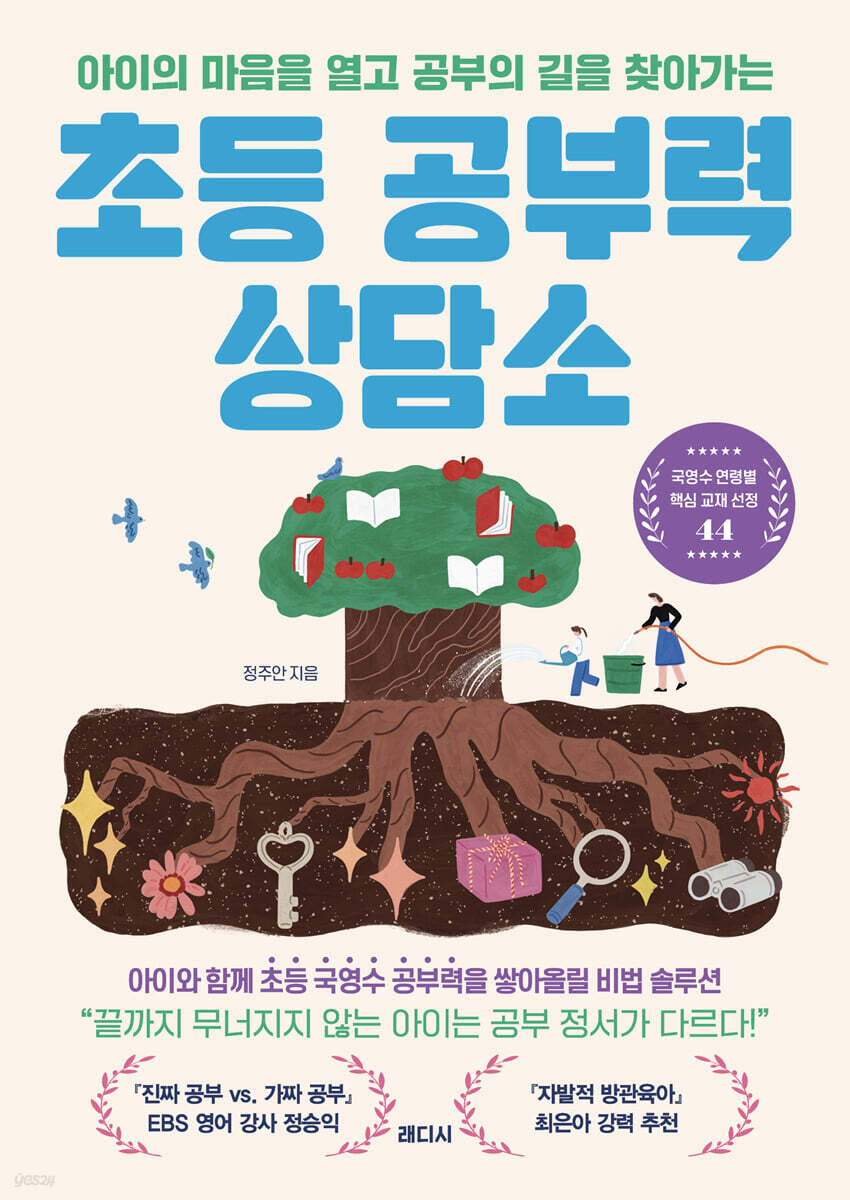
The sixth year of elementary school is a crucial period for developing a positive attitude toward studying! “This is what parents do to help their children develop their study skills!” A 12-year veteran middle school teacher shares his secret solution for boosting the academic performance of apathetic students in the classroom. Who is most upset about not being able to study? It's the child himself. Children lose confidence in their studies faster than you might think. During the first six years of elementary school, when a positive attitude toward studying begins to develop, we must provide students with successful experiences in studying. Just having your child do origami and jump rope to build confidence won't directly lead to better academic performance. Just as beans grow where you plant them and red beans grow where you plant them, confidence in studying grows the fastest and most powerfully when it is nurtured through studying. So, is the answer to filling up on after-school classes, overwhelming homework, and progressing faster than others? This book is based on the insights and research gained from a 12-year veteran middle school teacher who has been a strong study mentor to countless children and their parents. It is also based on the experiences of a mother of three who has been happily studying at home every day for nine years without private tutoring. This book provides clear and satisfying answers to the most frequently asked questions from parents, including whether there are ways to improve reading comprehension in children who struggle with reading, when is the best time to start studying English, and why it's important to fill in the gaps in math with current rules rather than prior knowledge. In particular, the 'Study Counseling Center' corner, which is included for each subject of Korean, English, and Math, provides study tips that should be focused on from the lower grades of elementary school to the upper grades of elementary school and middle school, and selects core textbooks for each age group to help students apply them at each level. If there is no "real study time" where parents and children gather together at a desk to read, ask questions, find answers, and organize them into clear sentences, things can fall apart at any time. Let's learn the author's unique know-how, based on her trial and error as a busy working mom, to create a system that rivals even the best private academies, and a realistic roadmap to becoming a top-tier Korean, English, and math teacher. We will experience the miracle of our child becoming a child with a solid study ability that will not waver until the entrance exam. |
- You can preview some of the book's contents.
Preview
index
Recommendation
Author's Note
I decided to grow it with my child
Part 1: Opening a child's mind will help them develop their study skills.
Chapter 1: Children Who Did Not Develop Their Ability to Study During the Critical Period
If your foundation for studying is weak, you will become a child without motivation.
Academy doesn't teach you how to study.
The problem isn't attitude, it's the child's heart.
No to a child who just wants to be spoon-fed
Chapter 2: A positive study mindset comes before a good study mindset.
Parents who dig up their children's treasures are different.
A well-organized system, not to be envied by any other academy
This is how you get your child to sit at the desk.
How to Be Your Friend in the Struggle with Studying
Chapter 3: The Basic Principles of Minimum Study to Raise a Child Who Can Achieve Anything
Principle 1.
Let your child find the purpose of studying on his own.
Principle 2.
If you don't rest even for a single day, it becomes a habit.
Principle 3.
Sometimes in life, you need a backer.
Part 2: This is an elementary school study skills counseling center that helps children develop their inner strength.
Chapter 1: Studying Korean, English, and Math: If You Know It Right, You'll Find the Way
Things you must know before starting Korean, English, and Math
Check again with correct and incorrect answers and questions
Writing is the core of Korean, English, and math.
Chapter 2: How to Study Korean by Asking Questions and Finding Answers
Vocabulary: How to Win the Battle Against Chinese Characters
Reading Comprehension: Building Background Knowledge Starts with 'This'
Literacy: Creating Questions to Understand Text
Comprehensive Korean Language Skills: Finding Hidden Keywords
[Korean Language Study Counseling Center]
[Recommended Textbooks by Age] How to Choose a Korean Language Workbook
Chapter 3: Learning English through Writing
1.
Vocabulary: Learn English words through games instead of homework.
2.
Grammar: Writing a daily sentence in one line
3.
Listening: How to Take English Dictation Correctly
[English Study Counseling Center]
[Recommended Textbooks by Age] How to Choose an English Workbook
Chapter 4: Studying Math to Improve Concentration and Thinking Skills
1.
Operations: How to Catch Mistakes Before They Become Skills
2.
Mathematical Thinking: Developing Through Conversations with Children
3.
Comprehensive Math Skills: Three Secrets to Making Math Easier
[Math Study Ability Counseling Center]
[Recommended Textbooks by Age] How to Choose a Math Workbook
[Appendix] My Child's Study Checklist
[For Parents] What You Need to Know to Avoid Getting Tired Before Your Child
[To children exhausted from studying today] Things to remember when a slump strikes
Author's Note
I decided to grow it with my child
Part 1: Opening a child's mind will help them develop their study skills.
Chapter 1: Children Who Did Not Develop Their Ability to Study During the Critical Period
If your foundation for studying is weak, you will become a child without motivation.
Academy doesn't teach you how to study.
The problem isn't attitude, it's the child's heart.
No to a child who just wants to be spoon-fed
Chapter 2: A positive study mindset comes before a good study mindset.
Parents who dig up their children's treasures are different.
A well-organized system, not to be envied by any other academy
This is how you get your child to sit at the desk.
How to Be Your Friend in the Struggle with Studying
Chapter 3: The Basic Principles of Minimum Study to Raise a Child Who Can Achieve Anything
Principle 1.
Let your child find the purpose of studying on his own.
Principle 2.
If you don't rest even for a single day, it becomes a habit.
Principle 3.
Sometimes in life, you need a backer.
Part 2: This is an elementary school study skills counseling center that helps children develop their inner strength.
Chapter 1: Studying Korean, English, and Math: If You Know It Right, You'll Find the Way
Things you must know before starting Korean, English, and Math
Check again with correct and incorrect answers and questions
Writing is the core of Korean, English, and math.
Chapter 2: How to Study Korean by Asking Questions and Finding Answers
Vocabulary: How to Win the Battle Against Chinese Characters
Reading Comprehension: Building Background Knowledge Starts with 'This'
Literacy: Creating Questions to Understand Text
Comprehensive Korean Language Skills: Finding Hidden Keywords
[Korean Language Study Counseling Center]
[Recommended Textbooks by Age] How to Choose a Korean Language Workbook
Chapter 3: Learning English through Writing
1.
Vocabulary: Learn English words through games instead of homework.
2.
Grammar: Writing a daily sentence in one line
3.
Listening: How to Take English Dictation Correctly
[English Study Counseling Center]
[Recommended Textbooks by Age] How to Choose an English Workbook
Chapter 4: Studying Math to Improve Concentration and Thinking Skills
1.
Operations: How to Catch Mistakes Before They Become Skills
2.
Mathematical Thinking: Developing Through Conversations with Children
3.
Comprehensive Math Skills: Three Secrets to Making Math Easier
[Math Study Ability Counseling Center]
[Recommended Textbooks by Age] How to Choose a Math Workbook
[Appendix] My Child's Study Checklist
[For Parents] What You Need to Know to Avoid Getting Tired Before Your Child
[To children exhausted from studying today] Things to remember when a slump strikes
Detailed image

Into the book
Every student knows well the need to study.
I know the importance of studying, but I'm just saying that I'll have to give up because of the weight of learning that wasn't done in a timely manner.
The child who says those words feels greater sorrow than anyone else.
I say I gave up, but it's because I want to do better than anyone else.
This is why we need to help children develop positive attitudes toward studying.
--- From "If your study roots are weak, you will become a child without motivation"
If you really want to build the strength to move forward, start by filling in the holes.
The most important thing is to diligently work on improving the areas where your child is lacking.
We need to identify and prevent any more difficult and challenging issues before they arise.
By minimizing the gaps, children will have the strength to continue learning.
To do that, it is most important to build a good foundation.
To be good at finding factors and multiples, you need to build a solid foundation in arithmetic operations, and to understand English sentences well, you must not neglect studying vocabulary.
--- From "Sometimes you need 'backs' in life"
“I’ve never seen my older sister, who graduated from Seoul National University, read a book.”
In fact, there are many cases around us where people achieved good results without reading.
Even if you try to get your child to play with books at the library or show them how to read, it won't work for some children who can't read.
On the other hand, children who are not good at reading will eventually succeed.
I can make my child like that.
--- From "Things to know before starting Korean, English, and Math"
Using notes can be more effective than you might think.
First, you can kill two birds with one stone: save time and achieve high learning outcomes.
It is very time-efficient because you only study the vocabulary that your child really needs.
Additionally, the need for vocabulary learning becomes clear as the child organizes words he or she does not know while studying.
When children study, they adjust their concentration depending on how much they need it.
Since it was vocabulary that I didn't know when studying Korean, social studies, and science, I will show a high level of concentration.
These are words we hear often in class, so they are easy to remember.
--- From "Vocabulary: How to Win the Battle with Chinese Characters"
By looking at the words your child has organized, you can see which parts your child is having particular difficulty with.
For example, if words like 'fall, conversion, conservation, sunlight' are written, it is evidence that there were many difficulties when studying the 'energy and life' section of science.
Furthermore, you can easily see which subjects your child mainly studies and in which subjects he or she has the most unfamiliar words, so you can accurately identify even subjects in which he or she is weak.
You can study with choice and focus.
--- From "Vocabulary: How to Win the Battle with Chinese Characters"
The questions directly reflect the child's 'understanding of the text'.
By looking at the questions you've created, you can immediately see how well your child has understood the content.
When you solve only the given problems, you become familiar with the types of problems and get a feel for them, so you can guess and answer the question even if you don't fully understand the text.
But creating problems is a completely different story.
Questions asked when a child does not fully understand the given text tend to go in a completely different direction.
I know the importance of studying, but I'm just saying that I'll have to give up because of the weight of learning that wasn't done in a timely manner.
The child who says those words feels greater sorrow than anyone else.
I say I gave up, but it's because I want to do better than anyone else.
This is why we need to help children develop positive attitudes toward studying.
--- From "If your study roots are weak, you will become a child without motivation"
If you really want to build the strength to move forward, start by filling in the holes.
The most important thing is to diligently work on improving the areas where your child is lacking.
We need to identify and prevent any more difficult and challenging issues before they arise.
By minimizing the gaps, children will have the strength to continue learning.
To do that, it is most important to build a good foundation.
To be good at finding factors and multiples, you need to build a solid foundation in arithmetic operations, and to understand English sentences well, you must not neglect studying vocabulary.
--- From "Sometimes you need 'backs' in life"
“I’ve never seen my older sister, who graduated from Seoul National University, read a book.”
In fact, there are many cases around us where people achieved good results without reading.
Even if you try to get your child to play with books at the library or show them how to read, it won't work for some children who can't read.
On the other hand, children who are not good at reading will eventually succeed.
I can make my child like that.
--- From "Things to know before starting Korean, English, and Math"
Using notes can be more effective than you might think.
First, you can kill two birds with one stone: save time and achieve high learning outcomes.
It is very time-efficient because you only study the vocabulary that your child really needs.
Additionally, the need for vocabulary learning becomes clear as the child organizes words he or she does not know while studying.
When children study, they adjust their concentration depending on how much they need it.
Since it was vocabulary that I didn't know when studying Korean, social studies, and science, I will show a high level of concentration.
These are words we hear often in class, so they are easy to remember.
--- From "Vocabulary: How to Win the Battle with Chinese Characters"
By looking at the words your child has organized, you can see which parts your child is having particular difficulty with.
For example, if words like 'fall, conversion, conservation, sunlight' are written, it is evidence that there were many difficulties when studying the 'energy and life' section of science.
Furthermore, you can easily see which subjects your child mainly studies and in which subjects he or she has the most unfamiliar words, so you can accurately identify even subjects in which he or she is weak.
You can study with choice and focus.
--- From "Vocabulary: How to Win the Battle with Chinese Characters"
The questions directly reflect the child's 'understanding of the text'.
By looking at the questions you've created, you can immediately see how well your child has understood the content.
When you solve only the given problems, you become familiar with the types of problems and get a feel for them, so you can guess and answer the question even if you don't fully understand the text.
But creating problems is a completely different story.
Questions asked when a child does not fully understand the given text tend to go in a completely different direction.
--- From "Literacy: Creating Questions to Understand Text"
Publisher's Review
★★★44 Core Textbooks for Korean, English, and Math Subjects to Lead to Top Rankings
★★★Includes limited edition of "Vocabulary Notes" and "Daily Study Checklist"
★★★『Real Study vs.
『Fake Study』 EBS English instructor Jeong Seung-ik strongly recommends 『Voluntary Indifference Parenting』 Choi Eun-ah!!
Welcome to the lifelong development of your child's inner strength.
This is the 'Elementary School Study Ability Counseling Center'!
"Elementary Study Counseling Center" is a book that summarizes the study methods of the author, who has worked as a study mentor for numerous children in public education settings.
As a middle school teacher with 12 years of experience, I introduce a method to develop deep-rooted study skills that will never waver even when facing puberty.
As a current teacher and mother of three children, the author, who has raised her child to study on his own at home for nine years, following the child's wishes to refuse private academies, says that parents should stay by their children's side while they study.
This is so that the child can find the strength to sit down at the desk again.
Opening a child's mind will help them develop their ability to study.
The sixth year of elementary school is a time when we must focus on developing a positive attitude toward studying as well as a keen eye for studying.
The author, who has seen countless times in the classroom that even a child who was good at studying suddenly collapsed one day, hoped that that child would not become his child.
When I abandoned the rigidity of a polarized mother and chose to work on my conflicted relationship with my child and develop study habits, amazing changes began to occur.
From kindergarten to middle school, students sit around every evening and begin studying by asking and answering questions and writing.
I build my vocabulary by writing a vocabulary list every day, and I proactively create a study plan and even write a checklist to fill in any gaps in my studies.
Since such miraculous output cannot be achieved through the firmness of parents alone, we provide specific guidance through examples on how to encourage children's minds and establish solid study habits.
The 6th year of elementary school is a crucial period to fill the gap in learning!
If you are curious about the secret of a working mom who won gold medal in the Abacus Olympiad without private tutoring for her child who answers '12 plus 4' as '124', if you do not want to go down the path of parents who start a war with their children and get upset about studying as soon as the new semester starts, and if you want to break free from the illusion that you had no choice but to send your child to an academy for studying due to circumstances, this book is a must-read.
The author points out that the advanced study method of running ahead is easier than the current study method of filling in the details.
Everyone is being deceived.
Rather, it is more remarkable to have the courage to go back and find a 'back-up' route to fill in the gaps in your child's studies.
If we just follow the three minimum study principles the author suggests, neither grandiose good deeds, expensive academies, nor the dreaded puberty will be a factor in our children's college entrance exams.
The basic principles of studying Korean, English, and Math to improve your study skills.
If Part 1 of this book laid the foundation for fostering a child's love of studying, Part 2 focuses on various methods to truly develop Korean, English, and math study skills.
The core roots of the study method presented here are linked to questioning and writing.
These are ways to develop children's thinking skills and solidify their ability to think through writing through conversations that lead to questions.
Ultimately, studying depends on how well you understand what you've learned and how well you can derive answers.
Even if the subjects of Korean, English, and Math are different, if you know just this one method, you will have found a shortcut to becoming a top student.
There are many parents who feel depressed just thinking about sending their children to school.
So, the author, a working mom of three, researched and applied methods that can be easily accomplished without much effort, and compiled them into a series of successful experiences.
As the new school year begins, I wrote this book in the hope that many parents will avoid making similar mistakes due to their anxiousness.
We hope to open the doors to a study counseling center in earnest, hoping that our children will find their own path in learning without missing this crucial moment.
Let's hear the secret to killing three birds with one stone: Korean, English, and math, through a groundbreaking 'writing-based' home study method, along with countless counseling sessions and solutions for children and parents who cry and laugh because of studying.
You will be able to find clear answers to questions you couldn't even ask your homeroom teacher.
★★★Includes limited edition of "Vocabulary Notes" and "Daily Study Checklist"
★★★『Real Study vs.
『Fake Study』 EBS English instructor Jeong Seung-ik strongly recommends 『Voluntary Indifference Parenting』 Choi Eun-ah!!
Welcome to the lifelong development of your child's inner strength.
This is the 'Elementary School Study Ability Counseling Center'!
"Elementary Study Counseling Center" is a book that summarizes the study methods of the author, who has worked as a study mentor for numerous children in public education settings.
As a middle school teacher with 12 years of experience, I introduce a method to develop deep-rooted study skills that will never waver even when facing puberty.
As a current teacher and mother of three children, the author, who has raised her child to study on his own at home for nine years, following the child's wishes to refuse private academies, says that parents should stay by their children's side while they study.
This is so that the child can find the strength to sit down at the desk again.
Opening a child's mind will help them develop their ability to study.
The sixth year of elementary school is a time when we must focus on developing a positive attitude toward studying as well as a keen eye for studying.
The author, who has seen countless times in the classroom that even a child who was good at studying suddenly collapsed one day, hoped that that child would not become his child.
When I abandoned the rigidity of a polarized mother and chose to work on my conflicted relationship with my child and develop study habits, amazing changes began to occur.
From kindergarten to middle school, students sit around every evening and begin studying by asking and answering questions and writing.
I build my vocabulary by writing a vocabulary list every day, and I proactively create a study plan and even write a checklist to fill in any gaps in my studies.
Since such miraculous output cannot be achieved through the firmness of parents alone, we provide specific guidance through examples on how to encourage children's minds and establish solid study habits.
The 6th year of elementary school is a crucial period to fill the gap in learning!
If you are curious about the secret of a working mom who won gold medal in the Abacus Olympiad without private tutoring for her child who answers '12 plus 4' as '124', if you do not want to go down the path of parents who start a war with their children and get upset about studying as soon as the new semester starts, and if you want to break free from the illusion that you had no choice but to send your child to an academy for studying due to circumstances, this book is a must-read.
The author points out that the advanced study method of running ahead is easier than the current study method of filling in the details.
Everyone is being deceived.
Rather, it is more remarkable to have the courage to go back and find a 'back-up' route to fill in the gaps in your child's studies.
If we just follow the three minimum study principles the author suggests, neither grandiose good deeds, expensive academies, nor the dreaded puberty will be a factor in our children's college entrance exams.
The basic principles of studying Korean, English, and Math to improve your study skills.
If Part 1 of this book laid the foundation for fostering a child's love of studying, Part 2 focuses on various methods to truly develop Korean, English, and math study skills.
The core roots of the study method presented here are linked to questioning and writing.
These are ways to develop children's thinking skills and solidify their ability to think through writing through conversations that lead to questions.
Ultimately, studying depends on how well you understand what you've learned and how well you can derive answers.
Even if the subjects of Korean, English, and Math are different, if you know just this one method, you will have found a shortcut to becoming a top student.
There are many parents who feel depressed just thinking about sending their children to school.
So, the author, a working mom of three, researched and applied methods that can be easily accomplished without much effort, and compiled them into a series of successful experiences.
As the new school year begins, I wrote this book in the hope that many parents will avoid making similar mistakes due to their anxiousness.
We hope to open the doors to a study counseling center in earnest, hoping that our children will find their own path in learning without missing this crucial moment.
Let's hear the secret to killing three birds with one stone: Korean, English, and math, through a groundbreaking 'writing-based' home study method, along with countless counseling sessions and solutions for children and parents who cry and laugh because of studying.
You will be able to find clear answers to questions you couldn't even ask your homeroom teacher.
GOODS SPECIFICS
- Date of issue: April 1, 2024
- Page count, weight, size: 272 pages | 464g | 148*210*20mm
- ISBN13: 9791193406007
- ISBN10: 1193406005
You may also like
카테고리
korean


korean

![ELLE 엘르 스페셜 에디션 A형 : 12월 [2025]](http://librairie.coreenne.fr/cdn/shop/files/b8e27a3de6c9538896439686c6b0e8fb.jpg?v=1766436872&width=3840)


