

I'll teach you calculus so easily that even elementary school students can solve it.
 |
Description
Book Introduction
* 1PICK! Chosen by 500,000 Parents: Joanho Math Research Institute
* Grade 1! The math study method that has helped students reach the top 1% for 28 years.
Calculus: A Key Point in School Grades and College Scholastic Ability Test Grades
If you study like others, you should be in the upper middle class.
If you learn properly, you will get a high score of 1st grade!
It is no exaggeration to say that our country's current education begins and ends with mathematics.
It is not uncommon for students to study advanced mathematics from elementary school onward in order to pass the hundreds to one competition to get into medical school.
High school students taking the integrated liberal arts and science college entrance exam focus on mathematics to secure top rankings and study calculus as an elective.
Even though elective subjects are abolished in the 28th academic year, Calculus I is included in general mathematics that is taught jointly by both liberal arts and sciences, so there is a need to focus even more on the basics of calculus.
However, calculus is something that is difficult for elementary and middle school students who are already familiar with mathematics, and even high school students.
So many children give up on math without even grasping the basic concepts of calculus, or they devote years of their time to studying calculus but fail to achieve grades higher than a 3 on the college entrance exam.
So how should we study difficult calculus?
The book containing the answer, "Calculus, Taught So Easily That Even Elementary School Students Can Solve It," has been published.
This is a book by Director Jo An-ho, who has been a hot topic for dramatically improving children's math skills over the past 28 years.
Director Jo An-ho said, “There is no child who cannot succeed no matter how hard they try.
“Anyone can do it if they learn calculus properly,” he says.
As he is confident, this book teaches calculus properly and easily, from the basic concepts that must be grasped before studying calculus to the core concepts of calculus and problems.
I recommend this book right now to all children struggling with calculus, from the so-called top students to those in the lower middle and upper middle grades.
* Grade 1! The math study method that has helped students reach the top 1% for 28 years.
Calculus: A Key Point in School Grades and College Scholastic Ability Test Grades
If you study like others, you should be in the upper middle class.
If you learn properly, you will get a high score of 1st grade!
It is no exaggeration to say that our country's current education begins and ends with mathematics.
It is not uncommon for students to study advanced mathematics from elementary school onward in order to pass the hundreds to one competition to get into medical school.
High school students taking the integrated liberal arts and science college entrance exam focus on mathematics to secure top rankings and study calculus as an elective.
Even though elective subjects are abolished in the 28th academic year, Calculus I is included in general mathematics that is taught jointly by both liberal arts and sciences, so there is a need to focus even more on the basics of calculus.
However, calculus is something that is difficult for elementary and middle school students who are already familiar with mathematics, and even high school students.
So many children give up on math without even grasping the basic concepts of calculus, or they devote years of their time to studying calculus but fail to achieve grades higher than a 3 on the college entrance exam.
So how should we study difficult calculus?
The book containing the answer, "Calculus, Taught So Easily That Even Elementary School Students Can Solve It," has been published.
This is a book by Director Jo An-ho, who has been a hot topic for dramatically improving children's math skills over the past 28 years.
Director Jo An-ho said, “There is no child who cannot succeed no matter how hard they try.
“Anyone can do it if they learn calculus properly,” he says.
As he is confident, this book teaches calculus properly and easily, from the basic concepts that must be grasped before studying calculus to the core concepts of calculus and problems.
I recommend this book right now to all children struggling with calculus, from the so-called top students to those in the lower middle and upper middle grades.
- You can preview some of the book's contents.
Preview
index
Prologue: Calculus Isn't Difficult Once You Build a Bridge of Concepts
Part 1.
Concepts you must understand before learning calculus
Chapter 1.
vertical
Math: Know the Dots to Get Better
What can be known from line segments
Can you study properly without knowing vertical lines?
All numbers are on the number line
Chapter 2.
Function value
If you lack easy concepts, you cannot understand difficult ones.
Let's find the meaning of points on a plane
f(x) is not scary anymore
The function value must be on the y-axis1
The function value must be on the y-axis2
[Column] If you don't know function values, you're giving up on math, let alone calculus.
Chapter 3.
inclination
Slope can only be described from a straight line
Let's push the straight line
How can we express the 'degree of inclination' as a 'number'?
Indeterminate line that will change math grades
[Column] Let's Draw a Straight Line Quickly
Chapter 4.
Quadratic function
Quadratic functions are the most difficult
Let's also push the quadratic function graph
Do I also need to memorize the symmetry of quadratic functions?
[Column] Straight lines make higher-order functions difficult.
Part 2.
Differentiation is slope
Chapter 1.
limit
Let's learn properly from the limit of a sequence.
The Key to Understanding Limits: Three Perspectives on "0.999…"
Limits of Infinite Sequences: We Don't Know What They Are, But There's a Way
[Column] Law of the Jungle
Chapter 2.
limit of a function
There are three perspectives on the limits of functions.
If the limit value is not determined, let's substitute it first.
The limit and the function value must be the same for it to be continuous.
[Column] Infinity Trapped in Finity
Chapter 3.
differential
Differentiation, which allows us to predict smooth changes
The derivative is a function that derives the slope.
Differentiability: Conditions for differentiation
Differentiation is the slope, so it tells you whether something is increasing or decreasing.
Application of Derivatives 1: Indeterminate Lines
Application of Derivatives 2: Equations
[Column] Are differentiation and slope really the same?
Part 3.
Integral is area
Chapter 1.
Infinite series
Let's start with the consensus symbol sigma.
Converging infinite series: the more you add, the closer you get to a certain number.
[Column] The magnitude and limits of sequences
Chapter 2.
Area of a curved shape
Distinctive quadrature method
Integration is the reverse of differentiation.
Fundamental Theorem of Calculus
It may seem complicated, but there is only one variable.
If you study functions properly, extension is always easy.
[Column] Why ∫abf(x)dx = - ∫baf(x)dx
Chapter 3.
Application of definite integrals
Application of definite integral 1: Area between the curve and the x-axis
Application of definite integrals 2: Area between two curves
Application of definite integral 3: Area between curve and y-axis and equal area
[Column] How to reduce mistakes children frequently make in calculus
Epilogue: If you work hard like everyone else, you'll probably be in the upper-middle ranks.
Part 1.
Concepts you must understand before learning calculus
Chapter 1.
vertical
Math: Know the Dots to Get Better
What can be known from line segments
Can you study properly without knowing vertical lines?
All numbers are on the number line
Chapter 2.
Function value
If you lack easy concepts, you cannot understand difficult ones.
Let's find the meaning of points on a plane
f(x) is not scary anymore
The function value must be on the y-axis1
The function value must be on the y-axis2
[Column] If you don't know function values, you're giving up on math, let alone calculus.
Chapter 3.
inclination
Slope can only be described from a straight line
Let's push the straight line
How can we express the 'degree of inclination' as a 'number'?
Indeterminate line that will change math grades
[Column] Let's Draw a Straight Line Quickly
Chapter 4.
Quadratic function
Quadratic functions are the most difficult
Let's also push the quadratic function graph
Do I also need to memorize the symmetry of quadratic functions?
[Column] Straight lines make higher-order functions difficult.
Part 2.
Differentiation is slope
Chapter 1.
limit
Let's learn properly from the limit of a sequence.
The Key to Understanding Limits: Three Perspectives on "0.999…"
Limits of Infinite Sequences: We Don't Know What They Are, But There's a Way
[Column] Law of the Jungle
Chapter 2.
limit of a function
There are three perspectives on the limits of functions.
If the limit value is not determined, let's substitute it first.
The limit and the function value must be the same for it to be continuous.
[Column] Infinity Trapped in Finity
Chapter 3.
differential
Differentiation, which allows us to predict smooth changes
The derivative is a function that derives the slope.
Differentiability: Conditions for differentiation
Differentiation is the slope, so it tells you whether something is increasing or decreasing.
Application of Derivatives 1: Indeterminate Lines
Application of Derivatives 2: Equations
[Column] Are differentiation and slope really the same?
Part 3.
Integral is area
Chapter 1.
Infinite series
Let's start with the consensus symbol sigma.
Converging infinite series: the more you add, the closer you get to a certain number.
[Column] The magnitude and limits of sequences
Chapter 2.
Area of a curved shape
Distinctive quadrature method
Integration is the reverse of differentiation.
Fundamental Theorem of Calculus
It may seem complicated, but there is only one variable.
If you study functions properly, extension is always easy.
[Column] Why ∫abf(x)dx = - ∫baf(x)dx
Chapter 3.
Application of definite integrals
Application of definite integral 1: Area between the curve and the x-axis
Application of definite integrals 2: Area between two curves
Application of definite integral 3: Area between curve and y-axis and equal area
[Column] How to reduce mistakes children frequently make in calculus
Epilogue: If you work hard like everyone else, you'll probably be in the upper-middle ranks.
Detailed image
Publisher's Review
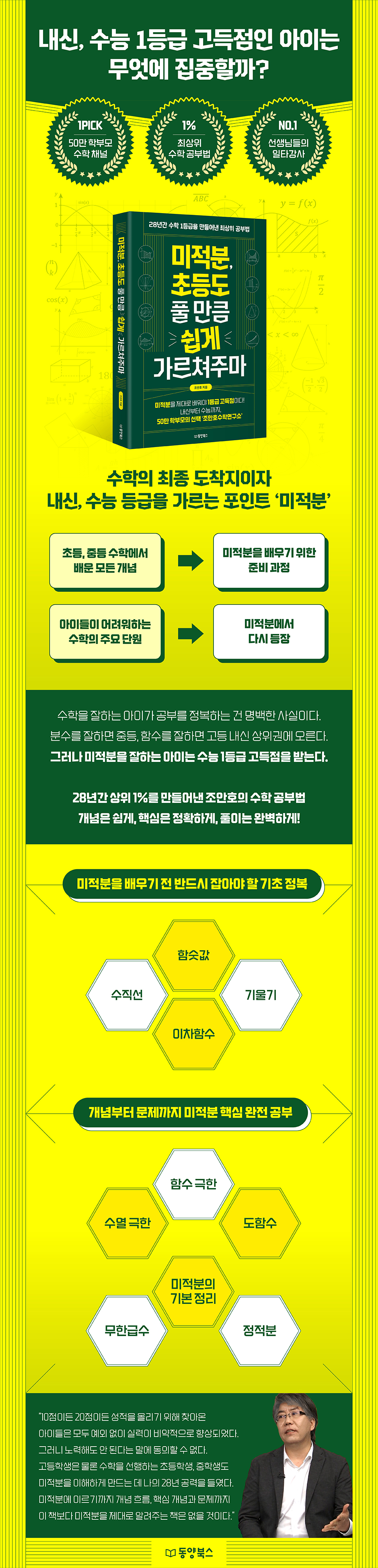
If you are good at fractions, you will get a high school grade.
If you are good at functions, you can conquer high school grades.
Children who are good at calculus will conquer the CSAT!
It is an obvious fact that children who are good at math conquer their studies.
If you are good at elementary fractions, you will likely be in the top ranks of your grades in middle school, and if you are good at middle school functions, you will likely be in the top ranks of your grades in high school.
However, children who are good at calculus not only receive high grades in high school but also receive top grades on the college entrance exam.
This is why students preparing for business, science, engineering, and medical schools at top universities focus on studying calculus.
However, most children make the mistake of skipping the section on calculus because it is difficult.
The idea is to focus on the easier and better sections to quickly raise your score.
Actually, this trick works until you learn middle school functions.
This is because your score will temporarily drop only when the abandoned unit is included in the test scope, and then increase again when you take the test for other units.
However, if you go on to high school as is, you will fall to the lower middle ranks because of calculus.
No matter how hard you study, it is difficult to get above the upper-middle level or 3rd grade.
In the end, he collapses in the CSAT, the final hurdle of 12 years of math study.
The final destination of mathematics is calculus.
All mathematics studies from elementary school to middle school were a preparatory process for learning calculus, and all the concepts learned then reappear in calculus.
So, when we look at children who have difficulty with higher mathematics, especially calculus, the biggest reason is that they did not learn mathematics properly in elementary or middle school.
Anyone can easily overcome the threshold of calculus if they step on it properly one by one.
Grade 5: The Core of the Integrated Humanities and Science CSAT System
Dental Herbal Medicine and the 'Solution' to Passing the Seopoca Ointment Exam
The topic that is constantly being discussed in school and college entrance exams is mathematics.
There has never been a time when mathematics was not important in studies, but its importance has grown even more since the college entrance exam was changed to an integrated liberal arts and science exam.
For children preparing to enter the top universities (Seoul National University, POSTECH, KAIST, Yonsei University, Korea University) or the medical, dental, oriental medicine, pharmacy, and veterinary schools, studying math is essential to secure the ability to differentiate among the top tiers.
Here, the grade system is changed from 9 to 5, as if lighting a fire.
The proportion of grades 1 and 2 increases from 4% and 7% to 10% and 24%, respectively.
In this case, it becomes more important to get into the top ranks, so all subjects, including math, must be managed to be within the top grade.
So kids study really hard to get high scores in math.
I go to academies, private tutoring, and online lectures, solve problems as they come up, and diligently memorize the types and techniques.
This is because math grades vary depending on how many low-correctness problems you answer correctly.
However, the belief that solving all sorts of problems will help you in some way or that you will do well has too many side effects.
Looking at the reality that 90% of children who studied like this, regardless of whether they received public or private education, give up on math, we cannot help but conclude that the study method is wrong.
Focusing on the core, drilling through it like a drill, and then expanding on it is a way to reduce the amount of study and minimize side effects.
This strategy is suitable for elementary, middle, and high school mathematics studies.
So what's the most important thing in mathematics? It's calculus.
Joanho Mathematics Research Institute, verified and selected by parents
The math study method that has produced the top 1% for 28 years!
"I'll teach you calculus so well that even elementary school students can solve it."
90% of average kids give up on math after studying calculus.
99% of children who get a grade 1 in math focus on calculus.
Calculus is difficult even if you study hard, and it is even more difficult if you don't study hard.
However, Director Jo An-ho says that anyone can do calculus if they properly step on the conceptual stepping stones.
In fact, when I explained difficult math problems that even high school students find difficult to solve to 5th and 6th graders, they understood the meaning of the problems and formulas and solved the problems.
This means that even elementary school students can do it if they learn calculus properly.
So, for elementary and middle school students who are already learning math, high school students who are currently having trouble understanding functions and limits, and children and parents who are worried about their math skills not improving, I published "Calculus, Taught So Easily That Even Elementary School Students Can Solve It."
This one book contains the 28 years of hard work of Director Jo An-ho, who raised the math scores of elementary, middle, and high school students from the 20s to 100 points.
It teaches the flow of concepts up to calculus and the process of solving basic problems in a way that even upper elementary school students can understand.
If you've been rushing to get through the book so far, or if you've been blindly focused on solving problems, you need to read this book.
Even if you are in the top tier or top tier of elementary or middle school, you should read it.
Math, like a foreign language, requires more effort if you start studying it later in life, and there may be limits to your ability to improve.
If you don't have the math skills you want, your future options will be limited.
So, I highly recommend you read this book.
If you are good at functions, you can conquer high school grades.
Children who are good at calculus will conquer the CSAT!
It is an obvious fact that children who are good at math conquer their studies.
If you are good at elementary fractions, you will likely be in the top ranks of your grades in middle school, and if you are good at middle school functions, you will likely be in the top ranks of your grades in high school.
However, children who are good at calculus not only receive high grades in high school but also receive top grades on the college entrance exam.
This is why students preparing for business, science, engineering, and medical schools at top universities focus on studying calculus.
However, most children make the mistake of skipping the section on calculus because it is difficult.
The idea is to focus on the easier and better sections to quickly raise your score.
Actually, this trick works until you learn middle school functions.
This is because your score will temporarily drop only when the abandoned unit is included in the test scope, and then increase again when you take the test for other units.
However, if you go on to high school as is, you will fall to the lower middle ranks because of calculus.
No matter how hard you study, it is difficult to get above the upper-middle level or 3rd grade.
In the end, he collapses in the CSAT, the final hurdle of 12 years of math study.
The final destination of mathematics is calculus.
All mathematics studies from elementary school to middle school were a preparatory process for learning calculus, and all the concepts learned then reappear in calculus.
So, when we look at children who have difficulty with higher mathematics, especially calculus, the biggest reason is that they did not learn mathematics properly in elementary or middle school.
Anyone can easily overcome the threshold of calculus if they step on it properly one by one.
Grade 5: The Core of the Integrated Humanities and Science CSAT System
Dental Herbal Medicine and the 'Solution' to Passing the Seopoca Ointment Exam
The topic that is constantly being discussed in school and college entrance exams is mathematics.
There has never been a time when mathematics was not important in studies, but its importance has grown even more since the college entrance exam was changed to an integrated liberal arts and science exam.
For children preparing to enter the top universities (Seoul National University, POSTECH, KAIST, Yonsei University, Korea University) or the medical, dental, oriental medicine, pharmacy, and veterinary schools, studying math is essential to secure the ability to differentiate among the top tiers.
Here, the grade system is changed from 9 to 5, as if lighting a fire.
The proportion of grades 1 and 2 increases from 4% and 7% to 10% and 24%, respectively.
In this case, it becomes more important to get into the top ranks, so all subjects, including math, must be managed to be within the top grade.
So kids study really hard to get high scores in math.
I go to academies, private tutoring, and online lectures, solve problems as they come up, and diligently memorize the types and techniques.
This is because math grades vary depending on how many low-correctness problems you answer correctly.
However, the belief that solving all sorts of problems will help you in some way or that you will do well has too many side effects.
Looking at the reality that 90% of children who studied like this, regardless of whether they received public or private education, give up on math, we cannot help but conclude that the study method is wrong.
Focusing on the core, drilling through it like a drill, and then expanding on it is a way to reduce the amount of study and minimize side effects.
This strategy is suitable for elementary, middle, and high school mathematics studies.
So what's the most important thing in mathematics? It's calculus.
Joanho Mathematics Research Institute, verified and selected by parents
The math study method that has produced the top 1% for 28 years!
"I'll teach you calculus so well that even elementary school students can solve it."
90% of average kids give up on math after studying calculus.
99% of children who get a grade 1 in math focus on calculus.
Calculus is difficult even if you study hard, and it is even more difficult if you don't study hard.
However, Director Jo An-ho says that anyone can do calculus if they properly step on the conceptual stepping stones.
In fact, when I explained difficult math problems that even high school students find difficult to solve to 5th and 6th graders, they understood the meaning of the problems and formulas and solved the problems.
This means that even elementary school students can do it if they learn calculus properly.
So, for elementary and middle school students who are already learning math, high school students who are currently having trouble understanding functions and limits, and children and parents who are worried about their math skills not improving, I published "Calculus, Taught So Easily That Even Elementary School Students Can Solve It."
This one book contains the 28 years of hard work of Director Jo An-ho, who raised the math scores of elementary, middle, and high school students from the 20s to 100 points.
It teaches the flow of concepts up to calculus and the process of solving basic problems in a way that even upper elementary school students can understand.
If you've been rushing to get through the book so far, or if you've been blindly focused on solving problems, you need to read this book.
Even if you are in the top tier or top tier of elementary or middle school, you should read it.
Math, like a foreign language, requires more effort if you start studying it later in life, and there may be limits to your ability to improve.
If you don't have the math skills you want, your future options will be limited.
So, I highly recommend you read this book.
GOODS SPECIFICS
- Date of issue: March 10, 2024
- Page count, weight, size: 344 pages | 508g | 150*220*30mm
- ISBN13: 9791172100124
- ISBN10: 1172100128
You may also like
카테고리
korean


korean

![GQ KOREA Mark (Monthly): December [2025]](http://librairie.coreenne.fr/cdn/shop/files/8ef265dbbfbf186523ed75ba7319009d.jpg?v=1765340328&width=3840)


