

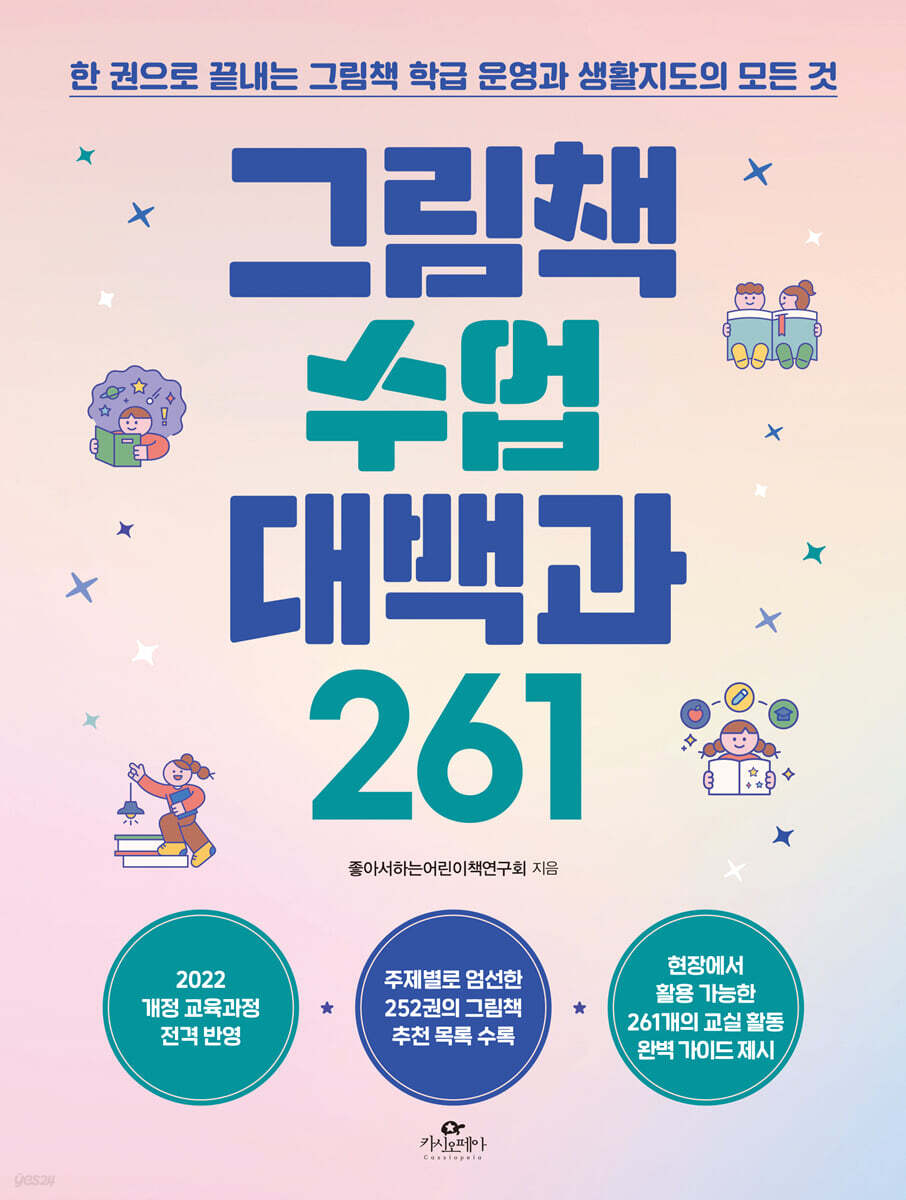
Picture Book Class Encyclopedia 261
 |
Description
Book Introduction
- A word from MD
-
A guide to picture book classes that can be completed in one volume!For teachers who are worried about how to prepare picture book classes for the new semester, we have revealed the teaching know-how of teachers from the 'Picture Book Research Group for Love'.
It is filled with 261 recommended picture books and post-reading activity tips that can be used in the classroom throughout the year.
This book is not only for teachers who teach picture book classes, but also for parents who are interested in picture book parenting.
February 13, 2024. Baek Jeong-min, PD of Home Life
The teaching know-how of the teachers of the 'Children's Book Research Group' that they enjoy is revealed!
A must-read for teachers and parents of elementary, middle, and high school students, compiling 261 classroom activities across 12 themes.
Presenting a roadmap for operating a picture book class for twelve months of the year.
Yes24's Grazebonso achieved 1,500% funding, a hit production.
As the new semester approaches, teachers' hearts are filled with both excitement and worry.
'What kind of children will I meet this year?', 'How should I run my classroom to spend a fun and meaningful year with those children?' 『Picture Book Class Encyclopedia 261』 is a practical educational book that contains 261 monthly class activities using picture books, written by current elementary school teacher management staff of the 'Picture Book Research Group for Love,' an educational group that shares educational content based on children's books, for fellow teachers who are thinking about classroom management and guidance plans for the year.
There are many advantages to using picture books in classroom management.
Above all, both teachers and children can prepare and participate in classes as if they were having fun, without feeling burdened by teaching and learning.
Moreover, picture books are works of art that combine beautiful and creative illustrations with fun and touching stories written at children's eye level.
Therefore, by using picture books in classes, we can develop not only our children's literacy and sensibility, but also their character.
『Picture Book Class Encyclopedia 261』 reflects the '2022 Revised Curriculum' and not only provides methods for teaching the picture book class activities presented in the text by linking them to the actual curriculum, but also provides even more abundant information on picture book classes through a list of 252 recommended picture books carefully selected by topic.
A must-read for teachers and parents of elementary, middle, and high school students, compiling 261 classroom activities across 12 themes.
Presenting a roadmap for operating a picture book class for twelve months of the year.
Yes24's Grazebonso achieved 1,500% funding, a hit production.
As the new semester approaches, teachers' hearts are filled with both excitement and worry.
'What kind of children will I meet this year?', 'How should I run my classroom to spend a fun and meaningful year with those children?' 『Picture Book Class Encyclopedia 261』 is a practical educational book that contains 261 monthly class activities using picture books, written by current elementary school teacher management staff of the 'Picture Book Research Group for Love,' an educational group that shares educational content based on children's books, for fellow teachers who are thinking about classroom management and guidance plans for the year.
There are many advantages to using picture books in classroom management.
Above all, both teachers and children can prepare and participate in classes as if they were having fun, without feeling burdened by teaching and learning.
Moreover, picture books are works of art that combine beautiful and creative illustrations with fun and touching stories written at children's eye level.
Therefore, by using picture books in classes, we can develop not only our children's literacy and sensibility, but also their character.
『Picture Book Class Encyclopedia 261』 reflects the '2022 Revised Curriculum' and not only provides methods for teaching the picture book class activities presented in the text by linking them to the actual curriculum, but also provides even more abundant information on picture book classes through a list of 252 recommended picture books carefully selected by topic.
- You can preview some of the book's contents.
Preview
index
prolog
How to use this book
March_First Encounter/Self-Exploration
[Week of March 1] Introducing Yourself Through Fun Wordplay
[Week of March 2] Self-Acceptance: Rewriting My Life Story
[Week of March 3] Self-Esteem: The One Thing Everyone Has
[Week of March 4] Exploring Identity: Expressing Self through Metaphor and Symbolism
April_Classroom Adaptation and Communication
[Week of April 1] A Bridge of Communication Between You and Me
[Week of April 2] Building Our World Through Collaboration
[Week of April 3] About Words That Don't Hurt Others
[Week of April 4] How to Resolve Conflict Wisely
May_Family Understanding and Diversity
[Week of May 1] Zoom in on the parents we didn't know about!
[Week of May 2] Let's create a happy home together.
[Week of May 3] Family is a Wider Thing Than You Think
[Week of May 4] There are many different types of families in the world.
June_Community/Regional Exploration
[Week of June 1] How to Live Together with Your Neighbors
[Week of June 2] Our Neighborhood, Open Your Eyes Wide and Look Around
[Week of June 3] I am your local expert!
[Week of June 4] Introducing the Proud Republic of Korea
July_Educational Theater and Physical Activities
[Week of July 1] Picture Books: Don't Just Read with Your Eyes, Read with Your Body
[Week of July 2] A play that can be anything using props and your body.
[Week of July 3] Diverse Minds Encountered Through Theater
[Week of July 4] Performing a Play Without a Script Using a Picture Book
August_School Violence and Safety Education
[Week of August 1] Stop School Violence Now!
[Week of August 2] Child Abuse Isn't Far Away
[Week of August 3] Our Attitude to Disaster Response
[Week of August 4] Cyber Overreliance: Where Does It Go Wrong?
September_Environmental and Ecological Transition Education
[Week of September 1] Get closer to nature and develop ecological sensitivity.
[Week of September 2] Coexistence for the Earth begins with moving away from human-centeredness.
[Week of September 3] Now is the time to properly understand and address climate change.
[Week of September 4] Becoming an Ecological Citizen: Transforming Your Life for the Earth
October_Literacy/Writing
[Week of October 1] The Foundation of All Study: Reading and Writing Correctly and Accurately
[Week of October 2] Wordplay to Boost Literacy
[Week of October 3] Diary and Life Stories, Turning Ordinary Life into Extraordinary Stories
[Week of October 4] Excellent Reading × Writing Comprehensive Activity, Book Review
November_World Citizens and Democracy
[Week of November 1] Refugee: What if I had to leave my home?
[Week of November 2] Democracy and Citizens, the power to change the world starts with me.
[Week of November 3] Child Labor Exploitation: Why I Was Able to Become Thrifty
[Week of November 4] Travel, so different! Where should I start?
December_Arts and Expression Activities
[Week of December 1] How to See Everyday Life Through Artist Glasses
[Week of December 2] A Harmonious Duet of Music Theory and Everyday Life
[Week of December 3] Art that Redefines Beauty
[Week of December 4] Change the world with socially engaged art.
January_Career Exploration
[Week of January 1] Why We Need Jobs
[Week of January 2] Understanding the Rapidly Changing World of Work
[Week 3 of January] Concrete and Practical Career Exploration
[Week of January 4] Designing a Career Path Based on My Life's Dreams
February_Disability Awareness and Inclusive Education
[Week of February 1] Intellectual Disability: For Independent Living and Integration
[Week of February 2] Autism: We're All the Same
[Week of February 3] Various Ways for People with Visual and Hearing Impairments to Connect with the World
[Week of February 4] Creating a World Without Discrimination for People with Disabilities
How to use this book
March_First Encounter/Self-Exploration
[Week of March 1] Introducing Yourself Through Fun Wordplay
[Week of March 2] Self-Acceptance: Rewriting My Life Story
[Week of March 3] Self-Esteem: The One Thing Everyone Has
[Week of March 4] Exploring Identity: Expressing Self through Metaphor and Symbolism
April_Classroom Adaptation and Communication
[Week of April 1] A Bridge of Communication Between You and Me
[Week of April 2] Building Our World Through Collaboration
[Week of April 3] About Words That Don't Hurt Others
[Week of April 4] How to Resolve Conflict Wisely
May_Family Understanding and Diversity
[Week of May 1] Zoom in on the parents we didn't know about!
[Week of May 2] Let's create a happy home together.
[Week of May 3] Family is a Wider Thing Than You Think
[Week of May 4] There are many different types of families in the world.
June_Community/Regional Exploration
[Week of June 1] How to Live Together with Your Neighbors
[Week of June 2] Our Neighborhood, Open Your Eyes Wide and Look Around
[Week of June 3] I am your local expert!
[Week of June 4] Introducing the Proud Republic of Korea
July_Educational Theater and Physical Activities
[Week of July 1] Picture Books: Don't Just Read with Your Eyes, Read with Your Body
[Week of July 2] A play that can be anything using props and your body.
[Week of July 3] Diverse Minds Encountered Through Theater
[Week of July 4] Performing a Play Without a Script Using a Picture Book
August_School Violence and Safety Education
[Week of August 1] Stop School Violence Now!
[Week of August 2] Child Abuse Isn't Far Away
[Week of August 3] Our Attitude to Disaster Response
[Week of August 4] Cyber Overreliance: Where Does It Go Wrong?
September_Environmental and Ecological Transition Education
[Week of September 1] Get closer to nature and develop ecological sensitivity.
[Week of September 2] Coexistence for the Earth begins with moving away from human-centeredness.
[Week of September 3] Now is the time to properly understand and address climate change.
[Week of September 4] Becoming an Ecological Citizen: Transforming Your Life for the Earth
October_Literacy/Writing
[Week of October 1] The Foundation of All Study: Reading and Writing Correctly and Accurately
[Week of October 2] Wordplay to Boost Literacy
[Week of October 3] Diary and Life Stories, Turning Ordinary Life into Extraordinary Stories
[Week of October 4] Excellent Reading × Writing Comprehensive Activity, Book Review
November_World Citizens and Democracy
[Week of November 1] Refugee: What if I had to leave my home?
[Week of November 2] Democracy and Citizens, the power to change the world starts with me.
[Week of November 3] Child Labor Exploitation: Why I Was Able to Become Thrifty
[Week of November 4] Travel, so different! Where should I start?
December_Arts and Expression Activities
[Week of December 1] How to See Everyday Life Through Artist Glasses
[Week of December 2] A Harmonious Duet of Music Theory and Everyday Life
[Week of December 3] Art that Redefines Beauty
[Week of December 4] Change the world with socially engaged art.
January_Career Exploration
[Week of January 1] Why We Need Jobs
[Week of January 2] Understanding the Rapidly Changing World of Work
[Week 3 of January] Concrete and Practical Career Exploration
[Week of January 4] Designing a Career Path Based on My Life's Dreams
February_Disability Awareness and Inclusive Education
[Week of February 1] Intellectual Disability: For Independent Living and Integration
[Week of February 2] Autism: We're All the Same
[Week of February 3] Various Ways for People with Visual and Hearing Impairments to Connect with the World
[Week of February 4] Creating a World Without Discrimination for People with Disabilities
Detailed image
.jpg)
Into the book
In the picture book 『Sweet Potato Guma』, all sentences end with the word ‘guma.’
When you read to children, you can get into the rhythm of the story as if you were playing with words.
After reading it excitedly for a while, Jiho said this.
“Teacher, by the way, this book has a lot of rhyme!” Just as you rhyme when writing poetry, you also rhyme song lyrics so that they sound the same.
For example, something like this.
“I crossed my legs, no, I crossed my legs, I crossed my legs, I crossed my legs.” Hehe, I recited a line from Akmu’s song “Don’t Cross Your Legs” and Jiho gave me a thumbs up.
This picture book also has a rhythmic rhythm like song lyrics, so children are drawn in and focused.
---From "March_First Meeting/Self-Exploration_Introducing 'Myself' in a Fun Way Through Wordplay"
If words were visible, what would they look like as they come out of my mouth? This picture book expresses words in form.
There are words that are like colorful flower petals and words that are like nails that hurt someone.
The picture book says that if we could see the shape of words, the words we speak might be different than they are now.
Let's think carefully about what it would be like if the words I've spoken so far were visible to the eye.
Perhaps there are more people who feel heartache than those who feel joy. They say that wounds on the body heal with new skin, but wounds on the heart never heal.
Imagine if the words I spit out hurt or crushed someone like a sharp nail or a heavy tank.
If you think like this, the way you speak will definitely change.
---From "April_Classroom Adaptation/Communication_About Words That Do Not Hurt Others"
These days, it is rare for four generations to live together like Byeol-ine, or for entire families to gather together.
When cousins who we used to visit often as children get married and start new families, the scope of relatives according to Korean law expands, but the opportunities to meet them actually decrease.
Since there are fewer opportunities to meet, there are fewer opportunities to call each other by their titles, and there are times when we don't know the correct titles.
Not only the family that lives together, but also the families of families are connected by invisible strings.
Even if it's difficult to see family often, we try to celebrate happy events together and help with difficult times.
Therefore, family is precious in itself.
After reading "The Grandmother Was 100 Years Old," let's draw a family tree of Byeol's family and learn the appropriate titles and degrees of kinship.
This activity helps children learn who they are and how their family and relatives are connected.
---From "May_Family Understanding and Diversity_The Scope of Family is Wider Than You Think"
These days, many ceremonial procedures have been simplified compared to the past, so there are fewer opportunities to naturally learn our country's symbols.
One of the national symbols that many children, especially those who don't know much about, is the Taegeukgi.
Even though it is hung on the wall in front of the classroom where we see it every day, when we are asked to draw the Taegeukgi, there are many cases where people get confused about what the Taegeuk pattern looks like and how many bars there are on the upper right side of the Taegeukgi.
The picture book, “Taegeukgi is so easy,” completely breaks the prejudice that the Taegeukgi is difficult.
I'll show you how to easily draw the Taegeukgi using only numbers from 1 to 6.
It also tells us the meaning of the Taegeukgi, including the white background that signifies peace and the geon-gon-gam-ri that signify sky, earth, water, and fire.
If you read along with each scene of the picture book 『Taegeukgi is so easy』, everything about the Taegeukgi will soon be ingrained in your children's minds.
---From "June_Community/Regional Exploration_Introducing the Proud Republic of Korea"
The picture book "Oh Really" features a main character who only says "Oh Really" in various situations.
At 7 in the morning, when I was dragged out of bed by my mom, I thought, "Oh really." When my brother received 10,000 won as allowance and I received 1,000 won, I thought, "Oh really." When my brother spilled water on my drawing, I thought, "Oh really."
Although they are saying the same thing, 'Oh really,' the main character's emotions are different in each scene.
The feeling you get when you are dragged out by your mother's hand in the morning is 'guidance' or 'tiredness'.
Saying "Oh really" in a slow, weak tone with a sleepy expression would be a perfect fit for the picture book scene.
When reading the picture book "Oh Really", one simple question is enough.
'How could I have said 'Oh really' in this situation?' Children become immersed in the picture book and express the main character's emotions with just one word, 'Oh really.'
Well, now let's take a look at the educational theater class and try to express the characters' emotions realistically, and also take some time to express my own emotions.
---From "July_Educational Theater/Physical Activity_Meeting Various Minds through Theater"
When teaching children to prevent school violence, what should be the first thing they realize? Reprimanding the perpetrator? A promise not to remain a bystander? There are many answers, but I believe it's important to teach them that the cause of school violence isn't the victim.
The reason why it is more important than ever to raise awareness of this is because countless victims of school violence suffer from guilt.
It's the feeling that you've become a victim because of your own mistakes.
This is precisely why people are reluctant to tell others about their damage.
‘If only I were a little taller’, ‘If only I had a brighter personality’, ‘If only I had more money’…
Many victims of school violence tend to find the cause of the violence within themselves.
This leaves a deep scar on the victim throughout his or her life.
There is another reason why it is important not to look for the cause of school violence in the victim.
Because it can instill a sense of caution in children.
If the cause is not with the victim, school violence could come to me as an unexpected accident someday.
Perhaps school violence prevention education isn't about protecting others, but about protecting ourselves. "Other People" is a picture book that unequivocally illustrates this truth.
---From "August_School Violence/Safety Education_Stop School Violence Now!"
So, where should we begin to achieve carbon neutrality? First, we need to understand where carbon is being emitted. The picture book "The Strange Vacation Brought to You by Global Warming" introduces various places where carbon is being emitted through the protagonist's summer vacation trip with his family to escape the heatwave.
Among them, we will look at the ‘mountain’, which is the first place the main character went to.
Exhausted by the heat, he climbs the mountain with cool anticipation.
"Should I cool off in the mountain breeze?" But what's this? A foul smell is wafting in on the wind, stinging my nose.
The source of the foul smell was the farts and burps of cows raised on a farm on the mountain.
Cow's burps and farts contain substances that not only offend our sense of smell, but also offend the planet.
It's methane.
Methane is a massive carbon-containing substance that, even in small quantities, creates a more powerful greenhouse effect than carbon dioxide.
Look at the small pictures with your children and try to find hidden carbon.
Some children even shout, “Even cow dung causes gas!”
---From "September_Environmental and Ecological Transition Education_Now is the time to properly understand and address climate change"
When I read children's writing, I realized that many children have difficulty writing final consonants than I thought.
For example, 'ㅅ', 'ㅈ', 'ㅊ', 'ㅌ', and 'ㅎ' in the final consonant position are all pronounced as [ㄷ], so it is difficult to distinguish them based on sound alone, and they are often mistaken.
On the other hand, there are many mistakes in double consonants that are two consonants combined.
Because children frequently make mistakes with so many different consonants, it is difficult to identify and correct the root causes of all errors.
It would not be an exaggeration to say that the picture book 『Support Structure』 was created to solve these concerns of teachers.
The 13 episodes in the picture book feature various consonants, so as you read the story, you will naturally learn which consonant is correct.
---From "October_Literacy·Writing_The Foundation of All Study, Reading and Writing Correctly and Accurately"
The elephants and other animals, frightened by the kangaroos' tyranny, suddenly find themselves unable to eat the delicious noodles.
But this is what makes me ask myself an important question:
'Is this law right?', 'Should we obey a law that is wrong?', 'If the law is wrong, can it be changed to a better law?', 'If it is changed, how should it be changed?' The animals, except for the kangaroo, eventually put their heads together and work together to change the 'Noodle Ban Law.'
In the process, they do not resort to violence or exclude anyone.
When I look at that sight, I feel not only exhilaration but also thrill.
The picture book "A Law Banning Noodles?" uses a delicious metaphor to illustrate the meaning of democracy and law.
As you read this picture book together, children will begin to develop an understanding of what constitutes righteousness.
---From "November_World Citizens·Democracy_Democracy and Citizens, the power to change the world starts with me"
This story of Joe deals with the 'social problem' of a bleak, gray city, and has an 'audience participation form' in which Joe's neighbors also participate.
This is also related to the context of socially engaged art.
All of Joe's actions, from planting seeds in flower pots to waiting and sharing, demonstrate the process of socially engaged art.
Just as socially engaged artists have been changing the world little by little through various guerrilla projects, Joe's garden project has brought about change in the city.
Now it's our turn to step up.
Give our children the opportunity to use their artistic power to dream of changing the world.
Would you like to become a socially engaged artist and experience the moment when the world becomes special?
---From "December_Art/Expression Activities_Change the World with Socially Engaged Art"
The picture book, "Let's Run a Veterinary Hospital," explains the realistic process of starting a veterinary hospital from a child's perspective.
Simply put, it can be said to be a customized career and business class book for children.
This book reflects the current cost of living in Korea, from veterinary hospital rent to examination fees, and includes stories from actual veterinary hospital directors about the rewards and challenges of running a business.
Children can experience the realistic operation of a veterinary hospital in a vivid and indirect way by calculating income and other expenses according to the book's instructions.
Ask your children what characteristics they would highlight if they were to open a real animal hospital.
How can I build my own competitive edge? Even if it's not necessarily a veterinary clinic, opening and operating a store or other business related to your aspirations will provide you with an opportunity to consider your career path more realistically.
---From "January_Career Exploration/Career Exploration_Specific and Practical Career Exploration"
Sign language is an abbreviation for sign language, and carries the meaning of an independent language like Korean or English.
The characters in the picture book “Happy and Bustling with Sign Language” live happily by communicating through sign language.
Before the bus departs, there is glass between the inside and outside of the bus, but the children can communicate using sign language.
Even when playing soccer, we communicate using sign language.
What is impressive is that the scene is depicted as if looking down from above, with only the heads of the children playing soccer, and the sounds visualized with the hands and speech lines.
The back of the picture book contains some interesting facts about hearing impairment that we should know.
Learn interesting facts about deaf people, such as that over 300 million people worldwide are deaf and that deaf people dance to the vibrations of sound.
After you finish reading the picture book, I encourage you to ask your children these questions:
“Guys, do we have to listen to each other to communicate?” Children will cross their hands to show no.
Hearing impairment does not pose a problem in life.
Because we can communicate using sign language.
When you read to children, you can get into the rhythm of the story as if you were playing with words.
After reading it excitedly for a while, Jiho said this.
“Teacher, by the way, this book has a lot of rhyme!” Just as you rhyme when writing poetry, you also rhyme song lyrics so that they sound the same.
For example, something like this.
“I crossed my legs, no, I crossed my legs, I crossed my legs, I crossed my legs.” Hehe, I recited a line from Akmu’s song “Don’t Cross Your Legs” and Jiho gave me a thumbs up.
This picture book also has a rhythmic rhythm like song lyrics, so children are drawn in and focused.
---From "March_First Meeting/Self-Exploration_Introducing 'Myself' in a Fun Way Through Wordplay"
If words were visible, what would they look like as they come out of my mouth? This picture book expresses words in form.
There are words that are like colorful flower petals and words that are like nails that hurt someone.
The picture book says that if we could see the shape of words, the words we speak might be different than they are now.
Let's think carefully about what it would be like if the words I've spoken so far were visible to the eye.
Perhaps there are more people who feel heartache than those who feel joy. They say that wounds on the body heal with new skin, but wounds on the heart never heal.
Imagine if the words I spit out hurt or crushed someone like a sharp nail or a heavy tank.
If you think like this, the way you speak will definitely change.
---From "April_Classroom Adaptation/Communication_About Words That Do Not Hurt Others"
These days, it is rare for four generations to live together like Byeol-ine, or for entire families to gather together.
When cousins who we used to visit often as children get married and start new families, the scope of relatives according to Korean law expands, but the opportunities to meet them actually decrease.
Since there are fewer opportunities to meet, there are fewer opportunities to call each other by their titles, and there are times when we don't know the correct titles.
Not only the family that lives together, but also the families of families are connected by invisible strings.
Even if it's difficult to see family often, we try to celebrate happy events together and help with difficult times.
Therefore, family is precious in itself.
After reading "The Grandmother Was 100 Years Old," let's draw a family tree of Byeol's family and learn the appropriate titles and degrees of kinship.
This activity helps children learn who they are and how their family and relatives are connected.
---From "May_Family Understanding and Diversity_The Scope of Family is Wider Than You Think"
These days, many ceremonial procedures have been simplified compared to the past, so there are fewer opportunities to naturally learn our country's symbols.
One of the national symbols that many children, especially those who don't know much about, is the Taegeukgi.
Even though it is hung on the wall in front of the classroom where we see it every day, when we are asked to draw the Taegeukgi, there are many cases where people get confused about what the Taegeuk pattern looks like and how many bars there are on the upper right side of the Taegeukgi.
The picture book, “Taegeukgi is so easy,” completely breaks the prejudice that the Taegeukgi is difficult.
I'll show you how to easily draw the Taegeukgi using only numbers from 1 to 6.
It also tells us the meaning of the Taegeukgi, including the white background that signifies peace and the geon-gon-gam-ri that signify sky, earth, water, and fire.
If you read along with each scene of the picture book 『Taegeukgi is so easy』, everything about the Taegeukgi will soon be ingrained in your children's minds.
---From "June_Community/Regional Exploration_Introducing the Proud Republic of Korea"
The picture book "Oh Really" features a main character who only says "Oh Really" in various situations.
At 7 in the morning, when I was dragged out of bed by my mom, I thought, "Oh really." When my brother received 10,000 won as allowance and I received 1,000 won, I thought, "Oh really." When my brother spilled water on my drawing, I thought, "Oh really."
Although they are saying the same thing, 'Oh really,' the main character's emotions are different in each scene.
The feeling you get when you are dragged out by your mother's hand in the morning is 'guidance' or 'tiredness'.
Saying "Oh really" in a slow, weak tone with a sleepy expression would be a perfect fit for the picture book scene.
When reading the picture book "Oh Really", one simple question is enough.
'How could I have said 'Oh really' in this situation?' Children become immersed in the picture book and express the main character's emotions with just one word, 'Oh really.'
Well, now let's take a look at the educational theater class and try to express the characters' emotions realistically, and also take some time to express my own emotions.
---From "July_Educational Theater/Physical Activity_Meeting Various Minds through Theater"
When teaching children to prevent school violence, what should be the first thing they realize? Reprimanding the perpetrator? A promise not to remain a bystander? There are many answers, but I believe it's important to teach them that the cause of school violence isn't the victim.
The reason why it is more important than ever to raise awareness of this is because countless victims of school violence suffer from guilt.
It's the feeling that you've become a victim because of your own mistakes.
This is precisely why people are reluctant to tell others about their damage.
‘If only I were a little taller’, ‘If only I had a brighter personality’, ‘If only I had more money’…
Many victims of school violence tend to find the cause of the violence within themselves.
This leaves a deep scar on the victim throughout his or her life.
There is another reason why it is important not to look for the cause of school violence in the victim.
Because it can instill a sense of caution in children.
If the cause is not with the victim, school violence could come to me as an unexpected accident someday.
Perhaps school violence prevention education isn't about protecting others, but about protecting ourselves. "Other People" is a picture book that unequivocally illustrates this truth.
---From "August_School Violence/Safety Education_Stop School Violence Now!"
So, where should we begin to achieve carbon neutrality? First, we need to understand where carbon is being emitted. The picture book "The Strange Vacation Brought to You by Global Warming" introduces various places where carbon is being emitted through the protagonist's summer vacation trip with his family to escape the heatwave.
Among them, we will look at the ‘mountain’, which is the first place the main character went to.
Exhausted by the heat, he climbs the mountain with cool anticipation.
"Should I cool off in the mountain breeze?" But what's this? A foul smell is wafting in on the wind, stinging my nose.
The source of the foul smell was the farts and burps of cows raised on a farm on the mountain.
Cow's burps and farts contain substances that not only offend our sense of smell, but also offend the planet.
It's methane.
Methane is a massive carbon-containing substance that, even in small quantities, creates a more powerful greenhouse effect than carbon dioxide.
Look at the small pictures with your children and try to find hidden carbon.
Some children even shout, “Even cow dung causes gas!”
---From "September_Environmental and Ecological Transition Education_Now is the time to properly understand and address climate change"
When I read children's writing, I realized that many children have difficulty writing final consonants than I thought.
For example, 'ㅅ', 'ㅈ', 'ㅊ', 'ㅌ', and 'ㅎ' in the final consonant position are all pronounced as [ㄷ], so it is difficult to distinguish them based on sound alone, and they are often mistaken.
On the other hand, there are many mistakes in double consonants that are two consonants combined.
Because children frequently make mistakes with so many different consonants, it is difficult to identify and correct the root causes of all errors.
It would not be an exaggeration to say that the picture book 『Support Structure』 was created to solve these concerns of teachers.
The 13 episodes in the picture book feature various consonants, so as you read the story, you will naturally learn which consonant is correct.
---From "October_Literacy·Writing_The Foundation of All Study, Reading and Writing Correctly and Accurately"
The elephants and other animals, frightened by the kangaroos' tyranny, suddenly find themselves unable to eat the delicious noodles.
But this is what makes me ask myself an important question:
'Is this law right?', 'Should we obey a law that is wrong?', 'If the law is wrong, can it be changed to a better law?', 'If it is changed, how should it be changed?' The animals, except for the kangaroo, eventually put their heads together and work together to change the 'Noodle Ban Law.'
In the process, they do not resort to violence or exclude anyone.
When I look at that sight, I feel not only exhilaration but also thrill.
The picture book "A Law Banning Noodles?" uses a delicious metaphor to illustrate the meaning of democracy and law.
As you read this picture book together, children will begin to develop an understanding of what constitutes righteousness.
---From "November_World Citizens·Democracy_Democracy and Citizens, the power to change the world starts with me"
This story of Joe deals with the 'social problem' of a bleak, gray city, and has an 'audience participation form' in which Joe's neighbors also participate.
This is also related to the context of socially engaged art.
All of Joe's actions, from planting seeds in flower pots to waiting and sharing, demonstrate the process of socially engaged art.
Just as socially engaged artists have been changing the world little by little through various guerrilla projects, Joe's garden project has brought about change in the city.
Now it's our turn to step up.
Give our children the opportunity to use their artistic power to dream of changing the world.
Would you like to become a socially engaged artist and experience the moment when the world becomes special?
---From "December_Art/Expression Activities_Change the World with Socially Engaged Art"
The picture book, "Let's Run a Veterinary Hospital," explains the realistic process of starting a veterinary hospital from a child's perspective.
Simply put, it can be said to be a customized career and business class book for children.
This book reflects the current cost of living in Korea, from veterinary hospital rent to examination fees, and includes stories from actual veterinary hospital directors about the rewards and challenges of running a business.
Children can experience the realistic operation of a veterinary hospital in a vivid and indirect way by calculating income and other expenses according to the book's instructions.
Ask your children what characteristics they would highlight if they were to open a real animal hospital.
How can I build my own competitive edge? Even if it's not necessarily a veterinary clinic, opening and operating a store or other business related to your aspirations will provide you with an opportunity to consider your career path more realistically.
---From "January_Career Exploration/Career Exploration_Specific and Practical Career Exploration"
Sign language is an abbreviation for sign language, and carries the meaning of an independent language like Korean or English.
The characters in the picture book “Happy and Bustling with Sign Language” live happily by communicating through sign language.
Before the bus departs, there is glass between the inside and outside of the bus, but the children can communicate using sign language.
Even when playing soccer, we communicate using sign language.
What is impressive is that the scene is depicted as if looking down from above, with only the heads of the children playing soccer, and the sounds visualized with the hands and speech lines.
The back of the picture book contains some interesting facts about hearing impairment that we should know.
Learn interesting facts about deaf people, such as that over 300 million people worldwide are deaf and that deaf people dance to the vibrations of sound.
After you finish reading the picture book, I encourage you to ask your children these questions:
“Guys, do we have to listen to each other to communicate?” Children will cross their hands to show no.
Hearing impairment does not pose a problem in life.
Because we can communicate using sign language.
---From "February_Understanding Disability and Integrated Education_Visual and Hearing Impairments, Various Ways to Communicate with the World"
Publisher's Review
Yes24's Grazebonso achieved 1,500% funding, a hit production.
This one book contains everything you need to know about picture book classes!
『Picture Book Class Encyclopedia 261』, which has received much anticipation and interest from many picture book lovers, has finally been published, achieving 1,500% of its Yes24 Grazebonso funding goal.
『Picture Book Class Encyclopedia 261』 is an educational practical book published by the current elementary school teacher management team of the 'Picture Book Research Group for Love', which is actively working in various fields such as picture book classes, reading education, fairy tales and picture book writing and translation, sharing educational content based on children's books.
Teacher Lee Hyeon-a, the representative of the ‘Picture Book Research Group for Love’ and the author of bestsellers such as ‘The Power of a Picture Book’ and ‘Children’s Mind Pharmacy’, has been giving lectures and trainings all over the country for the past 10 years, sharing various teaching methods and educational materials that instill strength in children, from picture book appreciation to creative writing. She said that she has noticed a significant increase in the number of teachers who teach picture book classes in the classroom.
The benefits of picture books that teachers cited were varied, but the most important one was that picture books serve as a conduit for emotional connection, connecting the hearts of children and teachers in the classroom.
『Encyclopedia of Picture Book Classes 261』 is the result of organizing a one-year roadmap for picture book classes by the current elementary school teacher management team of the ‘Picture Book Research Group for Love’, which has compiled the results of their research on picture book classes so far, for teachers who deeply sympathize with the power of picture book classes and want to properly teach picture books in their classrooms, and for teachers who want to teach picture books that are both fun and meaningful with children.
12 monthly topics selected to match the academic calendar and educational content for the year
A complete guide to 261 classroom activities you can use in the field!
『Picture Book Class Encyclopedia 261』, as its title suggests, is a comprehensive compilation of 'essential information on picture book classes' in a tight structure.
To this end, the authors selected 12 monthly topics that would serve as the foundation for annual class management and student guidance in line with the academic calendar and educational content for the year.
First Meeting? Self-Introduction (March), Classroom Adaptation? Communication (April), Family Understanding? Diversity (May), Community? Regional Exploration (June), Educational Theater? Physical Activity (July), School Violence? Safety Education (August), Environment? Ecological Transition Education (September), Literacy? Writing (October), Global Citizenship? Democracy (November), Art? Expressive Activities (December), Career Exploration? Career Exploration (January), Disability Understanding? Inclusive Education (February), etc.
Next, we selected 96 themed picture books that could be utilized effectively throughout the 52 weeks of the year (two themed picture books were presented per week), and introduced 261 creative experiential class activities based on the contents of the picture books.
The diverse classroom activities presented in this book are based on the 12 authors' experiences working with children in classrooms, ensuring their practicality and authenticity.
Fully reflecting the '2022 Revised Curriculum'!
Includes a list of 252 carefully selected picture books by topic!
What teachers and parents who want to teach picture book classes desperately need is a list of reliable picture book recommendations.
Reflecting this need, 『Picture Book Class Encyclopedia 261』 presents additional picture books that are good to read with children in connection with detailed topics or situations in addition to the 96 themed picture books ('One Step Further'), so that this one book is rich in content to the point that you don't have to worry about running classes for a year.
Another great advantage of 『Picture Book Class Encyclopedia 261』 is that it faithfully reflects the '2022 Revised Curriculum', which will be fully implemented in 1st and 2nd grade elementary school classes starting in 2024.
By providing specific guidance on how to link the picture book class activities presented in the text to the actual curriculum, we have provided guidance to teachers in the field so that they can conduct more beneficial classes.
Not only teachers concerned about classroom management and student guidance, but also educational planners interested in picture book classes and parents who want to actively engage in picture book parenting will be able to obtain highly useful ideas through 『Picture Book Class Encyclopedia 261』.
This one book contains everything you need to know about picture book classes!
『Picture Book Class Encyclopedia 261』, which has received much anticipation and interest from many picture book lovers, has finally been published, achieving 1,500% of its Yes24 Grazebonso funding goal.
『Picture Book Class Encyclopedia 261』 is an educational practical book published by the current elementary school teacher management team of the 'Picture Book Research Group for Love', which is actively working in various fields such as picture book classes, reading education, fairy tales and picture book writing and translation, sharing educational content based on children's books.
Teacher Lee Hyeon-a, the representative of the ‘Picture Book Research Group for Love’ and the author of bestsellers such as ‘The Power of a Picture Book’ and ‘Children’s Mind Pharmacy’, has been giving lectures and trainings all over the country for the past 10 years, sharing various teaching methods and educational materials that instill strength in children, from picture book appreciation to creative writing. She said that she has noticed a significant increase in the number of teachers who teach picture book classes in the classroom.
The benefits of picture books that teachers cited were varied, but the most important one was that picture books serve as a conduit for emotional connection, connecting the hearts of children and teachers in the classroom.
『Encyclopedia of Picture Book Classes 261』 is the result of organizing a one-year roadmap for picture book classes by the current elementary school teacher management team of the ‘Picture Book Research Group for Love’, which has compiled the results of their research on picture book classes so far, for teachers who deeply sympathize with the power of picture book classes and want to properly teach picture books in their classrooms, and for teachers who want to teach picture books that are both fun and meaningful with children.
12 monthly topics selected to match the academic calendar and educational content for the year
A complete guide to 261 classroom activities you can use in the field!
『Picture Book Class Encyclopedia 261』, as its title suggests, is a comprehensive compilation of 'essential information on picture book classes' in a tight structure.
To this end, the authors selected 12 monthly topics that would serve as the foundation for annual class management and student guidance in line with the academic calendar and educational content for the year.
First Meeting? Self-Introduction (March), Classroom Adaptation? Communication (April), Family Understanding? Diversity (May), Community? Regional Exploration (June), Educational Theater? Physical Activity (July), School Violence? Safety Education (August), Environment? Ecological Transition Education (September), Literacy? Writing (October), Global Citizenship? Democracy (November), Art? Expressive Activities (December), Career Exploration? Career Exploration (January), Disability Understanding? Inclusive Education (February), etc.
Next, we selected 96 themed picture books that could be utilized effectively throughout the 52 weeks of the year (two themed picture books were presented per week), and introduced 261 creative experiential class activities based on the contents of the picture books.
The diverse classroom activities presented in this book are based on the 12 authors' experiences working with children in classrooms, ensuring their practicality and authenticity.
Fully reflecting the '2022 Revised Curriculum'!
Includes a list of 252 carefully selected picture books by topic!
What teachers and parents who want to teach picture book classes desperately need is a list of reliable picture book recommendations.
Reflecting this need, 『Picture Book Class Encyclopedia 261』 presents additional picture books that are good to read with children in connection with detailed topics or situations in addition to the 96 themed picture books ('One Step Further'), so that this one book is rich in content to the point that you don't have to worry about running classes for a year.
Another great advantage of 『Picture Book Class Encyclopedia 261』 is that it faithfully reflects the '2022 Revised Curriculum', which will be fully implemented in 1st and 2nd grade elementary school classes starting in 2024.
By providing specific guidance on how to link the picture book class activities presented in the text to the actual curriculum, we have provided guidance to teachers in the field so that they can conduct more beneficial classes.
Not only teachers concerned about classroom management and student guidance, but also educational planners interested in picture book classes and parents who want to actively engage in picture book parenting will be able to obtain highly useful ideas through 『Picture Book Class Encyclopedia 261』.
GOODS SPECIFICS
- Date of issue: January 31, 2024
- Page count, weight, size: 400 pages | 820g | 170*225*30mm
- ISBN13: 9791168271647
- ISBN10: 1168271649
You may also like
카테고리
korean


korean

![ELLE 엘르 스페셜 에디션 A형 : 12월 [2025]](http://librairie.coreenne.fr/cdn/shop/files/b8e27a3de6c9538896439686c6b0e8fb.jpg?v=1766436872&width=3840)


